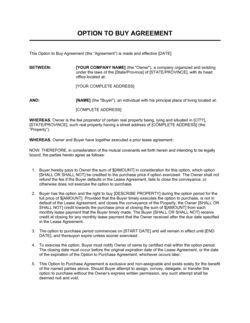
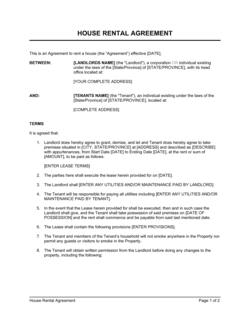
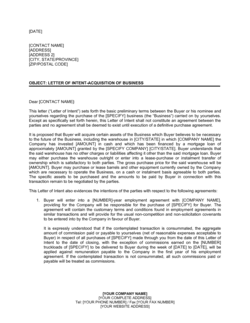
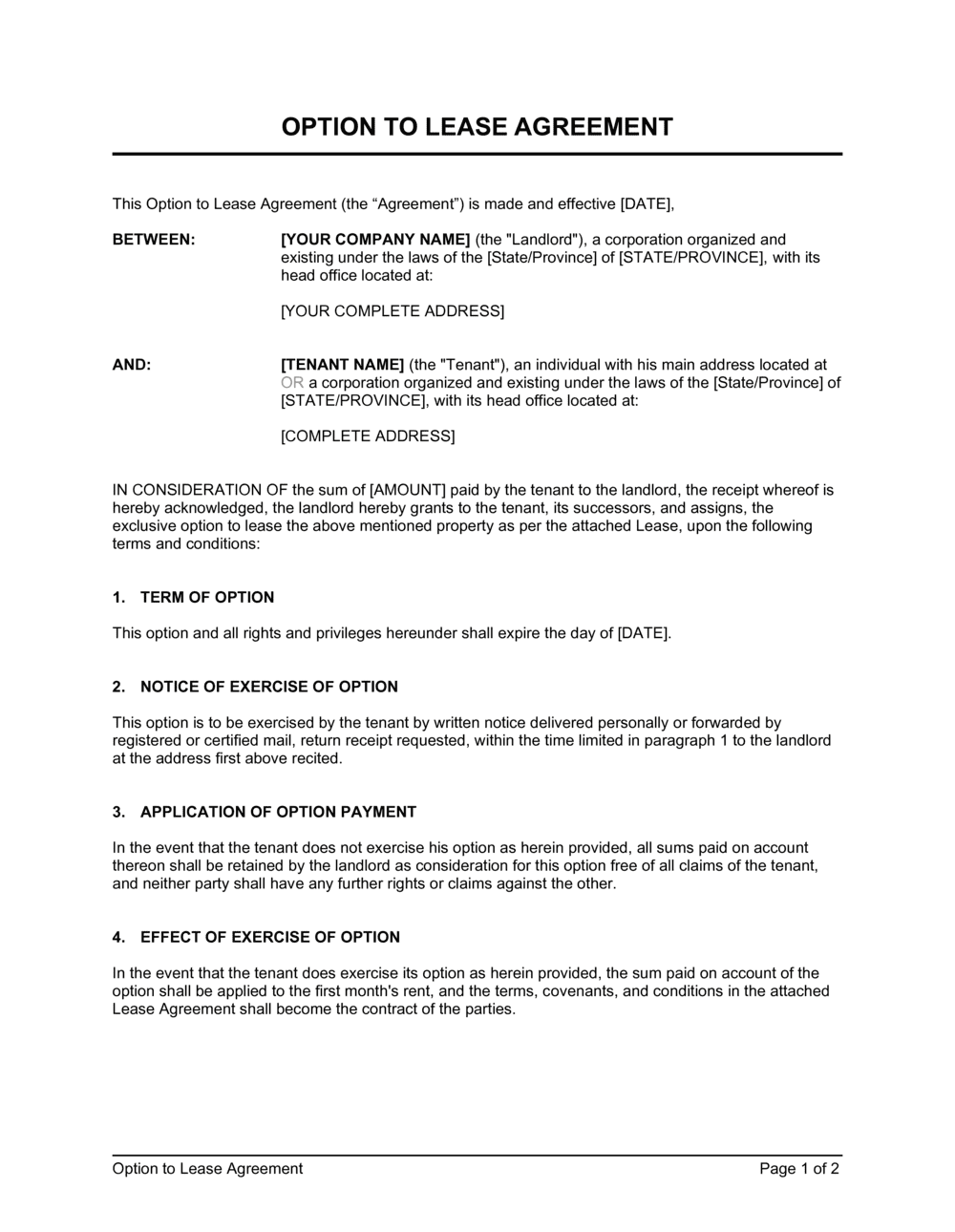
Option to Lease Agreement Template

Free Word download β€’ Edit online β€’ Save & share with Drive β€’ Export to PDF

2 pagesβ€’20–30 min to fillβ€’Difficulty: Standardβ€’Signature requiredβ€’Legal review recommended
Learn more ↓
FreeOption to Lease Agreement Template

At a glance

What it is
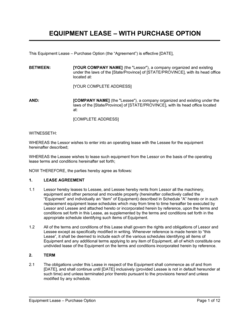
An Option To Lease Agreement is a legally binding contract that grants one party β€” typically a prospective tenant β€” the exclusive right to enter into a lease for a specific property at pre-agreed terms within a defined option period. This free Word download gives you a structured, attorney-informed starting point you can edit online and export as PDF for both commercial and residential real estate transactions.
When you need it
Use it when a tenant needs time to secure financing, obtain permits, or complete due diligence before committing to a full lease, or when a landlord wants to reserve a property for a specific tenant while negotiating final lease terms. It is also used when a business is evaluating a location before signing a long-term lease commitment.
What's inside
Identification of the property and parties, the option fee and its treatment upon exercise or expiry, the option period and exercise mechanism, the agreed lease terms to be triggered on exercise, conditions precedent, confidentiality, governing law, and default and termination provisions.

What is an Option To Lease Agreement?

An Option To Lease Agreement is a legally binding contract that grants a prospective tenant the exclusive right β€” but not the obligation β€” to enter into a lease for a specific property at terms already negotiated and recorded in the agreement, within a defined option period. The tenant pays an option fee to the landlord in exchange for this exclusivity right. If the tenant delivers a valid exercise notice before the option expires, the landlord is contractually obligated to execute the lease on those terms. If the option lapses unexercised, the landlord retains the fee and is free to lease the property to another party. Unlike a letter of intent, which is typically non-binding, an option to lease creates enforceable obligations on both sides the moment it is signed.

Why You Need This Document

Without a written option to lease agreement, a prospective tenant who needs 30 to 180 days before committing to a full lease has no legal protection against the landlord accepting a competing offer, increasing the rent, or simply changing their mind. Real estate transactions stall, collapse, or become expensive when there is no binding mechanism bridging the gap between initial agreement and lease execution. The option agreement locks in the agreed rent, term, and conditions β€” so the tenant can secure financing, obtain permits, or complete due diligence without losing the property. For landlords, it provides a documented commitment and a non-refundable fee that compensates for holding the property off market. This template gives both parties a professionally structured starting point that covers every material term, eliminates the most common drafting gaps, and is ready for attorney review in jurisdictions where the stakes justify it.

Which variant fits your situation?

If your situation is…Use this template
Tenant wants the right to purchase the property after leasingLease With Option To Purchase Agreement
Both parties are ready to execute a full binding commercial leaseCommercial Lease Agreement
Tenant needs a short-term occupancy arrangement before the main leaseShort-Term Lease Agreement
Property is residential and tenant wants an option to leaseResidential Lease Agreement
Parties need a non-binding letter of intent before the option agreementLetter of Intent (Real Estate)
Tenant requires exclusive access to the property during the option periodExclusive Right To Lease Agreement
Landlord is granting an option in exchange for tenant fit-out worksTenant Improvement Agreement

Common mistakes to avoid

❌ Leaving material lease terms to future negotiation

Why it matters: An option to lease that says rent or duration 'will be agreed' is generally unenforceable as an agreement to agree. If the parties can't agree later, the tenant has no property right to enforce.

Fix: Complete every material lease term β€” rent, escalation, term, commencement, permitted use β€” in the schedule attached to the option before signing.

❌ No exclusivity clause protecting the tenant

Why it matters: Without exclusivity, a landlord can accept a better offer from a third party, lease the property to someone else, and leave the tenant with nothing but a damages claim for the option fee.

Fix: Include an explicit exclusivity provision prohibiting the landlord from negotiating or entering into any competing arrangement during the option period.

❌ Using a duration instead of a fixed expiry date and time

Why it matters: Counting '60 days' from an execution date is disputed when months have different lengths or when the start date is unclear, and it creates no hard backstop for the landlord.

Fix: State the option expiry as a specific calendar date and local time β€” e.g., 'June 30, 2027 at 5:00 p.m. Pacific Time' β€” with no ambiguity.

❌ Tenant's remedy for landlord default limited to fee refund

Why it matters: If the landlord refuses to execute the lease after valid exercise, a refund of the option fee rarely compensates for lost business opportunity, relocation costs, or the inability to replace the property.

Fix: Expressly grant the tenant the right to seek specific performance β€” compelling the landlord to execute the lease β€” and include injunctive relief as an available remedy.

❌ Failing to register the option against the property title

Why it matters: An unregistered option is vulnerable to a landlord who sells or mortgages the property to a third party who takes free of the tenant's unregistered interest in many jurisdictions.

Fix: File a notice of option or caveat against the property title at the land registry as soon as the agreement is signed, where local law permits.

❌ Governing law clause that conflicts with lex situs

Why it matters: Courts in virtually every jurisdiction apply the law of the place where real property is situated to questions of property rights, regardless of a conflicting contractual choice of law.

Fix: Always set the governing law as the jurisdiction in which the property is physically located. If the parties are in different jurisdictions, add a separate arbitration seat clause for dispute resolution.

The 10 key clauses, explained

Parties and Property Description

In plain language: Identifies the landlord and prospective tenant as legal entities and provides the full legal description and address of the property subject to the option.

Sample language
This Option To Lease Agreement is entered into as of [DATE] between [LANDLORD LEGAL NAME], a [STATE/PROVINCE] [ENTITY TYPE] ('Landlord'), and [TENANT LEGAL NAME], a [STATE/PROVINCE] [ENTITY TYPE] ('Tenant'). The property subject to this option is located at [FULL ADDRESS] and legally described as [LEGAL DESCRIPTION] ('Property').

Common mistake: Using a trade name or informal address instead of the registered legal entity name and the full legal property description. A mismatch between the agreement and title records can prevent the option from being registered or enforced.

Grant of Option and Option Fee

In plain language: Grants the tenant the exclusive right to lease the property during the option period in exchange for a stated option fee, and specifies whether the fee is refundable or credited against rent on exercise.

Sample language
In consideration of the Option Fee of $[AMOUNT] paid by Tenant to Landlord (receipt of which is acknowledged), Landlord hereby grants Tenant the exclusive option to lease the Property on the terms set out in Schedule A. The Option Fee is non-refundable but shall be credited against the first month's rent if Tenant exercises the option.

Common mistake: Failing to state whether the option fee is refundable or applied to rent. Ambiguity on this point generates disputes that can delay or void the exercise.

Option Period and Exercise Mechanism

In plain language: Defines the exact start and end dates of the option period and prescribes how, to whom, and in what form the exercise notice must be delivered to be valid.

Sample language
The option period commences on [DATE] and expires at 5:00 p.m. local time on [DATE] ('Option Expiry'). To exercise this option, Tenant must deliver a written Exercise Notice to Landlord at [ADDRESS / EMAIL] on or before the Option Expiry. Notices sent by email are effective upon confirmed receipt.

Common mistake: Specifying only a duration (e.g., '60 days') without a fixed end date and time. Courts and counterparties disagree on how to count days; a precise calendar date and time eliminates ambiguity.

Agreed Lease Terms

In plain language: Sets out or incorporates by reference all material terms of the lease that will take effect upon exercise β€” rent, lease term, commencement date, permitted use, and any tenant improvement obligations.

Sample language
Upon valid exercise of this option, Landlord and Tenant agree to execute a lease substantially in the form set out in Schedule A, incorporating the following terms: Monthly Rent: $[AMOUNT]; Lease Term: [X] years commencing [DATE]; Permitted Use: [USE]; Tenant Improvement Allowance: $[AMOUNT].

Common mistake: Leaving key lease terms undefined or subject to 'further negotiation.' If agreement cannot be reached on those terms after exercise, the entire option arrangement may be unenforceable as an agreement to agree.

Conditions Precedent to Exercise

In plain language: Lists any approvals, permits, financing conditions, or third-party consents that must be satisfied before the option can be validly exercised, and allocates responsibility for obtaining them.

Sample language
Tenant's right to exercise this option is conditional upon: (a) Tenant obtaining [PERMIT TYPE] from [AUTHORITY] by [DATE]; (b) Tenant securing financing of no less than $[AMOUNT] on terms acceptable to Tenant, acting reasonably. If any condition is not satisfied by [DATE], this Agreement terminates and the Option Fee is [refunded / forfeited].

Common mistake: Omitting a deadline for satisfying conditions precedent. Without a cut-off date, a tenant can hold the property off market indefinitely while claiming conditions are still outstanding.

Exclusivity and Non-Interference

In plain language: Prohibits the landlord from negotiating or entering into any other lease, option, or sale of the property with a third party during the option period.

Sample language
During the Option Period, Landlord shall not solicit, negotiate, or enter into any lease, option to lease, or agreement to sell the Property with any party other than Tenant without Tenant's prior written consent.

Common mistake: No exclusivity clause at all. Without it, the landlord can continue marketing the property and grant a competing option or execute a lease with another tenant, leaving the first tenant with only a damages claim.

Landlord's Title and Encumbrances

In plain language: Represents that the landlord has good title and authority to grant the option, and discloses any existing mortgages, liens, or encumbrances that could affect the tenant's ability to occupy the property.

Sample language
Landlord represents and warrants that it has good and marketable title to the Property, has full authority to grant this option, and that the Property is free from encumbrances except as disclosed in Schedule B.

Common mistake: No title representation at all. If an undisclosed mortgage holder forecloses during or after the option period, the tenant's lease may be extinguished unless they have taken steps to protect their interest.

Default and Remedies

In plain language: Defines what constitutes a default by either party, the notice and cure period before remedies are triggered, and the remedies available β€” including specific performance or damages.

Sample language
If Landlord defaults under this Agreement, Tenant may, upon [10] days' written notice and failure to cure, seek specific performance compelling Landlord to execute the lease, in addition to any damages suffered. If Tenant defaults, Landlord's sole remedy is retention of the Option Fee.

Common mistake: Limiting Tenant's remedy to a refund of the Option Fee when Landlord defaults. The fee is rarely sufficient to compensate for lost business opportunity; specific performance is the more commercially meaningful remedy.

Confidentiality

In plain language: Restricts both parties from disclosing the existence or terms of the option agreement to third parties other than their professional advisors.

Sample language
Each party agrees to keep the existence and terms of this Agreement confidential and not to disclose them to any third party except legal counsel, accountants, or lenders on a need-to-know basis, or as required by law.

Common mistake: Omitting confidentiality entirely. In competitive commercial real estate markets, disclosure of the agreed rent and terms can disadvantage the landlord in future negotiations or alert competitors to the tenant's expansion plans.

Governing Law, Dispute Resolution, and Entire Agreement

In plain language: Specifies the jurisdiction whose law governs the agreement, how disputes are resolved, and confirms the written document supersedes all prior negotiations and representations.

Sample language
This Agreement is governed by the laws of [STATE / PROVINCE / COUNTRY]. Any dispute shall be resolved by [binding arbitration / litigation] in [CITY]. This Agreement constitutes the entire agreement between the parties with respect to the option and supersedes all prior letters of intent, emails, and negotiations.

Common mistake: Choosing a governing law that has no connection to where the property is located. Real property is almost always governed by the law of the jurisdiction in which it sits, regardless of what the contract states.

How to fill it out

  1. 1

    Identify the parties and property precisely

    Enter the full registered legal names of both the landlord and tenant entities. Use the property's official legal description from the title deed or land registry records, not just the street address.

    πŸ’‘ Run a title search before signing to confirm the landlord has authority to grant the option and that no prior option or encumbrance would conflict.

  2. 2

    Set the option fee and its treatment on exercise

    Agree on a fee that reflects the length of the option period and the landlord's opportunity cost of holding the property off market. State clearly whether the fee is non-refundable and whether it is credited against rent on exercise.

    πŸ’‘ A typical commercial option fee ranges from 0.5% to 2% of the first year's rent β€” a higher fee generally buys a longer option period.

  3. 3

    Define the option period with a fixed end date and time

    Set a specific calendar date and local time (e.g., 5:00 p.m.) for option expiry rather than a duration. Specify the exact delivery method for the exercise notice and the address or email to which it must be sent.

    πŸ’‘ Build in a buffer of at least 10 business days before the option expiry to allow for delivery delays and internal approvals.

  4. 4

    Attach the agreed lease terms as a schedule

    Complete Schedule A with all material lease terms β€” monthly rent, rent escalation, lease duration, commencement date, permitted use, and any tenant improvement allowance. Leave no material term subject to further negotiation.

    πŸ’‘ An option that says 'rent to be agreed' is likely unenforceable. Nail down every term the parties have agreed on before signing.

  5. 5

    List any conditions precedent with hard deadlines

    Identify every approval, permit, or financing condition the tenant must satisfy, and assign each a specific deadline. State the consequence β€” fee forfeiture or refund β€” if a condition is not met.

    πŸ’‘ Keep the conditions list short and objective. Subjective conditions like 'satisfactory due diligence' give a tenant an easy exit but also give landlords grounds to argue bad faith.

  6. 6

    Include an exclusivity clause

    Confirm the landlord is prohibited from marketing, negotiating, or executing any other lease or option on the property for the duration of the option period.

    πŸ’‘ Consider registering the option agreement against the property title to protect against a landlord who disregards the exclusivity obligation.

  7. 7

    Review default provisions and confirm remedies

    Ensure the tenant's remedy for landlord default includes specific performance β€” the right to compel execution of the lease β€” not just a fee refund. Confirm the landlord's remedy for tenant default is limited to forfeiture of the option fee.

    πŸ’‘ Add a notice-and-cure period of at least 10 business days for landlord default before the tenant can pursue specific performance β€” courts expect this before granting equitable relief.

  8. 8

    Execute before the option period is intended to start

    Both parties must sign and date the agreement before the option period commences. Have each party sign in counterpart and confirm receipt of the option fee by the landlord.

    πŸ’‘ In jurisdictions requiring deeds for real property options, ensure the agreement is executed as a deed with the appropriate formalities β€” a simple signed contract may be insufficient.

Frequently asked questions

What is an option to lease agreement?

An option to lease agreement is a binding contract that gives a prospective tenant the exclusive right β€” but not the obligation β€” to enter into a lease for a specific property at pre-agreed terms within a defined period. The tenant pays an option fee to secure this right. If they exercise the option by delivering a written notice before the deadline, the landlord is obligated to execute the lease on the agreed terms. If they let the option lapse, the fee is typically forfeited.

What is the difference between an option to lease and a lease agreement?

An option to lease grants the right to enter into a lease in the future β€” it does not itself create a landlord-tenant relationship or any right of occupation. A lease agreement is the binding occupancy contract that begins on a specific commencement date and grants the tenant the right to possess and use the property. The option is the mechanism by which the parties agree on terms in advance; the lease is the instrument that activates those terms.

Is an option to lease agreement legally binding?

Yes, an option to lease agreement is generally enforceable as a binding contract once signed by both parties and supported by consideration β€” typically the option fee. The landlord is contractually obligated not to lease the property to anyone else during the option period and, upon valid exercise, to execute the lease on the agreed terms. Specific performance is an available remedy in most jurisdictions if the landlord refuses to comply after valid exercise.

How long should the option period be?

The appropriate option period depends on what the tenant needs to accomplish before committing to the lease. For a tenant awaiting financing approval, 30 to 60 days is common. For a developer seeking planning permission or permits, 90 to 180 days β€” or longer β€” may be needed. Landlords typically resist option periods beyond 6 months without a meaningful option fee, as they bear the cost of holding the property off market.

Is the option fee refundable if the tenant does not exercise?

In most option to lease agreements, the option fee is expressly non-refundable if the tenant allows the option to lapse or chooses not to exercise. This is the consideration the landlord receives for granting exclusivity. Some agreements provide for a partial refund if a specified condition precedent β€” such as a permit denial β€” fails through no fault of the tenant. The treatment of the fee must be stated clearly in the agreement to avoid disputes.

What happens when the tenant exercises the option?

Upon delivery of a valid exercise notice within the option period, both parties become obligated to execute the lease on the terms already agreed and attached to the option agreement. The option fee is typically credited against the first month's rent. If the landlord refuses to execute the lease after valid exercise, the tenant may seek specific performance or damages through the courts.

Can an option to lease be registered against the property title?

In most common-law jurisdictions β€” including the US, Canada, the UK, and Australia β€” an option to lease can be protected by registering a notice, caveat, or memorandum against the property's title at the relevant land registry. Registration puts third parties β€” including subsequent purchasers and mortgagees β€” on notice of the tenant's option right and generally protects the tenant against losing their interest if the landlord sells or refinances during the option period.

What is the difference between an option to lease and a letter of intent?

A letter of intent sets out the proposed terms of a transaction but is typically non-binding on the principal commercial terms. An option to lease is fully binding β€” once signed, the landlord cannot lease to anyone else and is obligated to execute the lease upon valid exercise. A letter of intent is appropriate for early-stage negotiations; an option to lease is appropriate when both parties have agreed on all material terms and the tenant needs time before formally committing.

Do I need a lawyer to draft an option to lease agreement?

For a straightforward commercial or residential option on standard terms, a high-quality template is a solid starting point. Legal review is recommended when the property involves complex title issues, existing tenancies, development conditions, or cross-border parties. Given that a poorly drafted option can be unenforceable or leave the tenant without meaningful remedies, a 1–2 hour attorney review β€” typically $300–$800 β€” is worthwhile for any option fee above $5,000 or any lease with a first-year value above $50,000.

How this compares to alternatives

vs Commercial Lease Agreement

A commercial lease agreement immediately creates a binding landlord-tenant relationship with a definite commencement date and rent obligations. An option to lease is a pre-lease instrument that gives the tenant the right β€” not the obligation β€” to enter that relationship within a future window. Use the option when the tenant is not yet ready to commit; use the lease when both parties are ready to proceed.

vs Lease With Option To Purchase Agreement

A lease with option to purchase combines an active tenancy with the right to buy the property at a set price during or at the end of the lease term. An option to lease has no purchase component β€” it grants only the right to lease, not to own. Use the purchase-option variant when the tenant's long-term goal is ownership; use the lease option when the goal is simply to secure occupancy.

vs Letter of Intent (Real Estate)

A letter of intent outlines the proposed terms of a lease in a generally non-binding document used to advance negotiations. An option to lease is fully binding once signed and locks both parties into defined terms. A letter of intent is appropriate for early-stage discussions; an option to lease is appropriate when terms are agreed and the tenant simply needs time before committing to the full lease.

vs Right of First Refusal Agreement

A right of first refusal requires the landlord to offer the property to the holder before accepting any third-party offer, but it does not guarantee the holder can lease on pre-agreed terms at a time of their choosing. An option to lease is proactive β€” the holder chooses when to exercise within the option period, on terms already set. A right of first refusal is reactive; an option to lease is affirmative.

Industry-specific considerations

Retail and Hospitality

Franchise operators and independent retailers use lease options to secure high-foot-traffic locations while awaiting liquor licenses, health permits, or franchisor site approval.

Commercial Real Estate

Developers and investors use options to control development sites, anchor tenant spaces, and build-to-suit locations while completing feasibility studies and securing construction financing.

Technology / SaaS

Fast-growing tech companies use lease options to hold office or data center space during a funding round close, avoiding commitment before capital is confirmed.

Manufacturing and Industrial

Manufacturers use options on warehouse and factory sites while obtaining environmental approvals, zoning variances, and equipment installation permits that can take 60–180 days.

Healthcare

Medical and dental practices use lease options to secure clinic space while awaiting regulatory registration, equipment delivery timelines, and lender approval for practice financing.

Professional Services

Law firms, accountancies, and consultancies use lease options when consolidating offices or relocating, holding a preferred floor while negotiating fit-out contributions and departure obligations.

Jurisdictional notes

United States

Real property options are governed by the law of the state where the property is situated. Many states require options lasting more than one year to be in writing under the Statute of Frauds. In California, New York, and Texas, a memorandum of option may be recorded against the title to protect the tenant's interest. Some states impose transfer taxes on the grant of a lease option β€” verify local rules before execution.

Canada

Each province governs real property options under its own land titles or registry legislation. In Ontario, a caution or notice of option can be registered under the Land Titles Act to protect the tenant against a subsequent transferee. In Quebec, options must be published in the Register of Personal and Movable Real Rights or the land register to be opposable to third parties. Commercial lease options in British Columbia are subject to the Property Transfer Tax Act on exercise.

United Kingdom

In England and Wales, an option to lease for a term exceeding three years must be granted by deed to create a legal interest. Shorter options may be granted by contract but are typically protected by registration as a notice at HM Land Registry. Options over registered land should be protected by a unilateral notice to bind subsequent proprietors. Scotland and Northern Ireland have separate property law regimes with different formality requirements.

European Union

There is no harmonized EU framework for real property option agreements β€” each member state applies its own property law. In France, a promesse unilatΓ©rale de bail is enforceable but must comply with formal requirements under the Code Civil. In Germany, options over real property generally require notarial certification and land register entry (Grundbucheintragung) to be effective against third parties. GDPR applies to any personal data processed in connection with the agreement.

Template vs lawyer β€” what fits your deal?

PathBest forCostTime
Use the templateStandard commercial or residential lease options with agreed terms, low-to-mid-value properties, and straightforward conditionsFree30–60 minutes
Template + legal reviewOptions involving complex conditions precedent, development sites, existing encumbrances, or first-year rent above $50,000$300–$800 (1–2 hour attorney review)1–3 days
Custom draftedHigh-value commercial developments, multi-site portfolios, cross-border parties, or options that require title registration formalities$1,500–$5,000+1–3 weeks

Glossary

Option Period
The defined window of time β€” typically 30 to 180 days β€” during which the option holder may elect to exercise the right to lease the property.
Option Fee
A non-refundable payment made by the prospective tenant to the landlord in exchange for the exclusive right to lease the property during the option period.
Exercise Notice
A written notice delivered by the option holder to the landlord formally electing to exercise the option and proceed with the lease.
Conditions Precedent
Specific events or approvals β€” such as obtaining a business permit or zoning clearance β€” that must occur before the option can be validly exercised.
Agreed Lease Terms
The material terms of the future lease β€” rent, lease duration, commencement date, and permitted use β€” already negotiated and incorporated into the option agreement.
Holdover Provision
A clause defining what happens if the tenant remains in occupation after the option period expires without having exercised the option.
Option Lapse
The automatic expiry of the option right at the end of the option period if the exercise notice is not delivered in time and in the required form.
Permitted Use
The specific business activity or type of occupancy the tenant is authorized to conduct on the property, as agreed in the option and carried through to the lease.
Rent Commencement Date
The date on which the tenant's obligation to pay rent under the exercised lease begins, which may differ from the lease start or possession date.
Binding Offer to Lease
An alternative form of pre-lease document in which the tenant makes a formal offer on specific terms that, once accepted, constitutes a binding obligation to execute a full lease.
Encumbrance
Any mortgage, lien, easement, or third-party interest registered against the property that could affect the tenant's right to occupy or the landlord's right to lease.
Privity of Contract
The legal relationship between the parties who signed the option agreement, meaning only those parties can enforce or be bound by its terms.

Part of your Business Operating System

This document is one of 3,000+ business & legal templates included in Business in a Box.

  • Fill-in-the-blanks β€” ready in minutes
  • 100% customizable Word document
  • Compatible with all office suites
  • Export to PDF and share electronically

Create your document in 3 simple steps.

From template to signed document β€” all inside one Business Operating System.
1
Download or open template

Access over 3,000+ business and legal templates for any business task, project or initiative.

2
Edit and fill in the blanks with AI

Customize your ready-made business document template and save it in the cloud.

3
Save, Share, Send, Sign

Share your files and folders with your team. Create a space of seamless collaboration.

Save time, save money, and create top-quality documents.

β˜…β˜…β˜…β˜…β˜…

"Fantastic value! I'm not sure how I'd do without it. It's worth its weight in gold and paid back for itself many times."

Managing Director Β· Mall Farm
Robert Whalley
Managing Director, Mall Farm Proprietary Limited
β˜…β˜…β˜…β˜…β˜…

"I have been using Business in a Box for years. It has been the most useful source of templates I have encountered. I recommend it to anyone."

Business Owner Β· 4+ years
Dr Michael John Freestone
Business Owner
β˜…β˜…β˜…β˜…β˜…

"It has been a life saver so many times I have lost count. Business in a Box has saved me so much time and as you know, time is money."

Owner Β· Upstate Web
David G. Moore Jr.
Owner, Upstate Web

Run your business with a system β€” not scattered tools

Stop downloading documents. Start operating with clarity. Business in a Box gives you the Business Operating System used by over 250,000 companies worldwide to structure, run, and grow their business.

Start freeΒ Β·Β No credit card required