Option to Purchase Real Estate Property Template

Free Word download • Edit online • Save & share with Drive • Export to PDF

4 pages25–35 min to fillDifficulty: ComplexSignature requiredLegal review recommended
Learn more ↓
FreeOption to Purchase Real Estate Property Template

At a glance

What it is
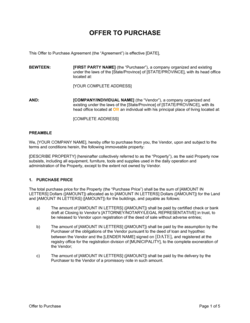
An Option To Purchase Real Estate Property is a legally binding agreement that grants a buyer the exclusive right — but not the obligation — to purchase a specific property at a predetermined price within a defined time period. This free Word download gives both parties a structured, enforceable starting point covering option consideration, purchase price, exercise conditions, and closing mechanics that you can edit online and export as PDF.
When you need it
Use it when a buyer wants to lock in a purchase price and secure exclusive rights to a property before committing to a full purchase — common in commercial development, lease-to-own arrangements, and investment acquisitions where due diligence or financing takes time to arrange.
What's inside
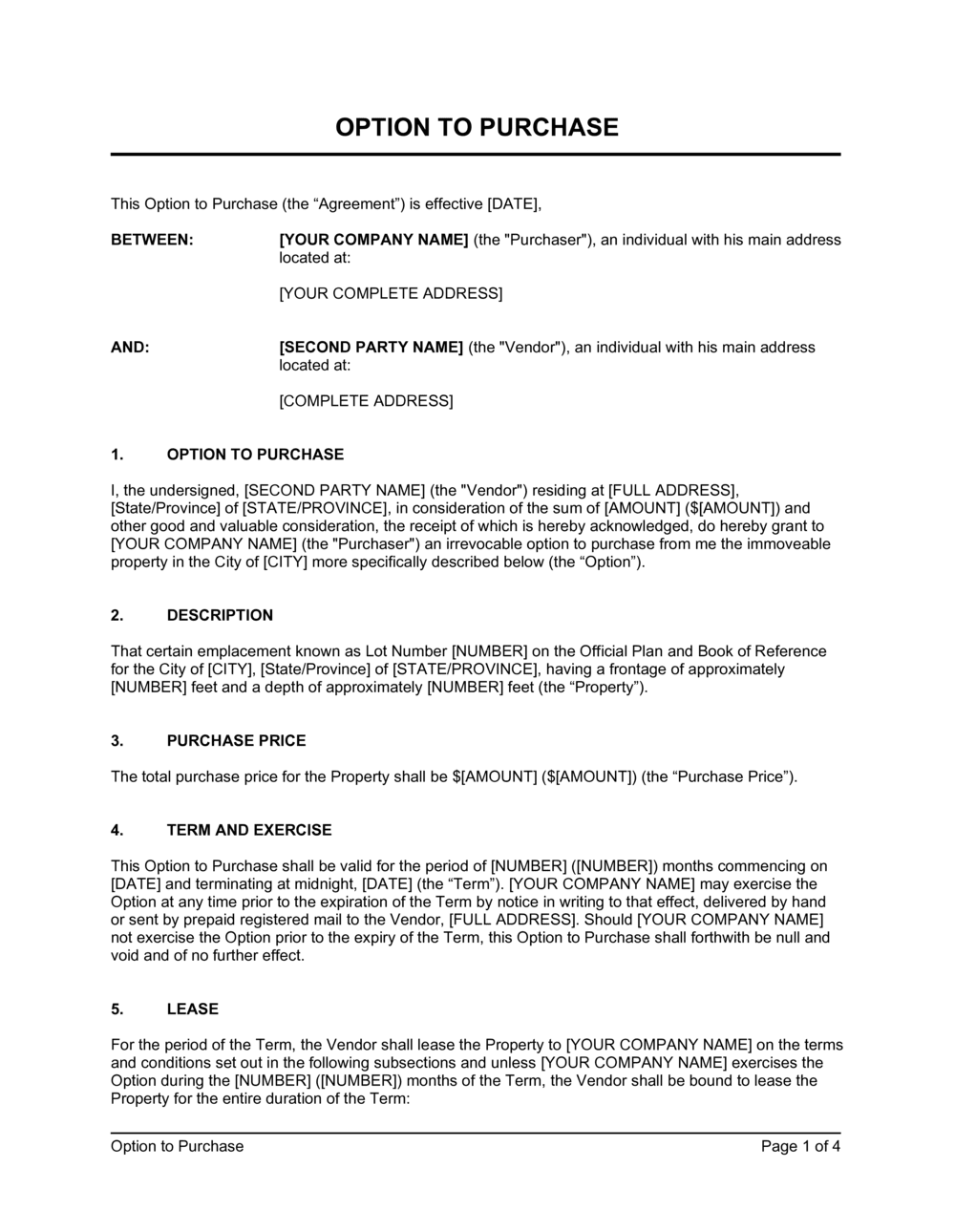
Parties and property description, option consideration, option period and exercise procedure, purchase price and payment terms, conditions precedent to closing, representations and warranties, default and forfeiture provisions, and governing law.

What is an Option To Purchase Real Estate Property?

An Option To Purchase Real Estate Property is a legally binding contract that grants a buyer the exclusive right — but not the obligation — to purchase a specific parcel of real estate at a predetermined price within a defined period of time. In exchange for this right, the buyer pays the seller an upfront option fee, which the seller keeps if the option is never exercised. If the buyer does elect to proceed, the seller is contractually bound to complete the sale on the agreed terms. The option functions as a time-limited lock on both the property and the price, allowing the buyer to conduct due diligence, arrange financing, or secure regulatory approvals without the risk that the seller will sell to someone else or raise the price in the interim.

Why You Need This Document

Without a written option agreement, a buyer who invests time and money in due diligence — commissioning surveys, environmental assessments, or rezoning applications — has no legal protection against the seller withdrawing, raising the price, or accepting a competing offer at any point before a purchase agreement is signed. The consequences are concrete: sunk costs with no recourse, lost development opportunities, and financing relationships damaged by a failed transaction. For sellers, a properly structured option provides certainty about the transaction timeline, delivers upfront consideration regardless of outcome, and creates an enforceable obligation that supports their own downstream planning. This template gives both parties a structured, enforceable starting point that protects the buyer's investment in pre-purchase activities and holds the seller to the agreed terms from day one.

Which variant fits your situation?

If your situation is…Use this template
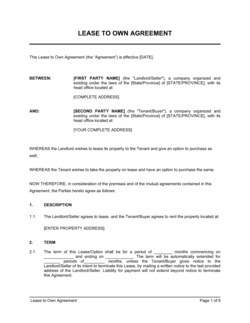
Residential property with a lease-to-own structureLease To Own Agreement
Commercial land acquisition pending rezoning or entitlementOption To Purchase Real Estate Property
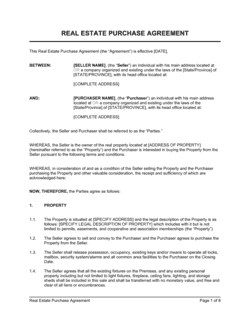
Buyer ready to proceed immediately without an option periodReal Estate Purchase Agreement
Granting a tenant the right of first refusal if property is listedRight of First Refusal Agreement
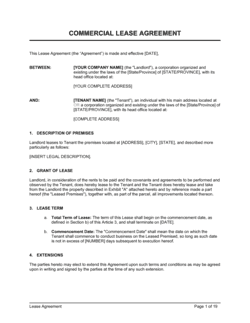
Option embedded within a long-term commercial leaseCommercial Lease Agreement
Land purchase contingent on subdivision or rezoning approvalConditional Purchase Agreement
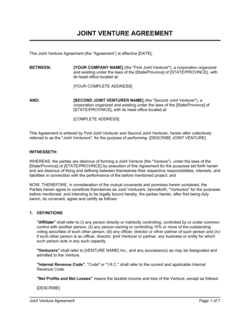
Option tied to a joint venture for development financingJoint Venture Agreement

Common mistakes to avoid

❌ Using a street address instead of a legal property description

Why it matters: A street address is not a legally sufficient property description in most jurisdictions and will cause a recorded memorandum to be rejected or rendered unenforceable against third parties.

Fix: Pull the exact legal description from the current deed or title certificate and reproduce it verbatim in the agreement and any memorandum.

❌ Setting nominal option consideration of one dollar

Why it matters: Courts in several jurisdictions have treated nominal consideration as a signal that no real bargain was struck, converting the option into an unenforceable offer that the seller can revoke at any time.

Fix: Pay a commercially meaningful option fee — at minimum a few hundred dollars for residential deals, and 1–3% of the purchase price for commercial transactions.

❌ Omitting 'time is of the essence' from the option period

Why it matters: Without this clause, a buyer who misses the expiration date may argue for equitable relief, keeping the seller's property tied up in litigation while the seller cannot transact with anyone else.

Fix: Include explicit 'time is of the essence' language next to every deadline in the agreement, including the exercise date and the closing date.

❌ Failing to record a memorandum of option

Why it matters: An unrecorded option is invisible to third parties. A seller who fraudulently or negligently sells to a second buyer may defeat the first buyer's interest in jurisdictions that protect bona fide purchasers without notice.

Fix: Prepare a short memorandum of option and record it in the applicable land registry or county recorder's office immediately after signing.

❌ Leaving conditions precedent open-ended with no deadline

Why it matters: An indefinite condition lets the buyer hold the property off-market for months or years, effectively converting the option into a free lock-up with no obligation to ever close.

Fix: Assign a specific calendar date to every condition precedent and include a mechanism for the buyer to formally waive or declare each condition unsatisfied.

❌ Preserving specific performance as the buyer's only default remedy

Why it matters: If specific performance is the sole remedy and the seller has already transferred title to a third party, the buyer may be left with an unenforceable judgment against a party who no longer owns the property.

Fix: Draft default remedies as cumulative — specific performance, return of option consideration, and liquidated damages — so the buyer can elect the most practical remedy given the circumstances.

The 10 key clauses, explained

Parties and property description

In plain language: Identifies the seller and buyer as legal entities and precisely describes the property subject to the option by legal description, address, and parcel number.

Sample language
This Option To Purchase Agreement is entered into on [DATE] between [SELLER LEGAL NAME] ('Seller') and [BUYER LEGAL NAME] ('Buyer'). The property subject to this option is located at [PROPERTY ADDRESS], legally described as [LEGAL DESCRIPTION], Parcel ID [PARCEL NUMBER] ('Property').

Common mistake: Using only a street address instead of the full legal description. A street address can be ambiguous — the legal description from the title deed is the only unambiguous identifier and is required to record a memorandum of option.

Option consideration

In plain language: States the amount the buyer pays to the seller for granting the option, whether it is refundable, and how it is applied to the purchase price if exercised.

Sample language
In consideration of [AMOUNT] ('Option Fee') paid by Buyer to Seller upon execution of this Agreement, Seller grants Buyer the exclusive option described herein. The Option Fee is non-refundable if the option is not exercised and shall be credited toward the Purchase Price at closing if the option is exercised.

Common mistake: Setting the option consideration at zero or one dollar to avoid paying anything upfront. Nominal consideration weakens enforceability in many jurisdictions — courts may treat the agreement as an unenforceable offer to sell rather than a binding option.

Option period and expiration

In plain language: Defines the start and end dates of the option window, states that time is of the essence, and confirms what happens if the buyer does not exercise before expiration.

Sample language
The option period commences on [START DATE] and expires at 5:00 PM local time on [EXPIRATION DATE] ('Option Period'). Time is of the essence with respect to all dates in this Agreement. If Buyer does not exercise the option on or before the expiration date, this Agreement terminates automatically and Seller retains the Option Fee.

Common mistake: Omitting a 'time is of the essence' clause. Without it, courts may allow a buyer to exercise the option days or weeks late on equitable grounds, defeating the seller's ability to re-list or negotiate with other parties.

Exercise of option procedure

In plain language: Specifies exactly how the buyer must notify the seller to exercise the option — form of notice, delivery method, and who must receive it — to trigger the purchase obligation.

Sample language
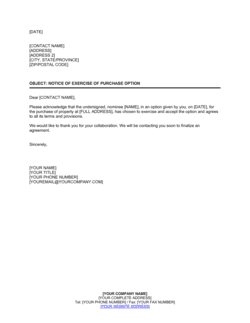
Buyer may exercise this option by delivering written notice to Seller at [SELLER ADDRESS / EMAIL] on or before the expiration date. Exercise by email is effective upon confirmed receipt. Exercise by certified mail is effective upon deposit with the postal carrier.

Common mistake: Allowing verbal exercise of the option. A verbal notice creates he-said-she-said disputes about whether and when the option was exercised; written notice with a timestamp protects both parties.

Purchase price and payment terms

In plain language: States the fixed purchase price agreed at the time the option is signed, the deposit due upon exercise, and the balance payable at closing.

Sample language
If Buyer exercises this option, the purchase price for the Property shall be [PURCHASE PRICE] ('Purchase Price'). Upon exercise, Buyer shall deposit [DEPOSIT AMOUNT] into escrow within [X] business days. The balance of the Purchase Price shall be paid at closing in immediately available funds.

Common mistake: Leaving the purchase price subject to reappraisal at the time of exercise. A re-appraisal mechanism converts the option into an agreement to agree — which is not enforceable — and eliminates the buyer's price certainty.

Conditions precedent to closing

In plain language: Lists specific events that must occur — such as financing approval, zoning change, or satisfactory inspection — before the buyer is obligated to close the purchase after exercising the option.

Sample language
Buyer's obligation to close is contingent upon: (a) Buyer obtaining financing on terms acceptable to Buyer on or before [DATE]; (b) the Property receiving [ZONING DESIGNATION] zoning approval from [AUTHORITY]; and (c) a satisfactory Phase I environmental assessment. If any condition is not satisfied by [DATE], Buyer may terminate this Agreement by written notice.

Common mistake: Including conditions precedent that are entirely within the buyer's control without a deadline. Open-ended conditions let a buyer hold a property indefinitely without closing — courts may treat this as a right to walk away for any reason at any time, undermining the seller.

Title and encumbrances

In plain language: Requires the seller to convey marketable title free of undisclosed encumbrances at closing, and defines the buyer's remedies if title is defective.

Sample language
At closing, Seller shall convey marketable fee simple title to the Property, free and clear of all liens, encumbrances, and restrictions except those listed in Schedule A. If title is not marketable and Seller cannot cure title defects within [30] days of notice, Buyer may terminate this Agreement and receive a refund of the Option Fee.

Common mistake: No title review period before the option period expires. A buyer who exercises without ordering a title search may discover defects only after becoming contractually obligated to close.

Seller's representations and warranties

In plain language: The seller confirms key facts about the property — no undisclosed litigation, no environmental violations, no material defects known to seller — that the buyer is relying on.

Sample language
Seller represents and warrants that: (a) Seller has full authority to grant this option and sell the Property; (b) there is no pending or threatened litigation affecting the Property; (c) Seller has no actual knowledge of any environmental contamination on the Property; and (d) all property taxes are current as of the date of this Agreement.

Common mistake: Omitting seller representations entirely on the assumption that real estate is always sold 'as-is.' An 'as-is' clause limits physical condition warranties but does not excuse non-disclosure of known material defects or title issues, which carry separate legal liability.

Default and remedies

In plain language: States what happens if the seller defaults — by selling to a third party or failing to close — and what the buyer's remedies are, including specific performance or return of funds.

Sample language
If Seller defaults by failing to convey title at closing or by granting an inconsistent interest to a third party, Buyer may, at Buyer's election: (a) seek specific performance of this Agreement; or (b) terminate this Agreement and recover the Option Fee plus [LIQUIDATED DAMAGES AMOUNT]. Buyer's remedies are cumulative and not exclusive.

Common mistake: Relying solely on a liquidated damages clause for seller default without preserving specific performance as an alternative remedy. For unique real estate, money damages may be inadequate — a buyer who wants that specific property needs the right to compel the sale.

Governing law and recording

In plain language: Specifies which jurisdiction's law governs the agreement, where disputes are resolved, and whether a memorandum of option will be recorded against the property title.

Sample language
This Agreement is governed by the laws of [STATE / PROVINCE]. Buyer may record a Memorandum of Option in the real property records of [COUNTY / REGISTRY] to provide public notice of Buyer's interest. Seller shall cooperate in executing any instrument reasonably required for such recording.

Common mistake: Not recording a memorandum of option. An unrecorded option is vulnerable to a bona fide purchaser who buys the property without knowledge of the option — in most jurisdictions, the BFP's interest wins.

How to fill it out

  1. 1

    Identify parties with their full legal names

    Enter each party's full legal name — the registered entity name for companies or legal name for individuals — along with addresses and contact information. For corporate entities, confirm the signing officer has authority to bind the entity.

    💡 Request a certificate of good standing for corporate sellers before signing — it confirms the entity exists and is authorized to transact in the jurisdiction.

  2. 2

    Describe the property precisely

    Pull the exact legal description from the current title deed or land registry record — not just the street address. Include the parcel or folio number and the county or municipality for recording purposes.

    💡 A single typographical error in a legal description can invalidate a recorded instrument. Copy and paste directly from the deed rather than retyping.

  3. 3

    Set the option consideration and its treatment

    Agree on a meaningful option fee — typically 1–5% of the purchase price for commercial deals — and specify whether it is refundable if conditions are not met and how it credits toward the purchase price at closing.

    💡 In commercial deals, a higher option fee signals genuine buyer intent and reduces the seller's incentive to negotiate with competing parties during the option period.

  4. 4

    Define the option period with a specific expiration date and time

    Enter the exact start date, expiration date, and time zone. Add 'time is of the essence' language. Build in enough time for financing, due diligence, or regulatory approvals — but not so long that the seller is locked out of the market indefinitely.

    💡 For commercial development projects requiring rezoning, a 12–18 month option period with one extension right (at an additional fee) is common. Residential options rarely exceed 90 days.

  5. 5

    State the purchase price as a fixed amount

    Enter the agreed purchase price as a specific dollar figure. Confirm that no reappraisal mechanism applies and that the price is fixed regardless of market movement during the option period.

    💡 If the parties want price flexibility, consider a formula tied to an index (e.g., CPI adjustment) rather than reappraisal — a formula is deterministic and enforceable; a reappraisal mechanism is not.

  6. 6

    List all conditions precedent with deadlines

    Identify every condition the buyer needs to satisfy — financing, inspections, approvals — and assign a specific deadline for each. Include the notice procedure for waiving or declaring conditions unsatisfied.

    💡 Each condition should have its own deadline rather than a single omnibus closing deadline — this allows the parties to track progress on each item independently.

  7. 7

    Confirm recording and notice provisions

    Decide whether a memorandum of option will be recorded against the property title. If yes, attach a form memorandum as an exhibit and confirm both parties will execute it at signing.

    💡 Recording protects the buyer against a fraudulent or inadvertent double-sale. It costs a nominal filing fee and takes less than a day in most jurisdictions.

  8. 8

    Execute before distributing the option consideration

    Both parties should sign the agreement — and any authorized officer certificate if a corporate party is involved — before the buyer transfers the option fee. Confirm the signing date matches the agreement date.

    💡 Use a countersigned written acknowledgment of receipt of the option fee to eliminate disputes about whether consideration was actually paid.

Frequently asked questions

What is an option to purchase real estate property?

An option to purchase real estate property is a binding contract that gives a buyer the exclusive right — but not the obligation — to purchase a specific property at a fixed price within a set time period. The buyer pays an upfront option fee for this right. If the buyer exercises the option, the seller must sell at the agreed price. If the buyer does not exercise, the option expires and the seller typically retains the fee.

What is the difference between an option to purchase and a purchase agreement?

A purchase agreement creates a mutual obligation — both parties must complete the transaction once signed, subject to any contingencies. An option to purchase gives the buyer a unilateral right to buy but imposes no obligation to do so. The seller is bound to sell if the buyer exercises; the buyer is free to walk away, forfeiting only the option fee. Options are used when the buyer needs time before committing to a full purchase.

How much should the option consideration be?

There is no universal standard, but commercially meaningful consideration is important for enforceability. Residential options typically range from $1,000 to 5% of the purchase price. Commercial and development options commonly run 1–5% of the purchase price. The option fee is often credited toward the purchase price at closing if exercised, making it effectively an early deposit rather than a sunk cost.

Can a seller sell the property to someone else during the option period?

No. Once a valid option agreement is signed, the seller is contractually prohibited from selling the property to any other party during the option period. A seller who does so is in material default and faces remedies including specific performance and damages. Recording a memorandum of option in the public land records provides notice to potential third-party buyers, significantly reducing the risk of a fraudulent double-sale.

What happens if the buyer does not exercise the option before it expires?

If the buyer does not deliver written notice of exercise before the expiration date and time, the option terminates automatically. The seller retains the option fee as compensation for holding the property off-market. The buyer has no further rights to the property. This is why 'time is of the essence' language is critical — it eliminates any argument that a late exercise should be accepted on equitable grounds.

Does an option to purchase need to be recorded?

Recording is not legally required for the option to be valid between the parties, but it is strongly recommended to protect the buyer's interest against third parties. In most jurisdictions, a bona fide purchaser who buys without notice of a prior unrecorded interest takes free of that interest. Recording a short memorandum of option gives constructive notice to the world at a nominal cost and effectively eliminates this risk.

What is a memorandum of option?

A memorandum of option is a short, publicly recorded document that identifies the parties, the property, and the existence and expiration date of the option agreement — without disclosing the full purchase price or all other terms. It is recorded in the county or land registry where the property is located to put third parties on notice that a buyer holds an option interest in the property. The full option agreement typically remains confidential between the parties.

Is an option to purchase real estate enforceable?

An option to purchase is generally enforceable when it identifies the property with specificity, states a fixed or determinable purchase price, is supported by genuine consideration, and is signed by both parties. Enforceability varies by jurisdiction — California, for example, requires options on real property to meet the same writing requirements as sale agreements. Consider consulting a real estate attorney to confirm enforceability in the specific jurisdiction where the property is located.

Can the option period be extended?

Yes, if both parties agree in writing before the original expiration date. Many commercial option agreements include one or more extension rights — for an additional fee — that the buyer can exercise unilaterally. An extension negotiated after the option has already expired requires new consideration and, effectively, a new option agreement, since the original rights have already lapsed.

How this compares to alternatives

vs Real Estate Purchase Agreement

A real estate purchase agreement creates an immediate bilateral obligation to complete the sale, subject to negotiated contingencies. An option to purchase gives only the buyer a unilateral right to buy — the seller cannot back out, but the buyer can walk away by forfeiting the option fee. Use an option when the buyer needs time or flexibility before committing; use a purchase agreement when both parties are ready to transact.

vs Lease To Own Agreement

A lease-to-own agreement combines an active rental relationship with a future purchase option, typically applying a portion of each month's rent toward the purchase price. A standalone option to purchase has no rental component and is used independently of any tenancy. Lease-to-own is common in residential contexts; standalone options are standard in commercial and investment real estate.

vs Right of First Refusal Agreement

A right of first refusal gives a party the right to match any third-party offer before the seller accepts it — the price is not fixed in advance. An option to purchase sets a specific price and timeline upfront, giving the buyer certainty regardless of what the market does. Options provide stronger buyer protection; rights of first refusal give sellers more flexibility in pricing.

vs Commercial Lease Agreement

A commercial lease agreement governs the ongoing rental of property without any obligation or right to purchase. An option to purchase may be included as a clause within a commercial lease or executed as a standalone document. When a tenant wants the right to buy the leased property in the future, a separate option agreement — or an option clause added to the lease — is required alongside the rental terms.

Industry-specific considerations

Commercial real estate development

Developers option land for 12–24 months while obtaining rezoning, environmental clearance, and construction financing before committing to a full purchase.

Retail and franchise

Franchise operators and national retailers option sites in target markets while awaiting corporate real estate committee approval and lease or purchase financing.

Agricultural and rural land

Buyers option farmland or timber tracts while conducting soil testing, mineral rights review, and water rights due diligence before committing to acquisition.

Residential lease-to-own

Tenants negotiating a purchase option within a residential lease use this structure to lock in a purchase price while building credit or saving for a down payment.

Jurisdictional notes

United States

Options on real property must generally satisfy the Statute of Frauds — a signed writing describing the property and the price is required for enforceability. California imposes additional requirements under Civil Code §1624 and limits non-refundable option fees in residential lease-option contexts. In some states, recording a memorandum of option is essential to preserve priority against subsequent purchasers under race-notice recording statutes.

Canada

Options to purchase real property must be in writing and signed to satisfy provincial Statute of Frauds equivalents in all provinces. In Ontario, the legal description must conform to the Land Titles Act. In Quebec, the option (promesse de vente) is governed by the Civil Code of Quebec and may be enforceable for up to five years. Recording (registration) at the provincial land registry is strongly recommended to protect priority.

United Kingdom

Under the Law of Property (Miscellaneous Provisions) Act 1989, contracts for the sale or other disposition of an interest in land must be in writing, incorporate all agreed terms, and be signed by both parties. Options must be registered against the title at HM Land Registry to bind third parties — an unregistered option is not binding on a buyer of the freehold. Stamp Duty Land Tax may be triggered both on grant and on exercise of the option.

European Union

Real estate option requirements vary significantly by member state. In Germany (Vorkaufsrecht), a notarized option agreement is generally required for land transactions. French law (promesse unilatérale de vente) requires registration within 10 days to be enforceable against third parties. Spanish law requires a public deed (escritura pública) for registration. GDPR considerations apply when personal data of parties is processed in connection with the transaction.

Template vs lawyer — what fits your deal?

PathBest forCostTime
Use the templateStraightforward residential or small commercial options between parties who have already agreed on price and termsFree30–60 minutes
Template + legal reviewCommercial property options, development land deals, or any transaction exceeding $250,000$400–$800 for a real estate attorney review2–5 days
Custom draftedComplex development options requiring rezoning conditions, multi-party structures, or cross-border transactions$1,500–$5,000+1–3 weeks

Glossary

Option Agreement
A contract that gives one party the right, but not the obligation, to buy a property at a set price within a specified time period.
Option Consideration
The upfront payment made by the buyer to the seller in exchange for granting the option — typically non-refundable if the option is not exercised.
Option Period
The defined window of time during which the buyer may exercise the right to purchase the property — commonly 30 days to 24 months.
Exercise of Option
The formal act by which the buyer notifies the seller in writing that they intend to proceed with the purchase under the terms of the option agreement.
Purchase Price
The fixed price at which the buyer may purchase the property if the option is exercised, agreed upon at the time the option is signed.
Conditions Precedent
Events or approvals — such as financing, rezoning, or environmental clearance — that must occur before the buyer is obligated to close the purchase.
Forfeiture
The loss of the option consideration paid by the buyer when the option expires without being exercised or is abandoned.
Right of First Refusal
A related but distinct right allowing a party to match any third-party offer before the seller accepts it — different from a fixed-price option.
Encumbrance
Any lien, mortgage, easement, or restriction on the property's title that could affect the buyer's use or ownership after closing.
Closing
The final step in the real estate transaction where title transfers from seller to buyer and the purchase price is paid in full.
Memorandum of Option
A short recorded document that provides public notice of the option agreement's existence without disclosing all of its terms.
Time of the Essence
A contract clause requiring all deadlines — including the option exercise date — to be met exactly, with failure treated as a material breach.

Part of your Business Operating System

This document is one of 3,000+ business & legal templates included in Business in a Box.

  • Fill-in-the-blanks — ready in minutes
  • 100% customizable Word document
  • Compatible with all office suites
  • Export to PDF and share electronically

Create your document in 3 simple steps.

From template to signed document — all inside one Business Operating System.
1
Download or open template

Access over 3,000+ business and legal templates for any business task, project or initiative.

2
Edit and fill in the blanks with AI

Customize your ready-made business document template and save it in the cloud.

3
Save, Share, Send, Sign

Share your files and folders with your team. Create a space of seamless collaboration.

Save time, save money, and create top-quality documents.

★★★★★

"Fantastic value! I'm not sure how I'd do without it. It's worth its weight in gold and paid back for itself many times."

Managing Director · Mall Farm
Robert Whalley
Managing Director, Mall Farm Proprietary Limited
★★★★★

"I have been using Business in a Box for years. It has been the most useful source of templates I have encountered. I recommend it to anyone."

Business Owner · 4+ years
Dr Michael John Freestone
Business Owner
★★★★★

"It has been a life saver so many times I have lost count. Business in a Box has saved me so much time and as you know, time is money."

Owner · Upstate Web
David G. Moore Jr.
Owner, Upstate Web

Run your business with a system — not scattered tools

Stop downloading documents. Start operating with clarity. Business in a Box gives you the Business Operating System used by over 250,000 companies worldwide to structure, run, and grow their business.

Start free · No credit card required