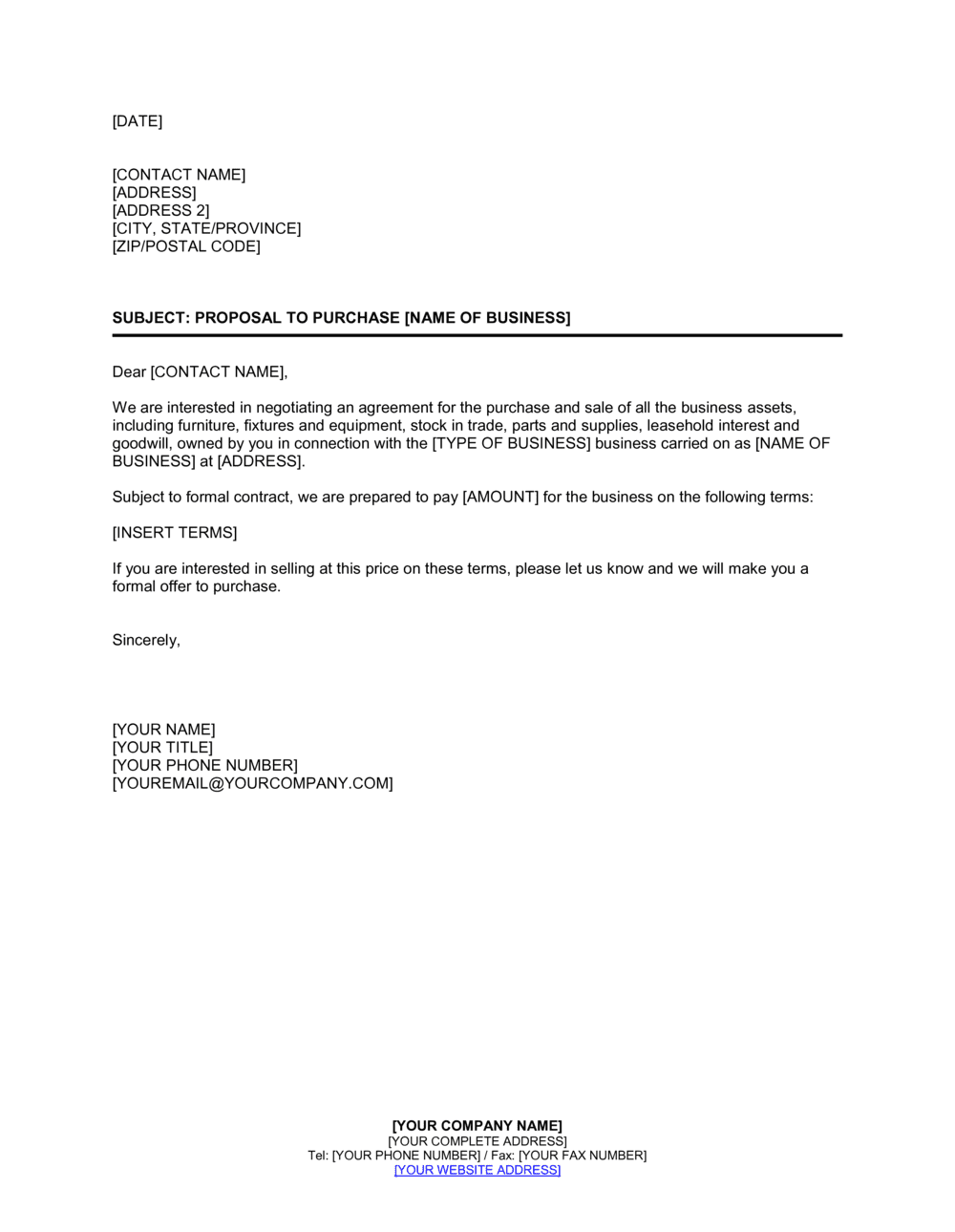
Proposal to Buy a Business Template

Free Word download β€’ Edit online β€’ Save & share with Drive β€’ Export to PDF

1 pageβ€’20–25 min to fillβ€’Difficulty: Standard
Learn more ↓
FreeProposal to Buy a Business Template

At a glance

What it is
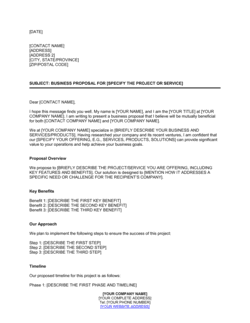
A Proposal To Buy A Business is a formal written document in which a prospective buyer presents a structured offer to acquire a target business, outlining the proposed purchase price, payment structure, due diligence conditions, and transition timeline. This free Word download gives buyers a professional, organized starting point they can edit online and export as PDF to present to a seller or their advisors.
When you need it
Use it after initial exploratory conversations with a seller confirm serious mutual interest but before a full purchase agreement is drafted. It structures the negotiation, signals buyer credibility, and establishes the key commercial terms both parties will work from.
What's inside
Buyer and seller identification, business description and rationale, proposed purchase price and payment structure, due diligence requirements, transition and handover plan, exclusivity request, key conditions, and a proposed timeline for closing.

What is a Proposal To Buy A Business?

A Proposal To Buy A Business is a formal written document in which a prospective buyer presents a structured acquisition offer to a business seller, covering the proposed purchase price, payment structure, due diligence requirements, transition expectations, exclusivity request, and a milestone-based closing timeline. It sits between an informal expression of interest and a signed letter of intent β€” detailed enough to demonstrate seriousness and financial capability, but flexible enough to allow negotiation before binding legal documents are prepared. The proposal functions as the commercial framework that both parties refine before lawyers begin drafting a purchase agreement.

Why You Need This Document

Without a structured proposal, acquisition conversations remain informal β€” prices are floated verbally, conditions go unrecorded, and sellers have no basis for evaluating one buyer against another. A written proposal signals credibility, forces the buyer to clarify their own assumptions about price and structure before the seller can challenge them, and creates a reference document that anchors every subsequent negotiation. Sellers who receive multiple offers prioritize the most organized buyer β€” not always the highest bidder. A proposal that clearly states valuation methodology, payment terms, transition expectations, and a closing timeline also protects the buyer: if the deal later falls apart over a term the seller claims was never discussed, the written proposal is the record. This template gives buyers a professional, complete starting point that covers every material commercial term and can be adapted from a $100,000 local business acquisition to a multi-million-dollar strategic deal.

Which variant fits your situation?

If your situation is…Use this template
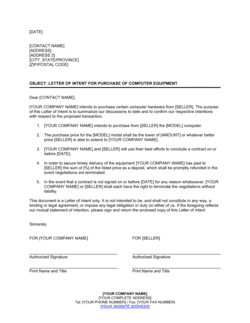
Making a preliminary non-binding offer before full due diligenceLetter of Intent to Buy a Business
Acquiring assets only, not the legal entityAsset Purchase Agreement
Acquiring the entire corporate entity including liabilitiesShare Purchase Agreement
Buying a franchise location from a franchiseeFranchise Purchase Proposal
Management team buying out the existing ownershipManagement Buyout Proposal
Merger where both businesses combine into a single entityMerger Proposal
Formalizing final agreed terms in a binding contractBusiness Purchase Agreement

Common mistakes to avoid

❌ Stating a purchase price with no valuation basis

Why it matters: A price without methodology appears arbitrary. The seller's advisors will immediately challenge it, and the negotiation starts on the wrong footing β€” defending a number rather than discussing terms.

Fix: Reference a specific multiple (e.g., 4Γ— trailing EBITDA) and the financial data you used to calculate it. Even a preliminary multiple signals that the offer is grounded in analysis.

❌ Proposing a transition period without specifying the seller's obligations

Why it matters: Vague transition language leads to post-closing disputes about how much time the seller owes, which customers they must introduce, and whether they have fulfilled their obligations before earnout payments become due.

Fix: Define transition deliverables explicitly: number of hours per week, specific customer introductions required, knowledge transfer milestones, and the consulting fee or included period.

❌ Requesting an exclusivity period longer than 60 days

Why it matters: Sellers and their brokers routinely reject exclusivity windows beyond 60 days as unreasonable. An overly long request signals the buyer is either unprepared to move quickly or seeking to tie up the business while exploring other options.

Fix: Request 30–45 days for straightforward acquisitions, 60 days for complex or large transactions. Demonstrate preparedness by attaching your due diligence checklist at the same time.

❌ Omitting financing contingency language

Why it matters: A buyer who cannot obtain financing but has not included a financing condition is legally and reputationally exposed β€” and may lose any deposit paid if the deal collapses.

Fix: Include an explicit condition stating that closing is contingent on buyer securing acquisition financing on acceptable terms by a specific date, and describe the financing source in general terms.

❌ Using a vague due diligence condition ('subject to satisfactory review')

Why it matters: An undefined satisfaction standard makes the condition potentially illusory β€” and gives neither party a clear benchmark for when due diligence is complete and the buyer is committed.

Fix: List specific categories of documents and define what 'satisfactory' means: no undisclosed liabilities above $[X], no pending litigation, financial statements consistent with representations made.

❌ Sending a proposal with no response deadline

Why it matters: Without a deadline, sellers deprioritize the proposal while waiting for competing offers, and negotiations drag on for months with no momentum.

Fix: Set a clear response deadline of 10–14 business days. This is standard practice and is not perceived as aggressive β€” it simply moves the process forward.

The 9 key sections, explained

Buyer introduction and background

Business description and acquisition rationale

Proposed purchase price and valuation basis

Payment structure and terms

Due diligence requirements

Conditions to closing

Transition and handover plan

Exclusivity and confidentiality

Proposed timeline and next steps

How to fill it out

  1. 1

    Identify both parties and confirm the target business

    Enter the buyer's full legal name, entity type, and contact details. Confirm the registered name of the target business and the seller's legal name or entity. Ensure these match any existing NDA or confidentiality agreement already in place.

    πŸ’‘ If you are acquiring through a newly formed acquisition entity, name it here β€” even if it is not yet fully registered β€” and note that it is formed for the purpose of this transaction.

  2. 2

    Write the acquisition rationale in specific terms

    State why you want to buy this specific business β€” geographic expansion, customer base, technology, brand, or cash flow. One focused paragraph with concrete details outperforms a page of generic enthusiasm.

    πŸ’‘ Sellers share this rationale with their advisors. A compelling, specific reason increases the probability the seller takes your offer seriously rather than waiting for a higher bid.

  3. 3

    Calculate and state the proposed purchase price with methodology

    Enter the proposed price and the valuation methodology behind it β€” EBITDA multiple, revenue multiple, or asset value. Reference the specific financial statements or data room materials you based the number on.

    πŸ’‘ Propose a price range ($X–$Y) rather than a single number if you are still awaiting full financials. This preserves negotiating flexibility without appearing uninformed.

  4. 4

    Define the payment structure in full

    Break down the total consideration into its components β€” cash at closing, seller note, earnout, and any equity rollover. For each component, state the amount, interest rate (if applicable), repayment schedule, and any triggering conditions.

    πŸ’‘ Earnout terms that tie payments to EBITDA rather than revenue are less susceptible to accounting manipulation and are generally preferred by sophisticated sellers.

  5. 5

    List your due diligence requirements by category

    Enumerate every category of information you need to review β€” financial, legal, operational, HR, IP, tax, and environmental as applicable. Be specific: 'three years of audited financials' rather than 'financial records.'

    πŸ’‘ Attach a separate due diligence checklist as an appendix to the proposal. It demonstrates preparation and immediately accelerates the data room setup process.

  6. 6

    Specify conditions to closing

    List every condition that must be satisfied before you are obligated to close, including financing contingencies, regulatory approvals, and key-person retention. Make each condition specific and measurable.

    πŸ’‘ Keep the conditions list tight β€” more than six or seven conditions signals excessive risk aversion and may cause the seller to prioritize a cleaner competing offer.

  7. 7

    Outline transition expectations and non-compete terms

    State the length of the desired transition period, the seller's expected activities during that period, compensation for transition services, and the scope and duration of any non-compete covenant.

    πŸ’‘ Frame the transition request as a benefit to both parties β€” a smooth handover protects the value the buyer is paying for, which is also in the seller's interest if any portion of the price is deferred.

  8. 8

    Set the exclusivity window and proposed closing date

    Request a specific exclusivity period (30–60 days is standard) and provide a milestone timeline from acceptance to closing. End the proposal with a clear call to action and a response deadline.

    πŸ’‘ A response deadline of 10–14 business days creates appropriate urgency without pressuring the seller so hard that they feel manipulated.

Frequently asked questions

What is a proposal to buy a business?

A proposal to buy a business is a formal written document in which a prospective buyer presents a structured acquisition offer to a seller. It outlines the proposed purchase price, payment structure, due diligence requirements, transition expectations, and a timeline for closing. It is typically more detailed than an expression of interest but less legally binding than a letter of intent or a purchase agreement.

Is a proposal to buy a business legally binding?

In most cases, a business acquisition proposal is not legally binding on its own β€” it is an invitation to negotiate rather than a concluded agreement. However, specific provisions such as exclusivity, confidentiality, and break-fee clauses can be drafted as binding even within a non-binding proposal. Always clarify in the document which sections, if any, are intended to create enforceable obligations.

What is the difference between a proposal to buy a business and a letter of intent?

A letter of intent (LOI) is a more formalized preliminary document that both parties typically sign, and it often includes binding provisions around exclusivity and confidentiality. A proposal to buy a business is generally issued by the buyer alone before the seller has responded β€” it is the offer that, if accepted or negotiated, leads to a signed LOI. The proposal starts the conversation; the LOI records the agreed framework.

How do I determine the purchase price to propose?

The most common approaches are a multiple of EBITDA (typically 3–6Γ— for small businesses), a multiple of annual revenue (common in professional services and SaaS), or an asset-based valuation (common in asset-heavy businesses like manufacturing or real estate). Review at least three years of financials before proposing a price, and state your methodology clearly so the seller understands the basis for your number rather than viewing it as arbitrary.

What due diligence should I request in the proposal?

At minimum, request three years of financial statements, all material customer and supplier contracts, employee headcount and compensation data, a list of owned or licensed intellectual property, pending or threatened litigation, and tax filings. For regulated industries, add licensing and compliance records. Attach a full due diligence checklist as an appendix to the proposal to accelerate the data room setup.

Should I include an earnout in my proposal?

An earnout makes sense when there is a valuation gap between buyer and seller, when the business is heavily dependent on the seller's relationships, or when future performance is uncertain. It bridges the gap by deferring part of the purchase price and tying it to measurable results. However, earnouts introduce post-closing complexity β€” define the metric, measurement period, payment schedule, and any anti-manipulation protections clearly in the proposal.

How long should a business acquisition proposal be?

A well-structured proposal typically runs 3–8 pages. It should be detailed enough to demonstrate seriousness and cover all key commercial terms, but concise enough that the seller and their advisors can review it quickly. Supporting materials β€” due diligence checklist, financial model, buyer background β€” can be attached as appendices rather than incorporated into the body.

What happens after the seller accepts the proposal?

Acceptance of the proposal typically triggers the exclusivity period and opens the data room for due diligence. Both parties then negotiate and execute a letter of intent (if not already done) or move directly to drafting a binding purchase agreement. The proposal terms serve as the commercial framework that the purchase agreement will formalize.

Do I need a lawyer to prepare a proposal to buy a business?

A well-designed template is sufficient for most initial proposals β€” the goal is to open a structured negotiation, not to create a binding legal document at this stage. However, for acquisitions above $500K, complex payment structures, or heavily regulated industries, having a lawyer review the proposal before submission is advisable. Legal review becomes essential when you move from proposal to letter of intent and purchase agreement.

How this compares to alternatives

vs Letter of Intent to Purchase a Business

A letter of intent is a mutually signed preliminary document that typically includes binding exclusivity and confidentiality provisions. A proposal to buy a business is issued by the buyer alone before the seller has formally responded. The proposal initiates the process; the LOI records the agreed framework before a full purchase agreement is drafted.

vs Business Purchase Agreement

A business purchase agreement is the final binding contract that closes the transaction β€” it contains representations, warranties, indemnities, and legally enforceable obligations on both sides. A proposal is a commercial outline used to align on terms before legal drafting begins. Attempting to use a proposal as a purchase agreement creates significant legal exposure.

vs Asset Purchase Agreement

An asset purchase agreement is a binding legal contract for acquiring specific assets of a business rather than its equity. A proposal to buy a business is the pre-negotiation document used to agree on whether the deal will be structured as an asset purchase or share purchase before legal documents are prepared. The structure decision β€” assets vs. shares β€” should be specified in the proposal.

vs Business Valuation Report

A business valuation report is an analytical document prepared by an accountant or appraiser that determines the fair market value of a business using formal methodologies. A proposal to buy a business is a commercial negotiation document in which the buyer proposes terms based on their own analysis. The valuation report informs the proposal price but serves a different, standalone purpose.

Industry-specific considerations

Professional Services

Buyer must address client relationship portability, key-person dependency, and non-solicitation terms covering the seller's existing client base.

Retail and E-commerce

Inventory valuation at closing, lease assignment for physical locations, and platform or domain transfer are critical deal terms to specify in the proposal.

Manufacturing

Equipment appraisal, environmental liability review, supplier contract continuity, and working capital targets for raw material inventory are deal-specific considerations.

SaaS and Technology

IP ownership verification, source code escrow, customer contract assignment rights, and retention of key engineering staff are the primary value drivers to address.

Template vs pro β€” what fits your needs?

PathBest forCostTime
Use the templateIndividual buyers and small business owners making offers on businesses valued under $500KFree2–4 hours
Template + professional reviewAcquisitions of $500K–$2M, complex payment structures, or seller-financed deals requiring professional input$300–$800 for a business broker or M&A advisor review1–3 days
Custom draftedAcquisitions above $2M, regulated industries, multi-party transactions, or deals involving significant earnout or equity rollover$1,500–$5,000+ for M&A attorney preparation1–2 weeks

Glossary

Purchase Price
The total consideration a buyer proposes to pay for the business, which may include cash, seller financing, earnouts, or assumed liabilities.
Earnout
A portion of the purchase price paid to the seller after closing, contingent on the business meeting defined performance targets over a set period.
Due Diligence
The buyer's structured investigation of the target business β€” reviewing financials, contracts, liabilities, operations, and legal standing β€” before committing to a final purchase.
Exclusivity Period
A defined window during which the seller agrees not to negotiate with other buyers, allowing the buyer to conduct due diligence without competition.
Letter of Intent (LOI)
A preliminary non-binding document that outlines the key terms of a proposed acquisition before a formal purchase agreement is drafted.
Working Capital
Current assets minus current liabilities at the time of closing; buyers and sellers often negotiate a working capital target to ensure the business transfers with adequate liquidity.
Seller Financing
An arrangement in which the seller accepts a portion of the purchase price as a promissory note, paid by the buyer over time rather than at closing.
Asset Purchase
A transaction structure in which the buyer acquires specific assets and selected liabilities of the business rather than its ownership shares.
Share Purchase
A transaction structure in which the buyer acquires all or a controlling percentage of the seller's equity, inheriting both assets and liabilities.
Transition Period
A defined post-closing window during which the seller assists the buyer with customer introductions, staff handovers, and operational knowledge transfer.
Valuation Multiple
A ratio β€” commonly expressed as a multiple of EBITDA or annual revenue β€” used to derive or justify a proposed purchase price.
Representations and Warranties
Statements of fact made by the seller about the business's condition, financials, and legal standing that the buyer relies on in agreeing to the purchase price.

Part of your Business Operating System

This document is one of 3,000+ business & legal templates included in Business in a Box.

  • Fill-in-the-blanks β€” ready in minutes
  • 100% customizable Word document
  • Compatible with all office suites
  • Export to PDF and share electronically

Create your document in 3 simple steps.

From template to signed document β€” all inside one Business Operating System.
1
Download or open template

Access over 3,000+ business and legal templates for any business task, project or initiative.

2
Edit and fill in the blanks with AI

Customize your ready-made business document template and save it in the cloud.

3
Save, Share, Send, Sign

Share your files and folders with your team. Create a space of seamless collaboration.

Save time, save money, and create top-quality documents.

β˜…β˜…β˜…β˜…β˜…

"Fantastic value! I'm not sure how I'd do without it. It's worth its weight in gold and paid back for itself many times."

Managing Director Β· Mall Farm
Robert Whalley
Managing Director, Mall Farm Proprietary Limited
β˜…β˜…β˜…β˜…β˜…

"I have been using Business in a Box for years. It has been the most useful source of templates I have encountered. I recommend it to anyone."

Business Owner Β· 4+ years
Dr Michael John Freestone
Business Owner
β˜…β˜…β˜…β˜…β˜…

"It has been a life saver so many times I have lost count. Business in a Box has saved me so much time and as you know, time is money."

Owner Β· Upstate Web
David G. Moore Jr.
Owner, Upstate Web

Run your business with a system β€” not scattered tools

Stop downloading documents. Start operating with clarity. Business in a Box gives you the Business Operating System used by over 250,000 companies worldwide to structure, run, and grow their business.

Start freeΒ Β·Β No credit card required