Office Manager Job Description Template

Free Word download β€’ Edit online β€’ Save & share with Drive β€’ Export to PDF

2 pagesβ€’20–30 min to fillβ€’Difficulty: Standardβ€’Signature requiredβ€’Legal review recommended
Learn more ↓
FreeOffice Manager Job Description Template

At a glance

What it is
An Office Manager Job Description is a formal document that defines the scope, responsibilities, qualifications, compensation range, and reporting structure for an office manager role. This free Word download gives you an editable, legally grounded starting point you can tailor to your organization and export as PDF to post on job boards, attach to offer letters, or include in employment files.
When you need it
Use it when hiring a new office manager, backfilling an existing position, or formalizing a role that has been operating without documented expectations. It is also the foundation document when transitioning an administrative assistant or coordinator into an office manager title.
What's inside
Position overview and reporting line, a detailed list of day-to-day duties and administrative responsibilities, required and preferred qualifications, compensation range and benefits summary, working conditions, and an acknowledgment block for the employee and hiring manager to sign at offer or onboarding.

What is an Office Manager Job Description?

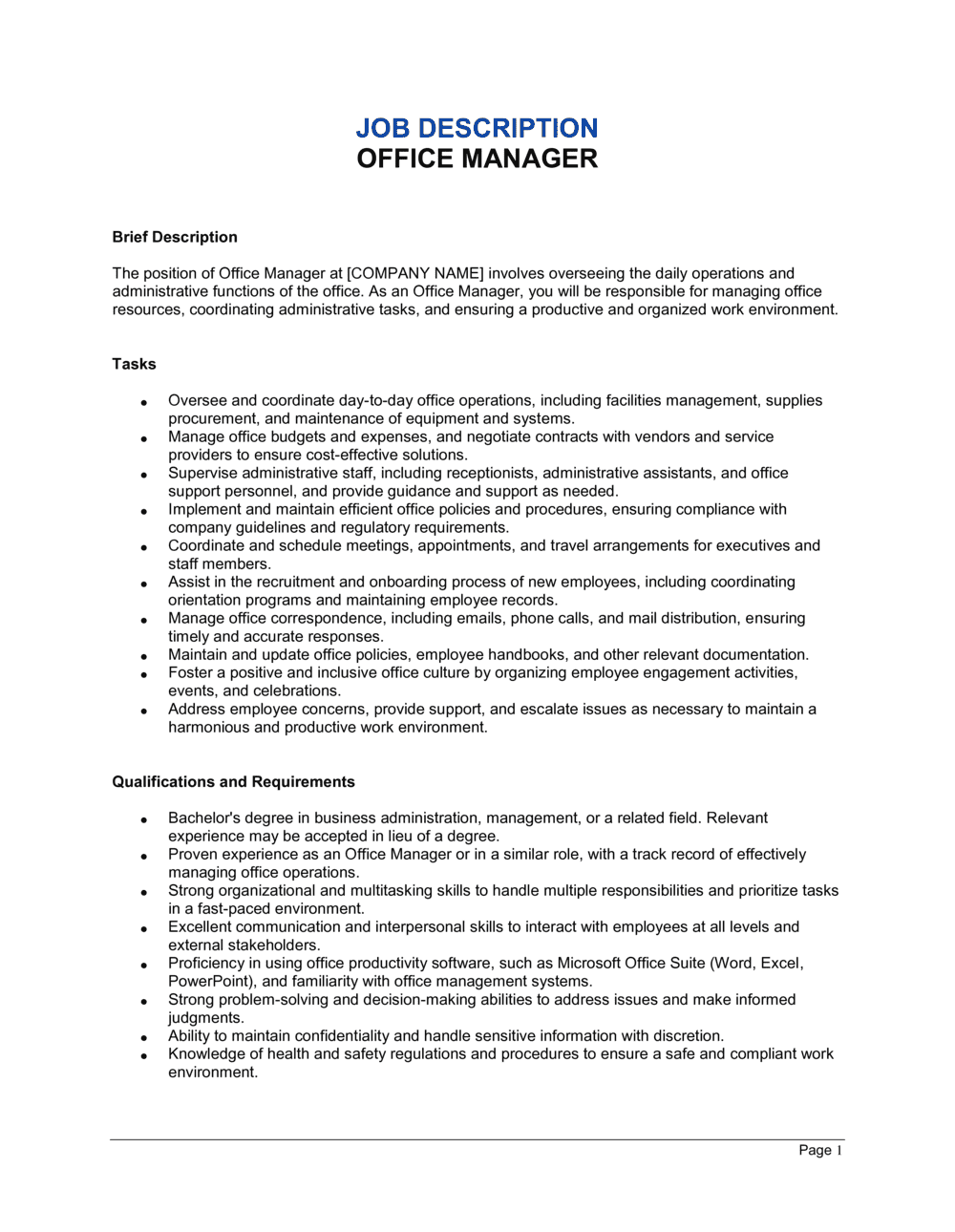
An Office Manager Job Description is a formal document that defines the duties, qualifications, reporting relationships, compensation range, and working conditions for an office manager position within an organization. It establishes the scope of the role in writing, creating a shared baseline between employer and employee that governs recruiting decisions, onboarding, performance reviews, and β€” when signed β€” becomes part of the employee's permanent personnel file. Unlike a casual bullet-point summary circulated during hiring, a properly structured job description includes an at-will disclaimer, a physical requirements clause for ADA compliance, and a clear separation between required and preferred qualifications that can withstand legal scrutiny.

Why You Need This Document

Operating without a documented office manager job description creates compounding risk at every stage of the employment relationship. During recruiting, an undefined role attracts mismatched candidates and exposes the employer to EEOC disparate-impact claims when qualification standards are applied inconsistently. At onboarding, the absence of a signed description means there is no enforceable baseline for performance expectations β€” making it difficult to issue a performance improvement plan or defend a termination decision. In the US, a detailed signed job description without an explicit at-will disclaimer has been used in several states to argue implied employment contracts, limiting the employer's ability to modify duties or terminate without cause. In Canada and the UK, documented role scope directly influences statutory notice entitlements and pay-equity assessments. This template gives you a legally grounded, editable starting point that closes all of these gaps in under an hour.

Which variant fits your situation?

If your situation is…Use this template
Hiring an office manager for a single small business locationOffice Manager Job Description (Small Business)
Hiring an office administrator with narrower administrative dutiesOffice Administrator Job Description
Hiring a receptionist with front-desk and coordination dutiesReceptionist Job Description
Hiring an executive assistant reporting directly to the CEOExecutive Assistant Job Description
Hiring a facilities manager responsible for building operationsFacilities Manager Job Description
Documenting a remote operations coordinator roleRemote Work Employment Agreement
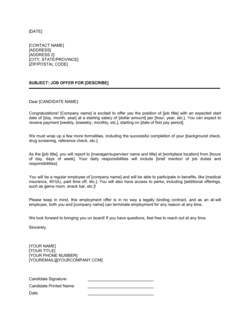
Pairing the job description with a formal employment offerJob Offer Letter

Common mistakes to avoid

❌ Omitting the at-will disclaimer

Why it matters: A detailed, signed job description without an at-will statement can be interpreted as an implied employment contract in several US states, limiting the employer's ability to terminate or modify the role.

Fix: Include a clear at-will disclaimer at the end of the document and cross-reference it with a parallel statement in the employee handbook.

❌ Listing every conceivable task instead of essential functions

Why it matters: An exhaustive task list makes it impossible to distinguish core duties from marginal ones, undermining ADA accommodation assessments and performance improvement plans.

Fix: Limit the essential duties section to 8–12 items that represent at least 5% of the role's time. Move peripheral tasks to a 'discretionary duties' section.

❌ Setting unnecessarily high qualification requirements

Why it matters: Requiring a degree or a specific number of years of experience that the role does not genuinely need can expose the employer to EEOC disparate-impact claims if the requirement screens out protected groups at a higher rate.

Fix: Audit every required qualification against the actual demands of the role. Replace degree requirements with skills-based equivalents where appropriate.

❌ Stating a fixed salary instead of a range

Why it matters: A fixed salary published in a job description or signed at onboarding creates a contractual expectation that limits the employer's ability to adjust compensation at review time.

Fix: Use a salary range (e.g., $52,000–$68,000 annually) and add language stating the actual offer will reflect experience, qualifications, and internal equity.

❌ Merging required and preferred qualifications into one list

Why it matters: Screeners and hiring managers apply the full list as a hard filter, disqualifying viable candidates β€” and the blended list cannot support a defensible rejection rationale if a complaint is filed.

Fix: Use two clearly labelled sections: 'Required Qualifications' and 'Preferred Qualifications,' each with a distinct bullet list.

❌ Skipping the physical requirements section

Why it matters: Without documented physical demands, an employer cannot invoke the ADA's 'undue hardship' standard or engage in the interactive accommodation process with the necessary factual basis.

Fix: Include a working conditions clause that describes the environment, lifting limits, seated work hours, and travel requirements even for a standard office role.

The 9 key clauses, explained

Position title and department

In plain language: Identifies the official job title, the department or team the role sits in, and whether it is a full-time, part-time, or contract position.

Sample language
Position: Office Manager | Department: Operations | Employment Type: Full-Time, Exempt | Reports To: [DIRECTOR OF OPERATIONS / CEO NAME]

Common mistake: Using an inflated or ambiguous title β€” such as 'Office Operations Director' for an entry-level role β€” which distorts compensation benchmarks and creates classification problems when the employee later competes for promotions.

Position summary

In plain language: A 3–5 sentence overview of the role's purpose, the team it supports, and the primary outcome the organization expects from it.

Sample language
The Office Manager is responsible for overseeing the day-to-day administrative operations of [COMPANY NAME]'s [LOCATION] office, supporting a team of [NUMBER] employees. This role serves as the central coordination point for facilities, vendor relationships, HR administration, and executive support.

Common mistake: Writing a summary so generic β€” 'responsible for office operations' β€” that it could apply to any company. A specific summary anchors performance reviews and prevents scope disputes.

Essential duties and responsibilities

In plain language: A detailed list of the core tasks the employee is expected to perform regularly, written in active voice with enough specificity to support performance evaluation.

Sample language
Manage day-to-day office operations including supply procurement, vendor contracts, and facilities coordination. Coordinate scheduling and travel for [NUMBER] executives. Maintain employee onboarding files and HR records in compliance with [HRIS SYSTEM NAME]. Process accounts-payable invoices under $[DOLLAR THRESHOLD] with approval from [TITLE].

Common mistake: Listing responsibilities so broadly β€” 'perform all administrative tasks as needed' β€” that the document cannot support a performance improvement plan or a reclassification decision.

Supervisory responsibilities

In plain language: States whether the office manager supervises other employees, how many direct reports they have, and what HR authority they hold (hire, discipline, terminate).

Sample language
This position supervises [NUMBER] administrative staff, including [RECEPTIONIST / ADMINISTRATIVE COORDINATOR]. The Office Manager has authority to recommend hiring and disciplinary actions; final decisions rest with [TITLE].

Common mistake: Omitting supervisory scope entirely when the role has direct reports. Courts and HR tribunals treat undocumented supervisory authority as evidence that management had constructive knowledge of a subordinate's conduct.

Required qualifications

In plain language: The minimum education, certifications, years of experience, and technical skills a candidate must have to be considered for the role.

Sample language
Bachelor's degree in Business Administration or equivalent; minimum [3] years of office management or senior administrative experience; proficiency in Microsoft Office 365 and [HRIS/ACCOUNTING SOFTWARE]; valid [STATE] driver's license preferred.

Common mistake: Setting education or experience minimums that exceed what the role genuinely requires. This can expose the employer to disparate-impact claims if the requirement screens out protected-class candidates disproportionately.

Preferred qualifications

In plain language: Competencies and experience that are desirable but not eliminatory β€” used to differentiate candidates who meet the minimum threshold.

Sample language
Experience with [SPECIFIC SOFTWARE PLATFORM]; prior experience supporting a team of [NUMBER]+ employees; familiarity with basic bookkeeping or accounts-payable workflows; bilingual in [LANGUAGE] preferred.

Common mistake: Conflating required and preferred qualifications in a single list. This makes it impossible to defend a hiring decision if a rejected applicant files a discrimination complaint.

Compensation and benefits

In plain language: States the salary range, pay frequency, bonus eligibility, and an overview of the benefits package, without committing to specific plan terms that may change.

Sample language
Salary range: $[MIN] – $[MAX] annually, paid bi-weekly. Eligible for annual discretionary performance bonus of up to [X]%. Benefits include [HEALTH / DENTAL / VISION / 401(k) / PTO] as described in the Company's benefits summary, subject to change.

Common mistake: Stating a fixed salary rather than a range and omitting the word 'discretionary' on bonuses. Both create contractual expectations that bind the employer even when circumstances change.

Working conditions and physical requirements

In plain language: Describes the work environment β€” office, remote, hybrid β€” and any physical demands relevant to ADA compliance, such as lifting, standing, or extended screen time.

Sample language
This role is performed primarily in an office environment at [LOCATION]. May require lifting up to [25] lbs, extended periods of sitting, and occasional travel to [SATELLITE LOCATIONS]. Hybrid schedule of [X] days on-site per week may be available upon mutual agreement.

Common mistake: Skipping physical requirements entirely. Without this clause, the employer cannot engage in the ADA interactive process to assess reasonable accommodations when a candidate or employee discloses a disability.

At-will statement and acknowledgment

In plain language: Confirms that the job description is not a contract of employment, that duties may be modified, and includes a signature block for the employee and manager.

Sample language
This job description does not constitute a contract of employment. [COMPANY NAME] is an at-will employer and may modify duties, reporting structure, or this description at any time with reasonable notice. Employee signature confirms receipt and understanding of these expectations. Employee: _________________ Date: _______ Manager: _________________ Date: _______

Common mistake: Omitting the at-will disclaimer. Courts in several US states have found that detailed, signed job descriptions create an implied contract of employment β€” particularly when paired with an employee handbook that does not contain a parallel disclaimer.

How to fill it out

  1. 1

    Enter the position title, department, and reporting line

    Use the exact job title that will appear on the offer letter and payroll system. Confirm the department name and the direct supervisor's title β€” not just their name, in case the role changes hands.

    πŸ’‘ Use a title that matches market benchmarks on LinkedIn and Indeed. Mismatched titles make salary benchmarking harder and slow candidate screening.

  2. 2

    Write the position summary with a specific outcome

    Draft 3–5 sentences describing what the office manager does, for whom, and what success looks like. Reference the office size, team headcount, and any specific systems or environments relevant to the role.

    πŸ’‘ End the summary with a one-sentence statement of the primary outcome β€” for example, 'ensuring the office operates efficiently and employees have the resources they need to do their best work.'

  3. 3

    List essential duties in active voice and order of priority

    Write each duty starting with an action verb (manage, coordinate, oversee, process). Order them from most time-intensive to least. Aim for 8–12 bullet points that could be used directly in a quarterly performance review.

    πŸ’‘ If a duty takes up less than 5% of the employee's time, move it to a discretionary duties section rather than the essential list.

  4. 4

    Define supervisory scope and HR authority

    Specify the number of direct reports, their titles, and the exact HR authority the office manager holds β€” recommend, approve, or execute hiring, discipline, and termination decisions.

    πŸ’‘ If the role has no direct reports today but may in future, add a clause like 'may supervise administrative support staff as the team grows.'

  5. 5

    Separate required from preferred qualifications

    In two clearly labelled sections, list minimum education and experience requirements separately from desirable-but-not-mandatory competencies. Verify that every required qualification is genuinely necessary to perform the essential duties.

    πŸ’‘ Review your required qualifications against EEOC guidance on disparate impact before publishing the role externally.

  6. 6

    Insert the compensation range and benefits overview

    Enter the salary band for the role (sourced from a compensation benchmark tool or recent market data), payment frequency, bonus eligibility with the word 'discretionary,' and a benefits reference β€” not specific plan details.

    πŸ’‘ Several US states and cities now mandate salary range disclosure in job postings. Check applicable pay-transparency laws before publishing.

  7. 7

    Complete the working conditions and physical requirements section

    State whether the role is on-site, hybrid, or remote. Include any physical demands β€” lifting limits, extended sitting, driving requirements β€” using the specific ADA-compliant language in the template.

    πŸ’‘ Even for a primarily sedentary office role, list screen time and desk work as physical requirements. It enables a structured accommodation conversation if needed.

  8. 8

    Obtain signatures before or on the first day

    Route the completed description through the hiring manager and HR for review, then obtain the new employee's signature at offer acceptance or on day one. File the signed copy in the employee's personnel record.

    πŸ’‘ Pair the signed job description with a signed offer letter and a signed acknowledgment of the employee handbook to create a complete onboarding documentation set.

Frequently asked questions

What is an office manager job description?

An office manager job description is a formal document that defines the duties, qualifications, reporting structure, compensation range, and working conditions for an office management role. It serves as the authoritative reference for recruiting, onboarding, performance reviews, and compensation decisions. When signed by the employee, it also functions as part of the employment record, supporting disciplinary and termination processes.

What are the typical duties of an office manager?

Core duties typically include overseeing day-to-day office operations, managing vendor and supplier relationships, coordinating facilities and equipment maintenance, handling HR administrative tasks such as onboarding paperwork and leave tracking, supporting executive scheduling and travel, and managing office supply procurement and budget oversight. In smaller organizations, the role may also cover basic bookkeeping and IT liaison responsibilities.

Should a job description be signed by the employee?

Yes. Obtaining the employee's signature confirms they received, read, and understood the role expectations. The signed document becomes part of the personnel file and provides a factual baseline for performance reviews, disciplinary actions, and β€” if necessary β€” termination proceedings. In jurisdictions where a written statement of employment particulars is legally required, the signed job description contributes to meeting that obligation.

Does a job description create a binding employment contract?

Without a clear at-will disclaimer, a detailed signed job description can be construed as an implied contract in several US states, limiting the employer's ability to change duties or terminate the employee without cause. Including an explicit at-will statement and a clause permitting reasonable duty modifications protects the employer from this interpretation. In Canada and the UK, job descriptions do not eliminate statutory notice entitlements regardless of disclaimer language.

What qualifications should an office manager have?

Typical minimum qualifications include 2–4 years of office management or senior administrative experience, proficiency with productivity software (Microsoft 365 or Google Workspace), and strong organizational and communication skills. A bachelor's degree in business administration is commonly listed but is increasingly replaced by skills-based equivalents. Preferred qualifications may include experience with HRIS platforms, basic bookkeeping, and prior supervisory experience.

How is an office manager different from an administrative assistant?

An administrative assistant primarily supports one or more individuals with calendar management, correspondence, and task coordination. An office manager has broader organizational scope β€” overseeing facilities, managing vendors, supervising support staff, and carrying budget responsibility. The distinction matters for FLSA classification, compensation benchmarking, and the level of authority granted to the role.

What should the compensation section of a job description include?

The compensation section should state the salary range (not a fixed number), payment frequency, bonus eligibility with the word 'discretionary,' and a summary reference to benefits categories β€” health, dental, retirement, PTO β€” without specifying plan details that may change annually. Several US states and cities now require salary range disclosure in job postings, so confirm applicable pay-transparency laws before publishing externally.

How often should an office manager job description be updated?

Review the job description at least annually during the performance review cycle and whenever the role's duties materially change β€” for example, when a direct report is added, a new software platform is adopted, or the office expands to a new location. An outdated job description undermines performance management and exposes the employer to classification disputes if the actual role has drifted significantly from what is on file.

What physical requirements should be included for an office manager role?

Even for a primarily desk-based role, ADA-compliant job descriptions should document: typical seated work duration (e.g., 6–8 hours per day), any lifting requirements (typically up to 25 lbs for office supply restocking), the ability to operate standard office equipment, and any travel or multi-location requirements. Documenting these demands enables the employer to engage in the ADA interactive process if an employee or candidate discloses a disability requiring accommodation.

How this compares to alternatives

vs Employment contract

A job description defines the scope, duties, and qualifications of the role. An employment contract is the binding legal agreement covering compensation, IP assignment, confidentiality, non-compete, and termination terms. The job description is typically attached as a schedule to the employment contract. Using a job description alone β€” without a parallel employment contract β€” leaves the employer without enforceable restrictive covenants.

vs Job offer letter

A job offer letter extends the offer of employment and summarizes key terms β€” start date, salary, and reporting line β€” to secure acceptance. A job description is the detailed operational document that defines duties, qualifications, and working conditions. The offer letter references the job description but does not replace it. Both should be signed before the employee's first day.

vs Executive assistant job description

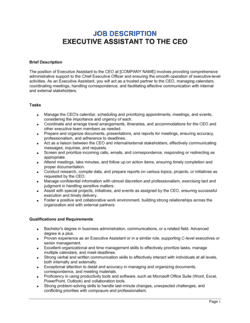
An executive assistant job description focuses on direct personal support to one or two senior leaders β€” calendar management, travel coordination, and confidential correspondence. An office manager job description covers broader organizational operations including facilities, vendor management, and administrative team supervision. The two roles may overlap in small organizations but require distinct documents for accurate classification and compensation benchmarking.

vs Employee handbook

An employee handbook sets company-wide policies, conduct standards, and procedures that apply to all employees. A job description defines the specific duties and expectations for a single role. The handbook and job description work together β€” the handbook governs how work is done across the organization; the job description defines what this employee is responsible for doing. Referencing the handbook in the job description strengthens the at-will disclaimer.

Industry-specific considerations

Professional services

Office managers in law firms, accounting practices, and consulting firms often carry enhanced confidentiality responsibilities and coordinate client-facing administrative workflows alongside internal operations.

Healthcare

Healthcare office managers must address HIPAA compliance obligations, credentialing file maintenance, and coordination with clinical and billing staff β€” requirements that should be reflected explicitly in the essential duties clause.

Technology and SaaS

Tech companies often require office managers to coordinate distributed or hybrid workforces, manage IT asset procurement, and support people-operations functions in fast-scaling environments where the role evolves rapidly.

Retail and hospitality

Retail and hospitality office managers frequently oversee hourly-workforce scheduling, vendor invoice processing at volume, and multi-location facilities coordination β€” duties that require a more operationally detailed job description than a single-site professional services role.

Jurisdictional notes

United States

FLSA classification must be assessed carefully β€” office managers are commonly designated exempt under the administrative exemption, but the role must pass both the salary-level test ($684/week as of 2024) and the duties test. Several states and cities now require salary range disclosure in job postings. An explicit at-will disclaimer in the job description is essential in states like California, Massachusetts, and New York where implied-contract claims are common.

Canada

Provincial employment standards legislation sets minimum requirements for written role documentation in several provinces. In Ontario, a job description that specifies duties in detail can influence common-law notice entitlements at termination β€” clearer scope definitions support shorter notice periods. Quebec employers must provide French-language documentation to employees whose primary workplace language is French, per the Charter of the French Language.

United Kingdom

UK employers must provide a written statement of employment particulars on or before the first day of work; a signed job description contributes to meeting this requirement. The job description should be consistent with the Working Time Regulations 1998 on maximum hours and rest periods. Equal pay legislation requires that job descriptions support objective justification of pay differentials between roles of comparable value.

European Union

The EU Transparent and Predictable Working Conditions Directive requires employees to receive written information about their role and duties within seven days of starting work. GDPR considerations apply if the job description references systems or databases that process personal data β€” the document should note the employee's data-processing responsibilities and reference the company's privacy policy. Pay-transparency legislation advancing through the EU will increasingly require published salary ranges for posted roles.

Template vs lawyer β€” what fits your deal?

PathBest forCostTime
Use the templateSmall and mid-sized businesses hiring a standard office manager role in a single domestic locationFree30–45 minutes
Template + legal reviewRoles with supervisory authority, healthcare or regulated industry settings, or jurisdictions with strong implied-contract case law$150–$400 for an HR consultant or employment lawyer review1–3 days
Custom draftedMulti-jurisdiction employers, organizations subject to OFCCP or pay-equity audits, or roles with sensitive IP or data-access obligations$500–$2,000+1–2 weeks

Glossary

Position Description
A formal written document that defines the duties, qualifications, reporting relationships, and compensation of a specific role within an organization.
Reporting Structure
The chain of authority identifying who the employee reports to directly and, where applicable, who reports to them.
Essential Functions
The core duties of a role that are fundamental to the job β€” used in ADA and disability accommodation contexts to distinguish primary from marginal tasks.
FLSA Classification
The US Fair Labor Standards Act designation of a role as exempt (salaried, no overtime) or non-exempt (hourly, overtime-eligible) based on duties and salary level.
Acknowledgment Block
A signature section at the end of a job description confirming the employee has received, read, and understood the role expectations.
KSAs (Knowledge, Skills, and Abilities)
A structured framework for listing the competencies a candidate must or should possess to perform a role effectively.
At-Will Employment
Employment that either party may end at any time, for any lawful reason, without advance notice β€” applicable in most US states.
Discretionary Duties
Responsibilities that may be assigned periodically based on business need, as opposed to fixed core duties listed in the essential functions.
Compensable Factors
The measurable elements of a job β€” skill, effort, responsibility, and working conditions β€” used to set pay grades and conduct pay-equity analysis.
ADA Compliance
Adherence to the Americans with Disabilities Act requirement that job descriptions accurately describe physical and cognitive demands so that reasonable accommodations can be assessed.
Onboarding Documentation
The set of signed forms and policies provided to a new hire before or on their first day, of which the job description is typically a component.

Part of your Business Operating System

This document is one of 3,000+ business & legal templates included in Business in a Box.

  • Fill-in-the-blanks β€” ready in minutes
  • 100% customizable Word document
  • Compatible with all office suites
  • Export to PDF and share electronically

Create your document in 3 simple steps.

From template to signed document β€” all inside one Business Operating System.
1
Download or open template

Access over 3,000+ business and legal templates for any business task, project or initiative.

2
Edit and fill in the blanks with AI

Customize your ready-made business document template and save it in the cloud.

3
Save, Share, Send, Sign

Share your files and folders with your team. Create a space of seamless collaboration.

Save time, save money, and create top-quality documents.

β˜…β˜…β˜…β˜…β˜…

"Fantastic value! I'm not sure how I'd do without it. It's worth its weight in gold and paid back for itself many times."

Managing Director Β· Mall Farm
Robert Whalley
Managing Director, Mall Farm Proprietary Limited
β˜…β˜…β˜…β˜…β˜…

"I have been using Business in a Box for years. It has been the most useful source of templates I have encountered. I recommend it to anyone."

Business Owner Β· 4+ years
Dr Michael John Freestone
Business Owner
β˜…β˜…β˜…β˜…β˜…

"It has been a life saver so many times I have lost count. Business in a Box has saved me so much time and as you know, time is money."

Owner Β· Upstate Web
David G. Moore Jr.
Owner, Upstate Web

Run your business with a system β€” not scattered tools

Stop downloading documents. Start operating with clarity. Business in a Box gives you the Business Operating System used by over 250,000 companies worldwide to structure, run, and grow their business.

Start freeΒ Β·Β No credit card required