1
Enter sender and recipient details
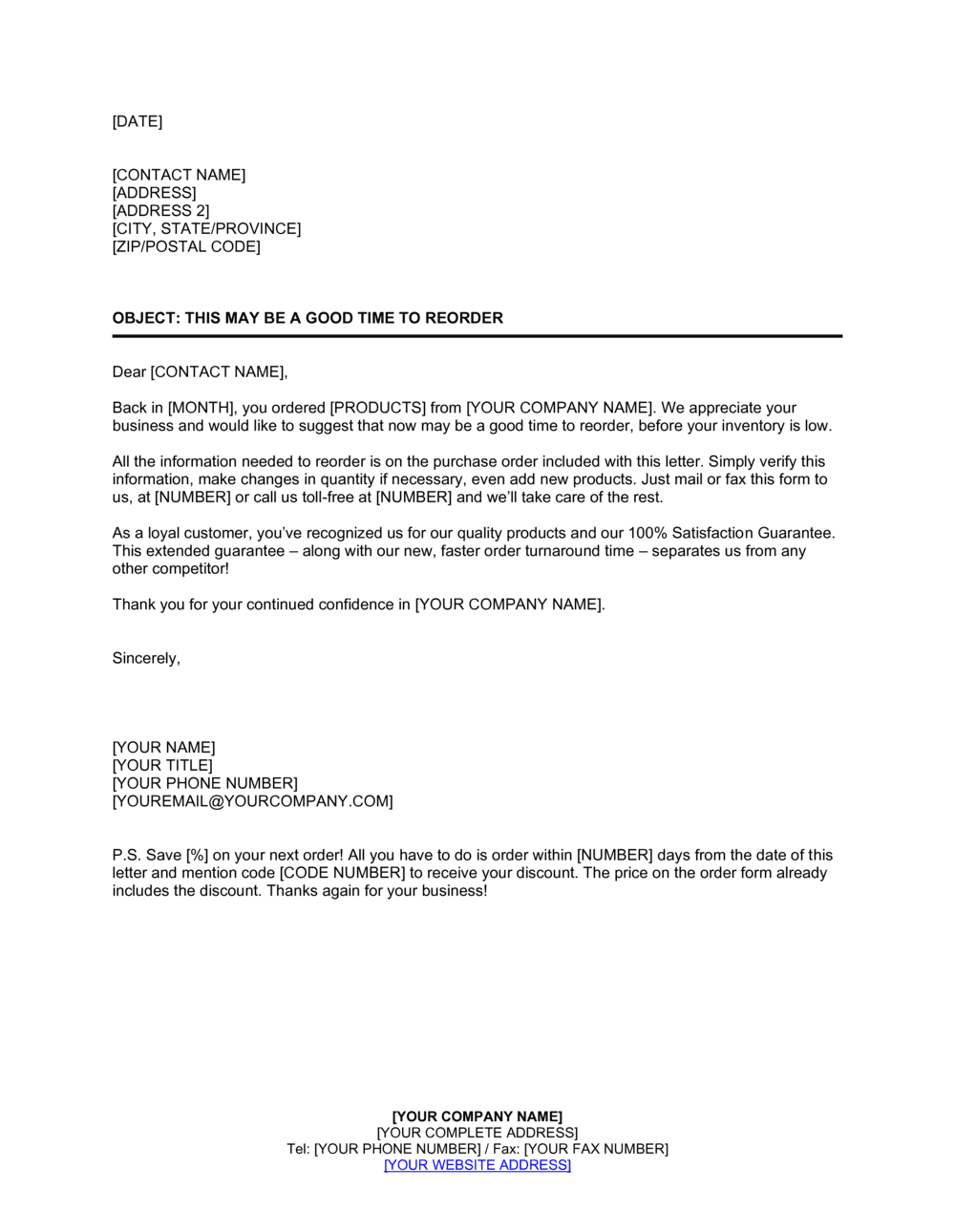
Replace all placeholders in the header with your full company name, the sending representative's name and title, and the customer's legal business name and named contact. Avoid generic salutations.
💡 Pull the contact name from your CRM to ensure it matches the current buyer — personnel changes at the customer's end are a common reason reorder letters go unanswered.
2
Reference the customer's last order accurately
Insert the prior order number, product name, SKU, quantity ordered, and the original order date. State the estimated usage rate in concrete terms (e.g., 'approximately 200 units per month').
💡 If your system tracks actual consumption rather than order frequency, use consumption data — it is more credible and more persuasive than cycle-based estimates.
3
Specify the recommended reorder quantity and product
Enter the product name, SKU, and a quantity recommendation based on actual usage data, your minimum order quantity, and the applicable lead time. Explain the basis for the quantity in one sentence.
💡 Recommend at least enough to cover the lead time plus 20% safety stock — a customer who runs out before their reorder arrives will blame you, not themselves.
4
State current pricing and any time-limited incentives
Enter the current unit price, any volume tier discounts, and the exact date through which those prices are guaranteed. If no incentive applies, state the current price and lead time only.
💡 A volume discount that saves the buyer 8–10% at a quantity they would order anyway is more persuasive than a percentage that requires an unusually large purchase.
5
Write the urgency context with factual specifics
Identify the genuine reason why acting promptly benefits the buyer — an upcoming price adjustment, constrained inventory, or seasonal demand peak. State the specific date or trigger event.
💡 Urgency backed by a verifiable fact (a published tariff date, a documented inventory count, a seasonal pattern) is dramatically more effective than vague warnings.
6
Confirm payment terms and trade credit
Reference the buyer's existing account terms by name (e.g., 'your current Net 30 account terms'). If you are offering extended terms as an incentive, state them explicitly with the qualifying conditions.
💡 Never alter existing payment terms without your finance team's sign-off — changing terms unilaterally can create disputes that outlast the order they were meant to facilitate.
7
Insert a single, clear call to action with a deadline
Name one primary contact and one primary method for placing the reorder. Set a response-by date that gives you enough lead time to fulfill by the buyer's likely need date.
💡 A deadline of 7–10 business days creates urgency without feeling aggressive — response rates drop sharply when deadlines exceed two weeks.
8
Sign and dispatch from an authorized representative
Have the letter signed by the account manager, sales director, or other named relationship owner. Send it via email with the Word or PDF attached, and follow up by phone within 48 hours.
💡 A phone call within 48 hours of sending the letter increases response rates by 30–40% compared to the letter alone — the written document primes the conversation.