Paid-Time-Off Policy Template

Free Word download β€’ Edit online β€’ Save & share with Drive β€’ Export to PDF

2 pagesβ€’20–25 min to fillβ€’Difficulty: Standard
Learn more ↓
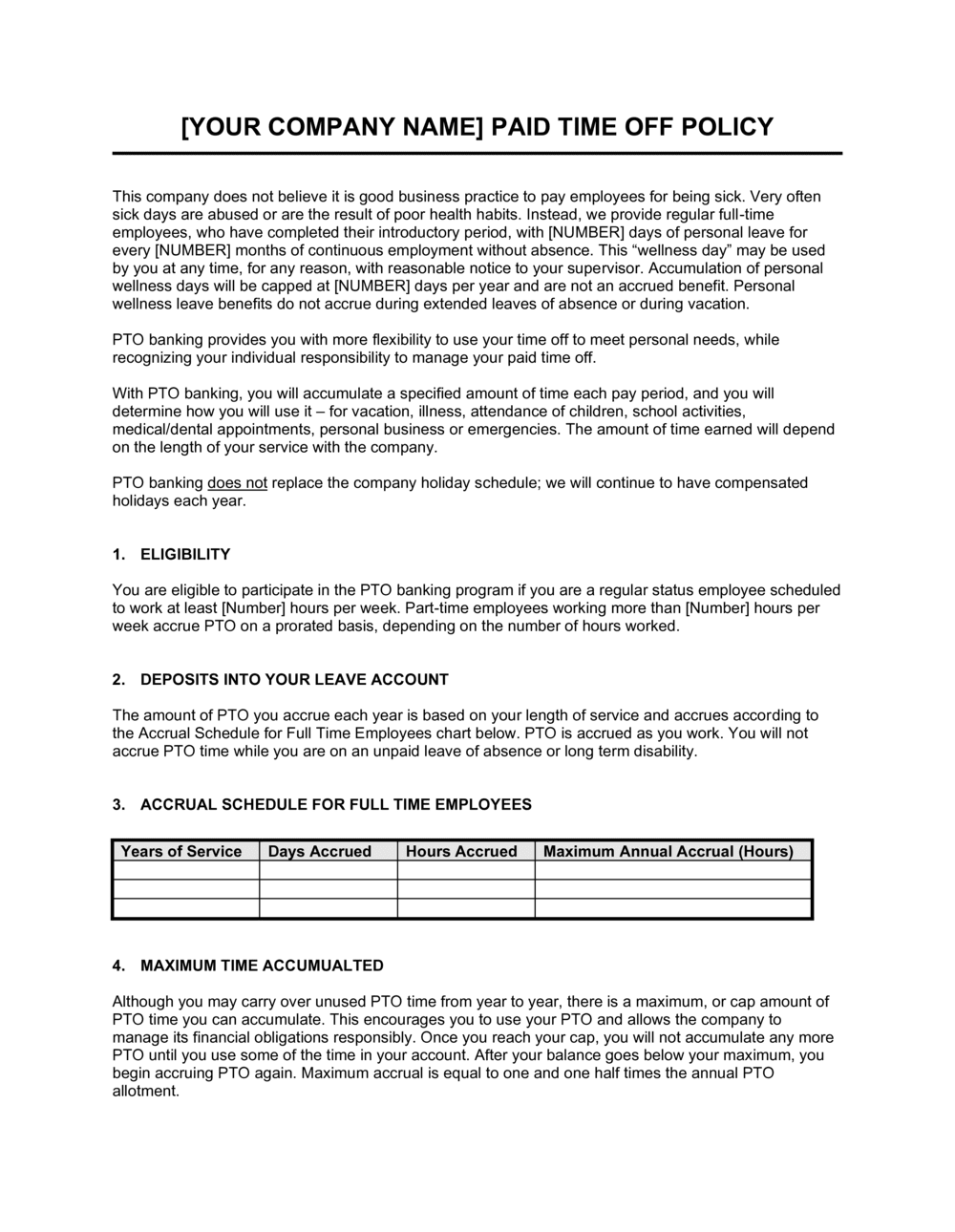
FreePaid-Time-Off Policy Template

At a glance

What it is
A Paid Time Off Policy is an internal HR document that defines how employees earn, request, use, and lose paid leave β€” combining vacation, sick time, and personal days into a single framework. This free Word download gives you a structured, editable starting point you can adapt to your headcount, accrual model, and applicable state or provincial rules, then export as PDF for your employee handbook or onboarding package.
When you need it
Use it when onboarding your first employees, updating an outdated leave policy, or standardizing inconsistent informal arrangements across departments. It becomes especially important when headcount passes the threshold where ad hoc approvals create favoritism complaints or accrual liability starts appearing on your balance sheet.
What's inside
Policy scope and eligibility, PTO accrual schedule and caps, carryover and forfeiture rules, request and approval procedures, payout rules on termination, and coordination with statutory leave such as FMLA or state-mandated sick leave.

What is a Paid Time Off Policy?

A Paid Time Off Policy is an internal HR document that defines how employees earn, request, use, and lose paid leave β€” consolidating vacation days, sick time, and personal days into a single governed framework. It sets the accrual rate by tenure, the maximum balance an employee may hold, carryover and forfeiture rules, the request and approval procedure, and what happens to unused PTO when an employee separates from the company. A well-written PTO policy functions as both an employee benefit document and a liability-management tool, translating informal management discretion into consistent, auditable rules.

Why You Need This Document

Without a written PTO policy, leave decisions default to manager judgment β€” and inconsistent judgment generates favoritism complaints, wrongful-termination claims, and payroll disputes that are expensive and time-consuming to defend. Accrued but undocumented PTO also becomes a balance-sheet liability: in states that treat accrued leave as earned wages, every hour an employee banks is money you owe them on their last day, whether or not you ever wrote it down. A clear, distributed policy closes those gaps by giving employees transparent rules to follow, giving managers an objective framework to apply, and giving HR documented evidence of consistent treatment. This template provides the complete structure β€” scope, accrual schedule, cap, carryover, request procedure, and payout rules β€” so you can have a compliant, professional policy in place in a single afternoon.

Which variant fits your situation?

If your situation is…Use this template
Offering vacation, sick, and personal days as separate bucketsVacation and Sick Leave Policy
Providing unlimited PTO for salaried employeesUnlimited PTO Policy
Managing part-time or hourly employee leave separatelyPart-Time Employee Leave Policy
Tracking leave in a detailed schedule by employeeEmployee Vacation Schedule
Formalizing all types of employee leave in a single master documentEmployee Leave of Absence Policy
Documenting parental leave as a distinct benefitParental Leave Policy
Capturing the full range of HR policies in one documentEmployee Handbook

Common mistakes to avoid

❌ Forfeiture clauses in states where they are unlawful

Why it matters: California, Colorado, and Illinois treat accrued PTO as earned wages. A use-it-or-lose-it clause is void on its face and can trigger class-action wage claims for the full value of all forfeited balances.

Fix: Replace forfeiture language with a hard accrual cap β€” once the cap is reached, accrual pauses until the employee uses PTO. This achieves the same operational goal without the legal exposure.

❌ Conditioning payout on resignation with notice

Why it matters: Policies that pay out accrued PTO only when an employee gives two weeks' notice are unenforceable in states that classify accrued PTO as wages β€” and create a chilling effect on at-will terminations.

Fix: Pay out all accrued PTO on the final paycheck regardless of separation circumstances, and separately enforce notice requirements through other policy mechanisms.

❌ No advance-notice requirement for time-off requests

Why it matters: Without a minimum notice rule, employees can submit same-day PTO requests that leave managers unable to arrange coverage, increasing overtime costs and missed deadlines.

Fix: Require at least 3–5 business days' advance notice for planned absences, with a separate 'unplanned absence' procedure for genuine emergencies.

❌ Treating the PTO bank as automatically satisfying state sick-leave mandates

Why it matters: Some state sick-leave laws restrict when employers can require advance notice, limit doctor's-note requirements, and mandate specific permitted uses β€” a generic PTO policy may not meet all of those conditions even if the accrual rate is sufficient.

Fix: Audit the policy against every applicable state or local sick-leave ordinance and add a compliance clause confirming the greater of the two standards applies.

The 9 key sections, explained

Purpose and scope

PTO accrual schedule

PTO cap and carryover rules

Request and approval procedure

Blackout periods and scheduling conflicts

Sick leave and statutory compliance

PTO payout upon termination

Coordination with other leave types

Policy administration and amendments

How to fill it out

  1. 1

    Define eligibility and waiting period

    Identify which employee classifications are covered β€” full-time, part-time, exempt, non-exempt β€” and set the waiting period before new hires can begin using (not accruing) PTO.

    πŸ’‘ A 90-day waiting period on use (not accrual) is the most common standard and is generally permissible in all US states, including California.

  2. 2

    Choose your accrual model

    Decide between per-pay-period accrual, an annual lump-sum grant, or a hybrid (lump sum at hire, then accrual-based thereafter). Per-pay-period accrual reduces liability if an employee leaves early in the year.

    πŸ’‘ Lump-sum grants feel more generous to employees but front-load your liability β€” if an employee uses the full year's PTO in January and resigns, you cannot recover it in most states.

  3. 3

    Set accrual rates and tenure tiers

    Enter the hours earned per pay period for each tenure band. Cross-check that the annualized rate meets or exceeds any applicable state sick-leave minimum before finalizing.

    πŸ’‘ Benchmark your rates against industry peers: 10 days/year is typical for employees under 2 years; 15 days for 3–5 years; 20 days for 6+ years.

  4. 4

    Configure the cap and carryover rules

    Set the maximum accrued balance (commonly 1.5Γ— the annual grant) and the carryover limit at year-end. Verify that forfeiture rules comply with your state's wage-payment laws before including a use-it-or-lose-it clause.

    πŸ’‘ In California, Colorado, Illinois, and a growing list of states, accrued PTO is a vested wage and cannot be forfeited β€” replace forfeiture language with a hard accrual cap instead.

  5. 5

    Write the request and approval procedure

    Specify the advance-notice requirement in business days, the submission method (HRIS, email, or paper form), the manager's approval window, and any escalation path if a manager is unresponsive.

    πŸ’‘ Require requests for absences of 3 or more consecutive days to route through HR in addition to the direct manager, to flag potential FMLA-qualifying situations early.

  6. 6

    Define payout rules for termination

    State whether accrued PTO is paid out at separation and at what rate. For multi-state employers, create a jurisdiction-specific addendum rather than trying to fit all variations into one clause.

    πŸ’‘ Using the employee's 'final regular rate of pay' for payout calculation avoids disputes and aligns with state wage-payment statutes in most jurisdictions.

  7. 7

    Review against applicable state and local laws

    Check your final draft against the sick-leave mandates and PTO-payout rules for every state or locality where you have employees. Highlight any clause that may need a state-specific override.

    πŸ’‘ The most common compliance failure is a forfeiture clause that works in Texas but is void in California β€” one template clause, two legal outcomes.

  8. 8

    Publish in the employee handbook and notify staff

    Add the completed policy to your employee handbook, distribute to all current employees with a read-receipt or signature acknowledgment, and update your offer letter template to reference it.

    πŸ’‘ Have employees sign an acknowledgment that they have received and read the policy β€” this closes the 'I didn't know' defense in any future dispute over denied or forfeited PTO.

Frequently asked questions

What is a paid time off policy?

A paid time off policy is an internal HR document that defines how employees earn, request, and use paid leave β€” typically combining vacation, sick days, and personal days into a single bank of hours. It sets the accrual rate, maximum balance, carryover rules, request procedures, and payout terms on separation. A clear policy reduces manager discretion, prevents favoritism complaints, and creates the paper trail needed to resolve disputes.

What is the difference between PTO and separate vacation and sick leave?

Traditional policies allocate separate buckets β€” e.g., 10 vacation days, 5 sick days, 3 personal days β€” that can only be used for their designated purpose. A unified PTO bank combines all three into one balance employees can use for any reason. PTO banks are administratively simpler and feel more flexible to employees, but they can mask attendance issues when employees use all their balance as vacation and then call out sick with nothing left.

Are employers required to offer paid time off?

No federal US law requires private employers to provide paid vacation or general PTO. However, a growing number of states and cities mandate paid sick leave β€” including California, New York, Illinois, and Massachusetts. In Canada, each province mandates a minimum number of vacation days and vacation pay. Once a policy is established, its terms become a binding commitment to employees and must be administered consistently.

Can a company have a use-it-or-lose-it PTO policy?

In many US states, yes β€” use-it-or-lose-it policies are permitted if employees have a reasonable opportunity to use their PTO before the forfeiture date. However, California, Colorado, Illinois, Montana, and Nebraska treat accrued PTO as earned wages and prohibit forfeiture entirely. Employers with employees in those states should use a hard accrual cap instead of a forfeiture clause to limit liability.

Does unused PTO have to be paid out when an employee leaves?

It depends entirely on state law. California, Colorado, Illinois, and several other states require payout of all accrued, unused PTO at the employee's final rate of pay regardless of the reason for separation. Other states β€” including Texas and Florida β€” permit employers to set their own payout rules in a written policy. In Canada, vacation pay must be paid out on termination in all provinces. Always check the rules for each state or province where you have employees.

How much PTO should a small business offer?

A competitive starting point for a US small business is 10 days (80 hours) per year for employees in their first two years, stepping up to 15 days at 3 years and 20 days at 6 or more years. Adding a separate allotment of 5–7 sick days β€” or confirming your PTO bank meets applicable sick-leave mandates β€” rounds out a standard offer. According to BLS data, the average US private-sector employee with 1 year of service receives about 10 days of paid vacation.

What is a PTO accrual cap and why does it matter?

A PTO accrual cap is a maximum balance β€” often set at 1.5Γ— the annual accrual rate β€” above which no additional PTO is earned until the employee uses some of their balance. Caps prevent employees from banking years of leave into a large liability on the company's books and encourage regular use of time off. In states where forfeiture is unlawful, a cap is the legally compliant alternative to a use-it-or-lose-it rule.

How should a PTO policy handle FMLA leave?

Under US federal law, employers may require employees to use accrued PTO concurrently with FMLA leave, which means the paid and unpaid periods run at the same time rather than back-to-back. This prevents an employee from taking 12 weeks of FMLA leave and then immediately using a large PTO balance for additional paid time away. The policy should state this requirement explicitly and note any state law exceptions.

How often should a PTO policy be updated?

Review the policy annually, typically during the fourth quarter before the new calendar year begins. Trigger an immediate review whenever you expand into a new state or locality with its own sick-leave law, whenever headcount crosses a threshold that activates new statutory obligations (such as 50 employees for FMLA), or whenever an employee dispute reveals a gap or ambiguity in the current language.

How this compares to alternatives

vs Employee Handbook

An employee handbook is a comprehensive document covering all HR policies β€” code of conduct, benefits, safety, and leave β€” in a single reference guide. A standalone PTO policy is a focused document that can be updated, distributed, and acknowledged independently without revising the full handbook. Use the standalone policy when you need to roll out or update leave terms quickly, then embed it in the handbook at the next full revision.

vs Leave of Absence Policy

A leave of absence policy covers extended, often unpaid leave β€” FMLA, medical leave, military leave, and personal leave of absence β€” that goes beyond the standard PTO bank. A PTO policy governs the routine, shorter paid absences employees take throughout the year. Both are necessary; they serve different situations and should cross-reference each other to clarify which governs when.

vs Vacation Policy

A vacation policy covers only planned, discretionary time off and does not include sick leave or personal days. A unified PTO policy replaces separate vacation, sick, and personal-day buckets with a single balance. PTO policies are administratively simpler but can obscure attendance patterns because employees are not required to state a reason for using their balance.

vs Employee Vacation Schedule

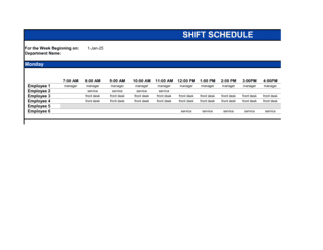
A vacation schedule is a tracking spreadsheet that records which employees are off on which dates. A PTO policy is the governing document that establishes the rules. The schedule operationalizes the policy β€” you need both, but they serve different functions. The policy should specify that managers maintain an approved schedule in the system named in the request-and-approval section.

Industry-specific considerations

Technology / SaaS

Unlimited PTO models are common but require a minimum-use floor to prevent employees from never taking leave; accrual caps matter less than clear manager approval norms.

Retail / Hospitality

Blackout periods during peak seasons (holiday, summer) are standard; high turnover makes payout liability and accrual-cap rules especially important to get right.

Healthcare

Shift-based scheduling requires advance-notice rules and coverage minimums; state-mandated sick leave often sets a higher floor than generic policies provide.

Professional Services

Client-facing blackout periods tied to project deadlines are common; billable utilization targets make unplanned absences costly, so structured request procedures reduce disruption.

Manufacturing

Production-line coverage requirements make scheduling conflicts high-stakes; seniority-based tiebreakers for competing requests are the norm in unionized environments.

Nonprofit

Budget constraints often make competitive PTO a primary retention lever; grant-funded positions may require time-tracking that intersects with PTO accrual and reporting.

Template vs pro β€” what fits your needs?

PathBest forCostTime
Use the templateSmall businesses and startups in a single state formalizing PTO for the first timeFree1–2 hours
Template + professional reviewEmployers with staff in multiple states, or those adding unlimited PTO or complex carryover structures$200–$500 for an HR consultant or employment attorney review2–5 business days
Custom draftedMulti-state employers, unionized workforces, or companies subject to complex local sick-leave ordinances$500–$2,000+ for custom drafting by an employment attorney1–3 weeks

Glossary

PTO Accrual
The rate at which employees earn paid time off over a period β€” typically expressed as hours earned per pay period or days earned per year of service.
Carryover
The portion of unused PTO an employee is permitted to transfer from one calendar year into the next.
PTO Cap
A maximum balance of accrued PTO an employee may hold at any one time, after which accrual stops until the balance drops below the ceiling.
Use-It-or-Lose-It Rule
A policy provision that forfeits any unused PTO balance at the end of the year rather than allowing carryover or payout.
PTO Payout
Payment of an employee's accrued but unused PTO balance upon separation from the company, either voluntarily or involuntarily.
Waiting Period
A defined period β€” typically 30 to 90 days after hire β€” during which a new employee earns PTO but cannot yet use it.
Blackout Period
Designated dates or ranges during which PTO requests will not be approved due to peak business demand, such as a retail holiday season.
Intermittent Leave
Leave taken in separate blocks of time or by reducing the normal work schedule rather than in one continuous absence β€” often associated with FMLA.
FMLA (Family and Medical Leave Act)
A US federal law requiring employers with 50 or more employees to provide up to 12 weeks of unpaid, job-protected leave for qualifying family or medical reasons.
Lump-Sum Grant
A PTO model in which the full annual allotment is credited to each employee at the start of the year rather than earned incrementally throughout the year.

Part of your Business Operating System

This document is one of 3,000+ business & legal templates included in Business in a Box.

  • Fill-in-the-blanks β€” ready in minutes
  • 100% customizable Word document
  • Compatible with all office suites
  • Export to PDF and share electronically

Create your document in 3 simple steps.

From template to signed document β€” all inside one Business Operating System.
1
Download or open template

Access over 3,000+ business and legal templates for any business task, project or initiative.

2
Edit and fill in the blanks with AI

Customize your ready-made business document template and save it in the cloud.

3
Save, Share, Send, Sign

Share your files and folders with your team. Create a space of seamless collaboration.

Save time, save money, and create top-quality documents.

β˜…β˜…β˜…β˜…β˜…

"Fantastic value! I'm not sure how I'd do without it. It's worth its weight in gold and paid back for itself many times."

Managing Director Β· Mall Farm
Robert Whalley
Managing Director, Mall Farm Proprietary Limited
β˜…β˜…β˜…β˜…β˜…

"I have been using Business in a Box for years. It has been the most useful source of templates I have encountered. I recommend it to anyone."

Business Owner Β· 4+ years
Dr Michael John Freestone
Business Owner
β˜…β˜…β˜…β˜…β˜…

"It has been a life saver so many times I have lost count. Business in a Box has saved me so much time and as you know, time is money."

Owner Β· Upstate Web
David G. Moore Jr.
Owner, Upstate Web

Run your business with a system β€” not scattered tools

Stop downloading documents. Start operating with clarity. Business in a Box gives you the Business Operating System used by over 250,000 companies worldwide to structure, run, and grow their business.

Free Forever PlanΒ Β·Β No credit card required