1
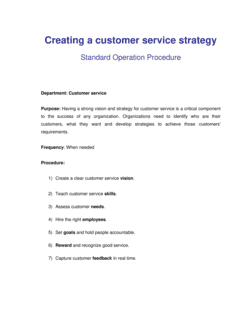
Define your service philosophy in plain language
Write two to three sentences stating what great customer service means for your specific business and customer base. Avoid generic statements — ground them in the real situations your team encounters daily.
💡 Ask your three best frontline staff what they tell upset customers. Their instinctive answers are often a better service philosophy than anything written in a head office.
2
Set specific response time targets for each channel
List every channel you use — phone, email, live chat, social media, in-person — and assign a maximum first-response time to each. Segment by priority level if your complaint volume warrants it.
💡 Start with your current average response time, then set a target 20% faster. Unreachable targets demoralize staff; incremental improvements compound quickly.
3
Map your complaint and escalation procedure step by step
Walk through a typical complaint from first contact to resolution and document each decision point: who handles it, what system logs it, and what criteria trigger escalation to the next level.
💡 Time your current escalation process end-to-end before writing this section. If it takes more than 4 hours to resolve a Priority 1 complaint, fix the process before documenting it.
4
Define make-good authorization limits by role
Specify exactly what each role is empowered to offer — credit amounts, refund thresholds, free replacements — without requiring additional approval. Document the approval path for anything above those limits.
💡 Authorization limits that require manager sign-off for anything over $10 signal a trust deficit. Most frontline resolution actions cost far less than a churned customer.
5
List required training by role and timeline
For each customer-facing role, write out the training modules required, the completion deadline from start date, and the frequency of refresher training.
💡 Pair product knowledge training with one scenario-based de-escalation exercise — reading a manual and handling a hostile caller require completely different skills.
6
Specify your feedback collection cadence and closed-loop process
Name the survey tool, the trigger event (ticket close, purchase, quarterly NPS), the person responsible for reviewing results, and the specific action taken when a score falls below your threshold.
💡 A personal follow-up call or email to a detractor (NPS 0–6) recovers roughly 30% of at-risk customers when done within 48 hours of a low score.
7
Set KPI targets and reporting frequency
Choose four to six metrics — CSAT, FCR, average handle time, NPS, complaint volume, resolution time — and set a realistic target for each. Assign a reporting owner and meeting cadence.
💡 Benchmark your initial targets against industry averages for your sector before setting them — retail, SaaS, and healthcare have very different norms for the same metrics.
8
Schedule a quarterly guide review
Add a recurring calendar event for the guide owner to review performance data and update at least one section based on what changed in the past quarter.
💡 Version-number the document (v1.0, v1.1) and keep a one-paragraph change log at the front so staff always know what is new.