1
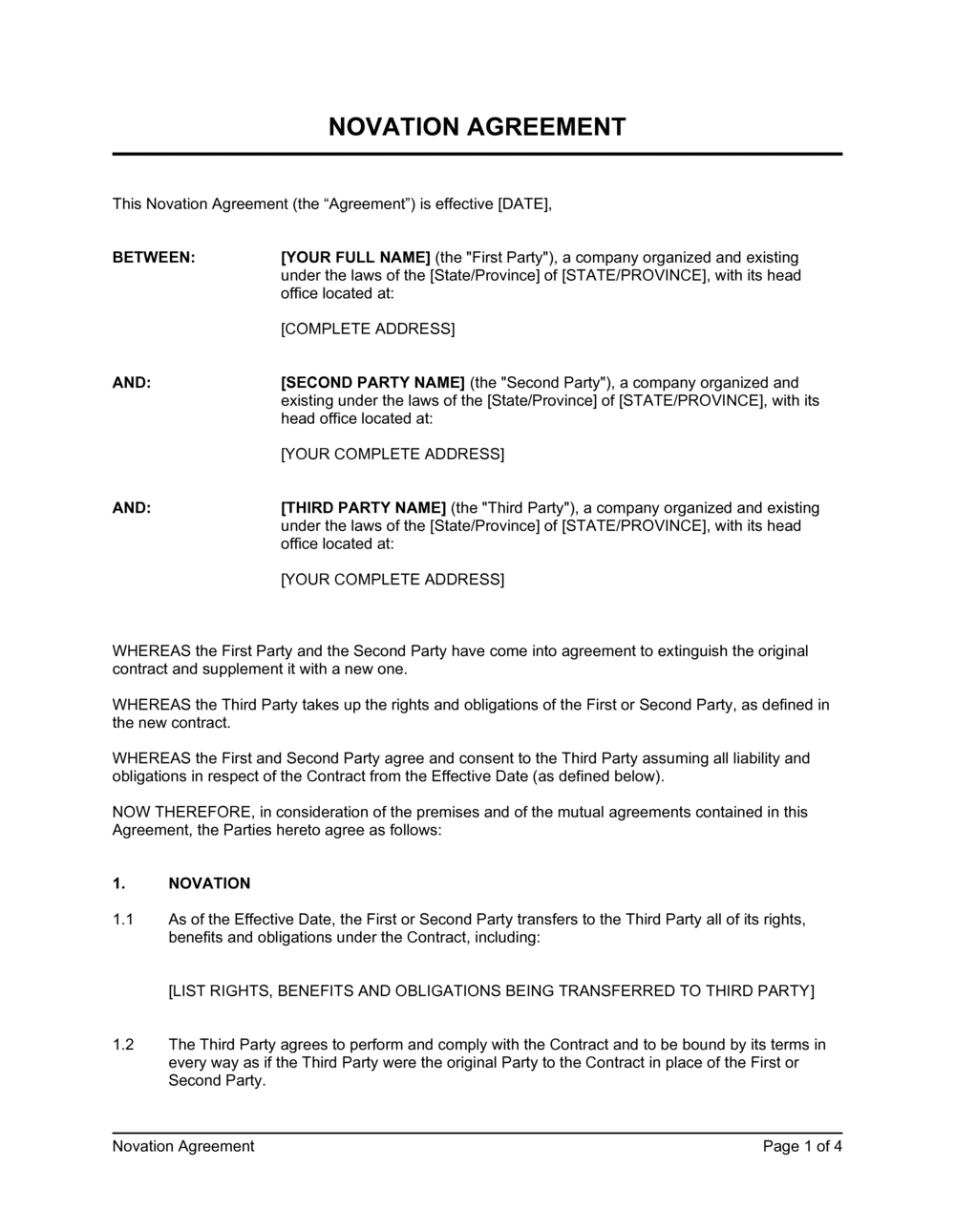
Identify and name all three parties correctly
Enter the full legal name and entity type (e.g., corporation, LLC, partnership, individual) of the outgoing party, incoming party, and remaining party. Confirm each name matches the relevant corporate registry or government ID.
💡 For business sales, the remaining party is typically the customer or supplier whose contract is being transferred — confirm their legal name hasn't changed since the original contract was signed.
2
Describe the original contract precisely
Enter the full title of the original contract, the date it was signed, and the names of the original parties exactly as they appear in that document. If the original contract has been previously amended, reference those amendments too.
💡 Attach a copy of the original contract (and any amendments) as a schedule to the novation agreement — this eliminates disputes about what terms were transferred.
3
Set the novation date
Choose a specific calendar date for the novation to take effect. For business sales, this is typically the completion or closing date. For lender substitutions, it is usually the date the new facility is drawn.
💡 The novation date and the execution date can differ — parties often sign in advance and specify a future effective date tied to a closing condition.
4
Allocate pre-novation accrued liabilities
Decide whether the incoming party is assuming all liabilities (including pre-novation amounts owed), or only liabilities arising after the novation date. Record the agreed allocation explicitly in the accrued rights clause.
💡 In a business sale context, the buyer typically assumes post-completion liabilities only — run a reconciliation of open invoices and accrued obligations before the novation date to avoid disputes.
5
Confirm authority to sign for corporate entities
For each company signatory, verify that the person signing holds a title with binding authority (CEO, director, authorized officer) and that no board resolution or additional internal approval is required.
💡 Request a certified copy of the board resolution or signing authority certificate for the incoming party — they are new to the contract and the remaining party has the most to gain from confirming capacity.
6
Confirm no third-party consents are outstanding
Check whether the original contract requires a third party's consent to transfer — such as a licensor, lender, or regulator. If so, obtain written consent before executing the novation.
💡 Government contracts and regulated financial agreements frequently require regulatory approval before novation — allow several weeks' lead time and confirm the approval condition in the recitals.
7
Obtain all three signatures simultaneously
Arrange for the outgoing party, incoming party, and remaining party to all execute the document. Electronic signature is accepted in most jurisdictions; confirm the original contract does not require wet ink.
💡 Use Business in a Box eSign to collect and timestamp all three signatures in sequence and store the fully executed copy automatically.
8
Distribute executed copies and update your records
Send a fully executed copy to each party and update your contract register to reflect the incoming party as the counterparty going forward. Notify any related systems (ERP, CRM, accounts payable) of the counterparty change.
💡 If the novated contract is registered (e.g., a construction contract with a performance bond or a lease), check whether the novation must also be registered or endorsed on the original instrument.