Notice of Job Opening_Form Template

Free Word download β€’ Edit online β€’ Save & share with Drive β€’ Export to PDF

1 pageβ€’15–25 min to fillβ€’Difficulty: Standard
Learn more ↓
FreeNotice of Job Opening_Form Template

At a glance

What it is
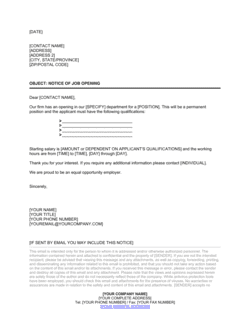
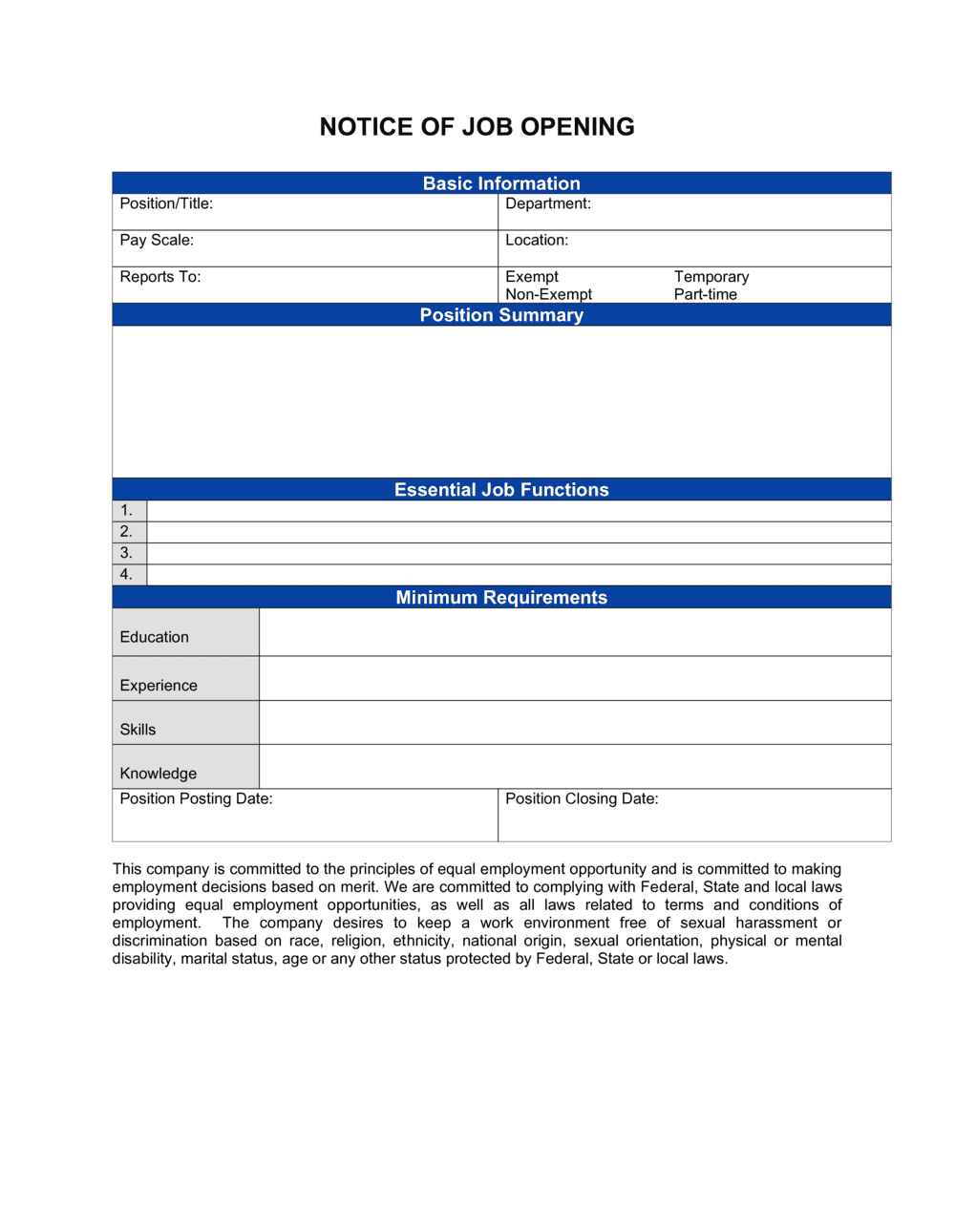
A Notice of Job Opening Form is a formal written announcement that an organization issues to communicate an available position β€” its title, qualifications, responsibilities, and application instructions β€” to internal staff, external job boards, or both. This free Word download gives you a structured, ready-to-edit template you can complete in minutes and distribute via email, bulletin board, or careers page.
When you need it
Use it whenever a position becomes available through new headcount approval, a resignation, a promotion, or a business expansion. It is equally useful for internal postings that give current employees the first opportunity to apply and for external announcements targeting outside candidates.
What's inside
Company name and logo block, position title and department, posting date and application deadline, role summary, key responsibilities, required and preferred qualifications, compensation range, reporting structure, and application instructions with contact details.

What is a Notice of Job Opening Form?

A Notice of Job Opening Form is a formal written announcement an organization issues to communicate that a position is available β€” describing the job title, department, key responsibilities, required qualifications, compensation range, and how to apply. It serves as the first official touchpoint between an employer and potential candidates, whether distributed to current employees as an internal posting, published on external job boards, or both. Unlike an informal job post, a structured notice ensures every open role is communicated consistently, completely, and in compliance with applicable pay-transparency and equal-opportunity requirements.

Why You Need This Document

Recruiting without a formal written notice creates immediate operational problems: candidates receive inconsistent information about the same role, screening becomes harder when applications arrive without the correct documents or position references, and the hiring manager and HR team lose time resolving confusion that a clear posting would have prevented. In unionized workplaces and federal contractor environments, failing to post a role according to policy can expose the organization to grievances and regulatory penalties. A standardized notice also protects the company in any post-hire dispute β€” it documents exactly what qualifications were advertised and what compensation was offered, reducing the risk of claims tied to misrepresentation or discriminatory screening. This template gives you a complete, ready-to-edit posting in under 30 minutes.

Which variant fits your situation?

If your situation is…Use this template
Notifying current employees of an open role before external postingInternal Job Posting Notice
Advertising a temporary or contract-based positionTemporary Position Job Notice
Announcing an executive or senior leadership vacancyExecutive Job Opening Announcement
Recruiting for a part-time or seasonal rolePart-Time Job Posting Template
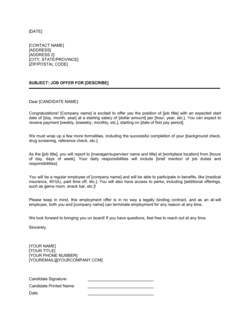
Following up the posting with a formal offer to a selected candidateJob Offer Letter
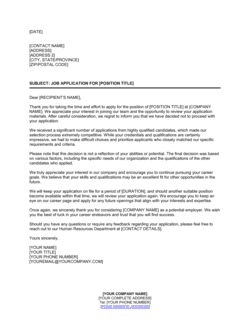
Informing unsuccessful applicants after filling the roleJob Application Rejection Letter

Common mistakes to avoid

❌ No application deadline

Why it matters: Without a deadline, candidates delay applying and managers receive uneven submission volumes that make scheduling and screening difficult to manage.

Fix: Always set a specific calendar date. If the role is urgent, note 'Applications reviewed on a rolling basis until [DATE]' to encourage early submission.

❌ Mixing required and preferred qualifications

Why it matters: Candidates cannot tell which criteria are filters and which are differentiators, leading to a mix of under-qualified applicants and missed strong candidates who assume they are unqualified.

Fix: Use two clearly labeled lists β€” 'Required Qualifications' and 'Preferred Qualifications' β€” and review each item before publishing to confirm it belongs in the right list.

❌ Omitting compensation information

Why it matters: Candidates skip postings with no pay information at higher rates than those with a stated range, and several US states and Canadian provinces now require disclosure.

Fix: Include at minimum a salary range. If your company policy restricts disclosure, state 'Compensation commensurate with experience; range available upon request' to signal transparency.

❌ Vague or generic application instructions

Why it matters: A generic 'send resume to hr@company.com' produces unsorted inboxes, missing cover letters, and applicants who do not reference the correct role β€” wasting recruiter time.

Fix: Specify the required documents, the email subject line format, and the posting reference number so every submission arrives pre-sorted and complete.

The 9 key clauses, explained

Header: company identity and posting date

In plain language: Identifies the organization issuing the notice and records when the posting was created and when it expires.

Sample language
[COMPANY NAME] | [COMPANY ADDRESS] | Date Posted: [DATE] | Application Deadline: [DATE]

Common mistake: Omitting the application deadline β€” candidates delay applying and managers receive a last-minute flood of submissions that compress screening time.

Position title and department

In plain language: States the exact job title and the department or business unit the role belongs to, so candidates and internal reviewers can route the posting correctly.

Sample language
Position Title: [JOB TITLE] | Department: [DEPARTMENT NAME] | Location: [CITY, STATE / REMOTE]

Common mistake: Using an internal job code or vague working title instead of the market-standard title. Candidates searching by title will never find the posting.

Employment type and FLSA classification

In plain language: Specifies whether the role is full-time, part-time, temporary, or contract, and whether it is exempt or non-exempt for overtime purposes.

Sample language
Employment Type: Full-Time, Permanent | FLSA Status: Exempt | Schedule: Monday–Friday, 40 hours per week

Common mistake: Leaving the employment type blank. Candidates who expect a permanent role and discover it is temporary after interviews create trust problems and pipeline drop-off.

Role summary

In plain language: A 2–4 sentence overview of the position's primary purpose, the team it serves, and the value it is expected to create.

Sample language
The [JOB TITLE] is responsible for [PRIMARY FUNCTION] within the [DEPARTMENT] team, supporting [BUSINESS OBJECTIVE]. Reporting to [MANAGER TITLE], this role plays a key part in [OUTCOME].

Common mistake: Copying and pasting the summary from an old posting without updating it to reflect current priorities β€” resulting in candidates who are misaligned with what the team actually needs.

Key responsibilities

In plain language: A bulleted list of the 5–8 primary duties the employee will perform on a regular basis.

Sample language
- [RESPONSIBILITY 1] - [RESPONSIBILITY 2] - [RESPONSIBILITY 3]

Common mistake: Listing more than 10 responsibilities without distinguishing core duties from occasional tasks. Overly long lists signal a poorly scoped role and deter strong candidates.

Required and preferred qualifications

In plain language: Two distinct lists β€” non-negotiable minimums and nice-to-have skills β€” that help candidates self-screen and help recruiters filter submissions.

Sample language
Required: [X] years of experience in [FIELD], [DEGREE/CERTIFICATION]. Preferred: Familiarity with [TOOL/PROCESS], experience in [INDUSTRY].

Common mistake: Collapsing required and preferred qualifications into a single list. Candidates cannot distinguish must-haves from nice-to-haves, leading to under-qualified applications and missed strong candidates who lacked only preferred skills.

Compensation and benefits

In plain language: States the salary or hourly range and summarizes the benefits package β€” health, retirement, PTO, and any variable compensation.

Sample language
Salary Range: $[MIN]–$[MAX] per year | Benefits: Medical, Dental, Vision, 401(k) with [X]% match, [X] days PTO

Common mistake: Omitting compensation entirely. Many jurisdictions now require pay transparency in job postings, and candidates routinely bypass notices with no stated range.

Application instructions

In plain language: Tells candidates exactly how to apply β€” email address, online portal, documents required, and any specific subject-line or reference number to include.

Sample language
To apply, submit a resume and cover letter to [EMAIL ADDRESS] with the subject line '[JOB TITLE] β€” Application' by [DATE]. Reference posting number [POSTING ID] in your submission.

Common mistake: Providing only a generic company email with no subject-line instructions. Applications arrive without position context and must be manually sorted, slowing the screening process.

Equal opportunity and accommodation statement

In plain language: A standard declaration that the employer is an equal-opportunity employer and will accommodate applicants with disabilities upon request.

Sample language
[COMPANY NAME] is an equal opportunity employer. We do not discriminate on the basis of race, color, religion, sex, national origin, age, disability, or any other characteristic protected by law. Accommodations are available upon request.

Common mistake: Omitting the equal opportunity statement altogether. Beyond the legal risk, its absence signals to diverse candidates that inclusion is not a company priority.

How to fill it out

  1. 1

    Enter company details and posting dates

    Add your company name, address, and logo to the header. Set the posting date to today and choose an application deadline that gives you at least 10 business days to collect applications.

    πŸ’‘ For internal postings, a 5-business-day window is typical β€” enough time for employees to consider and apply without stalling the external search.

  2. 2

    Define the position title and employment type

    Enter the market-standard job title, the department, the work location (on-site, hybrid, or remote), and whether the role is full-time, part-time, or temporary.

    πŸ’‘ Search the same title on LinkedIn or Indeed before finalizing it β€” if no results appear, the title is too idiosyncratic and will reduce candidate reach.

  3. 3

    Write a focused role summary

    Draft 2–4 sentences describing the role's primary purpose, the team context, and the main outcome the new hire is expected to deliver.

    πŸ’‘ Lead with what makes the role meaningful or interesting β€” a candidate reading 50 postings will skip a summary that opens with 'The [TITLE] is responsible for supporting the department.'

  4. 4

    List key responsibilities in priority order

    Write 5–8 bullet points covering the role's core duties. Put the most important and most frequent tasks first. Avoid vague entries like 'other duties as assigned' as a primary bullet.

    πŸ’‘ Each bullet should begin with an action verb β€” 'Manage', 'Analyze', 'Coordinate' β€” and describe a concrete output, not an activity.

  5. 5

    Separate required from preferred qualifications

    Create two distinct lists. Required: the minimum education, years of experience, and certifications without which a candidate will not be considered. Preferred: skills that differentiate strong from acceptable candidates.

    πŸ’‘ Challenge every required qualification β€” if a candidate without a degree but with 5 years of relevant experience could do the job, the degree should be 'preferred', not 'required'.

  6. 6

    State the compensation range and benefits

    Enter the full salary or hourly range and a summary of the benefits package. If your jurisdiction mandates pay transparency, confirm the range complies with local requirements.

    πŸ’‘ A specific range β€” '$58,000–$72,000' β€” attracts better-fit candidates than 'competitive compensation.' Candidates use pay ranges to self-screen before applying.

  7. 7

    Add application instructions and the equal opportunity statement

    Specify exactly how to apply, what to submit, and the correct email or portal address. Paste in the company's standard equal opportunity and accommodation statement at the close.

    πŸ’‘ Include a posting reference number in the application instructions β€” even a simple 'REF-[YEAR]-[001]' format makes it easy to track responses across multiple open roles.

Frequently asked questions

What is a notice of job opening form?

A notice of job opening form is a formal written announcement that an employer uses to communicate an available position to potential applicants. It describes the job title, department, responsibilities, qualifications, compensation, and how to apply. It may be distributed internally to current employees, posted externally on job boards, or both.

When should I use an internal job posting instead of an external one?

Use an internal posting first when company policy or union agreements require giving current employees priority consideration, when a qualified candidate likely already exists on staff, or when you want to signal a culture of internal advancement. Many organizations run an internal posting for 5–7 business days before opening the role to external candidates.

Is a notice of job opening legally required?

In most private-sector contexts, no law mandates a formal written posting for every open role. However, federal contractors in the US are required by OFCCP regulations to post most positions externally, and many collective bargaining agreements require internal postings before external recruiting begins. Several jurisdictions also require pay transparency in any published job notice.

Should I include the salary range in a job opening notice?

Yes, whenever possible. Salary transparency reduces unqualified applications, shortens negotiation timelines, and is increasingly required by law β€” Colorado, California, New York, and Washington state all mandate pay ranges in job postings. Even where not legally required, including a range typically improves application quality.

What is the difference between a job posting and a job description?

A job description is an internal HR document detailing a role's full scope, classification, and performance standards β€” it often runs 2–4 pages. A job posting is a public-facing notice derived from the job description, condensed to attract candidates. Job postings focus on what makes the role appealing and how to apply; job descriptions focus on scope, grading, and compliance.

How long should a job opening notice remain posted?

Typically 10–20 business days for most roles, which gives enough time for candidates to discover and respond to the posting. Urgent roles can post with a 5-day rolling review window. Federal contractor positions must remain posted for at least 3 business days under OFCCP rules. Close the posting promptly once you have moved candidates to interview to avoid managing late applications.

Can I use the same notice template for multiple roles?

Yes β€” the template's structure applies to any role. Update the position title, department, responsibilities, qualifications, and compensation for each new posting. Keep the company header, equal opportunity statement, and application instruction format consistent across all postings to maintain a professional, standardized employer brand.

What documents should candidates be asked to submit with their application?

At minimum, request a resume. Add a cover letter for roles where communication skills or cultural fit are important. For technical roles, a portfolio or work samples may replace the cover letter. Avoid requesting sensitive documents such as transcripts, references, or identification at the application stage β€” these are standard at the offer or background-check stage, not before a first interview.

How this compares to alternatives

vs Job Offer Letter

A notice of job opening announces a vacancy and invites applications from candidates who have not yet been selected. A job offer letter is issued to a specific individual after the hiring decision has been made, setting out the terms of employment. The notice starts the recruiting process; the offer letter concludes it.

vs Job Description

A job description is an internal HR document covering the full scope, grading, reporting structure, and performance criteria for a role β€” typically used for compensation benchmarking and performance management. A job opening notice is a condensed, candidate-facing announcement derived from the job description. The description governs the role internally; the notice attracts applicants externally.

vs Job Application Rejection Letter

A notice of job opening is sent at the start of the hiring cycle to attract candidates. A rejection letter is sent at the close, to inform unsuccessful applicants that the position has been filled. Both are part of the same recruiting workflow and should maintain a consistent professional tone.

vs Employment Contract

A job opening notice is a non-binding announcement that does not create any employment obligation. An employment contract is a legally binding agreement that formalizes the terms of hire once a candidate accepts an offer. The notice generates interest; the contract creates enforceable rights and duties.

Industry-specific considerations

Healthcare

Required certifications and licenses β€” RN, CNA, board certification β€” must appear under required qualifications, and HIPAA training requirements are often listed as a condition of hire.

Education

Postings typically reference tenure-track status, required teaching credentials or state licensure, and union-mandated internal posting periods before external candidates are considered.

Construction and Trades

Trade certifications, apprenticeship completion, and union membership status are standard required qualifications, and postings frequently specify shift patterns and physical requirements.

Professional Services

Postings emphasize billable-hour expectations, client-facing communication skills, and relevant professional designations such as CPA, PMP, or bar admission.

Template vs pro β€” what fits your needs?

PathBest forCostTime
Use the templateSmall businesses, HR teams, and managers posting standard roles without specialized legal requirementsFree15–30 minutes per posting
Template + professional reviewFederal contractors, unionized workplaces, or postings in jurisdictions with pay-transparency or OFCCP requirements$100–$300 (HR consultant or employment attorney review)1–2 business days
Custom draftedLarge enterprises with complex classification requirements, regulated industries, or multi-jurisdiction recruiting campaigns$300–$1,000+ (HR specialist or employment counsel)3–5 business days

Glossary

Job Posting
A public or internal announcement describing an open role, its requirements, and how candidates should apply.
Internal Job Posting
A notice distributed exclusively to current employees, giving them the opportunity to apply for a vacancy before it is opened to external candidates.
Application Deadline
The specific date by which all applications must be submitted for consideration in the hiring process.
Reporting Structure
The management hierarchy that defines who the new hire will report to and, where applicable, who will report to them.
Minimum Qualifications
The non-negotiable education, experience, or certification requirements an applicant must meet to be considered for the role.
Preferred Qualifications
Skills or experience that are desirable but not required, used to differentiate candidates who meet minimum requirements.
Compensation Range
The minimum and maximum salary or hourly rate the employer is prepared to offer for the position, sometimes including bonus or benefits.
FLSA Classification
A US Fair Labor Standards Act designation β€” exempt or non-exempt β€” that determines whether the role is eligible for overtime pay.
Equal Opportunity Statement
A standard declaration affirming that the employer does not discriminate based on protected characteristics such as race, gender, age, or disability.
Applicant Tracking System (ATS)
Software that manages job applications, resumes, and candidate communications throughout the hiring process.

Part of your Business Operating System

This document is one of 3,000+ business & legal templates included in Business in a Box.

  • Fill-in-the-blanks β€” ready in minutes
  • 100% customizable Word document
  • Compatible with all office suites
  • Export to PDF and share electronically

Create your document in 3 simple steps.

From template to signed document β€” all inside one Business Operating System.
1
Download or open template

Access over 3,000+ business and legal templates for any business task, project or initiative.

2
Edit and fill in the blanks with AI

Customize your ready-made business document template and save it in the cloud.

3
Save, Share, Send, Sign

Share your files and folders with your team. Create a space of seamless collaboration.

Save time, save money, and create top-quality documents.

β˜…β˜…β˜…β˜…β˜…

"Fantastic value! I'm not sure how I'd do without it. It's worth its weight in gold and paid back for itself many times."

Managing Director Β· Mall Farm
Robert Whalley
Managing Director, Mall Farm Proprietary Limited
β˜…β˜…β˜…β˜…β˜…

"I have been using Business in a Box for years. It has been the most useful source of templates I have encountered. I recommend it to anyone."

Business Owner Β· 4+ years
Dr Michael John Freestone
Business Owner
β˜…β˜…β˜…β˜…β˜…

"It has been a life saver so many times I have lost count. Business in a Box has saved me so much time and as you know, time is money."

Owner Β· Upstate Web
David G. Moore Jr.
Owner, Upstate Web

Run your business with a system β€” not scattered tools

Stop downloading documents. Start operating with clarity. Business in a Box gives you the Business Operating System used by over 250,000 companies worldwide to structure, run, and grow their business.

Free Forever PlanΒ Β·Β No credit card required