Disclosure Notice Template

Free Word download β€’ Edit online β€’ Save & share with Drive β€’ Export to PDF

1 pageβ€’15–25 min to fillβ€’Difficulty: Standard
Learn more ↓
FreeDisclosure Notice Template

At a glance

What it is
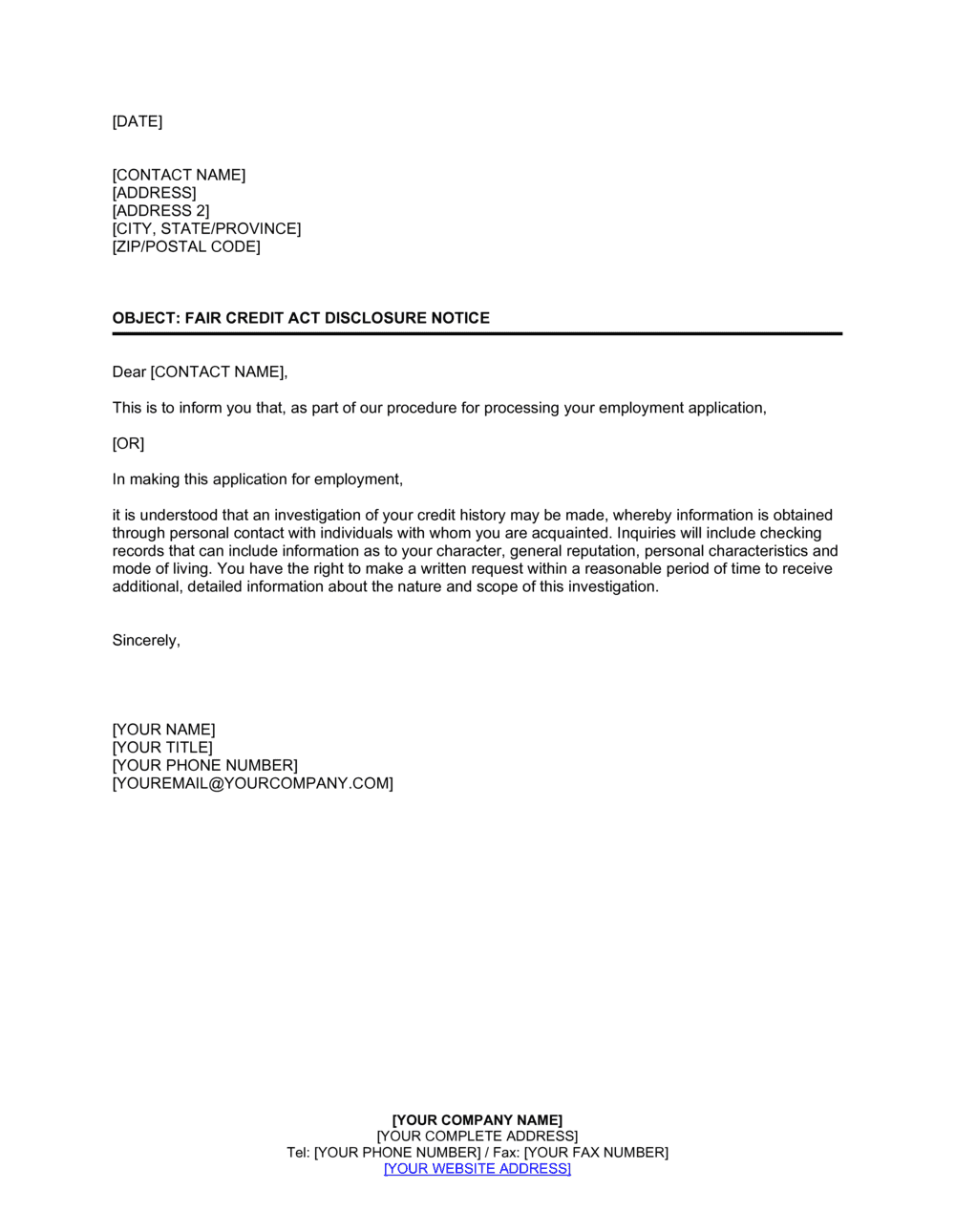
A Disclosure Notice is a formal business letter used to communicate a material fact, conflict of interest, regulatory requirement, or other significant information to a recipient who has a legitimate need to know. This free Word download is fully editable online and can be exported as PDF and sent to clients, partners, employees, or regulators in minutes.
When you need it
Use it whenever a business relationship, transaction, or regulatory obligation requires you to formally notify a party of information that could affect their decisions, rights, or obligations. Common triggers include conflict-of-interest situations, changes to service terms, data incidents, and pre-contractual material fact requirements.
What's inside
Sender and recipient details, a clear subject line identifying the disclosure, the body of the disclosed information with relevant dates and facts, any required action or response instructions, and a formal closing with contact details for follow-up questions.

What is a Disclosure Notice?

A Disclosure Notice is a formal written communication used to inform a named recipient of a material fact, conflict of interest, regulatory obligation, or significant change that affects their rights, decisions, or relationship with the sender. Unlike a general disclaimer or policy document, a disclosure notice is targeted and transaction-specific β€” it creates a dated, documented record that specific information was communicated to a specific party at a specific time. Businesses, professionals, and regulated entities use disclosure notices to fulfill legal, contractual, or ethical obligations to inform before a transaction is completed, a relationship continues, or a change takes effect.

Why You Need This Document

Failing to formally disclose a material fact when you are obligated to do so exposes you to claims of misrepresentation, regulatory sanctions, and potential liability for any loss the recipient suffers as a result of not being informed. In industries like financial services, real estate, and healthcare, disclosure obligations are prescribed by regulation β€” and an undocumented disclosure is treated the same as no disclosure at all. Even outside regulated contexts, a conflict of interest disclosed in an email thread provides far weaker protection than a dated formal notice with a delivery record. This template gives you a professional, structured format that ensures every required element β€” the what, the who, the why, the deadline, and the contact β€” is present and clearly communicated, so your disclosure record holds up whether it is reviewed by a client, a regulator, or a court.

Which variant fits your situation?

If your situation is…Use this template
Disclosing a personal or financial conflict of interest to a client or boardConflict of Interest Disclosure
Notifying customers of a data breach or privacy incidentData Breach Notification Letter
Informing a party of material facts before a real estate transactionProperty Disclosure Statement
Advising employees of a change to company policy or benefitsPolicy Change Notification Letter
Providing pre-contractual risk disclosures to investorsInvestment Risk Disclosure Notice
Notifying a counterparty of a material change in business circumstancesMaterial Change Notice
Disclosing fee structures or compensation arrangements to clientsFee Disclosure Letter

Common mistakes to avoid

❌ Vague or hedged disclosure language

Why it matters: Phrases like 'may represent a potential concern' instead of 'represents a conflict of interest' give recipients insufficient information to make an informed decision, which can void the notice's protective purpose.

Fix: State the disclosed fact directly and specifically. If the fact is a conflict of interest, name it as such β€” plain, unambiguous language is legally more defensible than softened alternatives.

❌ No reference number or transaction identifier

Why it matters: A notice without a reference number cannot be reliably linked to a specific file or transaction, making it nearly useless as evidence in a dispute or regulatory review.

Fix: Assign a reference number before issuing any disclosure notice and record it in the corresponding transaction or client file.

❌ Omitting a response deadline when acknowledgment is required

Why it matters: Without a deadline, recipients can delay acknowledgment indefinitely, stalling transactions, regulatory filings, or other time-sensitive processes that depend on confirmed receipt.

Fix: Set a specific calendar date β€” typically 5–10 business days from the notice date β€” for any required acknowledgment or response.

❌ Sending to a generic contact instead of the decision-maker or legal entity

Why it matters: A disclosure sent to the wrong person may never reach the party with authority to act on it, creating a gap in your documentation and potentially a failure to meet the disclosure obligation.

Fix: Confirm the correct recipient β€” including the legal entity name and the name of the individual responsible for the matter β€” before sending, and keep proof of delivery.

The 9 key clauses, explained

Header and date

In plain language: Identifies the sender, recipient, date of the notice, and a reference number or file identifier for record-keeping purposes.

Sample language
[SENDER NAME / COMPANY] | [ADDRESS] | [DATE] | Re: Disclosure Notice β€” Ref. No. [REFERENCE NUMBER] | To: [RECIPIENT NAME / COMPANY] | [ADDRESS]

Common mistake: Omitting a reference number or file identifier. Without one, the notice is difficult to match to a specific transaction or file during a later dispute or audit.

Subject line

In plain language: A single line clearly identifying the nature and purpose of the disclosure so the recipient immediately understands what is being communicated.

Sample language
Subject: Disclosure Notice β€” [NATURE OF DISCLOSURE] relating to [TRANSACTION / MATTER NAME]

Common mistake: Using a vague subject like 'Important Notice.' Recipients may not treat it with the urgency required, and it provides no useful context in an audit trail.

Opening statement

In plain language: States the sender's reason for writing, the relationship between the parties, and the legal or contractual basis for the disclosure obligation.

Sample language
We are writing to formally disclose [NATURE OF INFORMATION] in connection with [TRANSACTION / RELATIONSHIP] pursuant to [APPLICABLE REGULATION / AGREEMENT CLAUSE / PROFESSIONAL OBLIGATION].

Common mistake: Burying the disclosure behind two paragraphs of background. The opening sentence should state what is being disclosed and why β€” not work up to it gradually.

Disclosure of material information

In plain language: The core of the notice β€” a clear, factual description of the information being disclosed, including relevant dates, parties, amounts, or circumstances.

Sample language
[COMPANY NAME] discloses that [DESCRIPTION OF MATERIAL FACT / CONFLICT / CHANGE], effective [DATE]. The parties involved are [NAME(S)]. The potential impact on [RECIPIENT] is [DESCRIPTION OF IMPACT].

Common mistake: Using ambiguous or hedged language to soften the disclosure. Phrases like 'may potentially represent' instead of 'represents' create interpretive disputes and can undermine the notice's legal effectiveness.

Relevant supporting details

In plain language: Additional context, documentation references, or background facts that help the recipient fully understand the scope and implications of the disclosed information.

Sample language
For reference, the relevant agreement is [AGREEMENT NAME], dated [DATE], at [SECTION / CLAUSE]. Supporting documentation is attached as Exhibit [A / B].

Common mistake: Including far more background detail than the recipient needs. Excessive context dilutes the core disclosure and increases the risk that the key fact is missed.

Required recipient action

In plain language: Specifies whether the recipient must respond, acknowledge, consent, or take any other action, and sets a clear deadline for doing so.

Sample language
Please acknowledge receipt of this notice by signing and returning the attached acknowledgment form no later than [DATE]. If you wish to discuss this disclosure, please contact [NAME] at [CONTACT DETAILS].

Common mistake: Omitting a response deadline when one is required. Without a deadline, recipients may delay indefinitely, which can affect the sender's ability to proceed with a transaction or satisfy a regulatory requirement.

Effect on the existing relationship or agreement

In plain language: Explains whether the disclosure changes, suspends, or otherwise affects the ongoing business relationship, contract, or transaction between the parties.

Sample language
This disclosure does not alter the terms of the [AGREEMENT NAME] dated [DATE] except as expressly stated herein. [Alternatively: As a result of this disclosure, [SPECIFIC CHANGE TO RELATIONSHIP / AGREEMENT].]

Common mistake: Failing to state whether the relationship continues unchanged. Recipients who are not told may assume the relationship is affected and take unnecessary defensive action.

Confidentiality instruction

In plain language: States whether the disclosed information is confidential, who may receive it, and any restrictions on its use or further distribution.

Sample language
The information contained in this notice is confidential and intended solely for [RECIPIENT NAME]. It may not be shared with third parties without the prior written consent of [SENDER NAME], except as required by applicable law.

Common mistake: Omitting a confidentiality instruction entirely when the disclosed information is sensitive. The absence of any restriction can be construed as permission to share.

Closing and contact information

In plain language: A professional closing that restates the sender's availability for questions and provides a named contact with direct communication details.

Sample language
Should you have any questions regarding this disclosure, please do not hesitate to contact [NAME], [TITLE], at [PHONE] or [EMAIL]. We appreciate your attention to this matter. Sincerely, [SENDER NAME / SIGNATURE BLOCK]

Common mistake: Listing a generic inbox (info@company.com) instead of a named contact. Recipients are less likely to follow up, and accountability for the disclosure is harder to establish.

How to fill it out

  1. 1

    Identify the precise information being disclosed

    Before filling in any field, write one clear sentence describing what you are disclosing, to whom, and why it is material. This sentence will anchor your opening statement and subject line.

    πŸ’‘ If you cannot summarize the disclosure in one sentence, the notice will likely be unclear to the recipient β€” simplify before drafting.

  2. 2

    Complete the header with sender and recipient details

    Enter the full legal name and address of both the sender and recipient. Assign a reference number tied to the relevant file, project, or transaction for record-keeping.

    πŸ’‘ Use the recipient's legal entity name, not a contact person's name alone β€” this ensures the notice is legally addressed to the correct party.

  3. 3

    Write a specific subject line

    State the nature of the disclosure (e.g., 'Conflict of Interest Disclosure' or 'Material Change Notice') and the name of the specific transaction or matter it relates to.

    πŸ’‘ Specific subject lines make the notice easier to retrieve during audits and signal to the recipient that this is a formal, not routine, communication.

  4. 4

    Draft the core disclosure paragraph

    Describe the material fact, conflict, change, or obligation factually and specifically. Include names, dates, dollar amounts, or other concrete details as relevant. Avoid hedging language.

    πŸ’‘ Read the disclosure paragraph aloud to a colleague who is unfamiliar with the matter β€” if they cannot explain it back to you accurately, it needs to be clearer.

  5. 5

    Add supporting references or attachments

    Reference any agreements, regulations, or documents that provide context for the disclosure. List attachments as Exhibit A, B, etc., and ensure they are actually included before sending.

    πŸ’‘ Keep the supporting-details paragraph to three sentences or fewer β€” anything longer belongs in an attachment, not the body of the notice.

  6. 6

    Specify the required action and deadline

    State clearly whether the recipient must acknowledge, respond, consent, or do nothing, and set a specific calendar deadline where a response is required.

    πŸ’‘ For disclosures requiring acknowledgment, attach a one-line sign-and-return form β€” it makes compliance easy and gives you a dated record.

  7. 7

    Review and send through a traceable channel

    Proofread for accuracy β€” especially names, dates, and amounts. Send via email with read receipt, certified mail, or another method that creates a delivery record.

    πŸ’‘ Save the sent copy with any delivery confirmation in the same file as the underlying transaction β€” you may need to prove timely disclosure months or years later.

Frequently asked questions

What is a disclosure notice?

A disclosure notice is a formal letter used to communicate material information to a party who has a legal, regulatory, or contractual right to receive it. It documents that the sender has fulfilled an obligation to inform β€” covering situations like conflicts of interest, material changes to a transaction, pre-contractual risk disclosures, and regulatory notifications. The notice creates a dated, written record that the information was shared.

When do I need to send a disclosure notice?

Send a disclosure notice whenever a duty to disclose arises β€” typically triggered by a conflict of interest, a material change in business circumstances, a regulatory requirement, a pre-contractual obligation, or an event that could affect a recipient's rights or decisions. The timing matters: most disclosure obligations require notice before the affected transaction is completed or before the change takes effect.

Is a disclosure notice legally binding?

A disclosure notice is not itself a binding contract β€” it is a communication document. However, it creates a documented record that a party was informed of specific facts at a specific time, which can be legally significant in disputes, regulatory investigations, or litigation. In many professional and regulated industries, failure to issue a required disclosure can result in regulatory sanctions or civil liability.

Does a disclosure notice need to be signed?

The sender's signature block is standard professional practice and establishes accountability, but a signature is not generally required for the notice itself to be effective. However, many disclosure notices include a separate acknowledgment form that the recipient is asked to sign and return β€” this provides the sender with dated proof of receipt and is worth including whenever the disclosure is material.

What is the difference between a disclosure notice and a disclaimer?

A disclosure notice proactively communicates specific material information to a named recipient who has a right to know it β€” it is directed, specific, and creates a documented record. A disclaimer is a general statement limiting liability or excluding warranties, typically printed on contracts, websites, or marketing materials and addressed to no specific party. Disclosures inform; disclaimers limit exposure.

How specific does the disclosed information need to be?

Specific enough that a reasonable person in the recipient's position would understand the nature, scope, and potential impact of what is being disclosed. Vague or heavily hedged disclosures are often found insufficient β€” courts and regulators typically apply a standard of whether the recipient had the information they needed to make an informed decision. Names, dates, amounts, and relationships should be stated explicitly where relevant.

Can I use one disclosure notice template for all types of disclosures?

A single template covers the structural format β€” header, subject, opening, core disclosure, action required, and closing β€” for most standard business disclosure situations. The core disclosure paragraph must be tailored to the specific facts of each situation. For industry-specific disclosures governed by detailed regulatory requirements (such as financial services, healthcare, or real estate), verify that the content meets the specific prescribed language or elements required by the applicable regulator.

How should I deliver a disclosure notice?

Use a delivery method that creates a verifiable record β€” email with read receipt, certified mail, or a document management platform with delivery tracking. The goal is to be able to prove not just that you sent the notice, but that the recipient received it and when. For high-stakes or regulated disclosures, certified mail or a countersigned acknowledgment provides the strongest evidence.

How this compares to alternatives

vs Non-Disclosure Agreement

A non-disclosure agreement (NDA) is a binding contract that obligates a recipient to keep shared information confidential. A disclosure notice does the opposite β€” it formally communicates information the sender is obligated to share. An NDA restricts information flow; a disclosure notice fulfills an obligation to enable it.

vs Cease and Desist Letter

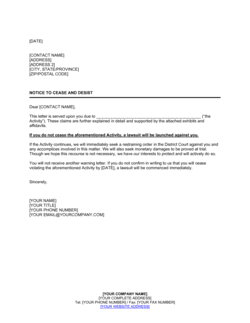
A cease and desist letter demands that a party stop a specific action, often under threat of legal proceedings. A disclosure notice communicates information without demanding a change in behavior. Both are formal written communications, but a cease and desist is adversarial while a disclosure notice is informational and typically collaborative.

vs Privacy Policy

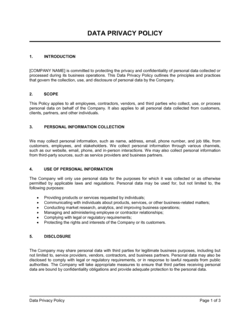
A privacy policy is a standing document that describes how an organization collects and uses personal data, typically published on a website and addressed to all users. A disclosure notice is a targeted, transaction-specific communication sent to a named recipient about a particular fact or event. One is a general policy document; the other is a specific, dated formal notice.

vs Letter of Intent

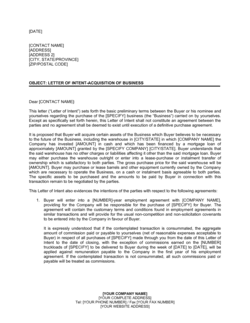
A letter of intent expresses a party's intention to enter into a transaction and outlines the proposed terms. A disclosure notice communicates specific facts the receiving party needs to know β€” often as part of the pre-contractual process that precedes a letter of intent or final agreement. They frequently accompany each other but serve entirely different purposes.

Industry-specific considerations

Financial Services

Advisors and brokers use disclosure notices to meet regulatory obligations on fee arrangements, conflicts of interest, and material investment risks under securities law requirements.

Real Estate

Agents and sellers use disclosure notices to communicate property conditions, dual-agency relationships, and material facts that buyers are entitled to know before completing a purchase.

Professional Services

Lawyers, accountants, and consultants issue disclosure notices when a conflict of interest arises mid-engagement, documenting informed consent before continuing to act for a client.

Healthcare

Healthcare organizations use disclosure notices to inform patients of privacy practices, data-sharing arrangements, and any financial relationships that could influence treatment recommendations.

Template vs pro β€” what fits your needs?

PathBest forCostTime
Use the templateStandard business disclosures β€” conflicts of interest, policy changes, pre-contractual notices β€” in non-regulated contextsFree15–30 minutes
Template + professional reviewDisclosures in regulated industries or situations where the adequacy of disclosure language could be challenged$100–$300 for a brief legal or compliance review1–2 days
Custom draftedComplex regulatory disclosures with prescribed statutory language, multi-party transactions, or disclosures that accompany high-value agreements$300–$1,000+2–5 days

Glossary

Material Fact
Any piece of information that would reasonably influence a party's decision to enter into, continue, or terminate a transaction or relationship.
Conflict of Interest
A situation in which a person's personal, financial, or professional interests could impair their ability to act impartially on behalf of another party.
Duty to Disclose
A legal or ethical obligation to proactively share information with another party, even if they have not specifically asked for it.
Informed Consent
A recipient's agreement to proceed with a transaction or relationship after being provided with all material information relevant to their decision.
Notice Period
The minimum amount of time that must pass between delivering a formal notice and the date on which the disclosed change or obligation takes effect.
Acknowledgment Receipt
A written confirmation from the recipient that they have received and reviewed the disclosure notice.
Fiduciary Duty
An obligation to act in the best interests of another party, which typically carries a heightened duty to disclose all relevant material information.
Safe Harbor
A regulatory provision that protects a disclosing party from liability if they have made timely and accurate disclosures in a prescribed format.
Waiver
A voluntary relinquishment of a known right β€” in the context of disclosure, a recipient may waive a conflict of interest after receiving a formal notice.
Related Party
An individual or entity with a personal, financial, or organizational relationship to one of the parties in a transaction, creating a potential disclosure obligation.

Part of your Business Operating System

This document is one of 3,000+ business & legal templates included in Business in a Box.

  • Fill-in-the-blanks β€” ready in minutes
  • 100% customizable Word document
  • Compatible with all office suites
  • Export to PDF and share electronically

Create your document in 3 simple steps.

From template to signed document β€” all inside one Business Operating System.
1
Download or open template

Access over 3,000+ business and legal templates for any business task, project or initiative.

2
Edit and fill in the blanks with AI

Customize your ready-made business document template and save it in the cloud.

3
Save, Share, Send, Sign

Share your files and folders with your team. Create a space of seamless collaboration.

Save time, save money, and create top-quality documents.

β˜…β˜…β˜…β˜…β˜…

"Fantastic value! I'm not sure how I'd do without it. It's worth its weight in gold and paid back for itself many times."

Managing Director Β· Mall Farm
Robert Whalley
Managing Director, Mall Farm Proprietary Limited
β˜…β˜…β˜…β˜…β˜…

"I have been using Business in a Box for years. It has been the most useful source of templates I have encountered. I recommend it to anyone."

Business Owner Β· 4+ years
Dr Michael John Freestone
Business Owner
β˜…β˜…β˜…β˜…β˜…

"It has been a life saver so many times I have lost count. Business in a Box has saved me so much time and as you know, time is money."

Owner Β· Upstate Web
David G. Moore Jr.
Owner, Upstate Web

Run your business with a system β€” not scattered tools

Stop downloading documents. Start operating with clarity. Business in a Box gives you the Business Operating System used by over 250,000 companies worldwide to structure, run, and grow their business.

Start freeΒ Β·Β No credit card required