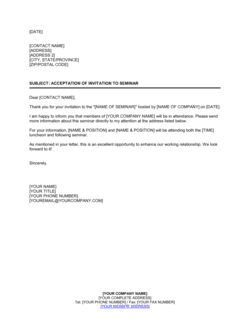
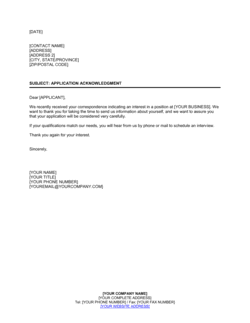
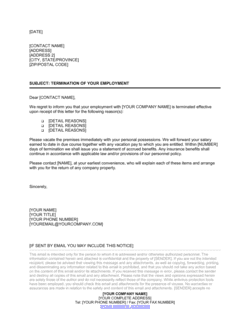
Notice of Job Opening_Letter Template

Free Word download β€’ Edit online β€’ Save & share with Drive β€’ Export to PDF

2 pagesβ€’20–25 min to fillβ€’Difficulty: Standard
Learn more ↓
FreeNotice of Job Opening_Letter Template

At a glance

What it is
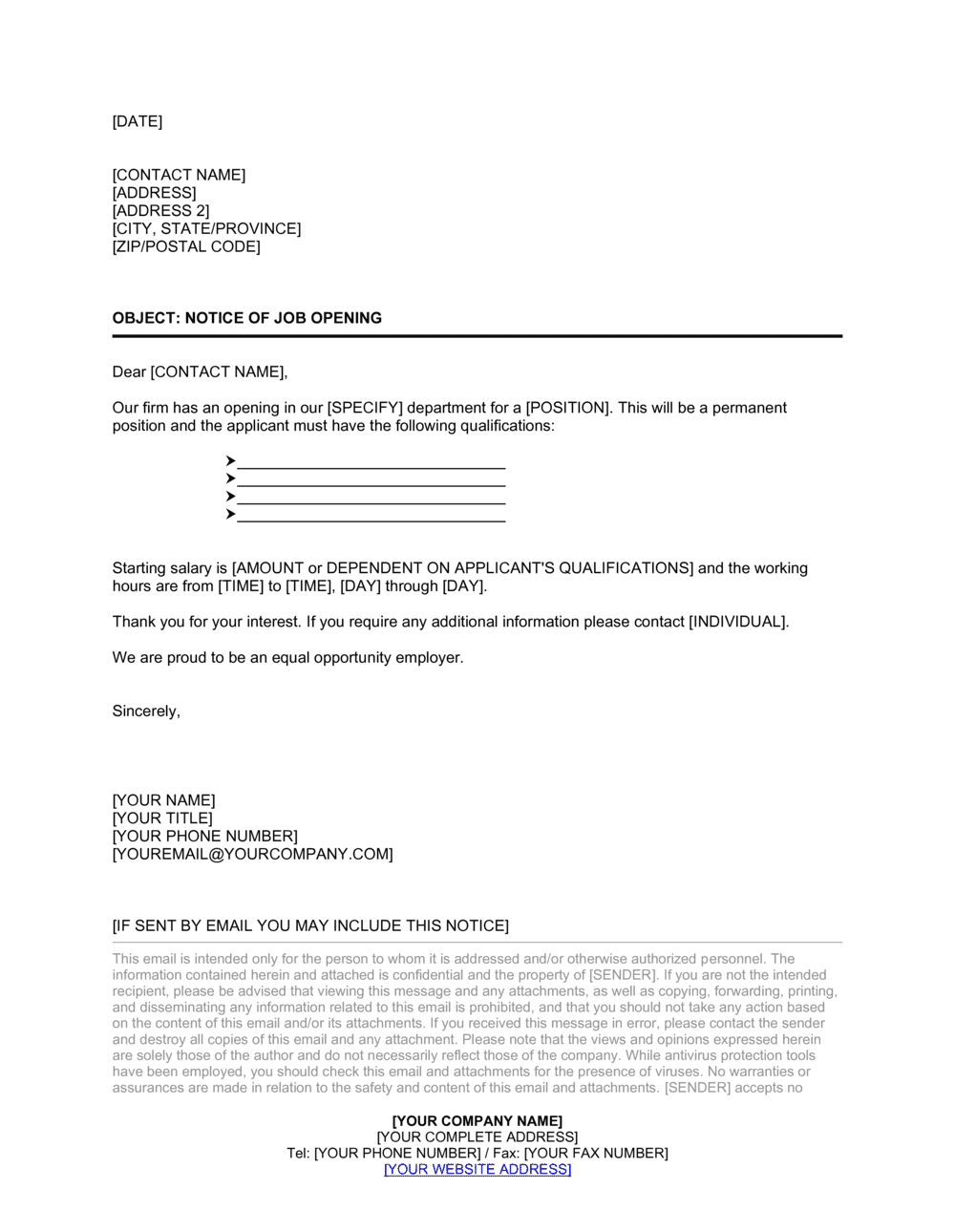
A Notice of Job Opening Letter is a formal written announcement that informs employees, applicants, or external audiences about a vacant or newly created position within an organization. This free Word download gives you a ready-to-edit template you can customize with the role details, qualifications, and application instructions, then distribute by email, bulletin board, or company intranet in minutes.
When you need it
Use it whenever a position opens up β€” whether through employee departure, promotion, business growth, or a newly created role β€” and you need to notify staff or the public in a consistent, professional format. It is equally useful for internal promotion opportunities and external hiring campaigns.
What's inside
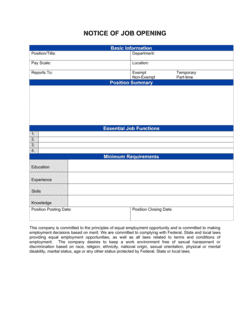
The letter covers the position title, department, reporting structure, key responsibilities, required and preferred qualifications, compensation range (if disclosed), and clear application instructions with a deadline. A brief organizational context statement and a contact person for questions round out the standard structure.

What is a Notice of Job Opening Letter?

A Notice of Job Opening Letter is a formal written announcement that an organization distributes β€” internally to staff, externally to the public, or both β€” to communicate that a position is available and to invite qualified candidates to apply. It summarizes the role title, department, key responsibilities, required qualifications, compensation terms, and application instructions in a single concise document. Unlike a full job description, which is an internal reference document cataloguing every duty and competency, a job opening notice is purpose-built for distribution: it gives readers exactly enough information to determine whether to apply and tells them precisely how to do so.

Why You Need This Document

Posting a job opening without a formal written notice creates several avoidable problems. Informal announcements β€” a verbal mention in a team meeting or a quick email with no structure β€” produce inconsistent applications, trigger questions about fairness, and leave the organization without a documented record that the vacancy was advertised before a hire was made. A structured notice ensures that every opening is communicated with the same level of detail, signals a professional hiring process to prospective candidates, and creates an audit trail that protects the organization against claims of discriminatory or arbitrary selection. For federal contractors and unionized employers, a written notice is not optional β€” it is a compliance requirement. This template gives you a clean, complete starting point that covers every component of an effective job opening notice, so you spend 15 minutes filling in role-specific details rather than rebuilding the structure from scratch each time a position opens.

Which variant fits your situation?

If your situation is…Use this template
Announcing an opening to current employees onlyInternal Job Posting Notice
Advertising a role to the general public or job boardsExternal Job Posting Letter
Notifying staff that a position has been filledJob Offer Acceptance Announcement Letter
Recruiting for a short-term or contract roleFreelance / Contract Position Notice
Announcing a promotion-based opening for internal candidates onlyInternal Promotion Job Posting
Notifying a candidate that their application was receivedApplication Acknowledgement Letter
Formally inviting a shortlisted candidate to interviewInterview Invitation Letter

Common mistakes to avoid

❌ Omitting a specific application deadline

Why it matters: Without a deadline, candidates defer applying and the hiring team cannot set a review schedule, stretching time-to-fill significantly.

Fix: Always include a specific calendar date for application submission β€” 10 to 15 business days from distribution is a practical default.

❌ Conflating minimum and preferred qualifications

Why it matters: Candidates cannot tell what is required versus optional, leading to both over-qualified and under-qualified applicants clogging the review queue.

Fix: Use two clearly labeled sections β€” 'Minimum Qualifications' and 'Preferred Qualifications' β€” and apply a strict test: would you reject an otherwise strong candidate who lacks this?

❌ Skipping the EEO statement

Why it matters: Omitting the equal opportunity statement on a formal job notice can draw regulatory scrutiny and undermines the organization's compliance posture.

Fix: Append your standard EEO statement as the final paragraph of every job opening notice, internal and external alike.

❌ No named contact person for questions

Why it matters: Directing candidates to a generic inbox discourages qualified applicants from asking clarifying questions and signals a disorganized hiring process.

Fix: Name a specific person β€” typically the hiring manager or HR coordinator β€” with a direct email address or phone number in the closing paragraph.

❌ Using an undated notice

Why it matters: An undated letter makes the application deadline ambiguous and creates a gap in compliance documentation if the hiring decision is ever challenged.

Fix: Add the issue date to the header at the time the letter is distributed; this anchors the deadline calculation and creates a clean audit trail.

❌ Distributing an internal posting externally before the internal window closes

Why it matters: Current employees who learn about a vacancy from a public job board before receiving an internal notice feel disrespected and are less likely to apply or refer candidates.

Fix: Set a clear internal-only distribution window β€” typically 5 to 7 business days β€” before publishing the notice externally.

The 10 key clauses, explained

Header and date

In plain language: Identifies the issuing organization, the date of the notice, and β€” for internal letters β€” the intended audience (e.g., All Staff, Department Heads).

Sample language
[COMPANY NAME] | Date: [DATE] | To: All Employees / Department Managers

Common mistake: Omitting the date. Undated notices make it impossible to calculate the application deadline and create compliance ambiguity for record-keeping.

Subject line

In plain language: A one-line label naming the open position and location so recipients immediately understand what the notice is about.

Sample language
Subject: Notice of Job Opening β€” [JOB TITLE], [DEPARTMENT / LOCATION]

Common mistake: Using a generic subject like 'Job Opportunity' without naming the role. Recipients cannot determine relevance without a specific title.

Opening statement

In plain language: Announces that a position is available, states whether it is a backfill or new role, and identifies the department and reporting relationship.

Sample language
[COMPANY NAME] announces an opening for a [JOB TITLE] within the [DEPARTMENT] department, reporting to the [SUPERVISOR TITLE]. This is a [full-time / part-time / contract] position [based in / remote].

Common mistake: Failing to state whether the role is new or a replacement. Employees notice when this is ambiguous and will speculate about layoffs or restructuring.

Role summary and key responsibilities

In plain language: A brief description of the role's purpose followed by four to six specific duties the new hire will perform.

Sample language
The [JOB TITLE] will be responsible for: (1) [RESPONSIBILITY]; (2) [RESPONSIBILITY]; (3) [RESPONSIBILITY]; (4) [RESPONSIBILITY].

Common mistake: Listing more than eight responsibilities. Notices are not full job descriptions β€” too many bullet points dilute the key duties and deter qualified applicants.

Minimum qualifications

In plain language: States the required education, years of experience, certifications, or technical skills an applicant must have to be considered.

Sample language
Minimum qualifications: [DEGREE OR EQUIVALENT], [X] years of experience in [FIELD], proficiency in [TOOL / SYSTEM], and [CERTIFICATION] (if applicable).

Common mistake: Setting a degree requirement that is not actually necessary for the role. Overly restrictive minimums narrow the applicant pool without improving quality and may raise disparate-impact concerns.

Preferred qualifications

In plain language: Lists additional skills or experience that are advantageous but not required, used to rank candidates who clear the minimum bar.

Sample language
Preferred: experience with [TOOL / METHODOLOGY], familiarity with [INDUSTRY / SECTOR], and [LANGUAGE / CERTIFICATION].

Common mistake: Combining minimum and preferred qualifications into a single list. Candidates cannot tell what is required, which leads to under-qualified applications and wasted screening time.

Compensation and employment terms

In plain language: States the salary range, employment type (full-time, part-time, contract), benefits summary, and start date if known.

Sample language
Compensation: $[MIN]–$[MAX] annually / hourly, commensurate with experience. Benefits include [BENEFIT LIST]. Anticipated start date: [DATE OR 'as soon as possible'].

Common mistake: Omitting the compensation range where pay-transparency laws require disclosure. Several US states β€” including California, Colorado, New York, and Washington β€” mandate salary ranges on job postings.

Application instructions and deadline

In plain language: Tells applicants exactly what to submit (resume, cover letter, portfolio, references), how to submit it, and by what date.

Sample language
To apply, submit a resume and cover letter to [EMAIL / PORTAL URL] by [DEADLINE DATE]. Please reference '[JOB TITLE] β€” [REFERENCE CODE]' in the subject line.

Common mistake: Leaving out a submission deadline. Without one, candidates delay applying and the hiring manager cannot coordinate a structured review.

Contact information for questions

In plain language: Provides the name, title, and contact details of the person who can answer questions about the role before application.

Sample language
For questions about this position, please contact [NAME], [TITLE], at [EMAIL] or [PHONE NUMBER].

Common mistake: Listing a generic HR inbox with no named contact. Serious candidates who have specific questions give up when there is no identifiable person to reach.

Equal opportunity statement

In plain language: A standard closing affirmation that the employer does not discriminate on the basis of any protected characteristic.

Sample language
[COMPANY NAME] is an equal opportunity employer and does not discriminate on the basis of race, color, religion, sex, national origin, age, disability, or any other protected status.

Common mistake: Omitting the EEO statement entirely. Its absence on a formal job notice can attract regulatory attention and signals a lack of HR compliance awareness.

How to fill it out

  1. 1

    Fill in the header with company name, date, and audience

    Enter your organization's full name, today's date, and specify whether the notice is for all employees, a specific department, or the general public.

    πŸ’‘ For internal postings, adding 'Confidential β€” Internal Distribution Only' to the header prevents the notice from being forwarded externally before you are ready.

  2. 2

    Write a specific subject line naming the role and location

    State the exact job title and the department or work location in the subject line so recipients immediately understand what is being announced.

    πŸ’‘ If you use an applicant tracking system, include the requisition or reference code in the subject line β€” it ties the letter to the ATS record.

  3. 3

    Draft the opening statement with role context

    State whether the opening is a new position or a backfill, identify the department, and name the supervisor title the role reports to.

    πŸ’‘ One sentence on why the role exists β€” growth, departure, reorganization β€” removes speculation and builds trust with existing staff.

  4. 4

    List four to six key responsibilities

    Select the duties that take up the majority of the role's time and that differentiate it from adjacent positions. Phrase each as an active verb followed by the object and context.

    πŸ’‘ Start each responsibility with a present-tense action verb β€” 'Manages', 'Analyzes', 'Coordinates' β€” not a noun phrase like 'Responsible for management of'.

  5. 5

    Separate minimum from preferred qualifications clearly

    List only the non-negotiable requirements under 'Minimum Qualifications' and move all nice-to-haves to a separate 'Preferred Qualifications' block.

    πŸ’‘ Review each minimum qualification and ask: would you reject an otherwise outstanding candidate who lacked this? If not, move it to preferred.

  6. 6

    State the compensation range and employment terms

    Enter the salary or hourly range, employment type, key benefits, and anticipated start date. Check whether your jurisdiction requires pay-range disclosure before deciding to omit it.

    πŸ’‘ Including the range β€” even a broad one β€” typically increases the volume and quality of applicants by filtering out mismatched expectations before the interview stage.

  7. 7

    Add application instructions with a firm deadline

    Specify the documents required, the submission method (email or portal), and a specific calendar deadline. Include any reference code or subject-line format you need for routing.

    πŸ’‘ Set the deadline at least 10 business days from the distribution date to give internal candidates time to prepare without missing their notice period.

  8. 8

    Close with a contact name and the EEO statement

    Name a specific person for pre-application questions and append your standard equal opportunity employer statement as the final paragraph.

    πŸ’‘ Use the hiring manager as the named contact rather than a generic HR mailbox β€” direct access increases candidate confidence and improves application quality.

Frequently asked questions

What is a notice of job opening letter?

A notice of job opening letter is a formal written announcement that an organization issues to inform employees, external candidates, or both that a position is available. It covers the role title, key responsibilities, required qualifications, compensation, and application instructions. It differs from a full job description in that it is shorter, distribution-focused, and designed to prompt applications rather than document every duty in exhaustive detail.

When should a notice of job opening be sent internally versus externally?

Internal notices are distributed first β€” typically giving current employees a 5 to 10 business day window to apply before the role is advertised publicly. This practice supports internal mobility, rewards loyalty, and is required by collective bargaining agreements in some unionized environments. External posting follows once the internal window closes, unless the role requires skills not available in the current workforce.

Is a notice of job opening legally required?

In most private-sector situations, no law requires a formal notice of job opening. However, federal contractors in the United States are required under VEVRAA and Section 503 to list most positions with state employment services. Government agencies often have civil service posting requirements. Union contracts may also mandate internal posting periods. Even where not required, a written notice creates a documented, consistent process that reduces claims of favoritism or discriminatory hiring.

Should a job opening notice include the salary range?

It depends on where the position is located. California, Colorado, New York, Washington, and several other US states require employers to include a compensation range on job postings. Even where not legally required, including a range typically increases application volume, improves candidate quality, and reduces time spent screening candidates with mismatched salary expectations.

What is the difference between a notice of job opening and a job description?

A notice of job opening is a brief announcement designed to attract applicants β€” typically one page covering highlights, qualifications, and application instructions. A job description is a comprehensive internal document that details every duty, competency, performance standard, and reporting relationship for a role. The notice is drawn from the job description but is edited for audience and brevity.

How long should a notice of job opening letter be?

One page is the standard length. Notices longer than a page see lower read-through rates, particularly in internal email distribution. Focus on four to six key responsibilities, two blocks of qualifications (minimum and preferred), compensation, and clear application instructions. Detailed duty lists belong in the attached or linked full job description.

Can the same template be used for internal and external postings?

Yes, with minor adjustments. Internal notices can include organizational context β€” such as the reason the role is open β€” that external audiences do not need. External postings typically require a brief company description and may need to meet job-board formatting standards. A single base template with two short variant sections covers both use cases.

What should the application instructions include?

At minimum: the documents required (resume, cover letter, portfolio, or references), the submission method (email address or portal URL), a subject-line or reference code for routing, and a firm deadline date. Adding a note on the expected hiring timeline β€” 'We anticipate conducting interviews the week of [DATE]' β€” further reduces candidate anxiety and improves the response rate.

How this compares to alternatives

vs Job Offer Letter

A notice of job opening announces a vacancy and solicits applications from candidates. A job offer letter is sent after the hiring decision to a specific individual, confirming the role, salary, and start date. The notice opens the process; the offer letter closes it. They serve opposite ends of the recruitment funnel.

vs Interview Invitation Letter

A notice of job opening is broadcast to a wide audience to generate a candidate pool. An interview invitation letter is sent to a specific shortlisted candidate to schedule a conversation. The notice triggers inbound interest; the invitation letter advances a candidate already under active consideration.

vs Employment Contract

A job opening notice is an informal announcement document with no binding obligations. An employment contract is a legally binding agreement signed by both parties that governs compensation, duties, IP, and termination. The notice is the first step in finding a hire; the contract formalizes the employment relationship once a candidate is selected.

vs Application Acknowledgement Letter

A notice of job opening is sent by the employer to attract candidates. An application acknowledgement letter is sent back to candidates confirming their application was received and is under review. Together they form the bookends of the applicant's first touchpoint with the organization.

Industry-specific considerations

Healthcare

Licensing and certification requirements (RN, LPN, CPA) must be listed as minimum qualifications, and internal posting windows are often mandated by facility policy or union contract.

Education

Public school districts are frequently required to post openings for a minimum number of days and to document that the position was advertised before a hire was made.

Manufacturing

Shift requirements, physical demands, and safety certifications are standard additions to the qualifications section; union shops must follow contractual internal-posting procedures.

Professional Services

Notices for client-facing roles often reference billable-hour expectations and the specific software or methodology proficiencies required, such as CPA licensure or project management certification.

Template vs pro β€” what fits your needs?

PathBest forCostTime
Use the templateHR managers, small business owners, and office managers posting standard roles without a dedicated recruitment teamFree15–20 minutes per notice
Template + professional reviewOrganizations adding pay-transparency disclosures, union-required language, or federal contractor compliance statements$0–$200 (HR consultant or employment counsel review)1–2 hours
Custom draftedGovernment agencies, federal contractors, or heavily unionized environments with mandatory posting and documentation requirements$200–$800 (employment attorney or specialized HR consultant)1–3 days

Glossary

Job Opening Notice
A formal written announcement communicating that a position is available and inviting qualified candidates to apply.
Internal Posting
A job notice distributed only to current employees, giving them the first opportunity to apply before the role is advertised externally.
External Posting
A job notice shared publicly β€” via job boards, company website, or social media β€” to attract candidates from outside the organization.
Reporting Structure
The line of authority the new hire will operate within, identifying the direct supervisor or manager title.
Minimum Qualifications
The non-negotiable education, experience, or certification requirements an applicant must meet to be considered.
Preferred Qualifications
Skills or experience that are desirable but not required, used to differentiate candidates who meet the minimum threshold.
Application Deadline
The specific date by which all applications must be submitted, used to coordinate the review and interview schedule.
Equal Employment Opportunity (EEO) Statement
A standard closing statement confirming the employer does not discriminate on the basis of race, gender, age, disability, or other protected characteristics.
Compensation Range
The minimum and maximum salary or hourly rate the employer is prepared to pay, increasingly required by pay-transparency laws in several US states.
Backfill
The process of hiring a replacement for a role vacated by an employee who resigned, retired, or was promoted.

Part of your Business Operating System

This document is one of 3,000+ business & legal templates included in Business in a Box.

  • Fill-in-the-blanks β€” ready in minutes
  • 100% customizable Word document
  • Compatible with all office suites
  • Export to PDF and share electronically

Create your document in 3 simple steps.

From template to signed document β€” all inside one Business Operating System.
1
Download or open template

Access over 3,000+ business and legal templates for any business task, project or initiative.

2
Edit and fill in the blanks with AI

Customize your ready-made business document template and save it in the cloud.

3
Save, Share, Send, Sign

Share your files and folders with your team. Create a space of seamless collaboration.

Save time, save money, and create top-quality documents.

β˜…β˜…β˜…β˜…β˜…

"Fantastic value! I'm not sure how I'd do without it. It's worth its weight in gold and paid back for itself many times."

Managing Director Β· Mall Farm
Robert Whalley
Managing Director, Mall Farm Proprietary Limited
β˜…β˜…β˜…β˜…β˜…

"I have been using Business in a Box for years. It has been the most useful source of templates I have encountered. I recommend it to anyone."

Business Owner Β· 4+ years
Dr Michael John Freestone
Business Owner
β˜…β˜…β˜…β˜…β˜…

"It has been a life saver so many times I have lost count. Business in a Box has saved me so much time and as you know, time is money."

Owner Β· Upstate Web
David G. Moore Jr.
Owner, Upstate Web

Run your business with a system β€” not scattered tools

Stop downloading documents. Start operating with clarity. Business in a Box gives you the Business Operating System used by over 250,000 companies worldwide to structure, run, and grow their business.

Free Forever PlanΒ Β·Β No credit card required