Notice of Dispatch Template

Free Word download β€’ Edit online β€’ Save & share with Drive β€’ Export to PDF

1 pageβ€’15–25 min to fillβ€’Difficulty: Standard
Learn more ↓
FreeNotice of Dispatch Template

At a glance

What it is
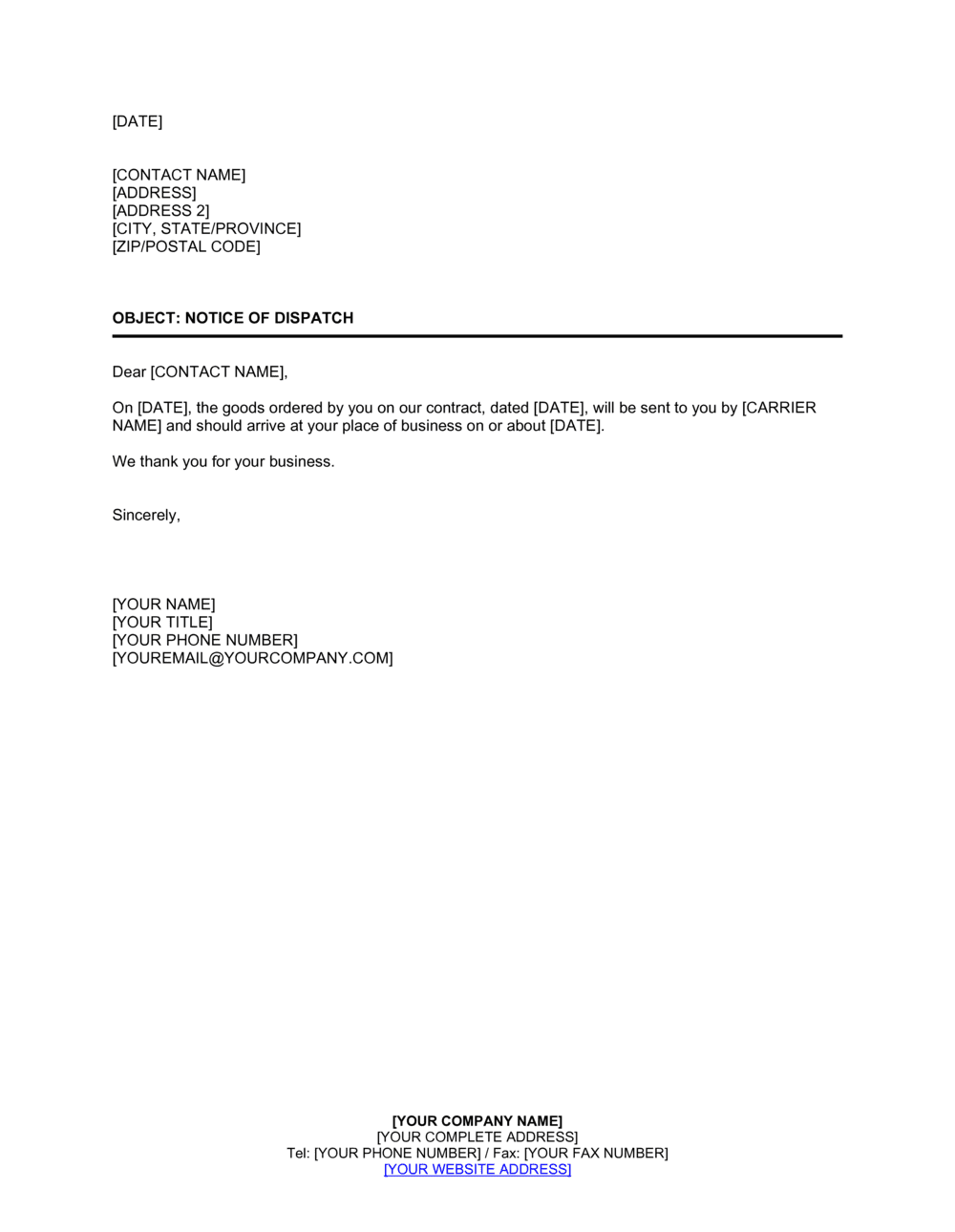
A Notice of Dispatch is a formal business letter a seller or supplier sends to a buyer to confirm that ordered goods have been shipped and are on their way. This free Word download gives you a ready-to-edit template covering shipment reference, carrier details, tracking information, and expected delivery date β€” exportable as PDF and sendable within minutes.
When you need it
Send it on the same day goods leave your warehouse or fulfillment center, or as soon as a carrier accepts the consignment. It is especially important when the buyer has payment or acceptance obligations tied to the dispatch date.
What's inside
Sender and recipient details, order and invoice reference numbers, dispatch date, itemized description of goods shipped, carrier name and tracking number, estimated delivery date, and any special handling or delivery instructions.

What is a Notice of Dispatch?

A Notice of Dispatch is a formal business letter sent by a seller or supplier to a buyer to confirm that ordered goods have been shipped and are in transit. It records the dispatch date, identifies the goods by description and quantity, names the carrier, provides the tracking number, and states the estimated delivery date. By creating a timestamped written record of when the seller fulfilled the shipment obligation, the notice protects both parties: the seller can demonstrate on-time dispatch, and the buyer has the information needed to arrange receipt, update inventory, and process payment.

Why You Need This Document

Without a formal notice of dispatch, buyers are left tracking down shipment information through informal emails or carrier portals, and sellers have no documented proof of when goods were sent. In contracts where payment terms run from the dispatch date β€” or where late delivery triggers penalties β€” the absence of a clear, dated notice creates disputes that are difficult to resolve. For international shipments, buyers need the notice's carrier and reference details to initiate customs clearance before the goods arrive. A consistent dispatch notice template also reduces errors: wrong tracking numbers, missing PO references, and undocumented partial shipments are the most common causes of delayed payments and strained supplier relationships. This template gives you a professional, complete format that takes five minutes to fill in and sends the right information to the right person every time.

Which variant fits your situation?

If your situation is…Use this template
Shipping a standard domestic order to a business buyerNotice of Dispatch
Shipping goods internationally with customs documentationCommercial Invoice (International)
Confirming partial shipment against a larger purchase orderPartial Shipment Dispatch Notice
Notifying a buyer that goods are ready for collection, not deliveryGoods Ready for Collection Notice
Confirming delivery after goods have been received by the buyerDelivery Confirmation Letter
Alerting a buyer to a delay before goods are dispatchedShipment Delay Notice

Common mistakes to avoid

❌ Sending the notice before goods are actually dispatched

Why it matters: If the dispatch is subsequently delayed, the buyer relies on the original date for planning, receiving, and triggering payments β€” creating a contractual and logistical conflict.

Fix: Send the notice only after the carrier has collected or the goods have left your premises. Set up an internal trigger tied to the carrier's collection confirmation.

❌ Omitting reference numbers from the subject line

Why it matters: Buyers with high-volume purchasing cannot match the notice to an open order, which delays goods acceptance, payment processing, and inventory updates.

Fix: Always include both the buyer's PO number and your invoice number in the subject line and opening paragraph of every dispatch notice.

❌ Presenting estimated delivery dates as guaranteed

Why it matters: Carrier transit times are estimates, not commitments. Framing them as guaranteed creates a breach-of-contract argument if the shipment arrives late.

Fix: Use 'estimated delivery' language throughout and include the carrier's service terms or a note that transit times are subject to carrier conditions.

❌ Listing documents in the notice that are not enclosed

Why it matters: A buyer who cannot find a referenced packing list or certificate of origin will hold the shipment for verification, delaying receipt and payment β€” and creating a customs risk for international orders.

Fix: Cross-check the notice against the physical shipment and the email attachments immediately before sending. Remove any document reference that is not confirmed as included.

The 9 key clauses, explained

Header: sender and recipient details

In plain language: Identifies the sending company, its address and contact details, the recipient's name and address, and the date the notice was issued.

Sample language
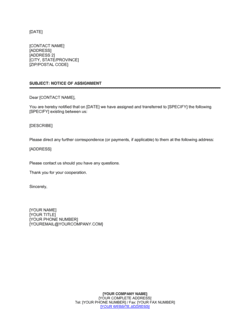
[SENDER COMPANY NAME] | [ADDRESS] | [CITY, STATE, ZIP] | [EMAIL] | [PHONE] | Date: [DATE] | To: [BUYER NAME], [BUYER ADDRESS]

Common mistake: Using a personal email address instead of a business address. This makes the notice harder to route through the buyer's AP or receiving team.

Subject line

In plain language: A one-line reference summarising the notice content, including the order or invoice number, so the buyer can file and retrieve it instantly.

Sample language
Re: Notice of Dispatch β€” Order No. [PO NUMBER] / Invoice No. [INVOICE NUMBER]

Common mistake: Omitting reference numbers from the subject line. Without them, the buyer cannot match the notice to an open order and may delay acceptance or payment.

Opening statement

In plain language: Confirms that the goods have been dispatched and states the dispatch date clearly.

Sample language
We are pleased to confirm that the goods ordered under Purchase Order No. [PO NUMBER] were dispatched on [DISPATCH DATE] and are now in transit to your premises.

Common mistake: Writing 'goods will be dispatched shortly' instead of confirming an actual dispatch. A notice of dispatch should be sent after dispatch β€” not as an advance notification.

Goods description and quantity

In plain language: Itemizes what was shipped β€” product names, SKUs, quantities, and units of measure β€” so the buyer can verify receipt against the order.

Sample language
The shipment comprises: [PRODUCT NAME / SKU], Qty: [X] units; [PRODUCT NAME / SKU], Qty: [X] units. Total: [X] units as per attached packing list.

Common mistake: Referencing only the PO number without listing the goods. If the packing list goes missing in transit, the buyer has no independent record of what to expect.

Carrier and tracking details

In plain language: Names the carrier, states the service level, and provides the tracking or consignment number the buyer can use to monitor progress.

Sample language
Shipment carrier: [CARRIER NAME]. Service: [SERVICE LEVEL, e.g., Express / Standard Freight]. Tracking / Consignment No.: [TRACKING NUMBER]. Track online at: [CARRIER URL].

Common mistake: Providing a tracking number without the carrier URL or instructions. Buyers unfamiliar with a carrier's portal waste time locating the tracking link.

Estimated delivery date

In plain language: States the date the carrier expects the goods to arrive, based on the service level selected.

Sample language
Based on the carrier's estimated transit time, delivery is expected by [ESTIMATED DELIVERY DATE]. Delivery will occur between [TIME WINDOW] on business days.

Common mistake: Presenting the estimated delivery date as a guaranteed date. Carrier estimates are not guarantees β€” framing them as such creates dispute risk if transit is delayed.

Delivery and receipt instructions

In plain language: Provides any instructions the buyer needs to accept the shipment β€” contact person, access requirements, inspection obligations, or what to do if delivery fails.

Sample language
Please ensure a responsible person is available to sign for the consignment. If delivery cannot be completed, the carrier will leave a collection card and hold the shipment for [X] business days. Please inspect goods on arrival and note any damage on the carrier's delivery receipt.

Common mistake: Skipping inspection instructions entirely. Without them, buyers may not note visible damage on the carrier receipt, weakening any subsequent claim.

Reference to accompanying documents

In plain language: Lists any documents included with or attached to the notice β€” invoice, packing list, certificate of origin, or bill of lading.

Sample language
The following documents are enclosed with this shipment / attached to this notice: [X] Commercial Invoice No. [INVOICE NUMBER]; [X] Packing List; [X] Certificate of Origin (if applicable).

Common mistake: Listing documents that are not actually enclosed. Discrepancies between the notice and the shipment package create confusion and delay customs clearance for international orders.

Closing and contact details

In plain language: Invites the buyer to contact the sender with questions, provides the relevant contact name and details, and closes the letter professionally.

Sample language
Should you have any questions regarding this shipment, please contact [NAME] at [EMAIL] or [PHONE NUMBER]. We look forward to confirming receipt with you.

Common mistake: Closing without a named contact. Directing queries to a generic 'customer service' address slows resolution when the buyer has an urgent delivery issue.

How to fill it out

  1. 1

    Enter sender and recipient details

    Fill in your company's full name, mailing address, phone, and email at the top. Add the buyer's legal name, delivery address, and accounts-payable or receiving contact.

    πŸ’‘ Use the same entity name that appears on your invoice β€” inconsistencies cause matching errors in the buyer's ERP system.

  2. 2

    Reference the order and invoice numbers

    Enter the buyer's PO number and your invoice number in the subject line and opening paragraph. If dispatching against multiple POs, list all of them.

    πŸ’‘ Ask the buyer at the order stage which reference number they prefer for correspondence β€” some use PO numbers, others use their internal requisition codes.

  3. 3

    Confirm the dispatch date

    Enter the exact date goods left your facility or were handed to the carrier. This is the date that triggers payment terms, contract milestones, or warranty periods in many agreements.

    πŸ’‘ Do not send the notice until goods have physically been dispatched β€” an advance notice sent before actual dispatch creates a misleading paper trail.

  4. 4

    List the goods with descriptions and quantities

    Itemize every product, SKU, and quantity included in the shipment. Cross-reference the packing list to make sure the notice and the physical shipment match exactly.

    πŸ’‘ For partial shipments, note which items are outstanding and when the next dispatch is expected β€” this prevents the buyer from raising a shortage claim prematurely.

  5. 5

    Add carrier and tracking information

    Enter the carrier name, service level, tracking or consignment number, and a direct URL to the carrier's tracking portal.

    πŸ’‘ Test the tracking link before sending β€” some carriers' tracking numbers are not active in their system for 2–4 hours after collection.

  6. 6

    State the estimated delivery date accurately

    Enter the carrier's estimated delivery date and note any time window for delivery. Use language like 'estimated' rather than 'guaranteed' to manage expectations.

    πŸ’‘ If shipping to a business address, confirm the buyer's receiving hours and any dock booking requirements to avoid failed delivery attempts.

  7. 7

    Attach or reference supporting documents

    List all documents enclosed with the shipment or attached to the email β€” invoice, packing list, certificate of origin, or bill of lading. Make sure every document listed is actually included.

    πŸ’‘ Send the notice by email with PDF attachments of all referenced documents so the buyer has a complete digital record before the physical shipment arrives.

Frequently asked questions

What is a notice of dispatch?

A notice of dispatch is a formal letter or email a seller sends to a buyer to confirm that ordered goods have been shipped and are on their way. It identifies the goods, the carrier, the tracking number, and the estimated delivery date. It creates a documented record of when the seller fulfilled the shipment obligation under the contract or purchase order.

When should a notice of dispatch be sent?

Send it on the same day the goods leave your facility or are collected by the carrier β€” not before. Sending it in advance of actual dispatch is misleading and can trigger payment or acceptance obligations the shipment has not yet earned. For international shipments, send it alongside or immediately after submitting export documentation to the freight forwarder.

Is a notice of dispatch legally required?

In most standard commercial transactions, no law specifically mandates a notice of dispatch. However, many supply contracts and purchase orders include a clause requiring the seller to notify the buyer within a set period of dispatch β€” typically 24–48 hours. Failing to comply with that clause can constitute a breach of contract even if the goods themselves are delivered on time.

What is the difference between a notice of dispatch and a delivery note?

A notice of dispatch is sent by the seller before or at the moment of shipment to inform the buyer that goods are on their way. A delivery note (also called a goods receipt note) travels with the physical shipment and is signed by the buyer on receipt to confirm the goods arrived. Together they create a complete paper trail from dispatch to confirmed delivery.

What information should a notice of dispatch include?

A complete notice includes: sender and buyer details, the order and invoice reference numbers, the dispatch date, an itemized list of goods shipped with quantities, the carrier name and tracking number, the estimated delivery date, any delivery or receipt instructions, and a list of supporting documents enclosed or attached.

Can a notice of dispatch be sent by email?

Yes β€” email is the standard delivery method for dispatch notices in most business-to-business contexts. Attach the notice as a PDF along with any referenced documents (invoice, packing list). Sending a PDF rather than plain email text ensures the notice is formatted consistently, easy to file, and readable if forwarded to a receiving team or customs agent.

Does a notice of dispatch need a signature?

A notice of dispatch does not typically require a handwritten or electronic signature to be effective. It is a notification letter, not a binding contract. However, including the name and title of the sender and a company letterhead gives the document a professional and traceable identity that is useful if a dispute arises over the timing or content of the notice.

How is a notice of dispatch used in international trade?

In international trade, a dispatch notice serves an additional purpose beyond simple notification. It gives the buyer advance information needed to arrange import customs clearance, schedule receiving staff, and prepare payment under letter-of-credit terms. It also supports compliance with incoterms obligations β€” for example, under CIF or FOB terms, the seller's notice of dispatch triggers the transfer of risk to the buyer.

How this compares to alternatives

vs Delivery Note

A delivery note travels physically with the goods and is signed by the buyer upon receipt to confirm delivery. A notice of dispatch is sent in advance by the seller to notify the buyer that goods are on their way. Both cover the same shipment but serve different moments in the transaction β€” one confirms dispatch, the other confirms arrival.

vs Commercial Invoice

A commercial invoice is a billing document that requests payment for goods sold. A notice of dispatch is a logistics notification confirming shipment has occurred. For international trade, both travel together, but the invoice creates the payment obligation while the notice triggers the buyer's receiving and clearance process.

vs Packing List

A packing list itemizes every unit, carton, and weight in a shipment and is primarily used by the carrier and the buyer's warehouse for physical verification. A notice of dispatch is a formal business letter addressed to the buyer's contact or AP team, summarizing the shipment and providing tracking information. They are complementary documents, not interchangeable.

vs Purchase Order

A purchase order is issued by the buyer before delivery to authorize a purchase. A notice of dispatch is issued by the seller after goods ship to confirm fulfillment of that order. The dispatch notice should always reference the original PO number so both parties can close the order in their respective systems.

Industry-specific considerations

Manufacturing

Dispatch notices accompany made-to-order shipments, often referencing production batch numbers and quality inspection certificates tied to the buyer's PO.

Wholesale and Distribution

High-volume dispatchers use notices to manage multiple simultaneous shipments, cross-referencing each notice to a specific delivery run or route.

Import and Export / Logistics

Cross-border notices must reference incoterms, customs declaration numbers, and country-of-origin certificates to support clearance at the destination port.

Retail and E-commerce

B2B retail buyers require formal dispatch notices to update inventory systems and schedule receiving dock bookings, distinct from consumer-facing carrier emails.

Template vs pro β€” what fits your needs?

PathBest forCostTime
Use the templateAny business dispatching goods to B2B buyers and needing a consistent, professional notification formatFree5 minutes per notice
Template + professional reviewBusinesses shipping internationally who need notices aligned with specific incoterms or letter-of-credit requirements$50–$150 (logistics consultant or freight forwarder check)1–2 hours
Custom draftedLarge-scale distributors integrating dispatch notices into an ERP or EDI system with automated data population$500–$3,000+ (systems integration or custom document design)1–4 weeks

Glossary

Dispatch Date
The date on which goods were physically handed over to a carrier or left the sender's premises β€” distinct from the order date or invoice date.
Consignment
A batch of goods sent from a supplier to a buyer in a single shipment, typically identified by a consignment or reference number.
Carrier
The transport company (e.g., FedEx, DHL, UPS, or a freight forwarder) responsible for moving goods from the sender to the buyer.
Tracking Number
A unique alphanumeric code assigned by the carrier that allows the sender and buyer to monitor the shipment's progress in real time.
Bill of Lading (BOL)
A transport document issued by a carrier that lists the goods being shipped, confirms receipt, and serves as a title document for certain commercial transactions.
Estimated Delivery Date (EDD)
The carrier's projected date for the goods to arrive at the buyer's nominated address, based on service level and transit time.
Purchase Order (PO) Number
A reference number from the buyer's procurement system that links the shipment back to the original order authorization.
Partial Shipment
A dispatch covering only part of the total quantity ordered, with remaining items to follow in one or more subsequent shipments.
FOB (Free on Board)
A shipping term specifying the point at which ownership and risk in goods transfers from the seller to the buyer β€” typically at the point of loading.
Packing List
A document accompanying a shipment that itemizes every unit, carton, or pallet included, used by the buyer to verify receipt against the order.

Part of your Business Operating System

This document is one of 3,000+ business & legal templates included in Business in a Box.

  • Fill-in-the-blanks β€” ready in minutes
  • 100% customizable Word document
  • Compatible with all office suites
  • Export to PDF and share electronically

Create your document in 3 simple steps.

From template to signed document β€” all inside one Business Operating System.
1
Download or open template

Access over 3,000+ business and legal templates for any business task, project or initiative.

2
Edit and fill in the blanks with AI

Customize your ready-made business document template and save it in the cloud.

3
Save, Share, Send, Sign

Share your files and folders with your team. Create a space of seamless collaboration.

Save time, save money, and create top-quality documents.

β˜…β˜…β˜…β˜…β˜…

"Fantastic value! I'm not sure how I'd do without it. It's worth its weight in gold and paid back for itself many times."

Managing Director Β· Mall Farm
Robert Whalley
Managing Director, Mall Farm Proprietary Limited
β˜…β˜…β˜…β˜…β˜…

"I have been using Business in a Box for years. It has been the most useful source of templates I have encountered. I recommend it to anyone."

Business Owner Β· 4+ years
Dr Michael John Freestone
Business Owner
β˜…β˜…β˜…β˜…β˜…

"It has been a life saver so many times I have lost count. Business in a Box has saved me so much time and as you know, time is money."

Owner Β· Upstate Web
David G. Moore Jr.
Owner, Upstate Web

Run your business with a system β€” not scattered tools

Stop downloading documents. Start operating with clarity. Business in a Box gives you the Business Operating System used by over 250,000 companies worldwide to structure, run, and grow their business.

Start freeΒ Β·Β No credit card required