Notice of Reclamation Template

Free Word download β€’ Edit online β€’ Save & share with Drive β€’ Export to PDF

1 pageβ€’20–25 min to fillβ€’Difficulty: Standard
Learn more ↓
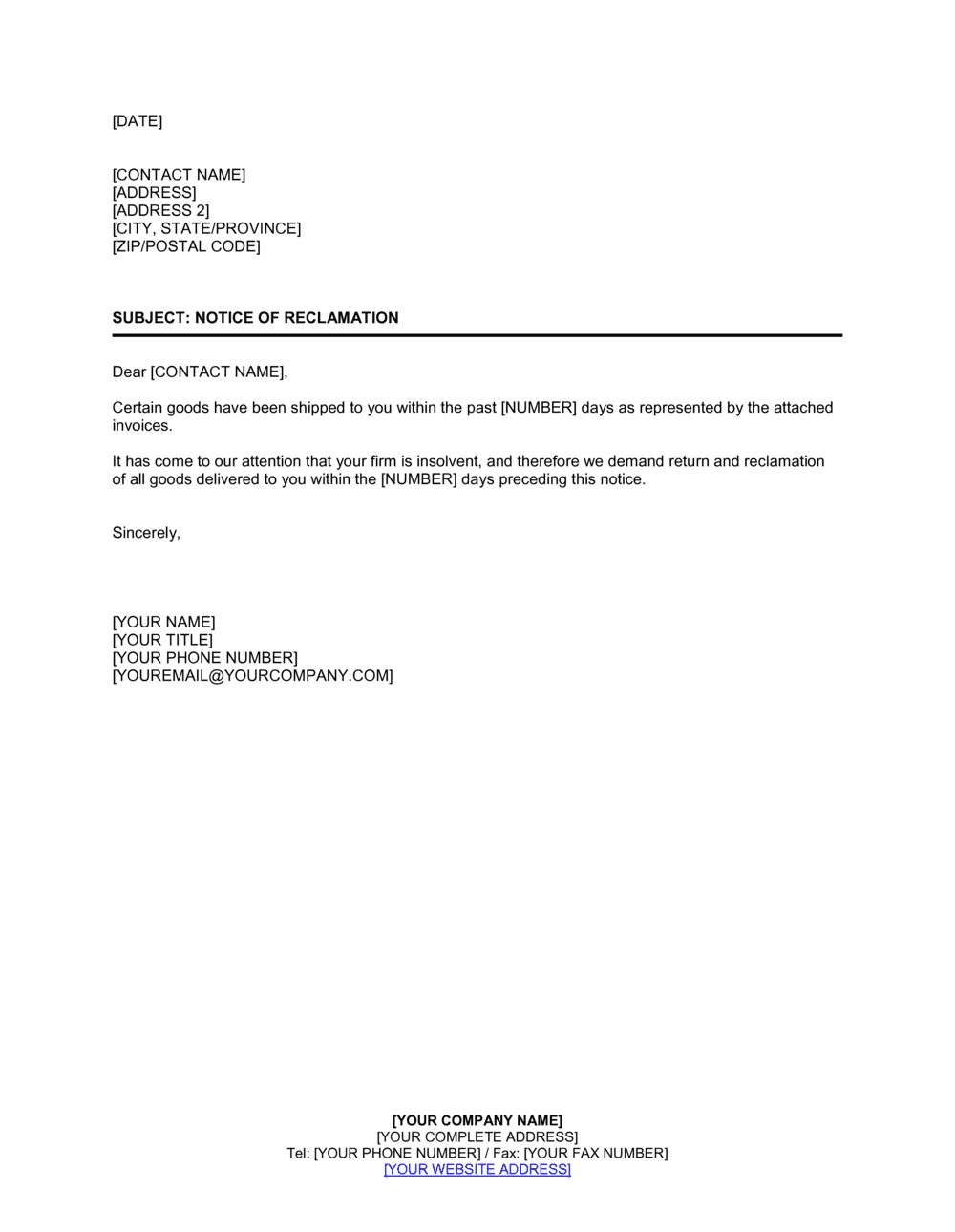
FreeNotice of Reclamation Template

At a glance

What it is
A Notice of Reclamation is a formal written demand sent by a seller to a buyer requesting the return of goods that were delivered but not paid for β€” typically because the buyer has become insolvent or has defaulted on payment terms. This template is a free Word download you can edit online and export as PDF, ready to send within minutes of identifying an unpaid delivery.
When you need it
Use it when a buyer has received your goods, failed to pay within the agreed terms, and shows signs of financial distress or insolvency β€” and you need to assert your right to reclaim those goods before a bankruptcy trustee or other creditor claims them first.
What's inside
Sender and recipient identification, a precise description of the goods at issue, the original delivery date and unpaid invoice reference, the legal or contractual basis for reclamation, a clear demand for return by a stated deadline, and instructions for arranging pickup or return logistics.

What is a Notice of Reclamation?

A Notice of Reclamation is a formal written demand issued by a seller to a buyer requiring the return of goods that were delivered on credit but have not been paid for β€” typically because the buyer has defaulted on payment terms, become insolvent, or filed for bankruptcy protection. Unlike a standard payment reminder, a reclamation notice asserts a specific legal right to physical recovery of the goods themselves, grounded in contract provisions such as a retention-of-title clause or in statutory rights under laws such as UCC Β§2-702 in the United States. It identifies the goods by invoice reference, confirms delivery, states the outstanding amount, and sets a firm deadline for return β€” creating a documented legal record that is essential if the matter escalates to court or a bankruptcy proceeding.

Why You Need This Document

When a buyer defaults on payment and insolvency looms, every day without a formal written demand works against you. The legal window to assert a reclamation right is short β€” as few as 10 days after delivery under the UCC in a standard default scenario β€” and once it closes, you become an unsecured creditor competing with everyone else for cents on the dollar. A properly drafted Notice of Reclamation stops that clock, puts the buyer on formal legal notice, and preserves your right to pursue both the goods and the outstanding payment. Without one, you have no documented basis to distinguish your claim from any other unpaid supplier. This template gives you a complete, correctly structured notice you can issue within 30 minutes of identifying a problem, with the invoice references, goods descriptions, demand deadline, and reservation-of-rights language that turn a payment dispute into an enforceable legal position.

Which variant fits your situation?

If your situation is…Use this template
Buyer has declared bankruptcy and goods were delivered within the past 45 daysNotice of Reclamation (Bankruptcy)
Buyer is in default but has not yet filed for insolvency protectionNotice of Reclamation
Goods have already been resold by the buyer and physical return is impossibleDemand Letter for Payment
Disputing a deduction or short payment on a fulfilled orderDispute Letter for Invoice Deduction
Formally placing a buyer on credit hold before reclamationCredit Hold Notice
Following up after a reclamation notice goes unansweredDemand Letter (Final Notice)

Common mistakes to avoid

❌ Sending the notice too late

Why it matters: Under the UCC, a seller typically has 10 days after the buyer's receipt of goods to send a reclamation demand. In a bankruptcy proceeding, the window extends to 45 days but closes on the filing date if shorter. Missing the window extinguishes the reclamation right entirely.

Fix: Issue the notice immediately upon learning of the buyer's default or insolvency β€” do not wait for a payment follow-up cycle to run its course.

❌ Using vague goods descriptions

Why it matters: If the goods cannot be specifically identified in the buyer's possession, a court or bankruptcy trustee may rule that reclamation does not apply to those items, leaving you as an unsecured creditor.

Fix: Reference the exact invoice line items, SKUs, quantities, and values β€” and attach the invoice as a supporting exhibit to the notice.

❌ Omitting the legal basis for the demand

Why it matters: A letter that simply asks for goods back reads as an informal request, not a legal demand. Without citing UCC Β§2-702, a contractual retention-of-title clause, or applicable state statute, the notice carries no legal weight.

Fix: Include a specific citation to the contractual or statutory authority for the reclamation demand in every notice, even if you use plain language to explain it.

❌ Not reserving rights to pursue payment

Why it matters: Sending a reclamation notice without a reservation-of-rights clause can be interpreted as an election of remedies β€” meaning you forfeit the right to sue for the unpaid invoice if the goods are returned damaged, incomplete, or not at all.

Fix: Always include a standard reservation-of-rights paragraph confirming that the reclamation demand does not waive any claim for the outstanding payment or damages.

The 10 key clauses, explained

Sender and recipient identification

In plain language: Identifies the seller issuing the notice and the buyer receiving it, including full legal names, addresses, and the date the letter is sent.

Sample language
[SELLER COMPANY NAME] | [SELLER ADDRESS] | [DATE] | Sent to: [BUYER COMPANY NAME], Attn: [CONTACT NAME / TITLE] | [BUYER ADDRESS]

Common mistake: Addressing the letter to a general contact rather than the buyer's accounts payable manager or legal department β€” causing it to be misdirected or ignored at a critical time.

Subject line and notice heading

In plain language: A clear heading that immediately identifies the letter as a formal reclamation demand, referencing the invoice number and delivery date.

Sample language
RE: Notice of Reclamation β€” Invoice No. [INVOICE NUMBER] | Goods Delivered [DELIVERY DATE]

Common mistake: Using a vague subject line such as 'Outstanding Account' β€” which fails to signal the legal significance of the demand and reduces the urgency conveyed to the recipient.

Description of goods

In plain language: Precisely identifies the goods subject to reclamation by product name, quantity, SKU or part number, and unit value.

Sample language
[QUANTITY] units of [PRODUCT NAME / SKU], as itemized on Invoice No. [INVOICE NUMBER] dated [DATE], with a total invoiced value of $[AMOUNT].

Common mistake: Describing goods in general terms such as 'merchandise' or 'products supplied' β€” making it difficult to distinguish the specific goods in the buyer's possession from other inventory.

Delivery confirmation

In plain language: States the date the goods were delivered and references the proof of delivery document to establish that the buyer received them.

Sample language
The above goods were delivered to and received by [BUYER NAME] on [DELIVERY DATE], as evidenced by Bill of Lading No. [BOL NUMBER] / Delivery Receipt No. [RECEIPT NUMBER].

Common mistake: Omitting the proof of delivery reference β€” without it, the buyer can dispute receipt and the notice loses much of its evidentiary weight.

Payment default statement

In plain language: States the agreed payment terms, the amount outstanding, and the fact that payment has not been received by the due date.

Sample language
Payment of $[AMOUNT] was due on [DUE DATE] pursuant to [NET 30 / NET 60] terms. As of the date of this notice, no payment has been received and the full balance of $[AMOUNT] remains outstanding.

Common mistake: Failing to state the original payment terms explicitly β€” leaving room for the buyer to claim different terms were agreed, which complicates any subsequent legal action.

Basis for reclamation

In plain language: Cites the legal or contractual authority for the reclamation demand β€” such as the UCC, a retention-of-title clause, or applicable state law.

Sample language
Pursuant to Section 2-702 of the Uniform Commercial Code and/or the retention of title provisions of our sales agreement dated [DATE], [SELLER NAME] hereby demands the immediate return of the goods described above.

Common mistake: Omitting any legal basis entirely, reducing the letter to an informal request rather than a formal demand with legal standing.

Formal demand and deadline

In plain language: States the explicit demand for return of the goods and sets a specific deadline β€” typically 3 to 10 business days β€” for the buyer to comply.

Sample language
You are hereby required to return the above-described goods to [SELLER NAME] no later than [DEADLINE DATE β€” e.g., 10 BUSINESS DAYS FROM DATE OF THIS NOTICE]. Failure to comply by this date may result in legal action without further notice.

Common mistake: Setting an unrealistically short deadline (24–48 hours) that the buyer cannot practically meet, which can undermine the notice's enforceability and good-faith standing.

Return logistics instructions

In plain language: Provides practical instructions for how the goods are to be returned β€” pickup address, contact person, and who bears the cost of return shipping.

Sample language
Please arrange return of the goods to [RETURN ADDRESS], Attn: [CONTACT NAME], during business hours. [SELLER / BUYER] will bear the cost of return transportation. Contact [NAME] at [PHONE / EMAIL] to schedule pickup.

Common mistake: Leaving logistics unspecified β€” a buyer willing to comply may delay simply because they do not know where to send the goods or who to contact.

Reservation of rights

In plain language: States that sending this notice does not waive any other legal remedies available to the seller, including claims for damages or outstanding payment.

Sample language
This notice is issued without prejudice to and without waiving any other rights or remedies available to [SELLER NAME] under applicable law or contract, including the right to pursue payment of the outstanding balance.

Common mistake: Omitting a reservation of rights clause β€” which can be interpreted as the seller electing reclamation as the sole remedy and waiving the right to sue for the unpaid invoice amount.

Authorized signature block

In plain language: Closes the letter with the sender's name, title, company, and contact information β€” establishing who issued the formal notice.

Sample language
Sincerely, [AUTHORIZED SIGNATORY NAME] | [TITLE] | [COMPANY NAME] | [PHONE] | [EMAIL]

Common mistake: Signing with only a first name or a department name rather than a named individual with authority β€” making follow-up and legal attribution difficult.

How to fill it out

  1. 1

    Gather the invoice and delivery documentation

    Before filling in the template, locate the original sales invoice, the bill of lading or delivery receipt, and any credit agreement or sales contract with the buyer. You will need exact dates, amounts, and reference numbers.

    πŸ’‘ Confirm the delivery date from a signed document rather than your shipping system β€” a signed receipt is far stronger evidence than an internal dispatch record.

  2. 2

    Enter seller and buyer details

    Fill in your company's full legal name and address in the sender block, then add the buyer's legal entity name and the correct contact for accounts payable or their legal team.

    πŸ’‘ Search the buyer's public filings or company registration to confirm the exact legal entity name β€” particularly important if the buyer trades under a different brand name.

  3. 3

    Complete the subject line with invoice and delivery references

    Insert the specific invoice number and delivery date in the subject line so the notice is immediately identifiable and cannot be confused with other correspondence.

    πŸ’‘ If multiple invoices are involved, list them all in the subject line or attach a schedule β€” one notice can cover several outstanding deliveries.

  4. 4

    Describe the goods precisely

    List each product by name, SKU, quantity, and unit value. Cross-reference the description against the original invoice to ensure the goods are identifiable without ambiguity.

    πŸ’‘ Attach a copy of the original invoice as Exhibit A β€” it reinforces the goods description and provides a self-contained record if the notice is used in legal proceedings.

  5. 5

    State the payment default facts

    Insert the agreed payment terms, the invoice due date, and the total outstanding amount. Keep this section factual β€” no accusatory language, just the documented figures.

    πŸ’‘ State the amount as a specific dollar figure rather than 'the outstanding balance' β€” precision leaves no room for the buyer to claim a different amount is owed.

  6. 6

    Set a realistic demand deadline

    Enter a deadline that gives the buyer enough time to arrange logistics β€” 5 to 10 business days is standard. Note the deadline in calendar date format (e.g., May 15, 2026) rather than as a relative period.

    πŸ’‘ A calendar date eliminates disputes about when the notice was received and when the countdown started.

  7. 7

    Add return logistics details and sign

    Specify the return address, a named contact for scheduling pickup, business hours, and who covers shipping costs. Then sign and date the letter with your full name and title.

    πŸ’‘ Send the notice by traceable method β€” certified mail, courier with delivery confirmation, or email with a read receipt β€” and retain proof of dispatch.
Frequently asked questions

What is a notice of reclamation?

A notice of reclamation is a formal written demand from a seller to a buyer requiring the return of goods that were delivered but not paid for. It is typically triggered when a buyer defaults on payment, becomes insolvent, or files for bankruptcy. The notice establishes the seller's reclamation right in writing and creates a documented legal record of the demand.

When should I send a notice of reclamation?

Send it as soon as you learn that a buyer who received your goods has defaulted on payment and shows signs of financial distress or insolvency. Under the UCC, the standard window is 10 days after the buyer received the goods. In a US bankruptcy proceeding, the window extends to 45 days from delivery or 20 days after the bankruptcy filing, whichever is shorter. Acting promptly is critical β€” the right expires when the window closes.

Does a notice of reclamation guarantee I get my goods back?

No. A timely and properly drafted notice establishes your reclamation right, but the buyer or a bankruptcy trustee may contest it, assert that the goods have been resold, or dispute the identification of specific items. In bankruptcy, reclamation claims are subject to the court's approval and may be subordinated to secured creditors' claims. The notice is a necessary first step β€” it is not a guarantee of recovery.

What if the buyer has already resold or consumed the goods?

If the specific goods can no longer be identified or have been resold to a good-faith purchaser, physical reclamation is generally not available. In that case, your claim converts to an unsecured monetary claim for the invoice value. In a bankruptcy proceeding, the court may in some cases substitute an administrative expense claim. Document the goods as specifically as possible in the original notice to maximize your options.

Do I need a lawyer to send a notice of reclamation?

For a straightforward default involving a solvent buyer, a well-drafted template notice is typically sufficient. If the buyer has filed for bankruptcy or insolvency protection, the situation becomes more complex β€” timing rules, court procedures, and creditor hierarchies all apply, and a commercial attorney can substantially improve your recovery prospects. A 1–2 hour consultation ($150–$400) is worthwhile before proceeding in a bankruptcy context.

Can I include multiple unpaid invoices in one notice?

Yes. A single notice can cover multiple deliveries as long as each invoice is listed with its reference number, delivery date, goods description, and outstanding amount. Attach a schedule of invoices as an exhibit if more than two or three are involved β€” this keeps the letter body readable while preserving the specificity needed for each claim.

How should I send a notice of reclamation?

Use a traceable delivery method that generates proof of receipt β€” certified mail with return receipt, a courier service with delivery confirmation, or email with a read receipt and a follow-up certified hard copy. Retain all delivery confirmations. The date the buyer receives the notice can affect whether your deadline is enforceable, so documented proof of receipt is essential.

What happens after I send a notice of reclamation?

The buyer has until your stated deadline to return the goods or contact you to arrange return logistics. If the buyer ignores the notice or refuses to return the goods, your next steps typically include a follow-up demand letter, a civil claim for the invoice value, or filing a proof of claim in a bankruptcy proceeding. Document every communication after the notice is sent, as this record supports any subsequent legal action.

How this compares to alternatives

vs Demand Letter for Payment

A demand letter for payment asks the buyer to pay the outstanding invoice β€” it does not claim the goods back. A notice of reclamation is used when you want the goods returned, not just payment. Use a payment demand when the buyer is solvent and simply late; use a reclamation notice when insolvency is a real concern and physical recovery of goods is still possible.

vs Collection Letter

A collection letter is a softer pre-legal communication designed to prompt payment before escalation. A notice of reclamation is a formal legal demand with time-sensitive enforceability tied to specific statutory windows. Collection letters are appropriate early in a payment dispute; reclamation notices are appropriate when insolvency is imminent or confirmed.

vs Credit Hold Notice

A credit hold notice suspends further deliveries to a buyer with a deteriorating payment record β€” it is a forward-looking action to prevent additional exposure. A notice of reclamation addresses goods already delivered and unpaid. In practice, both are often issued simultaneously when a buyer first shows signs of financial distress.

vs Proof of Claim (Bankruptcy)

A proof of claim is a court filing used in bankruptcy proceedings to assert a creditor's right to receive payment from the bankrupt estate. A notice of reclamation is a pre-court demand sent directly to the buyer. In a bankruptcy context, a reclamation notice should be followed by a proof of claim if the goods are not returned β€” the two documents work in sequence, not as alternatives.

Industry-specific considerations

Wholesale and Distribution

High-volume shipments and thin margins make timely reclamation notices critical when a retail buyer misses payment β€” even a single large delivery can represent significant exposure.

Manufacturing

Manufacturers shipping finished goods on Net 30 or Net 60 terms to distributors rely on reclamation notices as a first-response tool when a distributor enters default or restructuring.

Food and Beverage

Perishable goods complicate reclamation because the window for physically recovering usable product is extremely short β€” notices must be issued within hours of learning of insolvency, not days.

Retail and E-commerce

Suppliers to retail chains face reclamation scenarios most acutely during a retailer's Chapter 11 filing, where the 45-day bankruptcy reclamation window governs and court approval is required.

Template vs pro β€” what fits your needs?

PathBest forCostTime
Use the templateSellers dealing with a solvent buyer in default who needs a formal written demand to prompt return of goodsFree15–30 minutes
Template + professional reviewSituations involving a buyer showing early signs of insolvency or where the goods are high-value$150–$400 (1-hour commercial attorney consultation)1–2 business days
Custom draftedBuyer has filed for bankruptcy protection, multiple creditors are involved, or the reclamation claim will be contested in court$500–$2,000+3–7 business days

Glossary

Reclamation
A seller's legal right to demand the return of goods delivered to a buyer who was insolvent at the time of receipt or who subsequently failed to pay.
Reclamation Period
The time window within which a seller must send a reclamation demand β€” typically 10 days after the buyer's receipt of goods under the UCC, or 45 days in a US bankruptcy proceeding.
Insolvency
A financial state in which a party cannot meet its debts as they fall due, often triggering a seller's right of reclamation.
UCC (Uniform Commercial Code)
A set of standardized commercial laws adopted across US states that governs the sale of goods, including seller reclamation rights under Article 2.
Credit Terms
The agreed payment conditions attached to a sale β€” such as Net 30 or Net 60 β€” that define when payment is due after delivery.
Invoice Reference Number
The unique identifier on the original sales invoice, used to tie the reclamation demand to the specific unpaid transaction.
Demand Deadline
The specific date stated in the notice by which the buyer must return the goods or confirm a return arrangement, after which legal action may follow.
Consignee
The party to whom goods are delivered or addressed, and who is responsible for accepting and paying for them under the terms of the sale.
Retention of Title Clause
A contract provision stating that legal ownership of goods remains with the seller until full payment is received, strengthening a reclamation claim.
Proof of Delivery
Documentation β€” such as a signed bill of lading or delivery receipt β€” confirming that goods were received by the buyer on a specific date.

Part of your Business Operating System

This document is one of 3,000+ business & legal templates included in Business in a Box.

  • Fill-in-the-blanks β€” ready in minutes
  • 100% customizable Word document
  • Compatible with all office suites
  • Export to PDF and share electronically

Create your document in 3 simple steps.

From template to signed document β€” all inside one Business Operating System.
1
Download or open template

Access over 3,000+ business and legal templates for any business task, project or initiative.

2
Edit and fill in the blanks with AI

Customize your ready-made business document template and save it in the cloud.

3
Save, Share, Send, Sign

Share your files and folders with your team. Create a space of seamless collaboration.

Save time, save money, and create top-quality documents.

β˜…β˜…β˜…β˜…β˜…

"Fantastic value! I'm not sure how I'd do without it. It's worth its weight in gold and paid back for itself many times."

Managing Director Β· Mall Farm
Robert Whalley
Managing Director, Mall Farm Proprietary Limited
β˜…β˜…β˜…β˜…β˜…

"I have been using Business in a Box for years. It has been the most useful source of templates I have encountered. I recommend it to anyone."

Business Owner Β· 4+ years
Dr Michael John Freestone
Business Owner
β˜…β˜…β˜…β˜…β˜…

"It has been a life saver so many times I have lost count. Business in a Box has saved me so much time and as you know, time is money."

Owner Β· Upstate Web
David G. Moore Jr.
Owner, Upstate Web

Run your business with a system β€” not scattered tools

Stop downloading documents. Start operating with clarity. Business in a Box gives you the Business Operating System used by over 250,000 companies worldwide to structure, run, and grow their business.

Start freeΒ Β·Β No credit card required