Notice Following Refusal to Accept Delivery Template

Free Word download β€’ Edit online β€’ Save & share with Drive β€’ Export to PDF

1 pageβ€’15–25 min to fillβ€’Difficulty: Standard
Learn more ↓
FreeNotice Following Refusal to Accept Delivery Template

At a glance

What it is
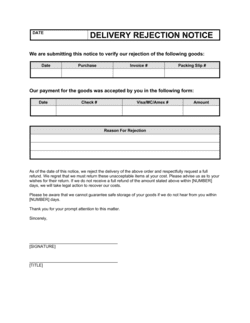
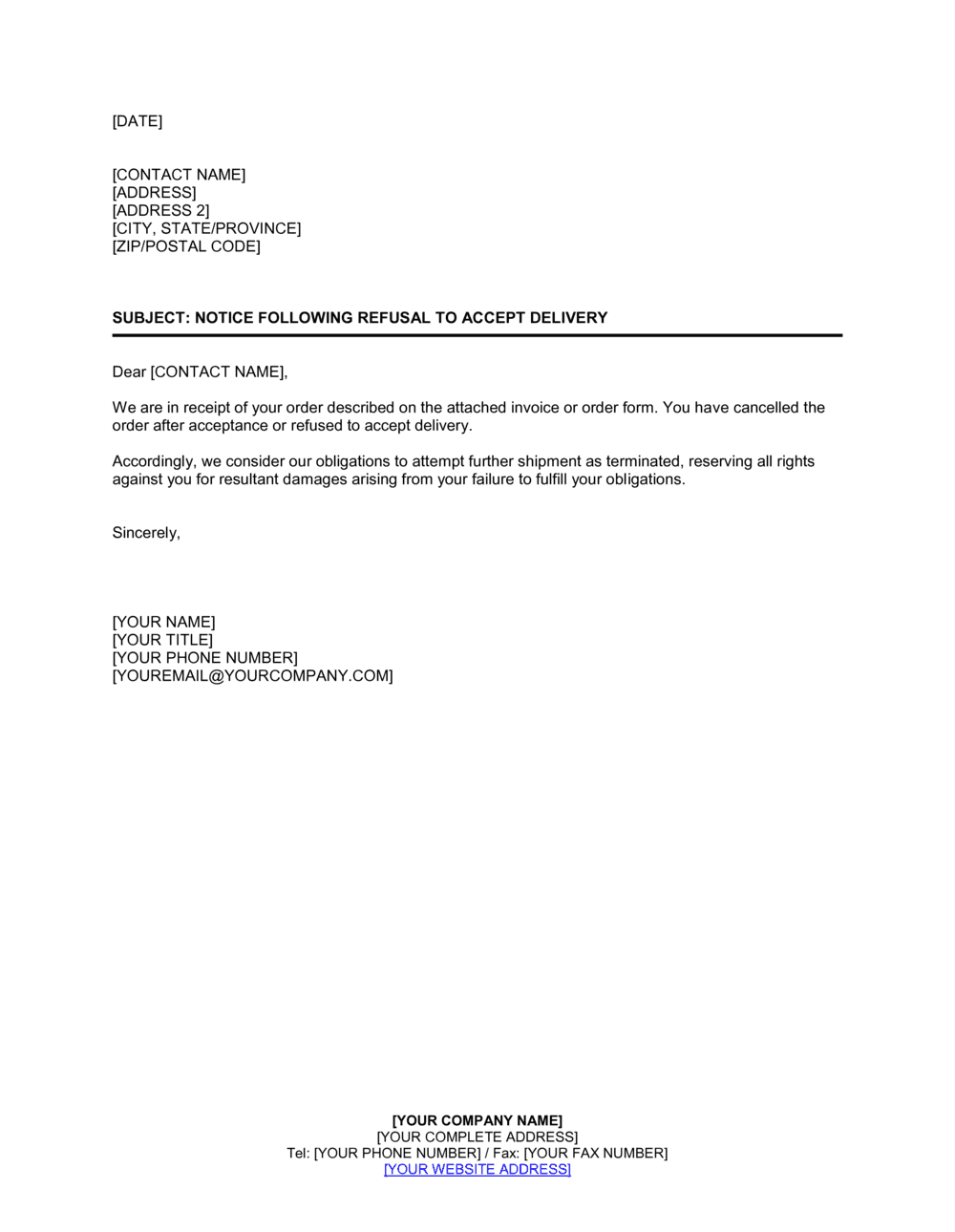
A Notice Following Refusal To Accept Delivery is a formal business letter sent by a seller or supplier to a buyer who has refused to take delivery of ordered goods. This free Word download gives you a ready-to-edit template that documents the refusal, states the consequences, and demands the buyer remedy the situation within a defined deadline.
When you need it
Use it immediately after a buyer or their representative turns away a confirmed shipment β€” whether at a loading dock, warehouse, or delivery address β€” without a legally valid reason. It is also appropriate when a carrier reports the consignee has declined to sign for or collect the goods.
What's inside
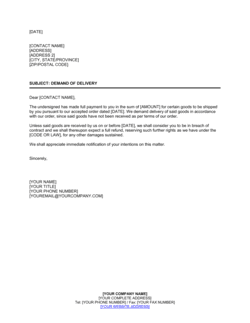
Party and shipment identification, a factual account of the refusal event, a statement of the seller's ongoing costs (storage, insurance, handling), a firm deadline for the buyer to collect or provide collection instructions, and a declaration of the seller's remedies if the deadline is not met.

What is a Notice Following Refusal To Accept Delivery?

A Notice Following Refusal To Accept Delivery is a formal business letter sent by a seller or supplier to a buyer who has declined to receive a contracted shipment. It serves as the official written record of the refusal event, asserts that the seller properly tendered delivery in accordance with the purchase order or supply agreement, and puts the buyer on notice that storage and handling costs are accruing at the buyer's expense. The letter sets a firm deadline for the buyer to collect the goods or provide collection instructions, and states the remedies the seller will exercise β€” typically resale and full cost recovery β€” if that deadline passes without a response.

Why You Need This Document

Failing to send a formal written notice after a delivery refusal is one of the costliest administrative omissions in commercial supply chains. Without a documented notice, the buyer can deny the refusal took place, dispute the amount of storage costs incurred, or argue that the seller waived their right to full payment by not acting promptly. In many jurisdictions, a seller cannot legally resell refused goods and claim the price difference without first giving the buyer a reasonable written opportunity to collect β€” and courts treat an undocumented resale as a potential breach of the seller's own obligations. This template creates the paper trail needed to protect your right to recover the contract price, storage fees, and all consequential costs β€” and it signals to the buyer, in clear commercial language, that inaction has a specific financial deadline attached to it.

Which variant fits your situation?

If your situation is…Use this template
Goods were refused with no stated reason by the buyerNotice Following Refusal To Accept Delivery
Buyer claims goods were defective or non-conforming at deliveryResponse to Notice of Defective Goods
Goods have been refused and seller intends to resell themNotice of Intent to Resell Refused Goods
Buyer has not paid and goods have not yet been dispatchedDemand for Payment Before Shipment
Seller is formally terminating the supply contract after repeated refusalsContract Termination Notice
Delivery was partially accepted but a portion of goods was rejectedNotice of Partial Rejection of Goods

Common mistakes to avoid

❌ No specific refusal date or witness details

Why it matters: A notice that says 'you recently refused our delivery' gives the buyer room to dispute the facts. Without a date and named witness, the notice is easy to ignore or challenge.

Fix: Record the exact date, time, delivery address, and the full name of the person who refused on the buyer's behalf β€” ideally corroborated by a carrier delivery report.
❌ Omitting the purchase order or contract reference

Why it matters: Without citing the specific contract or PO, the buyer can deny any binding obligation to accept delivery, leaving the seller without a clear legal foundation for their claim.

Fix: Always cite the PO number, contract date, and agreed delivery terms in the opening paragraph, and attach a copy if there is any risk the buyer disputes the terms.

❌ Setting no firm collection deadline

Why it matters: An open-ended request to 'arrange collection at your earliest convenience' has no legal force. The seller cannot exercise any remedy β€” resale, lien, or debt claim β€” until a reasonable deadline has passed and been missed.

Fix: State a specific calendar date as the deadline. Seven to fourteen days is standard; confirm that your supply contract does not impose a longer minimum notice period.

❌ Vague or absent cost quantification

Why it matters: Warning about 'additional charges' without a daily rate gives the buyer no financial incentive to act quickly and weakens a subsequent cost-recovery claim.

Fix: State the actual daily storage and insurance rate in the notice, note the start date from which it is running, and confirm it with a written quote from your storage provider.

The 9 key clauses, explained

Header and party identification

In plain language: Names and addresses of both the sender (seller/supplier) and the recipient (buyer), the date the letter is issued, and a clear subject line referencing the purchase order or contract number.

Sample language
[SELLER COMPANY NAME] | [ADDRESS] | [DATE] To: [BUYER COMPANY NAME] | [BUYER ADDRESS] Re: Notice Following Refusal to Accept Delivery β€” PO No. [PO NUMBER] dated [DATE]

Common mistake: Addressing the letter to a general contact rather than the buyer's named representative or legal entity β€” a misdirected notice may be challenged as not properly served.

Reference to the contract or purchase order

In plain language: Cites the specific agreement, purchase order number, and agreed delivery terms that obligated the buyer to accept the shipment.

Sample language
This notice is issued pursuant to the Supply Agreement dated [DATE] (the 'Agreement') and Purchase Order No. [PO NUMBER], under which you agreed to accept delivery of [DESCRIPTION OF GOODS] at [DELIVERY ADDRESS] on or before [AGREED DELIVERY DATE].

Common mistake: Omitting the PO or contract reference entirely. Without it, the buyer can dispute whether a binding acceptance obligation existed at all.

Statement of the refusal event

In plain language: A factual, timestamped account of when, where, and how the buyer refused delivery β€” including who refused on the buyer's behalf and any reason given.

Sample language
On [DATE] at approximately [TIME], our delivery agent attended [DELIVERY ADDRESS] with the above-referenced goods. Your representative, [NAME / TITLE], refused to accept delivery, stating [REASON GIVEN / 'no reason was provided'].

Common mistake: Using vague language like 'you recently refused our delivery.' Specific dates, times, and the name of the refusing party make the notice far harder to dispute.

Confirmation that tender of delivery was proper

In plain language: Asserts that the seller met all contractual delivery obligations β€” correct goods, quantity, condition, and timing β€” making the refusal unjustified.

Sample language
The goods tendered were in conformity with the specifications set out in the Agreement β€” [QUANTITY], [DESCRIPTION], in good condition β€” and delivery was tendered within the agreed delivery window.

Common mistake: Skipping this clause and moving straight to demands. Without affirming proper tender, the buyer may argue the refusal was justified by non-conforming goods.

Notice of ongoing costs

In plain language: Informs the buyer that storage, insurance, and handling costs are accruing daily and will be charged back to them as a result of the refusal.

Sample language
As a result of your refusal, the goods are currently held in storage at [FACILITY NAME], incurring storage and insurance charges of approximately $[DAILY RATE] per day from [DATE OF REFUSAL]. These costs will be added to the amount owing under the Agreement.

Common mistake: Failing to quantify the daily cost. A vague reference to 'additional charges' gives the buyer no urgency and weakens a subsequent cost-recovery claim.

Deadline to collect or provide instructions

In plain language: Sets a firm date by which the buyer must collect the goods or provide written instructions for redelivery, typically 7–14 days from the notice date.

Sample language
You are hereby required to collect the goods or provide us with written collection instructions no later than [DEADLINE DATE], being [X] days from the date of this notice.

Common mistake: Setting no deadline or using language like 'as soon as possible.' An undefined deadline makes it impossible to trigger the next remedy.

Statement of seller's remedies on non-compliance

In plain language: Warns the buyer that if they do not comply by the deadline, the seller will exercise specific remedies β€” typically reselling the goods and claiming the price difference plus all costs.

Sample language
If you fail to comply by [DEADLINE DATE], we reserve the right, without further notice, to resell the goods to a third party and hold you liable for any shortfall in the resale price, together with all storage, handling, insurance, and legal costs incurred.

Common mistake: Threatening legal action without specifying the actual remedy available. Vague threats of 'legal proceedings' carry less weight than a precise description of resale or debt-recovery action.

Reservation of rights

In plain language: Confirms that sending this notice does not waive any of the seller's contractual or legal rights, including the right to claim the full contract price.

Sample language
Nothing in this notice shall be construed as a waiver of any right or remedy available to [SELLER COMPANY NAME] under the Agreement or at law, including the right to claim the full contract price as a debt.

Common mistake: Omitting the reservation of rights clause. Courts have occasionally found that a seller who offered alternatives (e.g., resale or return) implicitly waived the right to claim the full price.

Call to action and contact details

In plain language: Invites the buyer to contact the seller immediately to resolve the matter and provides the specific name, phone, and email of the contact person.

Sample language
We urge you to contact us immediately to resolve this matter. Please direct all correspondence to [NAME], [TITLE], at [EMAIL] / [PHONE NUMBER].

Common mistake: Ending the letter without a clear contact route. If the buyer wants to remedy the situation, ambiguity on who to call extends the delay and increases costs.

How to fill it out

  1. 1

    Enter the seller's and buyer's full details

    Add the legal entity names, registered addresses, and the date the notice is issued. Include the buyer's accounts-payable or commercial contact where known.

    πŸ’‘ Use the buyer's registered company name as it appears on the purchase order β€” not a trading name β€” to avoid any challenge that notice was not properly served.

  2. 2

    Reference the purchase order or contract

    Enter the PO number, contract date, agreed delivery date, and delivery address. This anchors the notice to a specific binding obligation.

    πŸ’‘ Attach a copy of the PO or supply agreement as an exhibit so the buyer cannot claim they do not recognize the reference.

  3. 3

    Document the refusal event precisely

    State the exact date, time, and location of the refused delivery, the name and title of the person who refused, and any reason they gave β€” or note that no reason was provided.

    πŸ’‘ Collect a written report from your delivery driver or carrier at the time of refusal. Carrier delivery logs with timestamps are strong supporting evidence.

  4. 4

    Confirm that delivery was properly tendered

    State that the goods matched the order specification, were in good condition, and were presented within the agreed delivery window.

    πŸ’‘ If you have delivery photographs, condition reports, or weight/count certificates, reference them here and include them as supporting documents.

  5. 5

    Quantify the daily storage and handling cost

    Enter the actual daily rate being charged by your warehouse or logistics provider. Include the start date from which costs are accumulating.

    πŸ’‘ Get a written quote from your storage provider before sending the notice β€” a specific figure is far more effective than a general warning.

  6. 6

    Set a firm collection deadline

    Choose a deadline of 7–14 days from the notice date. Enter the specific calendar date in the notice so there is no ambiguity.

    πŸ’‘ Seven days is appropriate for domestic deliveries with no logistical complexity; 14 days is reasonable for international buyers or large shipments requiring specialist collection.

  7. 7

    State the remedy you will exercise on non-compliance

    Choose the specific remedy β€” resale on the open market, storage lien, or full debt recovery β€” and state it clearly. Do not list every conceivable option; pick the most likely and state it.

    πŸ’‘ If your supply contract specifies a particular remedy for refusal, use that language directly so the buyer cannot argue the remedy is outside the agreement.

Frequently asked questions

What is a notice following refusal to accept delivery?

It is a formal written communication sent by a seller or supplier to a buyer who has turned away a contracted shipment without a valid reason. The notice documents the refusal event, confirms the seller met their delivery obligations, warns the buyer of accumulating storage costs, and sets a deadline to collect the goods or face specific remedies such as resale or a debt claim for the full contract price.

When should I send this notice?

Send it as soon as possible after the refusal β€” ideally within 24 to 48 hours. A prompt notice demonstrates that you acted quickly to mitigate your losses, which courts and arbitrators take into account when assessing cost-recovery claims. Delaying the notice while storage costs accumulate unchecked can reduce the amount you are ultimately able to recover.

Does this letter need to be signed to be valid?

No signature is required for the letter to be legally effective as a formal notice in most jurisdictions. It must, however, be sent to the correct legal entity at their registered or contractually agreed address. Sending it by a traceable method β€” tracked courier, recorded post, or email with a read receipt β€” creates the evidence that the notice was delivered and received.

What happens if the buyer ignores the notice?

If the buyer does not collect the goods or respond by the stated deadline, the seller can typically exercise the remedies stated in the notice β€” reselling the goods on the open market, claiming the shortfall between the resale price and the original contract price, and recovering all documented storage, handling, insurance, and legal costs from the buyer. In many jurisdictions, the seller can also sue for the full contract price as an unpaid debt.

Can the buyer argue the refusal was justified?

Yes. A buyer may claim the goods were non-conforming, damaged, delivered late, or that a force majeure event prevented acceptance. The notice should pre-empt this by asserting that the goods were in conformity with the order and delivery was properly tendered. If the buyer raises a non-conformity claim, request written evidence of the alleged defect immediately and seek legal advice before reselling the goods.

How long should I give the buyer to collect the goods?

Seven to fourteen calendar days from the date of the notice is the standard range for domestic transactions. For international buyers, or where the goods require specialist handling or transport, fourteen days is more appropriate. Check your supply agreement β€” some contracts specify a minimum notice period before the seller may exercise resale or other remedies, and you must comply with that period regardless of the general standard.

Can I recover storage costs from the buyer?

In most cases, yes β€” provided you gave the buyer prompt notice of the refusal and quantified the costs clearly. Courts and arbitrators expect sellers to mitigate their losses, which means securing reasonably priced storage rather than the most expensive option available. Keep all invoices from your storage and logistics provider so you can produce a precise figure in any subsequent claim.

Should I send this notice by email or post?

Use both where possible. Send by email to create an instant, timestamped delivery record, and follow up with a hard copy by tracked courier or recorded post to the buyer's registered address. If your supply agreement specifies a notice method, follow it exactly β€” failure to use the prescribed method can invalidate the notice in some jurisdictions.

Is this the same as a rejection of goods notice?

No. A rejection of goods notice is sent by the buyer to the seller, stating that the buyer is rejecting delivered goods on grounds of non-conformity. A notice following refusal to accept delivery is sent by the seller to the buyer, documenting that the buyer turned away a shipment the seller had properly tendered. The two documents sit on opposite sides of a delivery dispute.

How this compares to alternatives

vs Demand letter for non-payment

A demand for non-payment addresses a buyer who has received goods but failed to pay. A notice following refusal to accept delivery addresses a buyer who has prevented receipt of the goods entirely. The two documents protect the seller at different stages of the same transaction and often need to be used in sequence if the buyer both refuses delivery and refuses to pay.

vs Contract termination notice

A contract termination notice ends the supply agreement between the parties. A notice following refusal to accept delivery focuses on a single refused shipment and demands remedy without necessarily ending the relationship. Use the termination notice only after the buyer has repeatedly refused deliveries or has clearly repudiated the contract.

vs Notice of defective goods (sent by buyer)

A notice of defective goods is issued by the buyer to reject a shipment that does not conform to specification. A notice following refusal to accept delivery is issued by the seller when the buyer refuses without a valid defect claim. The seller's notice typically responds to β€” or pre-empts β€” a buyer's defect argument by asserting proper tender.

vs Breach of contract notice

A breach of contract notice is a broader formal document citing a material failure across one or more contractual obligations. A notice following refusal to accept delivery is narrower and more operational β€” it focuses specifically on the refused shipment and the seller's immediate cost-recovery and resale rights, making it the right first step before escalating to a formal breach claim.

Industry-specific considerations

Manufacturing and wholesale

High-volume shipments and bulk goods make delivery refusals costly within hours β€” precise documentation of refused pallets, lot numbers, and daily storage rates is essential.

Retail and e-commerce

Seasonal stock refusals create urgent pressure to resell before goods lose value β€” the notice must set a short deadline and explicitly reserve the right to resell at market price.

Construction and building materials

Refused deliveries of materials often reflect project delays or cash-flow problems; the notice creates a paper trail for lien or bond claims against the construction project.

Food and beverage

Perishable goods require a much shorter collection deadline β€” sometimes 24 to 48 hours β€” and the notice should state the seller's right to dispose of the goods if not collected in time to prevent spoilage.

Template vs pro β€” what fits your needs?

PathBest forCostTime
Use the templateSellers and suppliers issuing a first notice for a single refused domestic shipmentFree15–30 minutes
Template + professional reviewInternational shipments, high-value goods, or buyers who have disputed the underlying contract$150–$400 for a solicitor or commercial lawyer review1–2 business days
Custom draftedRecurring delivery disputes, complex supply chains, or matters heading toward arbitration or litigation$500–$1,500+3–5 business days

Glossary

Refusal to Accept Delivery
An act by a buyer or consignee who declines to receive, sign for, or collect goods that have been tendered in accordance with a contract.
Consignee
The party named in a shipping document as the intended recipient of the goods.
Tender of Delivery
The seller's act of making goods available to the buyer at the agreed place and time, satisfying their delivery obligation under the contract.
Storage Charges
Fees incurred by the seller or carrier for holding refused goods at a warehouse or logistics facility while awaiting buyer collection.
Mitigation of Loss
The legal obligation of an injured party to take reasonable steps to reduce their own losses β€” here, the seller's duty to avoid piling up unnecessary costs after a refusal.
Breach of Contract
A failure by one party to perform a contractual obligation β€” a buyer's unjustified refusal to accept delivery is typically treated as a breach.
Reservation of Rights
A statement in the notice that the sender retains all legal remedies available under the contract or applicable law, without waiving any by sending the notice.
Purchase Order (PO)
The buyer's written authorization to supply specific goods at an agreed price, which forms the contractual basis for the delivery.
Force Majeure
A contractual clause excusing a party from performance due to extraordinary events outside their control β€” occasionally cited by buyers as justification for refusing delivery.
Lien on Goods
A seller's right to retain possession of goods until the buyer pays the outstanding purchase price β€” relevant when goods are refused and the seller holds them in storage.

Part of your Business Operating System

This document is one of 3,000+ business & legal templates included in Business in a Box.

  • Fill-in-the-blanks β€” ready in minutes
  • 100% customizable Word document
  • Compatible with all office suites
  • Export to PDF and share electronically

Create your document in 3 simple steps.

From template to signed document β€” all inside one Business Operating System.
1
Download or open template

Access over 3,000+ business and legal templates for any business task, project or initiative.

2
Edit and fill in the blanks with AI

Customize your ready-made business document template and save it in the cloud.

3
Save, Share, Send, Sign

Share your files and folders with your team. Create a space of seamless collaboration.

Save time, save money, and create top-quality documents.

β˜…β˜…β˜…β˜…β˜…

"Fantastic value! I'm not sure how I'd do without it. It's worth its weight in gold and paid back for itself many times."

Managing Director Β· Mall Farm
Robert Whalley
Managing Director, Mall Farm Proprietary Limited
β˜…β˜…β˜…β˜…β˜…

"I have been using Business in a Box for years. It has been the most useful source of templates I have encountered. I recommend it to anyone."

Business Owner Β· 4+ years
Dr Michael John Freestone
Business Owner
β˜…β˜…β˜…β˜…β˜…

"It has been a life saver so many times I have lost count. Business in a Box has saved me so much time and as you know, time is money."

Owner Β· Upstate Web
David G. Moore Jr.
Owner, Upstate Web

Run your business with a system β€” not scattered tools

Stop downloading documents. Start operating with clarity. Business in a Box gives you the Business Operating System used by over 250,000 companies worldwide to structure, run, and grow their business.

Start freeΒ Β·Β No credit card required