Notice of Termination Template

Free Word download β€’ Edit online β€’ Save & share with Drive β€’ Export to PDF

1 pageβ€’15–25 min to fillβ€’Difficulty: Standard
Learn more ↓
FreeNotice of Termination Template

At a glance

What it is
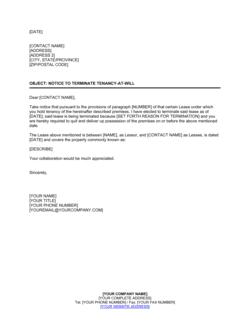
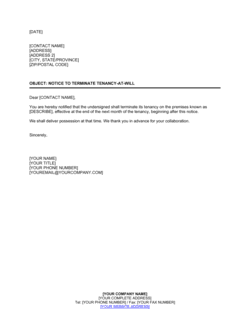
A Notice of Termination is a formal written letter that officially informs a party β€” an employee, contractor, vendor, or business partner β€” that a contract or working relationship is ending. This free Word download gives you a ready-to-edit template you can tailor to your situation, export as PDF, and deliver in minutes.
When you need it
Use it whenever you need to formally end an employment relationship, service contract, vendor agreement, or business partnership. A written notice creates a documented record of the termination date and reason, which is essential for payroll, compliance, and dispute prevention.
What's inside
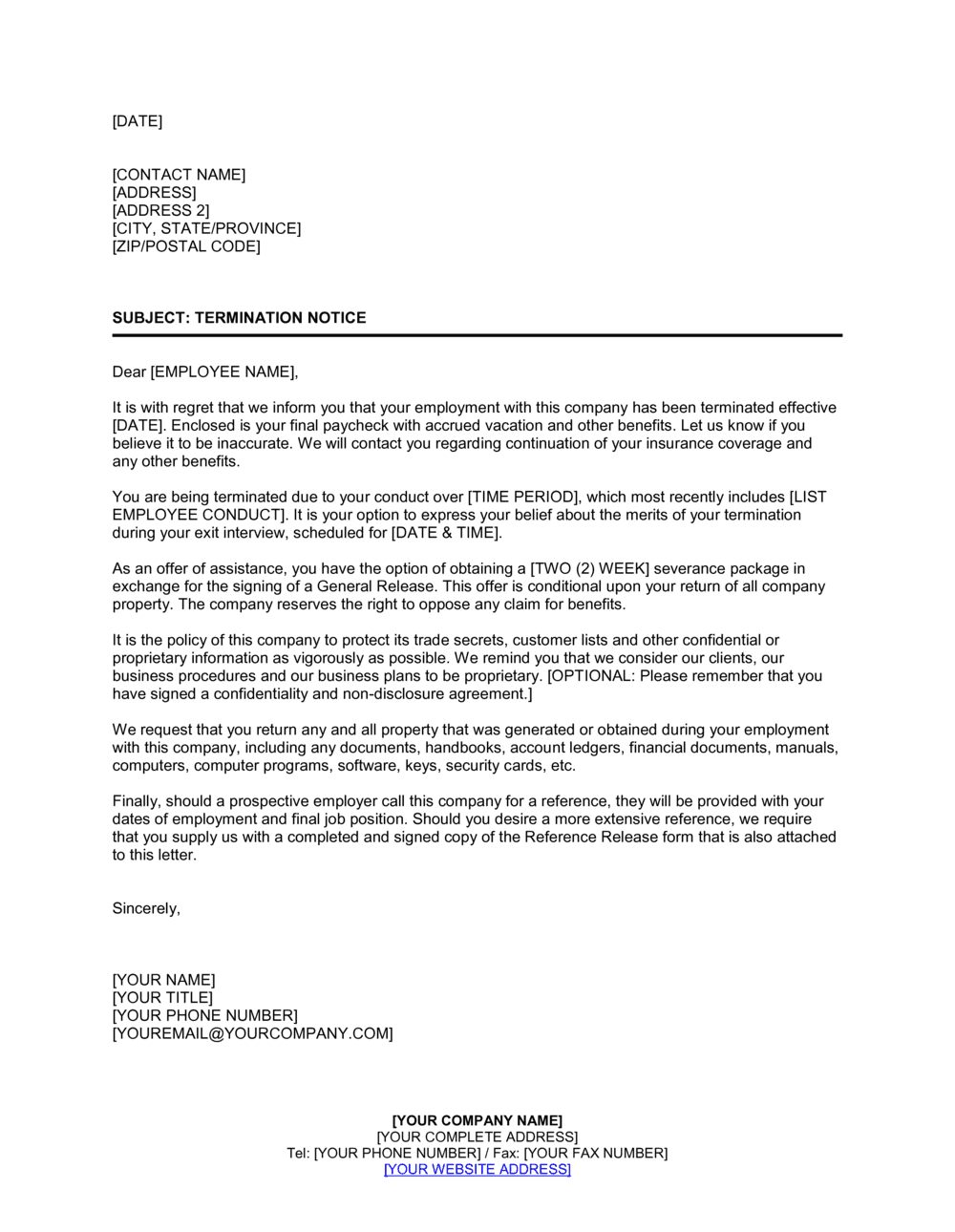
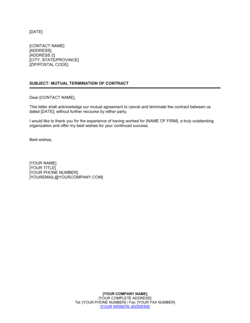
Date and recipient details, a clear statement of termination, the effective date, the reason for termination (where appropriate), instructions for outstanding obligations or return of property, and a professional closing with sender identification.

What is a Notice of Termination?

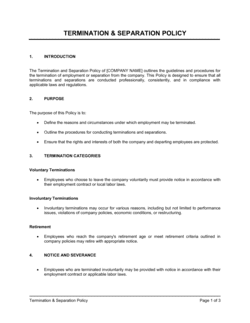
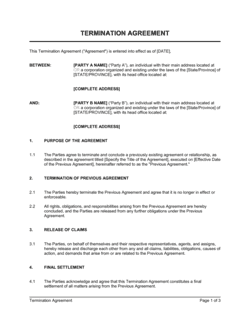
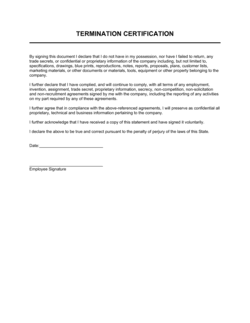
A Notice of Termination is a formal written letter that officially communicates to an employee, contractor, vendor, or business partner that a contract or working relationship is ending on a specific date. It states the effective termination date, the reason for ending the relationship where appropriate, any notice period that applies, and the obligations both parties must fulfill before the final day. Unlike a verbal conversation, a written notice creates a dated, documented record that anchors the timeline for final pay, benefits expiration, and the start of any post-termination restrictions.

Why You Need This Document

Ending a working relationship without a written notice is one of the most avoidable sources of business disputes. Without a dated letter on file, the start of the notice period becomes a matter of conflicting recollections β€” and in employment matters, ambiguity almost always resolves in the employee's favor. A missing or vague notice document delays final payroll processing, creates uncertainty about when benefits coverage ends, and leaves confidentiality and non-compete reminders undelivered at the moment they matter most. For vendor and contractor relationships, no written termination notice means no clear record of when outstanding obligations were communicated, making it harder to withhold payment or pursue damages for incomplete work. This template gives you a complete, professionally structured notice you can complete in under 15 minutes, deliver the same day, and retain as part of a clean termination record.

Which variant fits your situation?

If your situation is…Use this template
Ending employment without cause, with contractual notice periodNotice of Termination (Without Cause)
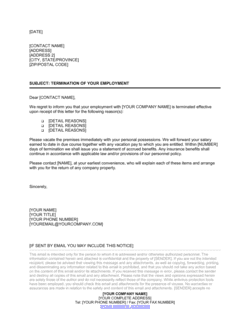
Dismissing an employee for documented misconduct or performance failureEmployee Dismissal Letter
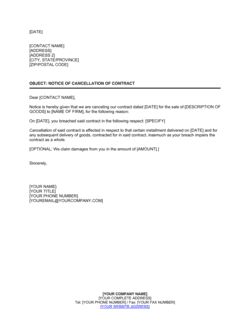
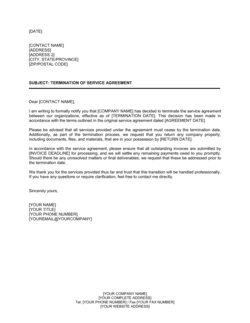
Canceling a service or vendor contract before the renewal dateContract Termination Letter
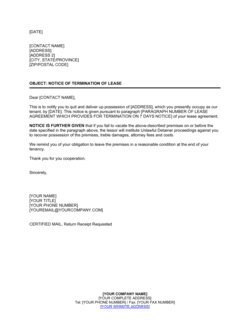
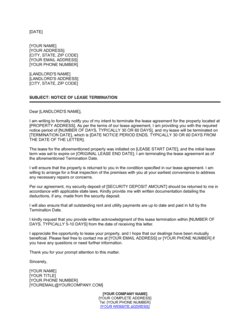
Ending a lease agreement with a landlord or tenantLease Termination Letter
Closing out a fixed-term employment contract at its end dateEnd of Contract Letter
Notifying a contractor that their engagement is endingIndependent Contractor Termination Letter
Dissolving a business partnership or joint venturePartnership Dissolution Notice

Common mistakes to avoid

❌ Giving less notice than the contract requires

Why it matters: Delivering notice shorter than the contractual or statutory minimum is a breach of the underlying agreement, exposing the company to a wrongful termination claim and potential damages.

Fix: Check the signed contract and the applicable employment standards in the recipient's jurisdiction before writing the effective date. When in doubt, give the longer period.

❌ Omitting the final pay date

Why it matters: Leaving the final pay timeline vague is one of the most common triggers for labor authority complaints and small claims disputes β€” employees have a legal right to know when they will be paid.

Fix: State the exact date final wages will be issued and confirm what the payment includes, such as accrued vacation and any outstanding expenses.

❌ Using inconsistent reasons across documents

Why it matters: If the termination letter states a different reason than prior performance reviews or warning letters, the inconsistency is the first thing an employment lawyer will use to challenge the decision.

Fix: Review all prior written communications before drafting the reason clause and use language that directly mirrors the documented history.

❌ Delivering the notice verbally and sending the letter days later

Why it matters: The notice period clock typically starts from written delivery, not the verbal conversation. A gap between the verbal and written notice creates ambiguity about the effective termination date.

Fix: Deliver the written notice on the same day as the termination conversation and retain proof of delivery with a timestamp.

The 9 key clauses, explained

Date and header

In plain language: States the date the letter was written and identifies both the sender and recipient with full names, titles, and addresses.

Sample language
[DATE] | [SENDER NAME], [TITLE] | [COMPANY NAME] | [ADDRESS] | To: [RECIPIENT NAME], [TITLE]

Common mistake: Using the date the letter is scheduled to be delivered instead of the date it was drafted β€” these should match, and gaps create ambiguity about when the notice period began.

Subject line

In plain language: A single line clearly identifying the letter as a notice of termination so the recipient understands the nature of the communication before reading further.

Sample language
Re: Notice of Termination β€” [EMPLOYEE / CONTRACT NAME] β€” Effective [DATE]

Common mistake: Omitting the subject line or using a vague label like 'Important Update' β€” recipients who forward the letter to HR or legal counsel need the subject to be unambiguous.

Opening statement of termination

In plain language: The first paragraph that clearly states the relationship is ending and the effective date, without burying the message in pleasantries.

Sample language
This letter serves as formal notice that [COMPANY NAME] is terminating [your employment / the service agreement dated [DATE]] effective [TERMINATION DATE].

Common mistake: Opening with two paragraphs of context before stating the termination β€” recipients are left uncertain about the letter's purpose, which increases the chance of a dispute about when notice was given.

Reason for termination

In plain language: A brief factual explanation of why the relationship is ending β€” performance, restructuring, contract breach, or end of term. The level of detail depends on the context.

Sample language
This decision is the result of [a company-wide restructuring / documented performance concerns as outlined in the Performance Improvement Plan dated [DATE] / a material breach of contract as described below].

Common mistake: Over-explaining the reason with emotional or subjective language. Excessive detail creates language that can be used against the sender in a dispute.

Notice period and final day

In plain language: States how long the notice period is and confirms the specific last day of the relationship, aligning with the contract or statutory requirement.

Sample language
Your notice period is [X] weeks / days, beginning today, [DATE]. Your final day of [employment / service] will be [LAST DAY DATE].

Common mistake: Not specifying whether the employee is expected to work through the notice period or is being given pay in lieu β€” leaving this ambiguous leads to disputes about attendance obligations and final pay calculations.

Outstanding obligations and offboarding instructions

In plain language: Tells the recipient what is required before their final day β€” return of company property, handover of files, completion of outstanding deliverables, or settlement of accounts.

Sample language
You are required to return all company property β€” including [laptop, access badges, client files] β€” by [DATE]. Please complete the handover of [SPECIFIC TASKS] to [COLLEAGUE NAME] before your final day.

Common mistake: Listing offboarding tasks in a separate email instead of in the notice letter β€” splitting instructions across documents creates gaps in the record and makes compliance harder to enforce.

Final pay and benefits statement

In plain language: Confirms when the employee or contractor will receive their final payment, what it includes, and when any benefits coverage ends.

Sample language
Your final paycheck, including [accrued vacation / outstanding expenses], will be issued on [DATE]. Health benefits coverage will continue through [DATE] / will end on your last day of employment.

Common mistake: Omitting the final pay date or leaving benefits end dates vague β€” this is one of the most common triggers for post-termination disputes and complaints to labor authorities.

Confidentiality and post-termination obligations reminder

In plain language: Reminds the recipient that any confidentiality, non-compete, or non-solicitation obligations from the underlying agreement remain in effect after termination.

Sample language
Please note that your obligations under Sections [X] (Confidentiality) and [X] (Non-Solicitation) of your [Employment Agreement / Contract] dated [DATE] continue in full force following your termination.

Common mistake: Skipping this clause on the assumption the original agreement covers it β€” the reminder in the termination letter is the last opportunity to put the departing party on clear written notice before they leave.

Closing and signature block

In plain language: A professional closing that invites the recipient to contact HR or a named person for questions, followed by the sender's name, title, and company.

Sample language
If you have questions regarding this notice, please contact [HR CONTACT NAME] at [EMAIL / PHONE]. | Sincerely, | [SENDER NAME] | [TITLE] | [COMPANY NAME]

Common mistake: Closing without a named contact person β€” recipients with questions or disputes will escalate through informal channels rather than the intended HR or legal contact, delaying resolution.

How to fill it out

  1. 1

    Enter the date and party details

    Add today's date at the top of the letter and fill in the sender's full name, title, and company address, followed by the recipient's full legal name, title, and address.

    πŸ’‘ Use the recipient's legal name exactly as it appears on their employment contract or service agreement β€” this matters if the notice is ever referenced in a legal dispute.

  2. 2

    Write a clear subject line

    Complete the Re: line with the recipient's name and the effective termination date so the purpose of the letter is immediately clear.

    πŸ’‘ Include the contract or employment start date in the subject line for vendor or contractor terminations β€” it removes any ambiguity about which agreement is being terminated.

  3. 3

    State the termination plainly in the first paragraph

    Write one to two sentences that directly state the relationship is ending and give the effective date. Do not delay this statement past the first paragraph.

    πŸ’‘ If the termination is without cause, use neutral language β€” 'this decision is unrelated to your performance' reduces the risk of a wrongful dismissal claim.

  4. 4

    Add the reason, if appropriate

    For terminations for cause, briefly reference the documented basis β€” a PIP, a contract breach notice, or a specific policy violation. For restructuring, a one-sentence explanation is sufficient.

    πŸ’‘ Keep reason language factual and consistent with any prior written warnings. Introducing new reasons in the termination letter that were not previously documented creates legal exposure.

  5. 5

    Confirm the notice period and last day

    State the length of the notice period, its start date, and the specific calendar date of the last day. Clarify whether the recipient is working through the notice or receiving pay in lieu.

    πŸ’‘ Cross-check the notice period against the signed contract β€” giving less notice than the contract requires exposes the company to a breach of contract claim.

  6. 6

    List offboarding tasks and final pay details

    Specify what property must be returned, which handovers are required, and when final pay will be issued. Include the end date for any benefits coverage.

    πŸ’‘ For senior roles or roles with system access, add a line confirming the date and time access credentials will be revoked β€” this prevents data security gaps.

  7. 7

    Add the post-termination obligations reminder and send

    Insert the clause referencing confidentiality and any non-compete or non-solicitation provisions from the underlying agreement. Sign the letter, deliver it in the agreed format, and retain a copy.

    πŸ’‘ Deliver the notice by a method that creates a delivery record β€” email with read receipt, registered mail, or hand delivery with a witness. The delivery date determines when the notice period begins.

Frequently asked questions

What is a notice of termination?

A notice of termination is a formal written letter that officially ends an employment relationship, service contract, or business agreement. It states the effective date of termination, the reason (where appropriate), and any obligations the departing party must fulfill before the relationship ends. It creates a written record that protects both parties in the event of a dispute.

When is a written notice of termination required?

Most employment contracts and service agreements require written notice of a specific length before termination takes effect. In many jurisdictions, employment standards legislation also mandates a minimum written notice period for employees. Even where not legally required, a written notice is strongly recommended because it establishes a clear timeline and prevents disputes about when notice was given.

What is the difference between a notice of termination and a dismissal letter?

A notice of termination is a broader document used to end any employment relationship or contract β€” including terminations without cause, end-of-term notices, and restructuring exits. A dismissal letter is specifically used to terminate an employee for cause, such as misconduct or a serious policy violation, and typically includes a more detailed account of the grounds for dismissal. The tone and legal implications of each differ significantly.

Does a notice of termination need to be signed?

A signature is not legally required in most jurisdictions for a termination notice to be valid, but it is strongly recommended as it authenticates the document and confirms the sender's identity. The recipient does not need to sign to acknowledge receipt β€” delivery by email with read receipt, registered mail, or hand delivery with a witness is typically sufficient to start the notice period.

How much notice is required when terminating an employee?

The required notice period is determined first by the signed employment contract, and second by the minimum statutory requirements in the applicable jurisdiction. In the US, there is no federal minimum notice period for at-will employees, though the WARN Act requires 60 days' notice for mass layoffs. In Canada and the UK, statutory minimums range from one week to several weeks depending on tenure. Always check both the contract and local law before setting the effective date.

Can I send a notice of termination by email?

Yes β€” email delivery is widely accepted and often preferred because it creates an automatic timestamp and delivery record. Attach the signed PDF letter to the email rather than writing the notice in the email body alone, so there is a clean, self-contained document on record. For sensitive terminations, follow up with a hard copy by registered mail if the contract requires written notice without specifying the delivery method.

What should I do if the employee refuses to acknowledge receipt?

Refusal to sign an acknowledgment does not invalidate the notice. Document the delivery by noting the date, time, and method in your records, and retain any delivery confirmation from email or postal service. Have a witness present if delivering in person, and note their name. The notice period begins from the date of delivery regardless of whether the recipient signs.

Is a notice of termination the same as a termination for cause?

No. A notice of termination is a general document that can be used for any type of ending β€” with cause, without cause, end of contract, or restructuring. Termination for cause is a specific situation where the employer ends the relationship immediately due to documented misconduct or a serious breach, typically without a notice period or severance. The notice letter for a for-cause termination will reference the specific grounds, while a without-cause notice focuses on the effective date and offboarding logistics.

Do I need a lawyer to write a notice of termination?

For standard employment terminations and contract endings, a well-structured template is typically sufficient. Consider consulting an employment lawyer when terminating a senior employee with equity or complex severance, when the reason involves potential discrimination claims, when the employee is in a union, or when the notice involves a jurisdiction with stringent statutory requirements. A 30-minute legal review costs $100–$300 and provides significant protection in high-risk situations.

How this compares to alternatives

vs Employee Dismissal Letter

A dismissal letter is used specifically to terminate an employee for cause β€” misconduct, policy violation, or gross negligence β€” and includes detailed grounds for the decision. A notice of termination is broader and covers any type of ending, including without-cause exits and restructuring. Dismissal letters are more legally sensitive and typically warrant HR or legal review before sending.

vs Contract Termination Letter

A contract termination letter ends a specific service or vendor agreement and focuses on outstanding deliverables, payment settlement, and contractual notice provisions. A notice of termination is primarily used in employment contexts and addresses final pay, benefits, and offboarding tasks. The two overlap in structure but differ in the obligations they address.

vs Resignation Letter

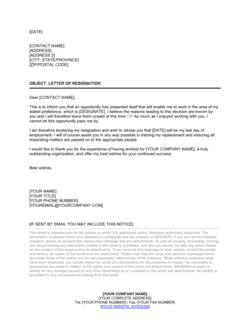
A resignation letter is issued by the employee to voluntarily end their employment. A notice of termination is issued by the employer. Both documents serve as formal written records of the ending date, but the legal implications β€” severance, unemployment eligibility, and COBRA continuation β€” differ significantly depending on which party initiates.

vs Lease Termination Letter

A lease termination letter ends a property rental agreement between landlord and tenant and addresses security deposits, move-out dates, and property condition. A notice of termination addresses employment or service relationships. While both follow a similar formal letter structure, the governing law and the obligations they trigger are entirely different.

Industry-specific considerations

Professional Services

Termination notices for project-based contractors and consultants commonly reference deliverable completion status and IP transfer obligations before the final date.

Retail and Hospitality

High employee turnover makes standardized termination notices essential for maintaining audit trails and ensuring consistent final-pay processing across locations.

Technology / SaaS

Access revocation timing and confidentiality reminders are critical components given departing employees' access to source code, customer data, and proprietary systems.

Construction and Trades

Subcontractor termination notices must address outstanding work completion, materials on site, and any applicable lien rights before the effective date.

Template vs pro β€” what fits your needs?

PathBest forCostTime
Use the templateStandard employment exits, vendor terminations, and end-of-contract notices for non-senior rolesFree10–15 minutes
Template + professional reviewTerminations involving documented performance issues, potential disputes, or senior employees with severance$100–$300 for a 30-minute HR or employment lawyer review1–2 days
Custom draftedC-suite exits, union employees, for-cause terminations with litigation risk, or cross-border employment$500–$2,000+3–7 days

Glossary

Notice Period
The amount of time between delivering the notice and the effective termination date, as required by the contract or applicable law.
Effective Date
The specific calendar date on which the termination takes legal effect and the relationship formally ends.
Termination for Cause
Ending a relationship due to a specific documented breach, misconduct, or failure β€” typically without a notice period or severance obligation.
Termination Without Cause
Ending a relationship for reasons unrelated to misconduct β€” restructuring, budget cuts, or strategic change β€” usually requiring notice or pay in lieu.
Pay in Lieu of Notice
A lump-sum payment made to the terminated party instead of requiring them to work through the notice period.
Final Pay
All wages, accrued vacation, and outstanding expense reimbursements owed to an employee as of their last day of work.
Severance
Compensation paid on top of final wages upon termination, typically calculated as a number of weeks' pay per year of service.
At-Will Employment
An employment arrangement, common in most US states, where either party may end the relationship at any time for any lawful reason without requiring advance notice.
Release of Claims
A document signed by the terminated party waiving the right to sue, often required before severance is paid.
Constructive Dismissal
When working conditions are changed so significantly by the employer that the employee is effectively forced to resign β€” treated legally as termination in many jurisdictions.

Part of your Business Operating System

This document is one of 3,000+ business & legal templates included in Business in a Box.

  • Fill-in-the-blanks β€” ready in minutes
  • 100% customizable Word document
  • Compatible with all office suites
  • Export to PDF and share electronically

Create your document in 3 simple steps.

From template to signed document β€” all inside one Business Operating System.
1
Download or open template

Access over 3,000+ business and legal templates for any business task, project or initiative.

2
Edit and fill in the blanks with AI

Customize your ready-made business document template and save it in the cloud.

3
Save, Share, Send, Sign

Share your files and folders with your team. Create a space of seamless collaboration.

Save time, save money, and create top-quality documents.

β˜…β˜…β˜…β˜…β˜…

"Fantastic value! I'm not sure how I'd do without it. It's worth its weight in gold and paid back for itself many times."

Managing Director Β· Mall Farm
Robert Whalley
Managing Director, Mall Farm Proprietary Limited
β˜…β˜…β˜…β˜…β˜…

"I have been using Business in a Box for years. It has been the most useful source of templates I have encountered. I recommend it to anyone."

Business Owner Β· 4+ years
Dr Michael John Freestone
Business Owner
β˜…β˜…β˜…β˜…β˜…

"It has been a life saver so many times I have lost count. Business in a Box has saved me so much time and as you know, time is money."

Owner Β· Upstate Web
David G. Moore Jr.
Owner, Upstate Web

Run your business with a system β€” not scattered tools

Stop downloading documents. Start operating with clarity. Business in a Box gives you the Business Operating System used by over 250,000 companies worldwide to structure, run, and grow their business.

Start freeΒ Β·Β No credit card required