Executive Summary - For Startups Template

Free Word download β€’ Edit online β€’ Save & share with Drive β€’ Export to PDF

2 pagesβ€’20–30 min to fillβ€’Difficulty: Standardβ€’Signature requiredβ€’Legal review recommended
Learn more ↓
FreeExecutive Summary - For Startups Template

At a glance

What it is
An Executive Summary for Startups is a concise, investor-facing document β€” typically 2–4 pages β€” that distills the core elements of a startup's business model, market opportunity, traction, team, and funding ask into a single structured overview. This free Word download gives founders a professional, investor-ready starting point they can edit online and export as PDF in under an hour.
When you need it
Use it when approaching angel investors, venture capitalists, or accelerators who request a written summary before reviewing a full business plan or sitting through a pitch. It is also the standard first document in a fundraising data room and the required submission for most startup competitions.
What's inside
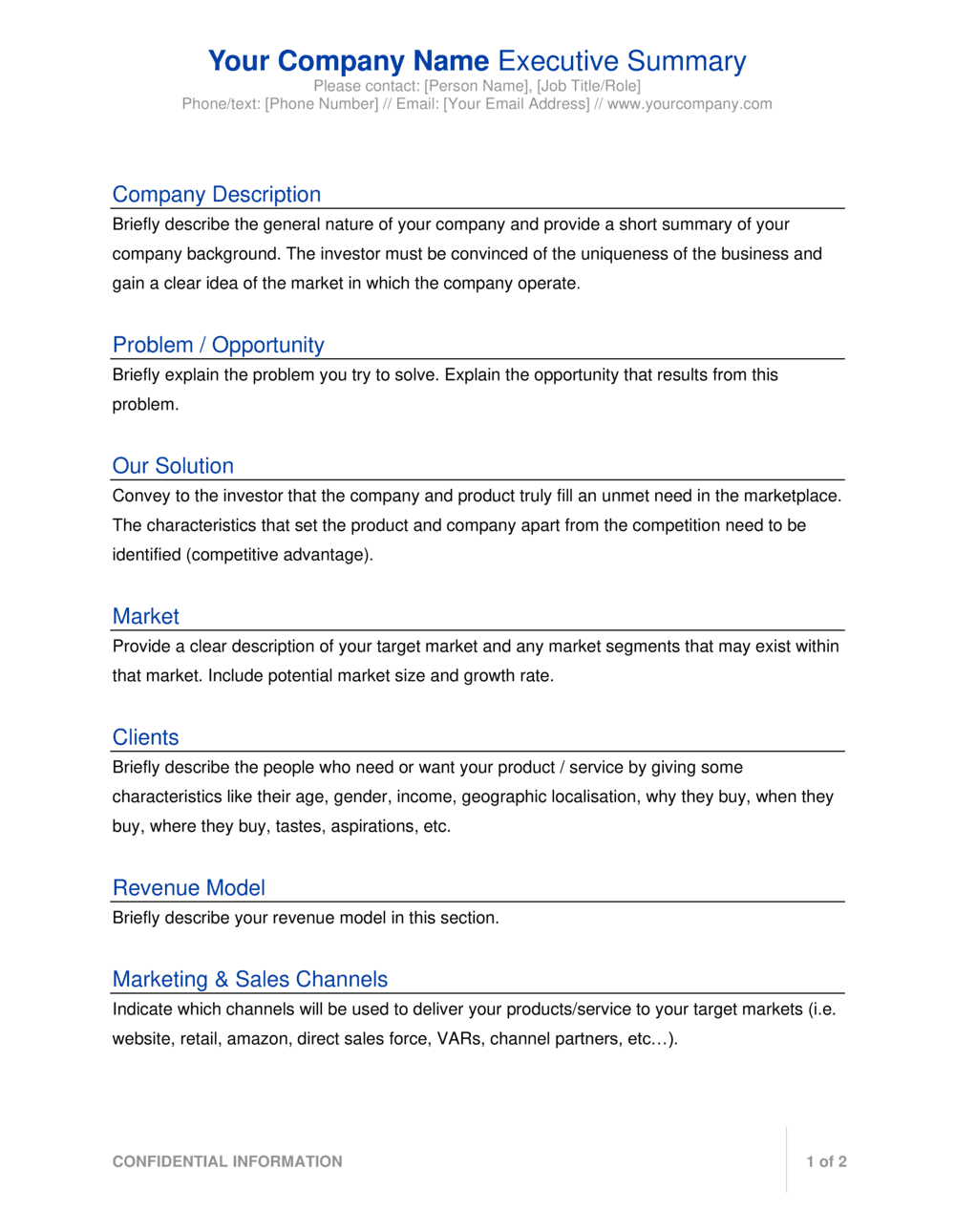
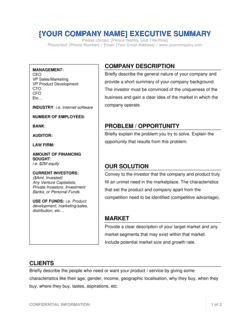
Company overview and mission, problem statement, proposed solution, target market and size, business model and revenue streams, traction and key metrics, competitive positioning, founding team credentials, and the specific funding ask with intended use of proceeds.

What is an Executive Summary for Startups?

An Executive Summary for Startups is a concise, investor-facing document β€” typically 2–4 pages β€” that presents the essential investment thesis of a startup in a single structured narrative. It covers the problem being solved, the proposed solution, the size of the market opportunity, the business model, early traction, competitive positioning, the founding team's credentials, and the specific capital being raised. Unlike a pitch deck, which relies on a live presenter, the executive summary must stand alone and communicate the full investment case to someone who has never spoken with the founders. It is the most frequently requested document in early-stage fundraising and the standard first submission for accelerators, angel groups, and seed-stage venture funds.

Why You Need This Document

Investors who receive a cold pitch deck without a written summary routinely pass without engaging β€” the deck demands time on a call before any context is established. A well-structured executive summary does the qualifying work in advance: it gives an investor enough information to decide whether the business fits their thesis, stage, and sector before a single meeting is scheduled. Without it, founders spend hours on exploratory calls that a two-page document would have filtered. Beyond fundraising, the discipline of compressing your market analysis, unit economics, and use-of-funds into four pages forces the clarity of thinking that accelerators and advisors consistently identify as the most reliable predictor of execution quality. Material misstatements in investor-facing summaries also carry legal exposure under securities law in every major jurisdiction β€” a professionally structured template helps founders present accurate, organized information that withstands scrutiny. This template gives you a complete, investor-ready starting point in under an hour.

Which variant fits your situation?

If your situation is…Use this template
Raising a pre-seed or seed round from angel investorsExecutive Summary For Startups
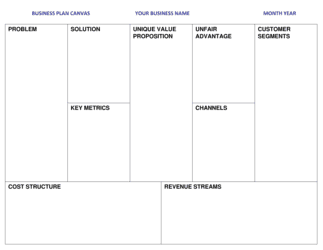
Submitting a two-page teaser to a VC fund's intake portalOne-Page Business Plan
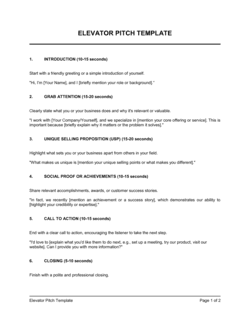
Preparing a 10–15 slide visual presentation for a live meetingElevator Pitch Template
Responding to a full due-diligence request from an institutional investorBusiness Plan Template
Summarizing a nonprofit program to present to a foundation or boardNonprofit Business Plan
Presenting a new product line to internal leadership or a board of directorsNew Product Launch Plan
Applying to a corporate accelerator requiring a structured submissionExecutive Summary For Startups

Common mistakes to avoid

❌ Writing the summary before finishing the business plan

Why it matters: An executive summary written in isolation contradicts the financial projections and market analysis in the full plan, undermining credibility at the diligence stage.

Fix: Draft the full business plan first, then extract the most compelling data point from each section to build the summary.

❌ Using vanity metrics as evidence of traction

Why it matters: App downloads, social followers, and press mentions do not demonstrate willingness to pay β€” experienced investors immediately ask for revenue and retention data, and the absence of it signals a weak business.

Fix: Lead with paying customers, MRR, and month-over-month growth. If revenue is zero, cite signed letters of intent with dollar values attached.

❌ Claiming no competition exists

Why it matters: Every investor knows every startup has at least the status quo as a competitor. Claiming otherwise signals poor market awareness and ends conversations before they start.

Fix: Name at least three alternatives β€” direct competitors and the status quo β€” and write one specific sentence explaining why your solution wins against each.

❌ Omitting the use-of-funds breakdown

Why it matters: A round amount with no allocation tells the investor you have not planned capital deployment β€” or that the number is arbitrary β€” reducing confidence in your ability to execute.

Fix: Break the ask into at least four buckets (product, sales and marketing, operations, G&A) with a dollar amount and percentage for each, tied to a named milestone.

❌ Padding founder bios with irrelevant credentials

Why it matters: A three-paragraph bio listing every job since college buries the one relevant achievement an investor actually needs to assess team credibility.

Fix: Lead each bio with the single most relevant, quantified accomplishment and cut everything that does not support the thesis that this team can execute this specific plan.

❌ Sending an executive summary without a specific funding ask

Why it matters: Investors who cannot determine the round size, instrument, or valuation cannot model their position β€” and most will not ask for clarification, they simply move on.

Fix: Always state the amount, instrument, and valuation cap or pre-money valuation explicitly, even if terms are still being finalized.

The 10 key clauses, explained

Company Overview and Mission Statement

In plain language: Identifies the startup by legal name, founding date, and location, and states the mission in one to two sentences that capture what the company does, for whom, and to what end.

Sample language
[COMPANY LEGAL NAME], founded in [YEAR] and incorporated in [STATE/COUNTRY], is a [STAGE] [INDUSTRY] company headquartered in [CITY]. Our mission is to [MISSION STATEMENT] for [TARGET CUSTOMER].

Common mistake: Using a brand tagline instead of a mission statement. A tagline markets; a mission statement frames the business problem being solved and who benefits β€” investors need the latter to evaluate fit.

Problem Statement

In plain language: Articulates the specific, painful, and measurable problem the startup addresses, establishing why the market is underserved by current solutions.

Sample language
[TARGET CUSTOMER] currently spends $[X] annually on [PAIN POINT], losing [TIME/MONEY/RESOURCE] because [ROOT CAUSE]. Existing solutions β€” [COMPETITOR A] and [COMPETITOR B] β€” fail to address [SPECIFIC GAP].

Common mistake: Stating the problem in abstract or jargon-heavy terms without quantifying the cost. Investors cannot assess market size or urgency without a concrete dollar or time figure attached to the pain.

Proposed Solution

In plain language: Describes what the startup has built or is building, how it solves the stated problem, and what makes the approach novel or defensible.

Sample language
[PRODUCT/SERVICE NAME] is a [DESCRIPTION] that enables [TARGET CUSTOMER] to [OUTCOME] in [TIMEFRAME], reducing [PAIN METRIC] by [X]%. Unlike [COMPETITOR], it [SPECIFIC DIFFERENTIATOR].

Common mistake: Leading with features and technical specifications rather than customer outcomes. Investors fund results, not product roadmaps β€” lead with the outcome and follow with the mechanism.

Market Opportunity (TAM, SAM, SOM)

In plain language: Quantifies the total addressable market, the serviceable segment the startup can realistically reach, and the obtainable portion it is targeting in the near term.

Sample language
The global [MARKET] market was valued at $[X]B in [YEAR] (Source: [CITATION]) and is projected to grow at [X]% CAGR through [YEAR]. Our initial serviceable market β€” [SEGMENT] β€” represents approximately $[X]M. We are targeting $[X]M of that in Year 1.

Common mistake: Using only top-down market sizing without a bottom-up validation. Claiming 1% of a $10B market with no model showing how to reach 1% of customers signals that the founder has not pressure-tested the assumption.

Business Model and Revenue Streams

In plain language: Explains how the startup generates revenue β€” pricing model, payment structure, average contract value, and any secondary revenue streams.

Sample language
[COMPANY NAME] generates revenue through [PRICING MODEL β€” e.g., SaaS subscription at $[X]/mo per seat / transaction fee of [X]% / license fee of $[X]/year]. Average contract value: $[X]. Secondary revenue: [STREAM, if any].

Common mistake: Describing the product without linking it to a revenue mechanism. An investor who cannot quickly identify how the company makes money β€” and at what margin β€” will not move forward.

Traction and Key Metrics

In plain language: Presents the most compelling evidence of market validation β€” revenue, active users, growth rate, signed customers, or letters of intent β€” with specific numbers and time periods.

Sample language
As of [DATE]: $[X] MRR ([X]% month-over-month growth), [X] paying customers, [X]% gross margin, [X] months of runway. Notable customers: [CUSTOMER NAME], [CUSTOMER NAME].

Common mistake: Listing vanity metrics β€” total sign-ups, app downloads, social media followers β€” instead of revenue or engagement metrics that demonstrate willingness to pay. Investors weight paying customers and retention above all else.

Competitive Landscape and Differentiation

In plain language: Identifies direct and indirect competitors, maps their positioning, and articulates the startup's specific, durable advantage β€” network effects, proprietary data, switching costs, or patents.

Sample language
Primary competitors: [COMPETITOR A] (priced at $[X]/mo, focused on [SEGMENT]) and [COMPETITOR B] (strong in [CHANNEL], lacks [FEATURE]). [COMPANY NAME] differentiates on [SPECIFIC ADVANTAGE], supported by [PATENT / DATA ASSET / NETWORK EFFECT].

Common mistake: Claiming no real competition exists. Every solution competes with the status quo. Stating otherwise destroys credibility with experienced investors who will independently identify the alternatives.

Founding Team and Key Hires

In plain language: Profiles the founders and any critical early hires, highlighting the specific prior experience and achievements most relevant to executing this business β€” not a full career history.

Sample language
[FOUNDER NAME], CEO β€” [X] years in [INDUSTRY], previously [ROLE] at [COMPANY] where [QUANTIFIED ACHIEVEMENT]. [CO-FOUNDER NAME], CTO β€” built [PRODUCT] used by [X] customers at [PRIOR COMPANY]. Hiring for: [ROLE] in [QUARTER/YEAR].

Common mistake: Padding bios with academic credentials and irrelevant work history. One specific, quantified achievement per person β€” 'grew ARR from $0 to $2M in 18 months' β€” outperforms a full LinkedIn summary.

Funding Ask and Use of Proceeds

In plain language: States the total capital being raised, the instrument offered, the valuation cap or pre-money valuation, and a breakdown of how the funds will be deployed across functional buckets.

Sample language
[COMPANY NAME] is raising $[AMOUNT] in [INSTRUMENT β€” e.g., pre-seed equity / convertible note / SAFE] at a $[VALUATION CAP / PRE-MONEY VALUATION]. Allocation: [X]% product development, [X]% sales and marketing, [X]% operations, [X]% G&A. This funding enables [MILESTONE] by [DATE].

Common mistake: Asking for a round amount with no breakdown and no milestone attached. 'We are raising $500K to grow the business' tells an investor nothing about capital efficiency or what they will own when the milestone is hit.

Contact Information and Next Steps

In plain language: Provides the founder's direct contact details and a clear call to action β€” typically a request for a meeting, a data room invitation, or a reference to the full business plan.

Sample language
To schedule a 30-minute call or request our full data room, please contact: [FOUNDER NAME] | [EMAIL] | [PHONE] | [LINKEDIN URL]. Full business plan and financial model available upon request.

Common mistake: Omitting contact details or burying them in a footer. Investors who want to move forward need a direct path to the founder β€” a corporate info@ address or missing phone number adds unnecessary friction.

How to fill it out

  1. 1

    Complete the company overview and mission statement

    Enter the startup's legal registered name, state or country of incorporation, founding year, city, and a one-to-two sentence mission that names what you do, for whom, and to what end.

    πŸ’‘ Write the mission statement before anything else β€” every subsequent section should directly support or amplify it.

  2. 2

    Quantify the problem with a specific cost or pain metric

    Describe the problem your startup solves and attach a dollar amount, time loss, or frequency metric that a third party can verify. Cite an industry source if possible.

    πŸ’‘ If you cannot quantify the problem in one sentence, the market may not be large enough to support a fundable startup.

  3. 3

    Frame the solution around the customer outcome

    Describe what your product or service does in plain language, state the specific outcome it produces for the customer, and name the one feature or mechanism that makes it different from every alternative.

    πŸ’‘ Read the solution paragraph aloud to someone unfamiliar with your industry β€” if they cannot paraphrase it back, it is too technical.

  4. 4

    Build market sizing from the bottom up

    Research TAM using at least two independent sources, then calculate SAM by multiplying the number of reachable target customers by your average contract value. State SOM as the realistic Year 1 target.

    πŸ’‘ Your bottom-up SAM and your top-down TAM should produce SOM estimates within 30% of each other β€” a wider gap signals a flawed assumption.

  5. 5

    State traction with specific, current numbers

    Enter your most recent MRR or ARR, customer count, month-over-month growth rate, gross margin, and runway. Use figures current to within 30 days of the document date.

    πŸ’‘ If you have zero revenue, lead with the strongest non-revenue signal β€” signed LOIs, a paid pilot, or a waitlist with documented conversion intent.

  6. 6

    Define the funding ask with a milestone and allocation

    Enter the total raise amount, the instrument (SAFE, convertible note, or priced equity), the valuation cap or pre-money valuation, and a four-bucket use-of-funds breakdown with percentages and dollar amounts.

    πŸ’‘ Tie the funding ask to a specific, time-bound milestone β€” 'reach $50K MRR by Month 18' β€” rather than a vague growth objective.

  7. 7

    Profile the team with quantified achievements

    Write one to three sentences per founder focused exclusively on the most relevant prior experience. Include a specific quantified achievement for each person β€” a company built, revenue grown, or product shipped.

    πŸ’‘ Investors back teams first, markets second β€” spend as much time on this section as on market sizing.

  8. 8

    Add contact information and a clear call to action

    Place the lead founder's name, direct email, phone number, and LinkedIn URL in the final section with a one-sentence call to action β€” request a meeting or offer data room access.

    πŸ’‘ Send the executive summary as a PDF attachment, not a link to a Google Doc β€” formatting shifts and access permissions create unnecessary friction at first contact.

Frequently asked questions

What is an executive summary for a startup?

A startup executive summary is a 2–4 page document that distills the core elements of the business for an investor audience: problem, solution, market size, business model, traction, competitive positioning, team, and funding ask. It is typically the first document an investor reads when evaluating a new opportunity and determines whether a follow-up meeting is scheduled. It is not a pitch deck and not a business plan β€” it sits between the two in level of detail.

How long should a startup executive summary be?

Two to four pages is the accepted range for an investor-facing executive summary. Two pages is appropriate for very early-stage companies with limited traction. Three to four pages works when there is meaningful financial data, a detailed competitive landscape, or a complex business model to explain. Anything over four pages is typically cut before it is read β€” investors treat length as a signal of the founder's ability to prioritize and communicate clearly.

What is the difference between an executive summary and a pitch deck?

A pitch deck is a 10–15 slide visual presentation designed for a live 20-minute meeting. An executive summary is a written document designed for asynchronous review β€” investors read it before agreeing to a meeting or as a follow-up to a deck. The deck generates interest; the executive summary provides enough structured detail for an investor to make an initial go/no-go decision. Both should be built from the same underlying facts and figures.

What traction metrics should a startup include in its executive summary?

Prioritize revenue metrics above all others: monthly recurring revenue (MRR), annual recurring revenue (ARR), month-over-month growth rate, and gross margin. If pre-revenue, use the strongest available signal β€” signed letters of intent with dollar values, paid pilots, waitlist size with documented conversion rates, or enterprise pilot agreements. Vanity metrics like app downloads or social followers carry almost no weight with experienced investors and should be omitted unless they directly correlate with a revenue mechanism.

Does an executive summary need to be signed?

A standalone executive summary is generally not a binding legal document and does not require signatures. However, when it is included in a formal fundraising package β€” alongside a term sheet, SAFE, or convertible note β€” the surrounding documents are executed by both parties. Some accelerators and corporate venture programs require founders to certify the accuracy of the summary as part of an application agreement. In those contexts, a signature block is appropriate and legally meaningful.

What should the funding ask section include?

At minimum: the total amount being raised, the instrument (equity, SAFE, convertible note), the valuation cap or pre-money valuation, and a four-bucket use-of-funds breakdown with dollar amounts and percentages. Close with a specific milestone the capital enables β€” for example, reaching $100K MRR by Month 18 or launching in two new markets by Q4. Investors fund milestones, not burn rates, so the milestone language is as important as the dollar figure.

When should a startup use an executive summary instead of a one-page plan?

Use an executive summary when engaging individual investors, family offices, angel groups, or early-stage VCs who expect structured written materials before a meeting. Use a one-page plan for internal alignment, early ideation, or quick-turnaround accelerator submissions that specify a one-page format. The executive summary is appropriate whenever the audience will have 10–15 minutes to read a document before making an evaluation decision.

How often should a startup update its executive summary?

Update it before every new investor outreach campaign β€” typically every 60–90 days during an active fundraise. Key metrics like MRR, customer count, and runway change fast in early-stage companies, and an outdated summary with stale numbers signals poor operational awareness. Treat the traction section as a living section that is refreshed monthly, even if the rest of the document stays stable.

Do I need a lawyer to review my executive summary?

For the document itself, legal review is typically not required for the narrative and operational sections. However, the funding ask section references securities instruments β€” SAFEs, convertible notes, or priced equity β€” that are governed by securities law in every major jurisdiction. Claims made in an executive summary can constitute representations to investors under securities fraud statutes. A one-hour review by a startup lawyer ($300–$500) to check the funding terms and any material claims is worthwhile before distributing the document broadly.

How this compares to alternatives

vs Business Plan

A business plan is a 20–35 page comprehensive document covering every aspect of the business in full detail, including a three-statement financial model. An executive summary is a 2–4 page distillation designed for first contact β€” it generates the conversation that leads to a request for the full plan. Sending a full business plan without first sharing an executive summary typically overwhelms early-stage investors and slows the process.

vs Elevator Pitch Template

An elevator pitch is a 60-to-90-second spoken script optimized for live or video meetings β€” it is conversational, short, and designed to secure a follow-up. An executive summary is a written document optimized for asynchronous review β€” it provides the structured detail investors need to make an initial evaluation without a call. The pitch gets you in the room; the executive summary keeps you there.

vs One-Page Business Plan

A one-page plan is a rapid-alignment tool for internal teams or early ideation, covering the business model in a single structured canvas. It lacks the financial depth, traction data, and competitive analysis that investors expect in an executive summary. Use the one-page plan to stress-test the idea internally, then build the executive summary for external fundraising conversations.

vs Investor Pitch Deck

A pitch deck is a visual slide presentation built for delivery in a live meeting β€” its impact depends heavily on the presenter and the room. An executive summary is a standalone written document that must communicate the full investment thesis without the founder present. Investors often review dozens of executive summaries before agreeing to see a deck, making the written summary the earlier and often higher-stakes document.

Industry-specific considerations

SaaS / Technology

MRR, churn rate, CAC payback, net revenue retention, and ARR growth rate are the traction metrics investors expect in technology executive summaries.

Healthcare / MedTech

Regulatory pathway (FDA 510(k), CE mark), reimbursement strategy, clinical validation status, and HIPAA compliance posture must be addressed alongside standard traction metrics.

Consumer / E-commerce

Average order value, repeat purchase rate, customer acquisition cost by channel, and contribution margin per order are the core unit economics to feature.

Fintech / Financial Services

Regulatory licensing status (money transmitter, broker-dealer, lending license), compliance infrastructure costs, and transaction volume alongside revenue metrics are expected by fintech-focused investors.

Professional Services

Billable utilization rate, revenue per employee, client concentration risk, and pipeline coverage ratio give investors visibility into the scalability constraints specific to services businesses.

Manufacturing / Hardware

Bill of materials cost, gross margin at scale, manufacturing partner agreements, and lead times are the operational metrics that differentiate credible hardware plans from aspirational ones.

Jurisdictional notes

United States

Material statements in an executive summary distributed to investors may constitute representations under federal securities law (SEC Rule 10b-5) and state blue-sky laws. Fundraising via SAFEs or convertible notes typically qualifies for Regulation D exemptions, but founders must confirm accredited investor status and file a Form D within 15 days of first sale. California-based fundraises are subject to additional state securities notice requirements.

Canada

Securities offerings to investors in Canada are governed by provincial securities regulators β€” primarily the OSC in Ontario and the BCSC in British Columbia. Most early-stage raises rely on the offering memorandum exemption or the accredited investor exemption under National Instrument 45-106. Material misrepresentations in a fundraising document create statutory liability under each province's securities act. Quebec investors must receive French-language materials if required under the Charter of the French Language.

United Kingdom

Financial promotions β€” including investor-facing executive summaries β€” must be approved by an FCA-authorized person before distribution to UK retail investors under the Financial Services and Markets Act 2000. Communications to sophisticated investors or high-net-worth individuals may qualify for exemptions under the Financial Promotion Order. Post-Brexit, UK and EU regulatory frameworks have diverged, and documents used for both markets should be reviewed separately.

European Union

Cross-border fundraising within the EU is subject to the Prospectus Regulation (EU) 2017/1129 for public offers above €8M; smaller raises typically rely on national private placement regimes or crowdfunding exemptions under the European Crowdfunding Service Providers Regulation (ECSPR). GDPR obligations apply to any personal data collected from EU-based investors during the fundraising process, including contact information gathered through the document.

Template vs lawyer β€” what fits your deal?

PathBest forCostTime
Use the templatePre-seed and seed founders approaching individual angels or early-stage accelerators with a standard narrative and sub-$500K raiseFree4–8 hours
Template + legal reviewFounders raising from institutional investors, including claims about IP, regulatory compliance, or material revenue figures that carry legal weight$300–$600 for a startup lawyer review of the funding terms and factual claims1–2 days
Custom draftedSeries A raises, regulated industries (fintech, healthtech), or situations where the executive summary is part of a formal securities offering memorandum$1,500–$5,000 combined with offering document preparation1–3 weeks

Glossary

Executive Summary
A 2–4 page overview of a startup's business model, market, traction, and funding ask β€” the first document most investors read when evaluating an opportunity.
Funding Ask
The specific dollar amount a startup is seeking to raise, the instrument being offered (equity, convertible note, or SAFE), and the intended use of the proceeds.
SAFE (Simple Agreement for Future Equity)
A financing instrument where an investor provides capital now in exchange for the right to receive equity at a future priced round, typically at a discount or with a valuation cap.
Convertible Note
A short-term debt instrument that converts into equity at a future funding round, usually with an interest rate, maturity date, and conversion discount.
Traction
Quantifiable evidence of market demand β€” such as monthly recurring revenue, active users, signed letters of intent, or customer growth rate.
TAM / SAM / SOM
Total Addressable Market, Serviceable Addressable Market, and Serviceable Obtainable Market β€” three nested measures of market size used to frame opportunity scale.
Valuation Cap
The maximum company valuation at which a convertible instrument converts into equity, protecting early investors from excessive dilution in a high-valuation future round.
Pre-Money Valuation
The agreed value of a company immediately before a new round of investment is received β€” used to calculate what percentage of equity investors receive for their capital.
Burn Rate
The monthly net cash outflow of a startup β€” how quickly it is spending its existing capital before reaching profitability or securing new funding.
Runway
The number of months a startup can operate at its current burn rate before running out of cash, assuming no new revenue or investment.
Unit Economics
Revenue and cost metrics measured at the level of a single customer or transaction, including customer acquisition cost (CAC) and lifetime value (LTV).
Data Room
A secure online repository where a startup stores due-diligence documents β€” including the executive summary, financials, cap table, and legal agreements β€” for investor review.

Part of your Business Operating System

This document is one of 3,000+ business & legal templates included in Business in a Box.

  • Fill-in-the-blanks β€” ready in minutes
  • 100% customizable Word document
  • Compatible with all office suites
  • Export to PDF and share electronically

Create your document in 3 simple steps.

From template to signed document β€” all inside one Business Operating System.
1
Download or open template

Access over 3,000+ business and legal templates for any business task, project or initiative.

2
Edit and fill in the blanks with AI

Customize your ready-made business document template and save it in the cloud.

3
Save, Share, Send, Sign

Share your files and folders with your team. Create a space of seamless collaboration.

Save time, save money, and create top-quality documents.

β˜…β˜…β˜…β˜…β˜…

"Fantastic value! I'm not sure how I'd do without it. It's worth its weight in gold and paid back for itself many times."

Managing Director Β· Mall Farm
Robert Whalley
Managing Director, Mall Farm Proprietary Limited
β˜…β˜…β˜…β˜…β˜…

"I have been using Business in a Box for years. It has been the most useful source of templates I have encountered. I recommend it to anyone."

Business Owner Β· 4+ years
Dr Michael John Freestone
Business Owner
β˜…β˜…β˜…β˜…β˜…

"It has been a life saver so many times I have lost count. Business in a Box has saved me so much time and as you know, time is money."

Owner Β· Upstate Web
David G. Moore Jr.
Owner, Upstate Web

Run your business with a system β€” not scattered tools

Stop downloading documents. Start operating with clarity. Business in a Box gives you the Business Operating System used by over 250,000 companies worldwide to structure, run, and grow their business.

Start freeΒ Β·Β No credit card required