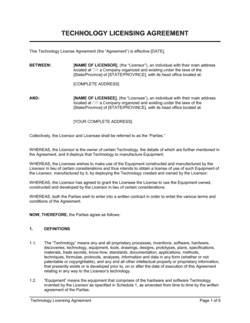
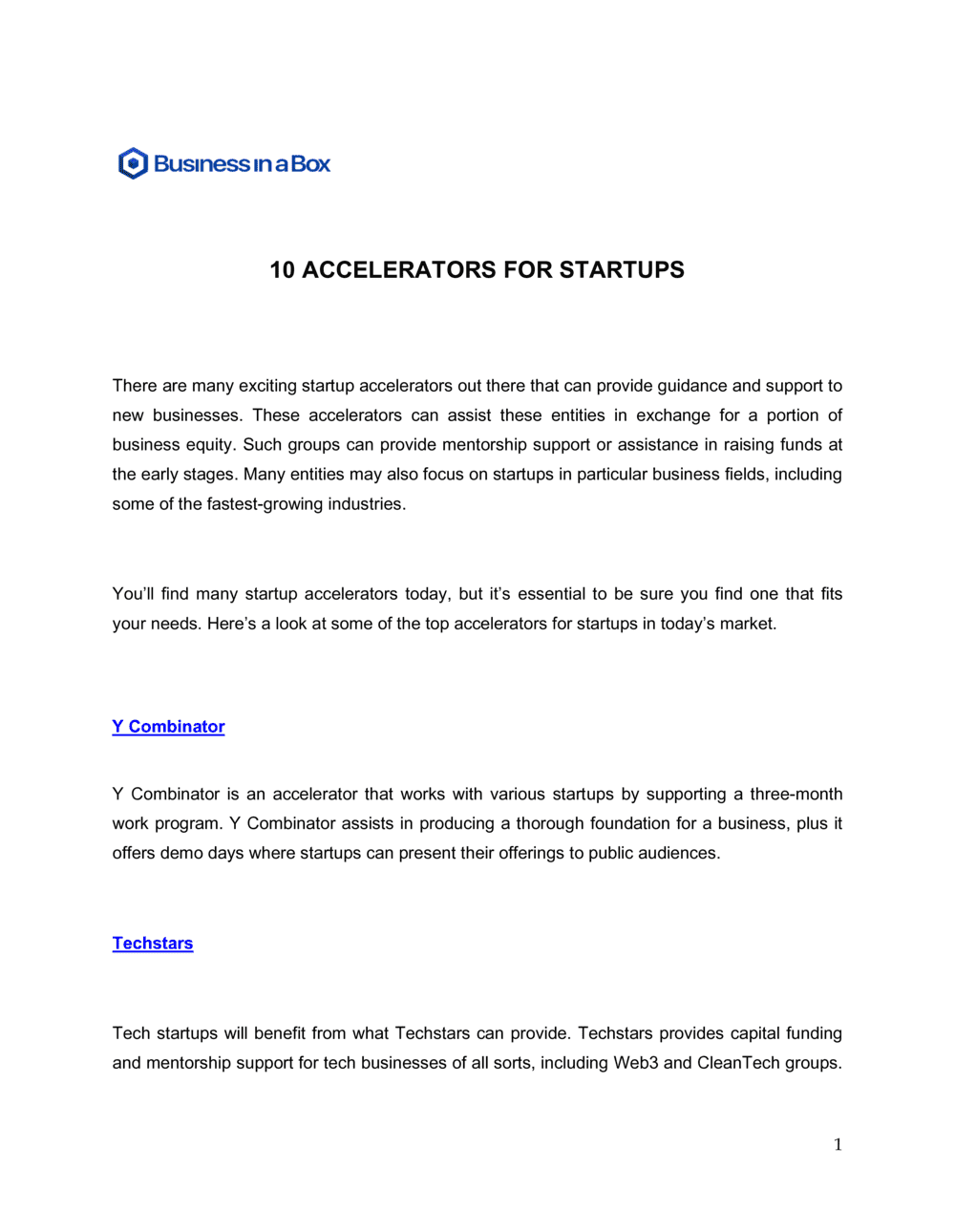
Accelerators For Startups Template

Free Word download • Edit online • Save & share with Drive • Export to PDF

3 pages25–30 min to fillDifficulty: StandardSignature requiredLegal review recommended
Learn more ↓
FreeAccelerators For Startups Template

At a glance

What it is
An Accelerators For Startups agreement is a legally binding contract between a startup accelerator program and a participating startup that defines the terms of the engagement — funding provided, equity taken, program obligations, IP rights, confidentiality, and exit conditions. This free Word download gives you a structured, attorney-reviewed starting point you can edit online and export as PDF for execution before a cohort begins.
When you need it
Use it when a startup accelerator is admitting a new company into its program in exchange for equity, a convertible note, or other consideration. It governs the relationship from the first day of the cohort through any post-program obligations such as follow-on rights or reporting requirements.
What's inside
Program terms and cohort schedule, funding and equity structure, IP assignment and licensing, confidentiality obligations, milestone and reporting requirements, anti-dilution protections, termination conditions, and governing law. All key clauses are pre-drafted with bracketed placeholders to minimize drafting time.

What is an Accelerators For Startups Agreement?

An Accelerators For Startups agreement is a legally binding contract between a startup accelerator program and a participating startup company that formally governs every dimension of the program relationship. It defines the funding the accelerator provides — whether cash stipend, SAFE, or convertible note — the equity or instrument the accelerator receives in exchange, the startup's program participation obligations, intellectual property and confidentiality terms, post-program reporting and information rights, and the accelerator's right to participate in future funding rounds. Unlike informal acceptance letters or term sheets, a properly executed accelerator agreement creates enforceable obligations on both sides and eliminates the ambiguity that routinely causes founder-accelerator disputes mid-cohort or at the next financing round.

Why You Need This Document

Without a signed accelerator agreement in place before the cohort begins, both the accelerator and the startup are exposed in ways that materialize quickly. Accelerators that disburse stipends without a written repayment and forfeiture mechanism have no contractual basis to recover funds if a startup withdraws early. Equity that has not been formally documented by a signed instrument is not reflected on the cap table, creating confusion — and sometimes litigation — when the startup raises its seed round and new investors demand a clean cap table. Startups that participate without a written agreement have no protection against accelerators asserting broad IP claims based on verbal program commitments. Post-program, accelerators without information rights clauses receive no financial updates and cannot exercise pro-rata rights before they expire. This template gives accelerator operators a structured, attorney-reviewed starting point that covers all of these gaps — closing in under an hour what would otherwise take weeks of back-and-forth negotiation before each cohort.

Which variant fits your situation?

If your situation is…Use this template
Accelerator takes a fixed equity stake at program entryAccelerators For Startups (Equity Model)
Accelerator provides funding via a convertible note instead of equityConvertible Note Agreement
Program offers mentorship only, with no equity or fundingIncubator Participation Agreement
Corporate accelerator requires IP licensing rather than assignmentTechnology License Agreement
Startup receives a SAFE instead of equity or a noteSimple Agreement for Future Equity (SAFE)
Post-program follow-on investment with pro-rata rightsSeed Investment Agreement
Accelerator and startup establishing a joint ventureJoint Venture Agreement

Common mistakes to avoid

❌ Using outstanding shares instead of fully diluted capitalization to calculate equity

Why it matters: The accelerator's modeled ownership percentage is materially understated once option pools, SAFEs, and convertible notes are included in the cap table — creating a discrepancy that founders will dispute at the next funding round.

Fix: Define equity percentage explicitly on a fully diluted basis and attach a pro-forma cap table as an exhibit showing how the accelerator's stake is calculated.

❌ No defined participation requirements or attendance minimums

Why it matters: Without measurable program obligations, the accelerator cannot terminate a non-participating startup for cause or withhold a second stipend tranche, leaving the program funding at risk.

Fix: Specify hours per week, required sessions, and milestone checkpoints in the body of the agreement — not in a separate program handbook that can be changed unilaterally.

❌ Omitting post-program information rights

Why it matters: Accelerators need cap table updates and financial data to exercise pro-rata rights before deadlines and to provide accurate portfolio reporting to their own investors and sponsors.

Fix: Include a 24–36 month information rights clause with specific deliverables (monthly financials, cap table on any new issuance, material event notices) and a delivery timeline for each.

❌ Signing the agreement after the cohort has already started

Why it matters: In common-law jurisdictions, a startup already receiving program benefits has given no new consideration for the equity and IP clauses signed later — potentially voiding those provisions.

Fix: Execute all documents before or on the official program start date. If execution is delayed, provide documented additional consideration — an extra stipend payment or program benefit — at the time of late signing.

❌ Broad IP assignment clause that transfers startup IP to the accelerator

Why it matters: No credible accelerator requires IP ownership. Including such a clause signals unsophisticated drafting, deters experienced founders, and may void the agreement entirely if it is found to be unconscionable.

Fix: Limit the accelerator's IP rights to a narrow promotional license covering the startup's name, logo, and product description, with an explicit carve-out confirming the startup retains all other IP.

❌ No cure period before termination for non-participation

Why it matters: Immediate termination without notice gives a startup grounds to challenge removal as wrongful and seek recovery of equity already issued, creating litigation exposure for the accelerator.

Fix: Require written notice of the deficiency and a 5–10 business day cure window before termination becomes effective for any breach other than fraud or criminal conduct.

The 10 key clauses, explained

Parties and program description

In plain language: Identifies the accelerator entity and the startup, states the program name and cohort cycle, and records the agreement effective date.

Sample language
This Accelerator Program Agreement is entered into as of [DATE] between [ACCELERATOR LEGAL NAME], a [STATE] [ENTITY TYPE] ('Accelerator'), and [STARTUP LEGAL NAME], a [STATE] [ENTITY TYPE] ('Company'). Company is accepted into the [PROGRAM NAME] Cohort [NUMBER], commencing [START DATE] and concluding [END DATE].

Common mistake: Using the startup's trade name rather than its registered legal entity. If the entity name on the agreement differs from the cap table entry, equity issuance can be delayed or legally challenged.

Program funding and stipend

In plain language: States the cash amount provided to the startup, the disbursement schedule, and any conditions precedent to receiving funds — such as signing, background checks, or entity formation.

Sample language
Accelerator shall provide Company a program stipend of $[AMOUNT] USD, disbursed as follows: $[AMOUNT 1] on [DATE 1] and $[AMOUNT 2] on [DATE 2], contingent on Company's execution of this Agreement and completion of required onboarding steps.

Common mistake: Disbursing the stipend before all conditions precedent are satisfied. If a startup fails to complete entity formation or background checks, recovering unearned funds without a written repayment obligation is difficult.

Equity compensation and issuance

In plain language: Defines the equity percentage the accelerator receives, the instrument used (common stock, preferred stock, SAFE, or convertible note), and the timeline for issuance.

Sample language
In consideration of the program benefits provided, Company shall issue to Accelerator [X]% of Company's fully diluted capitalization in the form of [INSTRUMENT], to be issued within [30] days of the Agreement effective date, on terms set out in Schedule A.

Common mistake: Stating equity as a percentage of outstanding shares rather than fully diluted capitalization. Outstanding-only calculations exclude option pools and convertible instruments, so the accelerator ends up with a larger slice than modeled once the cap table is properly diluted.

IP ownership and licensing

In plain language: Clarifies that the startup retains ownership of its intellectual property and that the accelerator receives only a limited license to use the startup's name, logo, and description for promotional purposes.

Sample language
Company retains all right, title, and interest in its Intellectual Property. Company grants Accelerator a non-exclusive, royalty-free license to use Company's name, logo, and product description solely to promote the Program and Accelerator's portfolio.

Common mistake: Including a broad IP assignment clause that transfers startup IP to the accelerator. No legitimate accelerator requires this, and it will deter sophisticated founders and their lawyers — or expose the accelerator to liability if the clause is later challenged.

Confidentiality obligations

In plain language: Establishes mutual confidentiality obligations covering the startup's business plans, technology, and financial information shared during the program.

Sample language
Each party agrees to hold the other's Confidential Information in strict confidence and not to disclose it to any third party without prior written consent, except as required by law. 'Confidential Information' means any non-public technical, financial, or business information disclosed in connection with the Program.

Common mistake: Making confidentiality one-sided in the accelerator's favor only. Startups share sensitive IP and financial data during the program; mutual obligations protect both parties and make the agreement more credible to founders' advisors.

Program obligations and milestones

In plain language: Sets out what the startup must do during the program — attendance requirements, mentor sessions, progress check-ins, and milestone targets — and what happens if the startup fails to participate.

Sample language
Company shall: (a) have at least one founder in residence at [LOCATION] or attending virtual sessions for no fewer than [X] hours per week; (b) complete all designated mentor sessions; and (c) present at Demo Day on [DATE]. Failure to meet participation requirements may result in termination under Section [X].

Common mistake: Leaving participation requirements vague. Without defined attendance and milestone standards, the accelerator has no contractual basis to terminate a non-participating startup or withhold a second funding tranche.

Information rights and reporting

In plain language: Requires the startup to deliver financial statements, cap table updates, and material-event notices to the accelerator on a specified schedule after the program ends.

Sample language
For [24] months following Demo Day, Company shall deliver to Accelerator: (a) unaudited monthly financials within [15] business days of month-end; (b) a current cap table within [5] business days of any equity issuance; and (c) prompt written notice of any Material Event, including a financing round closing or a change of control.

Common mistake: Omitting post-program information rights entirely. Accelerators need ongoing visibility into portfolio company performance to manage their own fund reporting and exercise pro-rata rights before deadlines expire.

Pro-rata and follow-on investment rights

In plain language: Grants the accelerator the right to participate in future funding rounds up to its pro-rata share, typically for a defined period after the program ends.

Sample language
Accelerator shall have the right, but not the obligation, to invest in any future Qualified Financing of Company on the same terms as other investors, in an amount up to Accelerator's pro-rata share based on its then-current fully diluted ownership, for a period of [36] months following the Agreement effective date.

Common mistake: Failing to define a 'Qualified Financing' threshold. Without a minimum round size (e.g., '$500,000 or more'), the pro-rata right can be triggered by small bridge notes, creating administrative burden and potential deal friction.

Termination and program removal

In plain language: States the conditions under which either party may exit the agreement early, the notice required, and what happens to equity and any unspent stipend funds on early termination.

Sample language
Accelerator may terminate Company's participation for Cause immediately upon written notice. 'Cause' includes material breach of this Agreement, fraud, or failure to meet participation requirements after [5] business days' written notice to cure. Upon termination for Cause, any undisbursed stipend tranche is forfeited, and Accelerator retains the equity already issued.

Common mistake: No cure period before termination for minor breaches. Immediate termination clauses without a notice-and-cure window expose the accelerator to wrongful-termination claims from startups that had a brief lapse in participation.

Governing law and dispute resolution

In plain language: Specifies which jurisdiction's law governs the agreement and whether disputes are resolved by arbitration, mediation, or litigation.

Sample language
This Agreement is governed by the laws of the State of [STATE], without regard to conflicts-of-law principles. Any dispute arising out of or relating to this Agreement shall be resolved by binding arbitration administered by [AAA / JAMS] in [CITY, STATE], except that either party may seek injunctive relief in any court of competent jurisdiction.

Common mistake: Choosing a governing law state with no connection to either party's operations. Courts in some jurisdictions will apply local law regardless — particularly in Canada, the UK, and the EU — making a mismatch between stated law and operational reality a litigation risk.

How to fill it out

  1. 1

    Enter legal entity names and program details

    Use the full registered legal name of the accelerator and the startup — not trade names or program brand names. Include the program name, cohort number, and exact start and end dates.

    💡 Verify the startup's entity formation documents before execution. An agreement with an unformed or dissolved entity cannot be enforced against the founders personally without separate guarantee language.

  2. 2

    Set the funding amount and disbursement schedule

    Enter the total stipend, the tranche amounts, and the specific disbursement dates or triggering milestones. List every condition precedent to the first tranche — entity formation, background check, signed documents.

    💡 Tie the second tranche to a midpoint milestone (e.g., completion of mentor sessions) rather than a fixed date. This gives the accelerator leverage if participation lags.

  3. 3

    Define the equity instrument and percentage

    Choose the instrument — common stock, SAFE, or convertible note — and enter the exact percentage on a fully diluted basis. Attach the instrument as Schedule A with all relevant terms, including any valuation cap or discount rate.

    💡 For SAFE or convertible note structures, confirm the valuation cap reflects current market benchmarks for your program's stage and sector to avoid founders rejecting terms as below-market.

  4. 4

    Confirm IP and confidentiality terms

    Ensure the IP clause grants the accelerator only a promotional license — not an assignment or broad license. Review the confidentiality definition to confirm it covers both parties' sensitive information.

    💡 Add a specific carve-out permitting the accelerator to share portfolio company details with its limited partners under a confidentiality obligation — this is standard in fund reporting.

  5. 5

    Specify program participation requirements

    List attendance minimums, required mentor sessions, check-in frequency, and any Demo Day obligations. Include the consequence — typically termination with forfeiture of undisbursed funds — for non-compliance.

    💡 Define 'in residence' or 'virtual attendance' precisely. Vague presence requirements are the single most common source of founder-accelerator disputes mid-cohort.

  6. 6

    Set post-program information rights and pro-rata terms

    Enter the reporting period (typically 18–36 months post-Demo Day), the reporting cadence, and the qualified financing threshold that triggers pro-rata rights.

    💡 Set the qualified financing floor at a round size your portfolio companies realistically reach — $250,000 is too low for most accelerators; $500,000–$1,000,000 is more standard.

  7. 7

    Review termination and cure provisions

    Confirm that termination for material breach includes a 5–10 business day cure period. Verify that the equity retention and stipend forfeiture mechanics on early termination are consistent with the disbursement schedule in the funding clause.

    💡 Have both parties initial the termination clause separately to confirm they have read the forfeiture terms — this reduces disputes when a startup is later removed from the program.

  8. 8

    Execute before the cohort start date

    Both parties must sign before the program begins. Post-start execution creates consideration problems in common-law jurisdictions and may invalidate key clauses, particularly IP restrictions and equity issuance obligations.

    💡 Use a digital signature tool with a timestamp audit trail. Store the fully-executed copy in a secure document vault accessible to both parties.

Frequently asked questions

What is an accelerators for startups agreement?

An accelerators for startups agreement is a legally binding contract between a startup accelerator program and a participating startup that governs the terms of the engagement. It specifies the funding provided, the equity or instrument the accelerator receives in return, the startup's program obligations, IP and confidentiality terms, and post-program rights such as follow-on investment and reporting. It replaces informal program letters of intent with enforceable obligations on both sides.

How much equity do accelerators typically take?

Most accelerators take between 3% and 10% of a startup's fully diluted capitalization. Top-tier programs such as Y Combinator have historically taken approximately 7% in exchange for a standard funding amount. Corporate and university accelerators sometimes take 0% equity in exchange for fees or licensing arrangements. The percentage should always be stated on a fully diluted basis to avoid cap table disputes at the next financing round.

What is the difference between an accelerator and an incubator?

Accelerators run fixed-duration, cohort-based programs — typically 3 to 6 months — that culminate in a Demo Day pitch to investors. They almost always provide funding in exchange for equity. Incubators provide longer-term support (12–36 months), often with physical office space and mentorship, but typically do not take equity and do not operate on a cohort model. The agreements governing each are structurally different: accelerator agreements focus on equity terms and program obligations, while incubator agreements focus on space use, service terms, and milestone-based continuation.

Does a startup need a lawyer before signing an accelerator agreement?

For well-known programs with standardized terms — such as Y Combinator's SAFE or Techstars' standard docs — a founder can sign with a basic review. For any program using custom agreements, particularly those with unusual IP clauses, broad equity provisions, or corporate accelerators with strategic partnership obligations, engaging a startup attorney for a 1–2 hour review is strongly advisable. The cost is typically $300–$800 and can prevent equity or IP terms that follow the startup for its entire lifecycle.

What happens to the accelerator's equity if the startup fails?

If the startup is dissolved, the accelerator's equity interest is extinguished with the entity. Most accelerators do not have personal recourse against founders for equity value lost on a failed company. However, if the accelerator provided a convertible note rather than equity, the note becomes a debt obligation of the startup entity — though practically, recovery from a dissolved startup with no assets is rare. The agreement should explicitly state that the accelerator's investment is at-risk capital with no personal guarantee from founders.

Can an accelerator agreement be terminated early?

Yes, typically by either party. Accelerators can terminate for cause — material breach, fraud, or non-participation — usually after a notice and cure period. Startups can withdraw, though withdrawal typically results in forfeiture of any undisbursed stipend tranches. The equity already issued is generally retained by the accelerator regardless of which party initiates early termination, since it represents consideration already received by the startup. Early termination mechanics should be fully specified in the agreement before signing.

Are accelerator agreements enforceable internationally?

Generally yes, but enforceability depends on the governing law specified and where the parties operate. In the US, accelerator agreements are routinely enforced under standard contract principles. In the EU, certain startup-protective regulations may override contractual terms — particularly around IP and information rights. Cross-border accelerator programs should specify governing law carefully and consider whether local employment-like regulations could recharacterize the startup-accelerator relationship in jurisdictions with strong founder-protection rules.

What is a Demo Day and does the agreement cover it?

Demo Day is the pitch event at the end of the accelerator program where startups present to investors, press, and partners. The accelerator agreement should require attendance as a program obligation and grant the accelerator a license to record, stream, and distribute the startup's Demo Day presentation for promotional purposes. Startups should confirm the agreement's IP license covers Demo Day materials specifically and does not inadvertently grant rights to underlying product IP or source code.

What is the difference between a SAFE and a convertible note in an accelerator context?

A SAFE (Simple Agreement for Future Equity) converts to equity at a future priced round without accruing interest or carrying a maturity date, making it simpler and less administratively burdensome than a convertible note. A convertible note is debt that accrues interest and must be repaid or converted by a maturity date, creating a repayment obligation if the startup does not raise a qualifying round. Most modern accelerators use SAFEs or issue equity directly; convertible notes are more common in angel and bridge financing contexts outside formal accelerator programs.

How this compares to alternatives

vs Convertible Note Agreement

A convertible note is a standalone debt instrument that converts to equity at a future financing round. An accelerator agreement is a comprehensive program contract that may include a convertible note as one component alongside program obligations, IP terms, and participation requirements. Use a convertible note alone for bridge financing; use an accelerator agreement when formalizing the full program relationship.

vs Seed Investment Agreement

A seed investment agreement governs a direct equity investment with no program or participation obligations attached. An accelerator agreement ties the equity grant to program attendance, mentor sessions, Demo Day, and ongoing reporting obligations. If a funder is simply writing a check with no programmatic expectations, a seed investment agreement is the right document.

vs Joint Venture Agreement

A joint venture agreement creates a new shared entity or ongoing commercial collaboration between two parties with aligned interests. An accelerator agreement is a one-directional support arrangement — the accelerator provides resources and funding; the startup participates and issues equity. A joint venture is appropriate when the accelerator and startup are co-developing a product or sharing revenue, not merely running a program.

vs Technology License Agreement

A technology license agreement grants one party the right to use another's IP under specified conditions. In an accelerator context, a license agreement is appropriate when a corporate accelerator wants access to the startup's technology as part of the program rather than equity. An accelerator agreement with a built-in IP license clause is more appropriate when the program relationship involves both funding and limited promotional IP access.

Industry-specific considerations

Technology / SaaS

Software IP ownership and open-source license compliance are critical; the agreement must confirm the startup retains all source code and proprietary algorithms with no accelerator license beyond promotional use.

Life Sciences / Biotech

Patent ownership, university technology transfer obligations, and regulatory milestone definitions require bespoke IP and milestone language that standard accelerator templates must be adapted to include.

Fintech

Regulatory licensing status, data privacy obligations, and restrictions on sharing customer data with accelerator sponsors must be addressed explicitly in the confidentiality and information rights clauses.

Hardware / Deep Tech

Physical prototype ownership, manufacturing partnership introductions made by the accelerator, and export control compliance on dual-use technologies require additional representations and warranties not present in software-focused templates.

Consumer Goods / E-commerce

Brand license terms for accelerator co-marketing, retail partnership introductions, and supply chain introductions made during the program may create post-program obligations that should be addressed in the agreement.

Social Impact / Nonprofit

Equity-for-funding models may be inappropriate for nonprofit entities; impact accelerators typically use grant agreements or revenue-share arrangements that require a structurally different agreement.

Jurisdictional notes

United States

Accelerator agreements in the US are governed by standard contract law in the state of incorporation, with Delaware being most common for startup entities. SAFE instruments are widely accepted and largely unregulated at the federal level, though SEC exemptions (Regulation D, Rule 506(b) or 506(c)) must be confirmed before issuing any equity or convertible instrument. California-based accelerators should note that broad IP assignment clauses are limited by Labor Code §2870, which protects employee and contractor inventions developed without company resources.

Canada

Canadian accelerators should use an equity or SAFE structure consistent with provincial securities law exemptions — the 'accredited investor' or 'offering memorandum' exemptions are most common. Quebec-based programs must provide French-language versions of material documents under the Charter of the French Language. IP assignment clauses are generally enforceable, but courts have narrowed overbroad assignments that purport to cover inventions with no nexus to the company's business.

United Kingdom

UK accelerator agreements typically use EIS- or SEIS-eligible structures to allow investors and accelerators to claim tax relief on qualifying investments. Equity issuance must comply with Companies Act 2006 share allotment requirements, and the accelerator's equity stake must be properly registered at Companies House. Post-Brexit, UK-based programs operating with EU startups should specify governing law carefully, as EU consumer and data protection rules may override UK contractual terms for EU-resident founders.

European Union

EU accelerator programs must comply with GDPR when collecting and processing startup founder data, including financial information and cap table details shared during the program. Equity instruments used by EU-based accelerators must comply with member-state securities regulations, which vary significantly — French PEA-eligible instruments differ from German GmbH share transfer requirements. Accelerators operating across multiple EU member states should obtain country-specific legal confirmation before executing agreements with startups incorporated in jurisdictions outside their home country.

Template vs lawyer — what fits your deal?

PathBest forCostTime
Use the templateEarly-stage accelerators running their first cohort with straightforward equity-for-funding termsFree30–60 minutes
Template + legal reviewPrograms involving corporate sponsors, university IP, cross-border startups, or non-standard equity instruments$500–$1,5003–5 business days
Custom draftedInstitutional accelerators managing a fund structure, regulated industries such as fintech or biotech, or programs with material pro-rata and follow-on investment rights$3,000–$10,000+2–4 weeks

Glossary

Cohort
The group of startups admitted to a single program cycle, typically running 3–6 months alongside each other with shared programming.
Equity Stake
The ownership percentage the accelerator receives in the startup in exchange for funding, resources, and program participation.
Convertible Note
A short-term debt instrument that converts into equity at a future financing round, typically at a discount or with a valuation cap.
SAFE (Simple Agreement for Future Equity)
A contract granting the accelerator the right to receive equity in the startup at a future priced round, without accruing interest or having a maturity date.
Pro-Rata Rights
A contractual right allowing the accelerator to invest in future funding rounds in proportion to its existing ownership, preventing dilution.
Vesting Schedule
A timeline over which equity earned by founders or granted to the accelerator becomes fully owned, often tied to continued participation milestones.
Anti-Dilution Protection
A clause that adjusts the accelerator's ownership percentage if the startup later issues shares at a lower valuation than the accelerator's entry price.
IP Assignment
A clause transferring ownership of the startup's intellectual property — patents, software, trademarks — to a specified entity as part of the program terms.
Demo Day
A structured pitch event at the end of the accelerator program where participating startups present to investors, press, and potential partners.
Right of First Refusal (ROFR)
A contractual right giving the accelerator the option to invest in the startup's next funding round before the startup accepts terms from a third-party investor.
Program Stipend
A cash payment made by the accelerator to the startup at program entry, typically ranging from $10,000 to $150,000 depending on the program.
Information Rights
Contractual provisions requiring the startup to deliver financial statements, cap table updates, and material-event notices to the accelerator on a defined schedule.

Part of your Business Operating System

This document is one of 3,000+ business & legal templates included in Business in a Box.

  • Fill-in-the-blanks — ready in minutes
  • 100% customizable Word document
  • Compatible with all office suites
  • Export to PDF and share electronically

Create your document in 3 simple steps.

From template to signed document — all inside one Business Operating System.
1
Download or open template

Access over 3,000+ business and legal templates for any business task, project or initiative.

2
Edit and fill in the blanks with AI

Customize your ready-made business document template and save it in the cloud.

3
Save, Share, Send, Sign

Share your files and folders with your team. Create a space of seamless collaboration.

Save time, save money, and create top-quality documents.

★★★★★

"Fantastic value! I'm not sure how I'd do without it. It's worth its weight in gold and paid back for itself many times."

Managing Director · Mall Farm
Robert Whalley
Managing Director, Mall Farm Proprietary Limited
★★★★★

"I have been using Business in a Box for years. It has been the most useful source of templates I have encountered. I recommend it to anyone."

Business Owner · 4+ years
Dr Michael John Freestone
Business Owner
★★★★★

"It has been a life saver so many times I have lost count. Business in a Box has saved me so much time and as you know, time is money."

Owner · Upstate Web
David G. Moore Jr.
Owner, Upstate Web

Run your business with a system — not scattered tools

Stop downloading documents. Start operating with clarity. Business in a Box gives you the Business Operating System used by over 250,000 companies worldwide to structure, run, and grow their business.

Free Forever Plan · No credit card required