Letter_Purchase Order Issued on Acceptance of Delivery Date Template

Free Word download • Edit online • Save & share with Drive • Export to PDF

1 page20–30 min to fillDifficulty: StandardSignature requiredLegal review recommended
Learn more ↓
FreeLetter_Purchase Order Issued on Acceptance of Delivery Date Template

At a glance

What it is
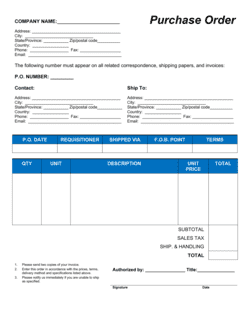
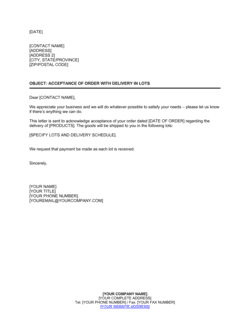
A Letter Purchase Order Issued On Acceptance Of Delivery Date is a formal binding document a buyer sends to a supplier to confirm that a purchase order is issued contingent on the supplier's acceptance of a specified delivery date. This free Word download lets you define the goods, quantity, price, delivery schedule, and acceptance conditions in a single professional letter you can edit online and export as PDF for execution.
When you need it
Use it when you need to lock in a supplier's commitment to a delivery timeline before the purchase order becomes fully binding — particularly for time-sensitive procurement, production scheduling, or contractual supply chain deadlines. It is the right tool when a verbal delivery commitment is insufficient and you need a signed record that the supplier has accepted the stated date as a condition of the order.
What's inside
Buyer and supplier identification, order reference number, itemized description of goods, unit price and total order value, the specific delivery date subject to acceptance, acceptance conditions, payment terms, inspection and rejection rights, consequences of late delivery, and governing law and signature blocks for both parties.

What is a Letter Purchase Order Issued On Acceptance Of Delivery Date?

A Letter Purchase Order Issued On Acceptance Of Delivery Date is a formal binding procurement document a buyer sends to a supplier to confirm that a purchase order is issued conditionally — it becomes fully effective only once the supplier provides written acceptance of a specified delivery date. Unlike a standard purchase order that creates an immediate bilateral obligation, this letter structures the commitment as a condition precedent: the buyer states the goods, quantity, price, and required delivery date, and the supplier must formally accept that date in writing before the order locks in. This mechanism gives the buyer documented assurance that the supplier can meet a critical schedule before any binding obligation arises, and creates an enforceable delivery commitment once acceptance is given.

Why You Need This Document

Relying on a standard purchase order or verbal delivery assurances when timing is critical exposes your business to significant operational and financial risk. Without a formal acceptance mechanism, a supplier who later misses the delivery date faces no clearly documented commitment to breach — and proving damages in the absence of written terms is slow and expensive. A missed delivery in a production environment can halt an assembly line, trigger customer penalties, or cause a product launch to slip, with costs that far exceed the value of the original order. This letter closes that gap by making the delivery date a documented, bilateral condition of the contract, including explicit consequences for non-delivery — cancellation rights, liquidated damages, or the right to source substitute goods at the supplier's cost. The template gives you a professionally structured starting point that you can customize for any procurement scenario in minutes, with all the clauses needed to make the commitment enforceable.

Which variant fits your situation?

If your situation is…Use this template
Ordering goods where no delivery date negotiation is requiredStandard Purchase Order
Requesting a quote before committing to an orderRequest for Quotation Letter
Confirming receipt of goods already deliveredDelivery Confirmation Letter
Cancelling a purchase order due to missed deliveryPurchase Order Cancellation Letter
Placing a recurring order on an agreed scheduleBlanket Purchase Order
Engaging a supplier under a long-term supply frameworkSupply Agreement
Ordering goods internationally with customs and shipping termsInternational Purchase Order

Common mistakes to avoid

❌ No deadline for the supplier's acceptance

Why it matters: Without a response window, the supplier can accept days or weeks later when your delivery schedule has changed, creating a binding order at an inconvenient time with no recourse.

Fix: Always state a specific number of business days — typically five — within which the supplier must return written acceptance, and declare the PO void if no acceptance is received.

❌ Omitting 'time is of the essence' language

Why it matters: Without this clause, courts in most common-law jurisdictions treat a missed delivery date as a minor breach that does not entitle the buyer to cancel the order or claim significant damages.

Fix: Add a specific 'time is of the essence' declaration in the delivery clause so the delivery date is treated as a material term of the agreement.

❌ Vague or unattached goods specification

Why it matters: A description like 'industrial components as discussed' is unenforceable — disputes over whether delivered goods conform to the order are the most common source of procurement litigation.

Fix: Attach a written specification sheet, product data sheet, or sample reference as a numbered exhibit and cross-reference it in the goods description clause.

❌ No liquidated damages or cancellation right for late delivery

Why it matters: Without stated consequences, a supplier who misses the delivery date faces no immediate financial risk, and the buyer must prove actual damages — a slow, expensive process — to recover anything.

Fix: Include either a per-day delay fee calibrated to your actual daily cost exposure, a right to cancel and source substitute goods at the supplier's expense, or both.

❌ Tying payment to invoice date rather than accepted delivery

Why it matters: If the supplier invoices before the buyer has completed inspection and accepted the goods, the payment due date arrives while goods may still be under review or subject to rejection.

Fix: State that payment terms run from the buyer's written acceptance of the goods following inspection, not from the date of the supplier's invoice.

❌ Using a trade name instead of the registered legal entity

Why it matters: If enforcement is needed, a PO issued to a trade name rather than the registerd legal entity can create standing problems — you may have contracted with a name that has no legal existence.

Fix: Verify each party's full registered legal name against corporate registry records before issuing the letter, and use those exact names in the parties clause.

The 10 key clauses, explained

Parties and Order Reference

In plain language: Identifies the buyer and supplier as legal entities, assigns a unique purchase order number, and records the date of issue.

Sample language
This Purchase Order ([PO NUMBER]) is issued on [DATE] by [BUYER LEGAL NAME], a [STATE/COUNTRY] [ENTITY TYPE] ('Buyer'), to [SUPPLIER LEGAL NAME], a [STATE/COUNTRY] [ENTITY TYPE] ('Supplier').

Common mistake: Using a trade name instead of the registered legal entity name. If the buyer's legal name differs from its brand, payment processing and dispute resolution become complicated when the PO is the primary reference document.

Description of Goods

In plain language: Specifies exactly what is being ordered — product name, SKU or part number, quantity, unit of measure, and technical specifications or a reference to an attached specification sheet.

Sample language
Supplier shall deliver [QUANTITY] units of [PRODUCT NAME / SKU] conforming to the specifications set out in Exhibit A, attached hereto and incorporated by reference.

Common mistake: Referencing a verbal or informal specification without attaching a written exhibit. Disputes about whether delivered goods conform to the order almost always stem from an undocumented specification.

Unit Price and Total Order Value

In plain language: States the agreed price per unit, any applicable taxes or duties, and the total order value so both parties have a single authoritative figure.

Sample language
The agreed unit price is [CURRENCY][UNIT PRICE], exclusive of [VAT / GST / APPLICABLE TAXES]. The total order value is [CURRENCY][TOTAL AMOUNT], subject to adjustment only by written amendment signed by both parties.

Common mistake: Omitting the currency or tax treatment on cross-border orders. A price stated without currency and tax basis is routinely disputed at invoice stage.

Acceptance of Delivery Date Condition

In plain language: States that this purchase order is issued conditionally and becomes binding only upon the supplier's written acceptance of the specified delivery date within a defined response window.

Sample language
This Purchase Order is issued subject to Supplier's written acceptance of the delivery date stated in Clause [X] within [5] business days of the date of this letter. Failure to accept within this period shall render this Purchase Order void and of no effect.

Common mistake: Issuing the PO without a deadline for the supplier's acceptance. Without a response window, the supplier can accept weeks later when the buyer's timeline has already shifted, creating an unintended binding obligation.

Delivery Date, Location, and Shipping Terms

In plain language: Specifies the exact delivery date, the delivery address, the shipping method or carrier, and the Incoterms or FOB point that determines when risk passes to the buyer.

Sample language
Supplier shall deliver the Goods to [DELIVERY ADDRESS] no later than [DELIVERY DATE] via [SHIPPING METHOD / CARRIER]. Title and risk of loss shall pass to Buyer upon delivery at the Delivery Address ([FOB DESTINATION / INCOTERMS TERM]).

Common mistake: Specifying a delivery date without a 'time is of the essence' declaration. Without this language, late delivery is treated as a minor breach — not grounds for rejection or cancellation — in most common-law jurisdictions.

Inspection and Acceptance

In plain language: Gives the buyer a defined window after delivery to inspect the goods and either formally accept them or reject them for non-conformance, and specifies the process for handling rejected goods.

Sample language
Buyer shall have [10] business days following delivery to inspect the Goods. Buyer may reject non-conforming Goods by written notice within this period. Rejected Goods shall be returned at Supplier's cost and expense.

Common mistake: Setting an inspection window that is too short for the goods being ordered. For complex equipment or large shipments, a 2-business-day window is unworkable and leaves the buyer deemed to have accepted defective goods by default.

Late Delivery and Liquidated Damages

In plain language: States the consequences of the supplier missing the delivery date — typically a right to cancel, a right to source replacement goods, and/or a daily liquidated damages rate for delay.

Sample language
If Supplier fails to deliver by the Delivery Date, Buyer may, at its option: (a) cancel this Purchase Order without liability; (b) accept late delivery subject to a daily delay fee of [CURRENCY][AMOUNT] per day; or (c) source substitute goods from a third party and charge Supplier for any excess cost.

Common mistake: Omitting a liquidated damages or delay fee clause entirely. Without it, the buyer must prove actual damages in litigation — a slow and expensive process that most buyers avoid, leaving late delivery effectively consequence-free for the supplier.

Payment Terms

In plain language: Specifies when and how the buyer will pay — the payment trigger (confirmed delivery, invoice date, or acceptance), payment method, and any early-payment discount or late-payment interest.

Sample language
Buyer shall pay the Total Order Value within [30] days of written acceptance of the Goods following inspection. Payment shall be made by [WIRE TRANSFER / ACH / CHECK] to the account specified by Supplier. Late payments shall accrue interest at [X]% per month.

Common mistake: Tying payment to the invoice date rather than confirmed acceptance of goods. If the supplier invoices before delivery or before the inspection window closes, the payment deadline arrives before the buyer has confirmed the goods conform.

Force Majeure

In plain language: Excuses either party from performance if delivery is prevented by events genuinely outside their control, but requires prompt notice and limits the excuse to the duration of the event.

Sample language
Neither party shall be liable for delay or failure in performance caused by events beyond its reasonable control, including acts of God, government actions, or natural disasters, provided that the affected party gives written notice within [5] business days of the event and uses reasonable efforts to resume performance.

Common mistake: Drafting force majeure so broadly that it covers foreseeable supply chain risks — port congestion, supplier insolvency, or raw material shortages — that the supplier should have planned for. Courts in most jurisdictions do not excuse performance for ordinary commercial risk.

Governing Law and Dispute Resolution

In plain language: Specifies which jurisdiction's law governs the agreement and how disputes will be resolved — litigation, arbitration, or mediation — and where.

Sample language
This Purchase Order shall be governed by the laws of [STATE / PROVINCE / COUNTRY]. Any dispute arising hereunder shall be resolved by binding arbitration administered by [AAA / JAMS / ICC] in [CITY], except that either party may seek injunctive relief in any court of competent jurisdiction.

Common mistake: Choosing a governing law with no connection to either party's location or the place of delivery. Courts may disregard a governing-law clause that has no legitimate relationship to the transaction, creating uncertainty about which rules apply.

How to fill it out

  1. 1

    Enter legal entity names and assign a PO number

    Use both parties' full registered legal names — not trade names or abbreviations. Assign a unique, sequential PO number using a format like PO-2026-0042 that integrates with your accounts payable system.

    💡 Confirm the supplier's exact legal name against their most recent invoice or registration document before issuing — mismatches create problems if the order is ever disputed or enforced.

  2. 2

    Describe the goods with specificity

    List each product with its SKU or part number, quantity, unit of measure, and a reference to a written specification document attached as Exhibit A. Never rely on a verbal or email description.

    💡 If the supplier provided a product data sheet or sample, attach it as an exhibit and reference it explicitly in the description clause.

  3. 3

    State the unit price, total value, and currency

    Enter the agreed price per unit, the total order value, the applicable currency, and whether prices are inclusive or exclusive of tax. For cross-border orders, add the applicable Incoterms.

    💡 For international orders, agree on the currency exchange rate basis (e.g., rate on PO date) to avoid disputes at invoice stage if rates move.

  4. 4

    Set the delivery date and acceptance window

    Enter the specific calendar delivery date the order is conditioned on, the delivery address, the shipping method, and the number of business days the supplier has to accept the date in writing.

    💡 Five business days is a standard acceptance window. Shorter windows suit time-critical procurement; longer windows invite the supplier to delay while the buyer's schedule moves on.

  5. 5

    Define inspection rights and the rejection process

    Set the number of business days after delivery during which the buyer may inspect and reject non-conforming goods. State how rejected goods are returned and who bears the cost.

    💡 Ten business days is a practical minimum for most goods. For complex equipment or international shipments, consider 15–20 business days.

  6. 6

    Add late delivery consequences

    Choose between a right to cancel, a liquidated damages rate per day of delay, a right to source substitute goods, or a combination. Enter the specific dollar amount for any daily delay fee.

    💡 Liquidated damages rates are most defensible when they reflect a genuine estimate of your actual daily loss — tie the rate to a known cost such as production downtime or customer penalty exposure.

  7. 7

    Confirm payment terms and trigger

    State when payment is due, how it is calculated (from delivery date, invoice date, or acceptance confirmation), the payment method, and any late-payment interest rate.

    💡 Link payment explicitly to the inspection acceptance confirmation, not just to the supplier's invoice — this gives you leverage to withhold payment on goods under inspection.

  8. 8

    Sign before communicating the delivery date to the supplier

    The buyer should sign the letter before sending it. The supplier's signed acceptance of the delivery date — returned within the stated window — completes the binding agreement.

    💡 Store the fully executed PO and the supplier's written acceptance together in your procurement system. A PO without the supplier's signed acceptance is not yet binding.

Frequently asked questions

What is a Letter Purchase Order Issued On Acceptance Of Delivery Date?

It is a formal business letter that functions as a binding purchase order, but only becomes fully effective once the supplier provides written acceptance of a specific delivery date stated in the letter. The buyer issues the letter to confirm the order terms — goods, price, and delivery date — and the supplier's signature or written acknowledgment of the delivery date activates the binding obligation. This structure protects the buyer from being locked into an order when the supplier cannot meet a critical schedule.

When should I use this letter instead of a standard purchase order?

Use this letter whenever the delivery date is a material condition of the purchase — not just a preference. Common scenarios include time-sensitive production runs, product launches with hard deadlines, seasonal inventory procurement, or any order where missing the delivery date would cause the buyer to incur penalties or cancel the underlying customer commitment. A standard PO creates a binding obligation immediately; this letter creates one only after the supplier confirms the delivery date in writing.

Does the supplier's acceptance of the letter make it a legally binding contract?

Yes, in most jurisdictions. Once the supplier returns signed written acceptance within the stated window, the letter and the acceptance together constitute a binding agreement covering all terms in the letter, including delivery date, price, inspection rights, and consequences of late delivery. The acceptance should be in writing — email with a clear acceptance statement is generally sufficient, though a countersigned copy of the letter is preferable for high-value orders.

What happens if the supplier does not accept within the stated window?

If the letter includes a clause stating the PO is void if no acceptance is received within the defined period — typically five business days — the order does not become binding and the buyer is free to approach alternative suppliers. This is precisely why the acceptance window clause is critical. Without it, there is no clear mechanism to confirm when (or whether) the order is binding.

Is 'time is of the essence' language required in the letter?

It is not legally mandatory, but it is strongly recommended. In common-law jurisdictions including the US, Canada, the UK, and Australia, without an express 'time is of the essence' clause, a missed delivery date is typically treated as a minor breach that does not entitle the buyer to cancel the contract. Including the language elevates the delivery date to a material term, giving the buyer full cancellation and damages rights if the supplier delivers late.

Can I include liquidated damages for late delivery in a purchase order letter?

Yes, and it is advisable for high-value or time-critical orders. A liquidated damages clause pre-agrees a daily dollar amount the supplier owes for each day of late delivery. To be enforceable, the amount must represent a genuine pre-estimate of the buyer's actual loss — not an arbitrary penalty. Courts in the US, Canada, and the UK will typically enforce reasonable liquidated damages clauses; EU member state rules vary but generally permit them if the amount is proportionate.

What is the difference between this letter and a standard purchase order?

A standard purchase order is binding on issue — the buyer commits to purchase and the supplier commits to deliver, without a separate acceptance mechanism for the delivery date. This letter adds a conditional structure: the full binding obligation only arises once the supplier accepts the delivery date in writing. The letter is the right choice when delivery timing is non-negotiable and you need the supplier's confirmed commitment before releasing the order.

Do I need a lawyer to issue a purchase order letter?

For routine domestic orders with established suppliers, a high-quality template is typically sufficient. Consider engaging a lawyer when the order value is material (generally above $50,000), the goods are complex or custom, the supplier is in a different jurisdiction, or the consequences of late delivery are severe. A brief legal review of the template costs $200–$500 and adds enforceability confidence for high-stakes procurement.

How does this letter interact with the supplier's own terms and conditions?

This is the 'battle of the forms' problem. If the supplier's acceptance references their own standard terms — on an acknowledgment form or website — those terms may conflict with the buyer's letter. To minimize this risk, include a clause in the letter stating that the buyer's terms govern and that any conflicting supplier terms are expressly rejected. Courts apply different rules by jurisdiction; in the US, the UCC governs most goods contracts and has specific rules for conflicting terms.

How this compares to alternatives

vs Standard Purchase Order

A standard purchase order is binding on issue — both parties are committed to the transaction the moment it is sent and accepted. This letter adds a conditional layer: the full binding obligation arises only when the supplier confirms the delivery date in writing. Use the standard PO for routine orders with reliable suppliers; use this letter when the delivery date is a critical condition of the purchase.

vs Supply Agreement

A supply agreement governs a long-term, ongoing procurement relationship — setting framework terms for multiple orders over months or years. A purchase order letter is a single-transaction document issued under (or independently of) that framework for one specific order. For established supplier relationships, individual purchase order letters often operate as call-off orders under a supply agreement.

vs Purchase Order Cancellation Letter

A cancellation letter is used after a purchase order has been issued and needs to be terminated — typically for missed delivery, non-conforming goods, or changed requirements. This letter precedes that stage: it is the mechanism for creating a binding delivery commitment in the first place. If the supplier fails to accept the delivery date under this letter, the order never becomes binding and no cancellation letter is needed.

vs Request for Quotation Letter

A request for quotation is a pre-contract document asking the supplier to propose price and delivery terms — it creates no binding obligation on either side. This purchase order letter is issued after price and terms are agreed; it creates a binding commitment contingent on delivery date acceptance. The RFQ starts the conversation; this letter closes it.

Industry-specific considerations

Manufacturing

Production scheduling depends on precise material delivery windows; a conditional PO letter locks the supplier to a date that aligns with line start times and prevents costly downtime.

Retail and E-commerce

Seasonal inventory orders — holiday stock, promotional campaigns — must arrive within narrow windows; this letter creates an enforceable delivery commitment before the buying season opens.

Construction

Materials and equipment deliveries are tied to project milestones and contractual completion dates; late delivery triggers downstream penalties that a liquidated damages clause in the PO letter can recover.

Technology / Hardware

Component procurement for hardware launches is tied to product release dates; a conditional PO letter protects launch schedules by requiring the supplier to commit to delivery timing before the order is confirmed.

Healthcare and Medical Devices

Supply of medical consumables and devices is subject to regulatory stock requirements and patient-care timelines; a documented delivery commitment is part of the compliance and audit trail.

Food and Beverage

Perishable ingredients and seasonal raw materials must arrive on precise dates to meet production schedules and shelf-life requirements; late delivery can render an entire batch unusable.

Jurisdictional notes

United States

Domestic goods sales are governed by Article 2 of the Uniform Commercial Code (UCC), which applies gap-filling rules on delivery, inspection, and rejection when the contract is silent. The 'battle of the forms' under UCC §2-207 means that if the supplier's acceptance includes different terms, those terms may become part of the contract. Including an express 'buyer's terms govern' clause and a 'time is of the essence' declaration is essential to override UCC defaults.

Canada

Provincial Sale of Goods Acts (modelled on the UK legislation) govern domestic goods transactions. Implied conditions of fitness for purpose and merchantable quality apply regardless of the contract. Quebec civil law governs transactions in that province and does not follow the common-law approach to battle of the forms. Liquidated damages clauses are generally enforceable if they represent a genuine pre-estimate of loss, not a penalty.

United Kingdom

The Sale of Goods Act 1979 and the Supply of Goods and Services Act 1982 imply conditions of satisfactory quality and fitness for purpose into commercial sale contracts. The Late Payment of Commercial Debts (Interest) Act 1998 automatically entitles a buyer to statutory interest on overdue payments even if not specified in the contract. Liquidated damages are enforceable if they are a genuine pre-estimate of loss and not a penalty under the Supreme Court's ruling in Cavendish Square v Makdessi.

European Union

The UN Convention on Contracts for the International Sale of Goods (CISG) applies to cross-border commercial goods transactions between EU members and many other countries unless expressly excluded. EU Late Payment Directive 2011/7/EU sets maximum payment terms of 60 days for B2B transactions and entitles creditors to statutory interest and recovery costs. Member states vary on liquidated damages enforceability — Germany requires proportionality; France permits contractual penalty clauses (clauses pénales) subject to judicial moderation.

Template vs lawyer — what fits your deal?

PathBest forCostTime
Use the templateDomestic orders with established suppliers where delivery timing is important but order value is moderateFree15–30 minutes per order
Template + legal reviewHigh-value orders, first-time suppliers, cross-border procurement, or orders where late delivery triggers downstream customer penalties$200–$500 for a legal review1–2 business days
Custom draftedComplex multi-party supply chains, regulated industries (medical devices, defense, food safety), or orders with material liquidated damages exposure$800–$3,000+3–7 business days

Glossary

Purchase Order (PO)
A buyer-issued commercial document that authorizes a specific purchase of goods or services at agreed prices and quantities.
Acceptance of Delivery Date
The supplier's formal acknowledgment that it agrees to deliver the ordered goods by a specified date, making that date a binding contractual obligation.
Contingent Order
A purchase order that becomes fully binding only when a specified condition — here, the supplier's acceptance of a delivery date — is satisfied.
Time Is of the Essence
A contractual clause declaring that the specified dates are material terms, meaning any breach of a deadline entitles the non-breaching party to remedies including termination.
Inspection Right
The buyer's contractual entitlement to examine delivered goods before accepting them as conforming to the order specifications.
Rejection Clause
A provision allowing the buyer to refuse and return non-conforming or late-delivered goods, typically without liability for the purchase price.
Liquidated Damages
A pre-agreed sum the supplier pays for each day of late delivery, calculated to reflect a genuine pre-estimate of the buyer's loss rather than a penalty.
FOB (Free on Board)
A shipping term specifying the point at which title and risk of loss transfer from seller to buyer — either at origin or at destination.
Force Majeure
A clause excusing a party from performance obligations when delivery is prevented by events outside reasonable control, such as natural disasters or government actions.
Payment Terms
The agreed schedule and conditions under which the buyer will pay the supplier — such as Net 30 from confirmed delivery, or a deposit plus balance on acceptance.
PO Acknowledgement
The supplier's written confirmation that it has received, reviewed, and accepted the purchase order and its stated terms, including the delivery date.

Part of your Business Operating System

This document is one of 3,000+ business & legal templates included in Business in a Box.

  • Fill-in-the-blanks — ready in minutes
  • 100% customizable Word document
  • Compatible with all office suites
  • Export to PDF and share electronically

Create your document in 3 simple steps.

From template to signed document — all inside one Business Operating System.
1
Download or open template

Access over 3,000+ business and legal templates for any business task, project or initiative.

2
Edit and fill in the blanks with AI

Customize your ready-made business document template and save it in the cloud.

3
Save, Share, Send, Sign

Share your files and folders with your team. Create a space of seamless collaboration.

Save time, save money, and create top-quality documents.

★★★★★

"Fantastic value! I'm not sure how I'd do without it. It's worth its weight in gold and paid back for itself many times."

Managing Director · Mall Farm
Robert Whalley
Managing Director, Mall Farm Proprietary Limited
★★★★★

"I have been using Business in a Box for years. It has been the most useful source of templates I have encountered. I recommend it to anyone."

Business Owner · 4+ years
Dr Michael John Freestone
Business Owner
★★★★★

"It has been a life saver so many times I have lost count. Business in a Box has saved me so much time and as you know, time is money."

Owner · Upstate Web
David G. Moore Jr.
Owner, Upstate Web

Run your business with a system — not scattered tools

Stop downloading documents. Start operating with clarity. Business in a Box gives you the Business Operating System used by over 250,000 companies worldwide to structure, run, and grow their business.

Start free · No credit card required