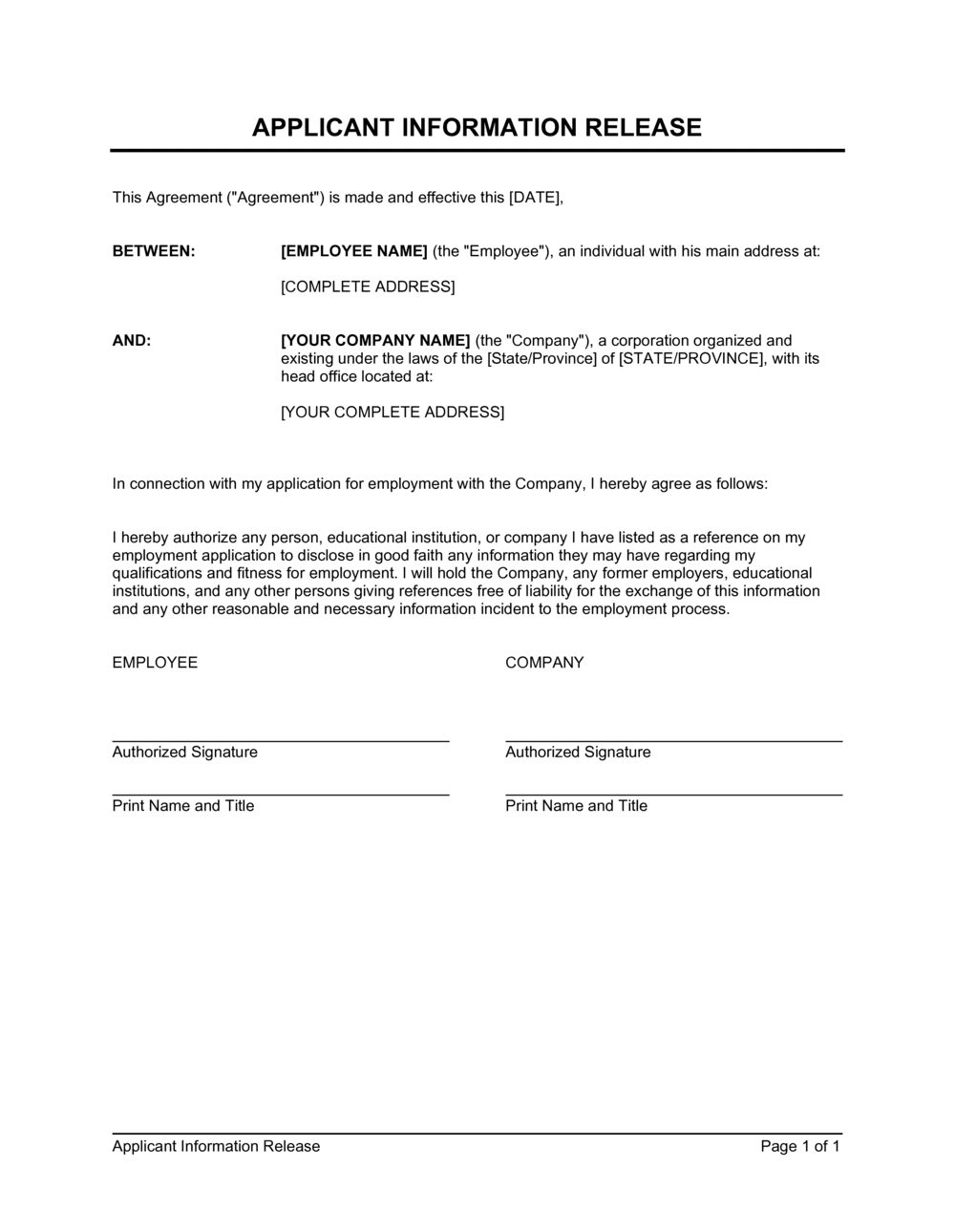
Information Release Authorization Template

Free Word download • Edit online • Save & share with Drive • Export to PDF

1 page20–30 min to fillDifficulty: StandardSignature requiredLegal review recommended
Learn more ↓
FreeInformation Release Authorization Template

At a glance

What it is
An Information Release Authorization is a legally binding document in which a subject — an individual or organization — gives written consent for a designated holder of their records or information to disclose that information to a specified third party. This free Word download gives you a structured, customizable form you can edit online and export as PDF, covering the scope of disclosure, permitted recipients, expiry conditions, and revocation rights.
When you need it
Use it whenever a third party requests access to records you hold on behalf of a client, employee, or patient — or whenever you need documented consent before sharing another party's information with a lender, insurer, background check provider, or government authority. It is also required when an individual wants to authorize release of their own records held by a financial institution, healthcare provider, or employer.
What's inside
Identification of the authorizing party and information holder, a precise description of the information to be released, the identity of the authorized recipient, the purpose of disclosure, the duration or expiry date of the authorization, revocation rights, and signature blocks for all required parties.

What is an Information Release Authorization?

An Information Release Authorization is a legally binding document in which an individual or organization (the authorizing party) gives written consent for a designated record holder to disclose specific information to a named third party for a defined purpose and period. It identifies exactly what records may be released, to whom, why, and for how long — and establishes the authorizing party's right to revoke consent at any time before expiry. Unlike a general consent form, a release authorization is transactional and specific: it governs a single, bounded disclosure event rather than a broad ongoing permission. In regulated contexts such as healthcare, education, and financial services, a valid signed authorization is not optional — it is the legal instrument that makes disclosure lawful.

Why You Need This Document

Without a properly executed information release authorization, disclosing another party's records — even in response to a legitimate request — exposes your organization to regulatory enforcement, civil liability, and reputational harm. Under HIPAA alone, penalties for unauthorized disclosure of protected health information can reach $50,000 per violation. Under GDPR and the UK Data Protection Act, fines extend to 4% of global annual turnover. Beyond regulatory risk, the absence of a signed authorization leaves the information holder with no documented evidence that the subject consented — turning a routine records request into a credibility dispute that is difficult and expensive to defend. A complete, jurisdiction-compliant authorization on file before any disclosure is made is the single most effective protection available. This template gives you a structured starting point with all required elements — scope, purpose, expiry, revocation rights, and signature block — so you can process records requests confidently, compliantly, and without delay.

Which variant fits your situation?

If your situation is…Use this template
Releasing medical or health records to a third partyHIPAA-Compliant Medical Records Release Authorization
Sharing employment and payroll records with a lender or background screenerEmployment Records Release Authorization
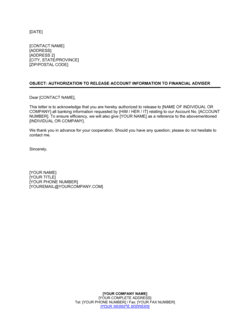
Authorizing a financial institution to share account data with an advisorFinancial Records Release Authorization
Releasing student academic records under FERPAStudent Records Release Authorization
Consenting to disclosure as part of a business sale or merger due diligenceNon-Disclosure Agreement (NDA)
Granting ongoing authority for an agent to act on your behalf including disclosuresPower of Attorney
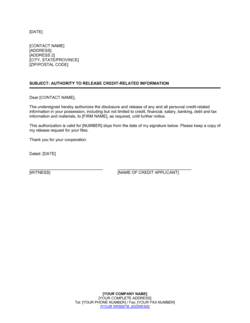
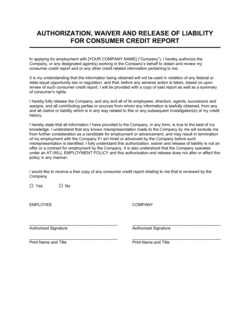
Permitting a credit bureau or lender to pull a consumer credit reportCredit Check Authorization Form

Common mistakes to avoid

❌ Overbroad 'any and all information' scope language

Why it matters: Blanket authorization language is routinely found non-compliant under HIPAA, GDPR, and PIPEDA. Regulators have fined organizations for releasing information beyond what the subject actually consented to.

Fix: Define the scope by specific record category, date range, and relevant data fields. If in doubt, apply the minimum necessary standard — release only what is required to fulfill the stated purpose.

❌ No expiry date or an unreasonably long duration

Why it matters: An authorization without an expiry date creates a theoretically perpetual obligation to disclose — which most privacy laws treat as invalid, and which exposes the holder to claims of unauthorized release years later.

Fix: Always enter a specific calendar date or event-based trigger. For most purposes, 90 days is sufficient; for ongoing relationships, 12 months is the standard maximum.

❌ Omitting the revocation rights clause

Why it matters: HIPAA explicitly requires that every authorization inform the subject of their right to revoke in writing. Omitting it can void the authorization entirely and expose the holder to regulatory enforcement action.

Fix: Include a revocation clause in every form, and specify the mechanism — written notice to a named address or email — so the subject knows exactly how to exercise the right.

❌ Failing to verify proxy authority before accepting a third-party signature

Why it matters: Releasing information on the basis of a signature from someone without documented legal authority — a family member acting without a power of attorney, for example — exposes the holder to liability for unauthorized disclosure.

Fix: Require and attach the legal basis document (power of attorney, guardianship order, or corporate resolution) whenever the signer is not the data subject themselves.

❌ Releasing information before receiving the signed form

Why it matters: Relying on a verbal request or email approval rather than a signed authorization is insufficient under virtually every privacy statute. Even a good-faith disclosure without a signed form can trigger regulatory penalties.

Fix: Establish a process that makes disclosure physically impossible until the signed, dated form is received and logged. An email attaching the signed PDF should be the minimum threshold.

❌ No re-disclosure restriction on the authorized recipient

Why it matters: Without language prohibiting the recipient from sharing the information further, downstream disclosure chains can extend well beyond what the authorizing party intended — and the original holder may still carry liability.

Fix: Include a re-disclosure restriction clause in every authorization and consider adding it to any cover letter or transmittal document accompanying the released records.

The 10 key clauses, explained

Identification of the authorizing party

In plain language: Names and identifies the person or entity giving consent — the individual whose information will be disclosed.

Sample language
I, [FULL LEGAL NAME], date of birth [DATE], residing at [ADDRESS], hereby authorize the release of my information as described below.

Common mistake: Using a nickname or trade name instead of the full legal name — creating a mismatch with the records held by the information holder and making the authorization difficult to process or legally challenge.

Identification of the information holder

In plain language: Names the organization or person that currently holds the records and is being instructed to release them.

Sample language
[ORGANIZATION NAME], located at [ADDRESS], is hereby authorized to disclose the information described in this form to the recipient named below.

Common mistake: Naming only a department rather than the full legal entity. If the information holder's name does not match their registered name, they may legally decline to act on the authorization.

Description of information to be released

In plain language: Precisely defines what category, type, and date range of information is covered — limiting the disclosure to what was actually consented to.

Sample language
The following information is authorized for release: [CATEGORY OF RECORDS — e.g., employment records, financial statements, academic transcripts] for the period [START DATE] to [END DATE].

Common mistake: Using a blanket 'any and all information' description. Courts and regulators — particularly under HIPAA and GDPR — have found overbroad descriptions to be invalid or unenforceable, exposing the holder to liability.

Identification of the authorized recipient

In plain language: Specifies exactly who may receive the disclosed information — by name, role, and organization — so the holder knows to whom they may release it.

Sample language
This information is authorized for release to: [RECIPIENT FULL NAME / ORGANIZATION], [TITLE / ROLE], located at [ADDRESS], for the purpose described below.

Common mistake: Leaving the recipient field vague — e.g., 'any authorized lender.' A recipient must be specifically identified for the authorization to be valid in most regulatory contexts.

Purpose of disclosure

In plain language: States the specific reason the information is being shared, which restricts the recipient from using it for any other purpose.

Sample language
The information is to be used solely for the following purpose: [PURPOSE — e.g., verification of employment for mortgage application, insurance underwriting, academic transfer evaluation].

Common mistake: Omitting the purpose entirely. Without a stated purpose, the recipient may argue they are entitled to use the information beyond what the authorizing party intended — and regulators may find the form non-compliant.

Duration and expiry

In plain language: Sets a specific date or event after which the authorization automatically expires and the holder may no longer release information under it.

Sample language
This authorization shall remain in effect until [SPECIFIC DATE] or upon [TRIGGERING EVENT — e.g., completion of the mortgage application], whichever occurs first, unless revoked in writing prior to that date.

Common mistake: Setting no expiry date — or using a duration so long (e.g., 10 years) that it is treated as perpetual. Most privacy regulations require a reasonable expiry; a perpetual authorization is frequently held invalid.

Revocation rights

In plain language: Informs the authorizing party of their right to cancel the authorization at any time before expiry, and explains how to do so.

Sample language
I understand that I may revoke this authorization at any time by submitting written notice to [ORGANIZATION NAME] at [ADDRESS / EMAIL]. Revocation will not affect information already disclosed in reliance on this authorization before the written notice is received.

Common mistake: Not including a revocation clause at all. Under HIPAA and GDPR, omitting revocation rights renders the authorization form non-compliant and may void consent for all disclosures made under it.

Acknowledgment of right to refuse

In plain language: States that the authorizing party is not required to sign — and that treatment, services, or benefits will not be conditioned on signing (where applicable by law).

Sample language
I understand that my [treatment / employment / enrollment] is not conditioned on providing this authorization, except where disclosure is required for [PERMITTED PURPOSE — e.g., eligibility determination for a health plan].

Common mistake: Conditioning a benefit or service on signature where prohibited by law — a practice known as conditioned authorization, which is explicitly banned under HIPAA and in several provincial privacy statutes.

Signature and date

In plain language: Captures the authorizing party's wet or electronic signature and the date of execution, establishing that consent was freely and knowingly given.

Sample language
Signature of Authorizing Party: _________________________ Date: [DATE] | If signed by a representative: [REPRESENTATIVE NAME], Relationship: [RELATIONSHIP], Authority: [LEGAL BASIS — e.g., Power of Attorney, Guardian].

Common mistake: Failing to include a representative's authority basis when the signer is not the data subject. Without documenting the legal basis for a proxy signature, the holder may face liability for relying on unauthorized consent.

Limitations and re-disclosure restriction

In plain language: Prohibits the authorized recipient from sharing the disclosed information with any further parties without a new authorization from the subject.

Sample language
The recipient named above is prohibited from re-disclosing the information received under this authorization to any other party without obtaining a separate written authorization from the authorizing party, unless otherwise required by law.

Common mistake: Omitting a re-disclosure restriction. Without it, the recipient may pass information to additional parties — particularly problematic in financial services and healthcare, where downstream disclosure chains create compounding liability.

How to fill it out

  1. 1

    Identify all parties with full legal names

    Enter the authorizing party's full legal name and date of birth (or registered business name and number), the information holder's full registered name and address, and the authorized recipient's full legal name and role.

    💡 Cross-check the authorizing party's name against the exact name in the records held — even a middle initial mismatch can delay processing.

  2. 2

    Define the scope of information precisely

    Specify the category of records (e.g., payroll records, bank statements, academic transcripts), the specific time period covered, and any sub-categories to include or exclude.

    💡 Applying the minimum necessary standard — releasing only what is needed for the stated purpose — reduces liability exposure for the holder and is required under HIPAA for PHI.

  3. 3

    Name the authorized recipient specifically

    Identify the recipient by full name, title, and organization. If the recipient is an institution, include the department or contact handling the request.

    💡 Avoid generic recipient descriptions like 'any authorized financial institution.' Regulators and courts require a specific, identified recipient.

  4. 4

    State the purpose of disclosure

    Write a clear, specific purpose statement — e.g., 'verification of employment history for residential mortgage application.' The purpose limits how the recipient may use the information.

    💡 If the purpose is sensitive (e.g., mental health treatment records, HIV status), check jurisdiction-specific requirements — many states and provinces require additional explicit acknowledgment for these categories.

  5. 5

    Set a reasonable expiry date

    Enter a specific calendar date or event-based trigger for expiry. For most routine authorizations, 90 days from the issue date is standard. HIPAA authorizations default to one year if no date is specified, but a shorter window reduces exposure.

    💡 Never leave the expiry date blank. An undated authorization creates an open-ended obligation that is difficult to close and may be held invalid.

  6. 6

    Include the revocation and refusal acknowledgments

    Confirm that both the revocation procedure and the right-to-refuse language are present. The authorizing party should initial these sections if your process requires it.

    💡 For healthcare and education records, have the authorizing party initial the revocation clause separately — this proves they were specifically informed of the right to cancel.

  7. 7

    Execute with signatures before disclosure

    Obtain the authorizing party's wet or electronic signature and the date of signing. If a proxy is signing, attach the legal basis document (power of attorney, guardianship order) to the authorization.

    💡 Never release information before the signed form is in your possession. A verbal or email-only authorization is insufficient for virtually all regulated information categories.

  8. 8

    Retain a copy and log the disclosure

    File the executed authorization in the subject's record and log the date, recipient, and scope of disclosure. Most privacy regulations require retention for a minimum of six years.

    💡 If you use a digital records system, attach the signed PDF to the subject's file at the time of disclosure — not retrospectively — to create a clean audit trail.

Frequently asked questions

What is an information release authorization?

An information release authorization is a signed legal document in which a person or organization consents to the disclosure of specific records or data to a named third party for a defined purpose and period. It protects the information holder from liability by documenting that the subject freely consented to the release, and it limits the recipient's use of the information to the stated purpose. It is required in virtually every regulated context where personal or confidential business records change hands.

When is a signed information release authorization required?

A signed authorization is required any time a regulated information holder — such as a healthcare provider, employer, educational institution, or financial institution — receives a request to share records with a third party. Common triggers include mortgage applications, background checks, insurance underwriting, litigation discovery, academic transfers, and business due diligence. In regulated sectors such as healthcare and education, disclosing without a valid signed authorization can result in significant regulatory penalties.

What is the difference between an information release authorization and a non-disclosure agreement?

An information release authorization is signed by the data subject (or their proxy) to permit disclosure of their own records to a specified third party. An NDA is signed by the receiving party, restricting them from sharing confidential information they receive. The two serve opposite purposes: the authorization opens the channel for disclosure; the NDA restricts what the recipient does with what they receive. In sensitive transactions, both documents are often used together.

How long should an information release authorization be valid?

For most routine purposes, 90 days from the date of signing is the standard duration. For ongoing advisory or lending relationships, 12 months is typical. HIPAA specifies that a medical records authorization expires on a date stated in the form, and if none is given, it defaults to one year — but a shorter window is generally safer. Authorizations for sensitive categories like mental health or substance abuse records often carry shorter statutory maximums in specific jurisdictions.

Can an information release authorization be revoked?

Yes. The authorizing party generally has the right to revoke at any time before the expiry date by submitting written notice to the information holder. Revocation does not retroactively undo disclosures already made in good faith before the notice was received. Under HIPAA, the right to revoke must be stated explicitly on the form; omitting it can void the authorization. In practice, include a revocation clause in every authorization regardless of jurisdiction.

Does an information release authorization need to be notarized?

In most contexts, notarization is not required — a dated signature is sufficient. Exceptions include certain financial power-of-attorney situations, court-ordered records requests, and some state-specific requirements for sensitive categories such as mental health or HIV-related records. If in doubt, check the specific regulatory requirements in the applicable jurisdiction, or require notarization as a precaution for high-stakes disclosures.

What happens if an organization discloses information without a valid authorization?

Unauthorized disclosure of personal information can trigger regulatory enforcement, civil liability, and reputational damage. Under HIPAA, penalties range from $100 to $50,000 per violation depending on culpability. Under GDPR, fines can reach €20 million or 4% of annual global turnover. Canadian PIPEDA and provincial laws impose similar obligations. The best protection is a signed, compliant authorization on file before any disclosure is made.

Who should sign an information release authorization if the subject is a minor?

For minors, the parent or legal guardian typically signs as the authorized representative, with their relationship and legal authority noted on the form. Once a minor reaches the age of majority, a new authorization signed by the individual themselves is generally required. Some jurisdictions allow mature minors to consent to certain disclosures — particularly in healthcare — so the applicable provincial or state law should be checked for the specific record category involved.

Can a business use one authorization form to cover multiple types of records?

A single form can cover multiple record categories if each is explicitly listed in the scope of disclosure section. However, certain regulated categories — such as mental health records, substance abuse treatment records, and HIV status under US law — typically require separate authorizations with specific statutory language. Bundling sensitive categories into a general form risks the entire authorization being challenged. When in doubt, use separate forms for each sensitive category.

How this compares to alternatives

vs Non-Disclosure Agreement (NDA)

An NDA binds the receiving party to keep disclosed information confidential and restricts its use. An information release authorization is signed by the data subject to permit the holder to make the disclosure in the first place. The two serve complementary but opposite functions: the authorization opens the channel; the NDA governs what happens after. In sensitive business transactions, both are typically used together.

vs Power of Attorney

A power of attorney grants an agent broad or specific authority to act on behalf of a principal across a range of legal and financial matters, including authorizing disclosures. An information release authorization is narrower — it covers a single, defined disclosure to a named recipient for a stated purpose and duration. Use a power of attorney when ongoing or wide-ranging authority is needed; use a release authorization for a specific, one-time or bounded disclosure event.

vs Privacy Policy

A privacy policy is a public-facing document that informs individuals about how an organization collects, uses, and shares their data — it does not by itself obtain consent for any specific disclosure. An information release authorization is a transactional document that captures individual consent for a specific, identified disclosure. Both are required in most regulated contexts: the policy sets out general practices; the authorization documents consent for each individual release event.

vs Consent Form

A general consent form obtains agreement for a broad range of activities — participation in a program, receipt of communications, or terms of service. An information release authorization is narrower and more specific: it covers only the release of identified records to a named party for a defined purpose. For regulated record types — medical records, education files, financial data — a general consent form is not a substitute for a properly structured release authorization.

Industry-specific considerations

Healthcare

HIPAA mandates a valid written authorization for disclosures of PHI outside treatment, payment, and operations — including specific required elements such as expiry date, revocation rights, and purpose.

Financial Services

Lenders, mortgage brokers, and investment advisors routinely require signed authorizations before requesting employment, income, and account records from third-party holders during underwriting.

Education

FERPA prohibits schools from releasing student education records without written consent, covering transcripts, disciplinary records, and financial aid information shared with employers or other institutions.

Human Resources

Background check firms, reference verification services, and pre-employment screening providers require a signed authorization from the candidate before requesting employment or criminal history records.

Jurisdictional notes

United States

HIPAA sets minimum required elements for medical records authorizations, including expiry date, revocation rights, purpose, and a prohibition on conditioning treatment on signature. The FTC Safeguards Rule and Gramm-Leach-Bliley Act impose parallel requirements for financial records. State laws may add stricter requirements for sensitive categories such as mental health, substance abuse, HIV status, and genetic information — California, New York, and Texas each have specific overlay statutes.

Canada

PIPEDA at the federal level and substantially similar provincial laws (Alberta PIPA, BC PIPA, Quebec Law 25) require meaningful, informed consent for the collection, use, and disclosure of personal information. Quebec's Law 25 (effective 2023) added explicit consent requirements and privacy impact assessments for cross-border transfers. Healthcare records fall under provincial health information legislation — Ontario PHIPA, Alberta HIA, and BC FIPPA each specify valid consent form elements with slight variations.

United Kingdom

Post-Brexit, the UK GDPR and the Data Protection Act 2018 govern consent to disclosure of personal data. Consent must be freely given, specific, informed, and unambiguous. The UK Information Commissioner's Office (ICO) requires that consent requests be separate from other terms and conditions. Special category data — health, biometric, religious, or criminal records — requires explicit consent and additional safeguards. Retention of consent records for accountability purposes is mandatory.

European Union

GDPR Article 7 governs consent as a legal basis for processing and disclosure of personal data. Consent must be freely given, specific, informed, and unambiguous — and must be as easy to withdraw as to give. Special categories under Article 9 (health, biometric, racial, religious data) require explicit consent with a higher threshold. Member states may impose additional national requirements — Germany and France, for example, have stricter rules for employee data disclosures and health records. Cross-border data transfers outside the EEA require additional transfer mechanisms such as Standard Contractual Clauses even when consent is obtained.

Template vs lawyer — what fits your deal?

PathBest forCostTime
Use the templateStandard employment, financial, or educational record requests in low-risk, non-regulated contextsFree10–15 minutes per authorization
Template + legal reviewHealthcare disclosures governed by HIPAA, cross-border disclosures subject to GDPR or PIPEDA, or sensitive record categories$200–$500 for a compliance or privacy counsel review1–3 days
Custom draftedEnterprise-wide authorization programs, heavily regulated industries, or multi-jurisdiction disclosure frameworks requiring tailored statutory language$1,000–$3,500+1–2 weeks

Glossary

Authorizing Party
The individual or organization whose information is being released and who provides signed consent for the disclosure.
Information Holder
The person, business, or institution that currently holds the records and is authorized to release them upon receipt of this form.
Authorized Recipient
The specific third party designated to receive the disclosed information — identified by name, role, or organization.
Scope of Disclosure
The defined category, type, and date range of information covered by the authorization, limiting what may be released.
Purpose of Disclosure
The stated reason for sharing the information, which limits the recipient's ability to use it for any other purpose.
Expiry Date
The calendar date or event after which the authorization is no longer valid and the information holder must cease disclosures under it.
Revocation
The authorizing party's right to cancel the authorization at any time before expiry, typically required to be in writing.
HIPAA
The US Health Insurance Portability and Accountability Act — the federal law governing privacy and security of protected health information, with specific requirements for valid authorizations.
FERPA
The US Family Educational Rights and Privacy Act — the federal law protecting the privacy of student education records and governing when and how schools may release them.
Minimum Necessary Standard
A principle in privacy law — particularly under HIPAA — requiring that only the minimum amount of information necessary to fulfill the stated purpose be disclosed.
Protected Health Information (PHI)
Individually identifiable health information held or transmitted by a covered entity, protected from unauthorized disclosure under HIPAA.
Data Subject
The living individual to whom personal data relates — a term used primarily under GDPR and UK data protection law.

Part of your Business Operating System

This document is one of 3,000+ business & legal templates included in Business in a Box.

  • Fill-in-the-blanks — ready in minutes
  • 100% customizable Word document
  • Compatible with all office suites
  • Export to PDF and share electronically

Create your document in 3 simple steps.

From template to signed document — all inside one Business Operating System.
1
Download or open template

Access over 3,000+ business and legal templates for any business task, project or initiative.

2
Edit and fill in the blanks with AI

Customize your ready-made business document template and save it in the cloud.

3
Save, Share, Send, Sign

Share your files and folders with your team. Create a space of seamless collaboration.

Save time, save money, and create top-quality documents.

★★★★★

"Fantastic value! I'm not sure how I'd do without it. It's worth its weight in gold and paid back for itself many times."

Managing Director · Mall Farm
Robert Whalley
Managing Director, Mall Farm Proprietary Limited
★★★★★

"I have been using Business in a Box for years. It has been the most useful source of templates I have encountered. I recommend it to anyone."

Business Owner · 4+ years
Dr Michael John Freestone
Business Owner
★★★★★

"It has been a life saver so many times I have lost count. Business in a Box has saved me so much time and as you know, time is money."

Owner · Upstate Web
David G. Moore Jr.
Owner, Upstate Web

Run your business with a system — not scattered tools

Stop downloading documents. Start operating with clarity. Business in a Box gives you the Business Operating System used by over 250,000 companies worldwide to structure, run, and grow their business.

Start free · No credit card required