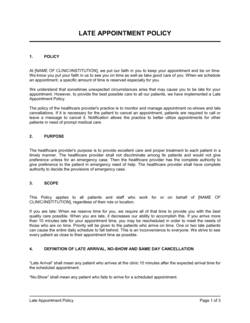
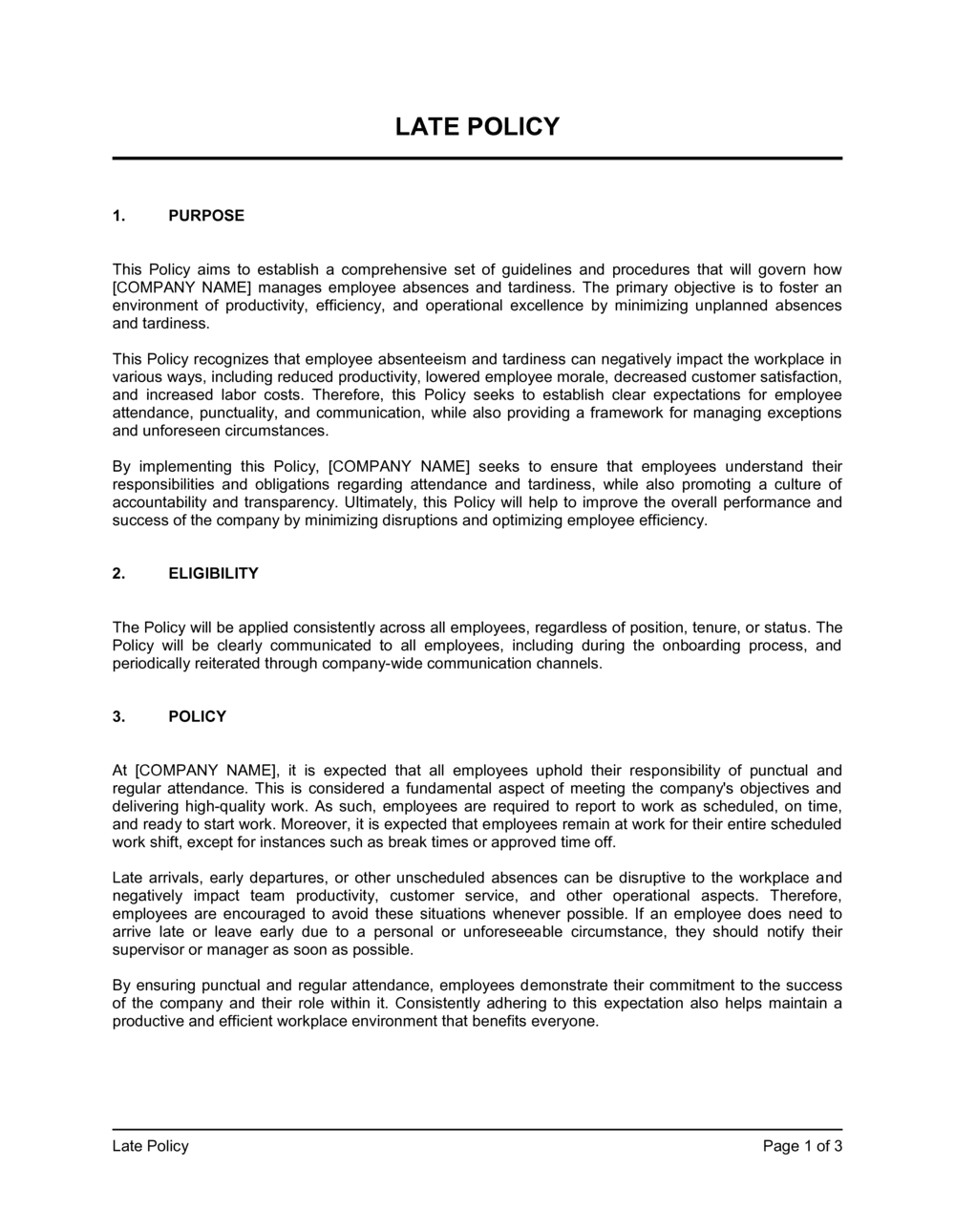
Late Policy Template

Free Word download β€’ Edit online β€’ Save & share with Drive β€’ Export to PDF

3 pagesβ€’20–30 min to fillβ€’Difficulty: Standard
Learn more ↓
FreeLate Policy Template

At a glance

What it is
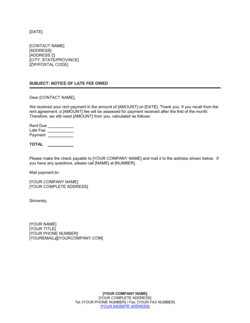
A Late Policy is a written operational document that defines what constitutes tardiness or a late submission, the consequences that follow, and how those consequences are applied consistently across an organization, classroom, or service arrangement. This free Word download gives you a structured, ready-to-edit template you can tailor to your business, team, or institution and export as PDF for distribution to employees, clients, or students.
When you need it
Use it when onboarding new employees, enrolling new students or clients, or any time you need to formalize expectations around punctuality, late deliverables, or overdue payments so that enforcement decisions are never made on the spot.
What's inside
A purpose statement, clear definitions of what "late" means in your context, grace periods and thresholds, a tiered consequence schedule, the notification and documentation process, appeal or exception procedures, and acknowledgment language for the affected party to sign.

What is a Late Policy?

A Late Policy is a written operational document that defines exactly what constitutes tardiness or a late submission in a specific business, academic, or service context, and prescribes the consequences and procedures that follow when that threshold is crossed. It establishes a consistent, documented standard β€” covering grace periods, excused circumstances, notification requirements, and a tiered consequence schedule β€” so that every enforcement decision is grounded in rules that were communicated and acknowledged in advance. Whether applied to employee shift attendance, client payment deadlines, or student assignment submissions, a late policy eliminates the ambiguity that makes inconsistent and legally vulnerable enforcement possible.

Why You Need This Document

Without a written late policy, every tardiness or overdue payment situation is handled on the spot, by feel, and often differently depending on the manager, the relationship, or the mood of the moment. That inconsistency is where disputes, grievances, and unpaid fees originate. Employees who receive a verbal warning for the same behavior that earned a colleague a written warning have grounds to challenge the action. Clients who are charged a late fee they were never told about can dispute it successfully. A signed, distributed late policy closes both of those gaps before the first incident occurs β€” it converts a judgment call into a documented process. This template gives you a professionally structured starting point with all the critical components in place, so you can define your thresholds and consequences once, distribute them clearly, and enforce them with confidence.

Which variant fits your situation?

If your situation is…Use this template
Managing employee tardiness and shift attendanceEmployee Attendance and Tardiness Policy
Collecting overdue payments from clients or customersLate Payment Policy
Setting late-submission rules in an academic settingAcademic Late Assignment Policy
Handling no-shows and late arrivals for scheduled appointmentsCancellation and Late Arrival Policy
Communicating late fees in a freelance or consulting engagementFreelance Late Payment Terms
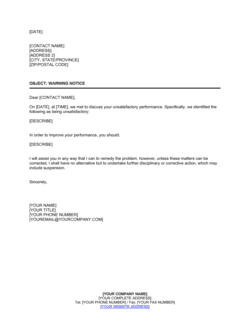
Tracking and documenting repeated tardiness for progressive disciplineEmployee Written Warning
Formalizing attendance expectations alongside other workplace rulesEmployee Handbook

Common mistakes to avoid

❌ Using subjective time language instead of a specific threshold

Why it matters: Phrases like 'reasonably on time' or 'promptly' generate constant disputes because every manager and employee has a different definition. There is no consistent baseline to enforce.

Fix: Replace vague language with a specific number of minutes β€” 'An employee is considered late if they have not reported to their station within 5 minutes of the scheduled start time.'

❌ Treating the grace period as the real start time

Why it matters: When a grace period is not explicitly described as a buffer, employees begin treating it as an informal schedule adjustment. Within 60 days, the stated start time loses all meaning.

Fix: Add one sentence to the grace period section stating that regular use of the grace period constitutes a pattern of tardiness and will be documented as such after a defined frequency.

❌ Using discretionary consequence language

Why it matters: Writing 'may result in disciplinary action' allows supervisors to skip consequences inconsistently, exposing the organization to fairness and discrimination complaints when the same behavior is handled differently across teams.

Fix: Rewrite every consequence as mandatory: 'a third occurrence within 30 days will result in a final written warning.' Reserve discretion only for documented exceptional circumstances.

❌ Omitting a signed acknowledgment step

Why it matters: Without a signed or electronically timestamped acknowledgment, an employee or client can credibly claim they never received the policy β€” invalidating every enforcement action taken against them.

Fix: Require acknowledgment before the policy's effective date, store the signed copy in the relevant record system, and include the acknowledgment date on the policy itself.

❌ Failing to align the late policy with the broader progressive discipline framework

Why it matters: If the late policy prescribes a four-step escalation but the employee handbook describes a three-step process, the inconsistency creates grounds for challenging any termination based on tardiness.

Fix: Cross-reference both documents when drafting, and ensure the occurrence thresholds and consequence types match exactly. Update both simultaneously when either changes.

❌ Leaving late fees out of the underlying contract or invoice

Why it matters: A late fee stated only in a standalone policy document β€” and not in the signed service agreement or invoice β€” is difficult to collect because the client never explicitly consented to that specific term.

Fix: Mirror the late fee language verbatim in the service contract, retainer agreement, or invoice template so the client acknowledges it at the point of engagement, not after the fact.

The 9 key sections, explained

Purpose and scope

Definitions

Grace period

Consequence schedule

Notification and documentation requirements

Excused lateness and exceptions

Appeal and dispute process

Late fees (for payment or service contexts)

Acknowledgment and distribution

How to fill it out

  1. 1

    Define your scope and context

    Identify exactly who the policy applies to β€” employees by role or department, students by grade or program, or clients by service type. Name the organization and the effective date at the top of the document.

    πŸ’‘ If different groups have different thresholds (e.g., office staff vs. shift workers), create separate appendices rather than trying to cover all cases in one set of rules.

  2. 2

    Set a specific tardiness threshold

    Choose the exact number of minutes after a scheduled time that constitutes being late. Write it as a number, not a phrase. Include whether the threshold differs for meetings, shifts, or payment deadlines.

    πŸ’‘ Five minutes is the most widely enforced tardiness threshold for shift-based work; ten minutes is more common for salaried office roles β€” pick one and state it plainly.

  3. 3

    Write the grace period terms

    State the grace period duration and add explicit language clarifying it is not a default extension of the deadline. Include how many times it can be used before it is treated as a pattern.

    πŸ’‘ Add a note in the grace period section that supervisors are not required to remind employees of the grace period β€” it is the employee's responsibility to know it.

  4. 4

    Build the consequence schedule

    List each consequence in numbered order tied to a specific occurrence count and a rolling time window. Use mandatory language ('will result in') rather than discretionary language ('may result in').

    πŸ’‘ Align your consequence schedule with your progressive discipline policy if one exists β€” inconsistency between the two documents creates enforcement gaps.

  5. 5

    Define excused lateness with specific criteria

    List every category of lateness the organization will accept as excused, and specify what documentation is required for each. Set a deadline for submitting that documentation.

    πŸ’‘ Requiring documentation within 48 hours of the incident prevents retroactive excuse requests during a disciplinary meeting weeks later.

  6. 6

    Add notification requirements and documentation channels

    Specify how and when employees or clients must notify the relevant party that they will be late, and name the exact system or channel where each occurrence is recorded.

    πŸ’‘ If you use an HR platform or scheduling tool, name it explicitly β€” 'log in to [SYSTEM NAME]' is clearer and more enforceable than 'notify management.'

  7. 7

    Include the appeal process with a deadline

    Write a two-to-three sentence appeal procedure naming who receives the appeal, within how many business days it must be filed, and how long the review takes.

    πŸ’‘ Keep the appeal window short β€” five business days is standard. A longer window creates a backlog and delays closure of the underlying disciplinary record.

  8. 8

    Distribute with a signed acknowledgment

    Send the completed policy to all affected parties and collect a dated signature or electronic acknowledgment before the effective date. File the signed copy in the employee record, CRM, or student management system.

    πŸ’‘ If distributing electronically, use a platform that logs the timestamp of acknowledgment β€” a forwarded email is not proof of receipt in a disciplinary dispute.

Frequently asked questions

What is a late policy?

A late policy is a written document that defines what constitutes tardiness or a late submission in a specific context β€” work, school, or a client relationship β€” and sets out the consequences and process that follow. It creates a consistent, documented standard so that enforcement decisions are based on rules rather than individual manager judgment. A well-written late policy applies equally to everyone it covers and includes an acknowledgment step to confirm each party received it.

What should a late policy include?

At minimum: a purpose and scope statement, a specific definition of what counts as late (in minutes or days), a grace period with clear limits, a tiered consequence schedule using mandatory language, the notification method and documentation process, a list of excused circumstances with required documentation, an appeal procedure, and a signed acknowledgment block. Missing any of these leaves a gap that will be exploited during the first enforcement dispute.

How many minutes late should trigger a formal occurrence?

Five minutes after the scheduled start time is the most common threshold for shift-based or hourly employees. Ten minutes is standard for salaried office roles with more flexibility. For appointment-based service businesses, a 15-minute threshold is typical before a no-show fee applies. The specific number matters less than stating it clearly and applying it consistently to everyone the policy covers.

Is a late policy legally enforceable?

A late policy is generally enforceable when it is written clearly, distributed before the effective date, and acknowledged in writing by the affected parties. For employment contexts, it must be applied consistently β€” different treatment of similar tardiness across protected groups can support a discrimination claim even if the policy itself is facially neutral. Late fees in client contexts are enforceable when they are referenced in the underlying service contract or invoice, not just in a standalone document.

What is the difference between a grace period and an extended deadline?

A grace period is a short buffer after a deadline during which lateness is noted but not penalized β€” it is not a rescheduled deadline. An extended deadline formally moves the due date with advance authorization. The policy must state this distinction explicitly, because employees and clients routinely treat a grace period as permission to arrive or pay up to that point without consequence, which defeats the purpose of setting a deadline at all.

Can I charge a late fee without a late policy in writing?

You can attempt to, but collecting it is significantly harder. Without a written policy acknowledged by the client, they can dispute the fee on the grounds that they were never informed of it. In most jurisdictions, a late fee must be agreed to in advance β€” either in the service contract, the invoice terms, or a signed policy document β€” before it becomes collectible. A written late policy signed at the start of the relationship removes that dispute entirely.

How do I handle a first-time late occurrence fairly?

Document it the same way you would any subsequent occurrence, but calibrate the consequence to the first tier of your schedule β€” typically a verbal warning noted in the employee's file. Consistency matters more than leniency on the first offense; applying the policy to everyone from the first incident prevents the appearance of selective enforcement. If you want to give informal verbal guidance before the first formal warning, build that as a pre-occurrence step into the policy itself.

How often should a late policy be reviewed and updated?

Review the policy annually and any time a related document β€” employee handbook, service contract, or progressive discipline policy β€” is updated. If enforcement disputes or employee grievances reveal a gap in the policy language, revise it immediately and re-distribute with a new acknowledgment. Policies that have not been reviewed in more than two years often contain threshold numbers or consequence structures that no longer reflect how the organization actually operates.

Do employees need to sign a late policy separately from the employee handbook?

If the late policy is embedded in the employee handbook, a single handbook acknowledgment is sufficient β€” provided the policy is clearly labeled and not buried in fine print. If the late policy is a standalone document, it requires its own signed acknowledgment. Either way, the acknowledgment must be dated and stored in the employee's personnel file. A general 'I received the handbook' signature that does not reference the late policy by name may not be sufficient evidence in a disciplinary dispute.

How this compares to alternatives

vs Employee attendance policy

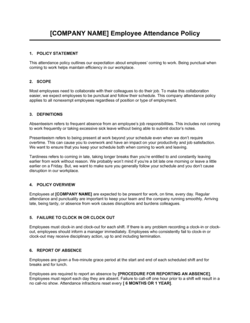
An attendance policy covers the full spectrum of absence and presence β€” scheduled leave, unscheduled absences, FMLA, and tardiness all in one document. A late policy is narrower, focusing exclusively on the definition of tardiness, the grace period, and the escalating consequences for repeated late arrivals. Use the late policy as a standalone when tardiness is your primary issue; embed it as a section in a broader attendance policy when you need to govern all absence types together.

vs Employee written warning

A late policy establishes the rules and thresholds in advance; a written warning is the documented consequence applied after a specific threshold has been crossed. The warning references the late policy as authority for the action being taken. You need the policy before the warning β€” a written warning issued without a pre-existing, acknowledged policy is difficult to defend in a wrongful termination claim.

vs Employee handbook

An employee handbook is a comprehensive reference document covering all workplace policies β€” code of conduct, benefits, safety, and attendance. A late policy is a single-topic document that can be distributed independently or embedded as a section in the handbook. For organizations that update individual policies frequently, maintaining the late policy as a standalone document makes versioning and re-distribution simpler than re-issuing the entire handbook.

vs Invoice with late payment terms

An invoice states the due date and late fee for a specific transaction. A late policy document establishes those terms as a standing operating rule for all transactions in an ongoing relationship. The two documents work together: the late policy sets the framework, and each invoice applies it to a specific billing event. Clients who sign the late policy at onboarding can be billed the stated fee without renegotiating terms on every overdue invoice.

Industry-specific considerations

Retail and hospitality

Shift-start tardiness directly impacts floor coverage and customer service levels, making a precise minute-threshold and same-day documentation essential for this industry.

Professional services

Late-payment policies with clearly stated fee percentages protect cash flow for firms billing on Net 30 terms across multiple active client engagements.

Education

Academic late policies must distinguish between classroom tardiness and late assignment submission, and account for accommodation plans that legally exempt certain students from standard penalties.

Healthcare

Appointment-based practices use late-arrival policies to manage scheduling efficiency, with a typical 10-to-15-minute threshold after which the appointment is rescheduled and a no-show fee may apply.

Template vs pro β€” what fits your needs?

PathBest forCostTime
Use the templateSmall businesses, sole proprietors, and managers needing a clear, enforceable policy without dedicated HR or legal staffFree30–60 minutes
Template + professional reviewOrganizations with unionized employees, multi-location operations, or a history of tardiness-related grievances$150–$400 for an HR consultant review2–5 business days
Custom draftedEnterprises with complex shift structures, regulated industries, or jurisdictions with strict labor codes governing disciplinary procedures$500–$1,500 for a labor attorney or HR specialist1–2 weeks

Glossary

Grace Period
A defined window of time after a deadline during which lateness is acknowledged but no formal penalty is applied.
Tardiness
Arriving at a scheduled time or place after the agreed start time, regardless of the reason.
Late Fee
A predetermined financial charge applied to overdue payments or late deliverables, expressed as a flat amount or a percentage of the outstanding balance.
Progressive Discipline
A structured escalation of consequences β€” verbal warning, written warning, suspension, termination β€” applied in sequence for repeated policy violations.
Occurrence
A single documented instance of tardiness or lateness, used to track a pattern over a rolling period for disciplinary purposes.
Rolling Period
A fixed window of time β€” typically 30, 60, or 90 days β€” within which occurrences are counted; older incidents fall off the record as the window moves forward.
Habitual Tardiness
A pattern of repeated late arrivals or submissions within a defined period that triggers escalated consequences beyond the standard first-offense response.
Acknowledgment of Receipt
A signed statement from an employee, student, or client confirming they have read and understood the policy β€” creating a documented baseline for enforcement.
Excused vs. Unexcused Lateness
A distinction between lateness with an accepted justification (medical emergency, documented transport disruption) and lateness without one, which determines whether an occurrence is counted toward discipline.
Cure Period
A defined window given to a party who is late on a payment or deliverable to remedy the situation before a penalty or formal consequence is applied.

Part of your Business Operating System

This document is one of 3,000+ business & legal templates included in Business in a Box.

  • Fill-in-the-blanks β€” ready in minutes
  • 100% customizable Word document
  • Compatible with all office suites
  • Export to PDF and share electronically

Create your document in 3 simple steps.

From template to signed document β€” all inside one Business Operating System.
1
Download or open template

Access over 3,000+ business and legal templates for any business task, project or initiative.

2
Edit and fill in the blanks with AI

Customize your ready-made business document template and save it in the cloud.

3
Save, Share, Send, Sign

Share your files and folders with your team. Create a space of seamless collaboration.

Save time, save money, and create top-quality documents.

β˜…β˜…β˜…β˜…β˜…

"Fantastic value! I'm not sure how I'd do without it. It's worth its weight in gold and paid back for itself many times."

Managing Director Β· Mall Farm
Robert Whalley
Managing Director, Mall Farm Proprietary Limited
β˜…β˜…β˜…β˜…β˜…

"I have been using Business in a Box for years. It has been the most useful source of templates I have encountered. I recommend it to anyone."

Business Owner Β· 4+ years
Dr Michael John Freestone
Business Owner
β˜…β˜…β˜…β˜…β˜…

"It has been a life saver so many times I have lost count. Business in a Box has saved me so much time and as you know, time is money."

Owner Β· Upstate Web
David G. Moore Jr.
Owner, Upstate Web

Run your business with a system β€” not scattered tools

Stop downloading documents. Start operating with clarity. Business in a Box gives you the Business Operating System used by over 250,000 companies worldwide to structure, run, and grow their business.

Free Forever PlanΒ Β·Β No credit card required