Warning Notice Template

Free Word download β€’ Edit online β€’ Save & share with Drive β€’ Export to PDF

1 pageβ€’15–20 min to fillβ€’Difficulty: Standard
Learn more ↓
FreeWarning Notice Template

At a glance

What it is
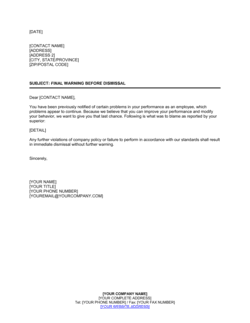
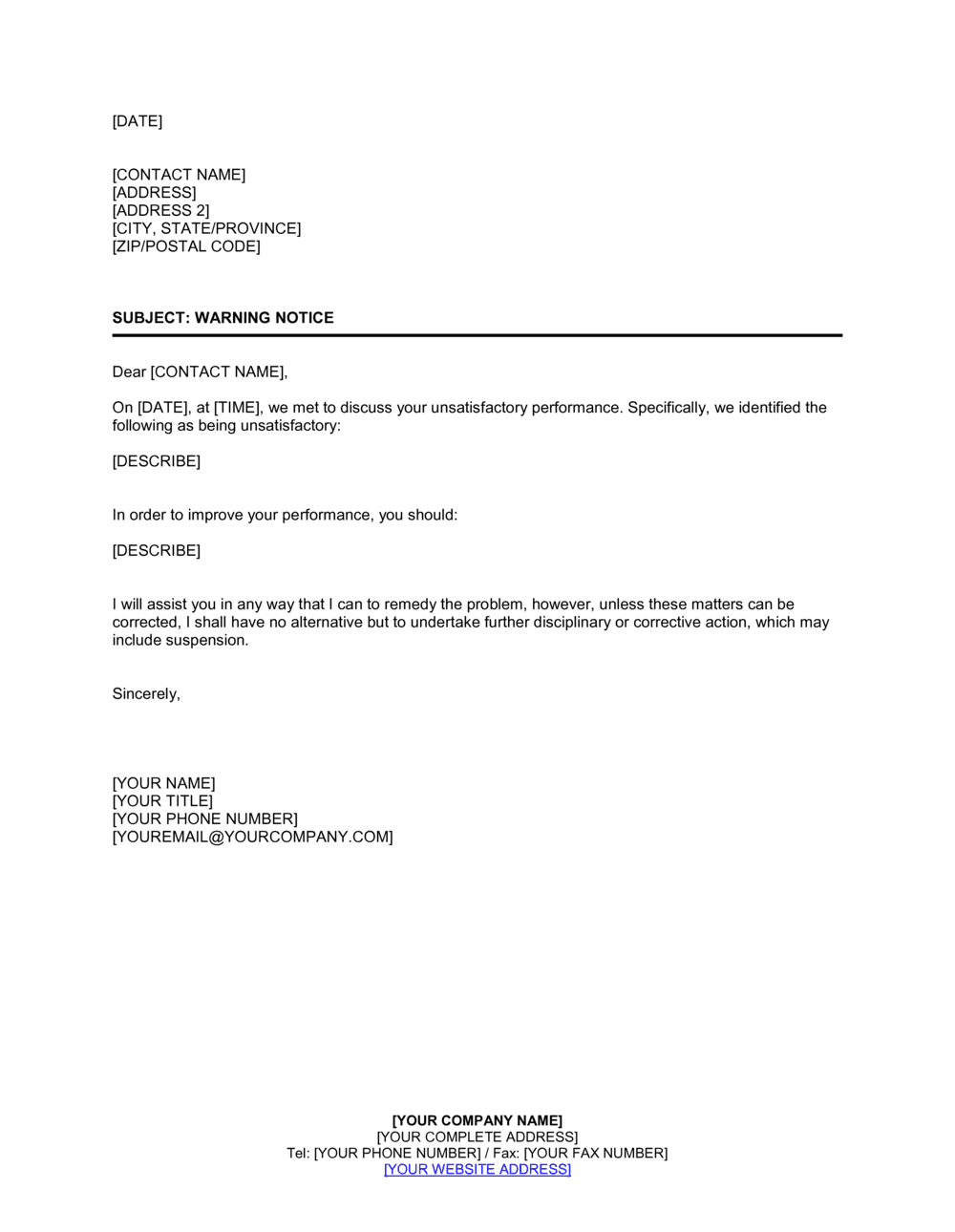
A Warning Notice is a formal written letter issued by an employer to an employee to document a specific instance of misconduct, policy violation, or performance shortfall. This free Word download gives you a structured, professionally worded template you can edit online and export as PDF to deliver in person or by email.
When you need it
Issue it when an employee's behavior, attendance, or performance fails to meet an established standard and you need a documented record before escalating to suspension or termination. It is typically the first or second formal step in a progressive discipline process.
What's inside
Employee and manager identification, a factual description of the violation or performance issue, reference to the applicable policy, a clear statement of required corrective action, a consequence clause if the behavior continues, and a signature block for acknowledgment.

What is a Warning Notice?

A Warning Notice is a formal written letter issued by an employer to an employee to document a specific instance of misconduct, policy violation, or performance shortfall. It records the facts of the incident, cites the rule or standard that was breached, states precisely what the employee must do to correct the situation, and warns of the consequences if the behavior continues or recurs. As a formal step in a progressive discipline process, a warning notice creates an official, dated record in the employee's personnel file that distinguishes a serious documented concern from an informal conversation.

Why You Need This Document

Managing employee conduct without written documentation is a significant legal and operational risk. When a termination or suspension is later challenged β€” through an employment tribunal, unemployment claim, or wrongful dismissal suit β€” the employer's entire case rests on whether the employee was clearly notified of the problem and given a fair opportunity to correct it. A well-documented warning notice answers both questions unambiguously. Without it, verbal warnings that were never recorded effectively did not happen as a matter of evidence. This template gives you a professionally structured, factually rigorous notice you can complete in under 15 minutes, deliver the same day, and file immediately β€” so your progressive discipline trail is solid before you ever need it.

Which variant fits your situation?

If your situation is…Use this template
First documented incident β€” misconduct or policy breachWarning Notice (First Written Warning)
Second offense after a prior written warning was issuedFinal Warning Notice
Persistent or serious attendance and lateness issuesAttendance Warning Letter
Documented failure to meet measurable performance targetsPerformance Improvement Plan (PIP)
Gross misconduct requiring immediate suspension pending investigationEmployee Suspension Letter
Terminating employment after warnings were not heededEmployee Dismissal Letter

Common mistakes to avoid

❌ Vague incident descriptions

Why it matters: A notice that says 'repeated unprofessional behavior' without a specific date and description cannot be used to support a later termination. Employment tribunals and courts require factual specificity.

Fix: Document the exact date, time, location, and observed conduct. If multiple incidents prompted the notice, list each one separately with its own date.

❌ Citing an unwritten or inconsistently enforced policy

Why it matters: If the rule the employee broke was never formally documented or has been ignored for others in similar circumstances, the warning is hard to defend and may be seen as selective enforcement.

Fix: Before issuing the notice, confirm the policy is written, was distributed to the employee, and has been applied consistently across the team.

❌ Omitting the consequence clause

Why it matters: A warning without a stated consequence reads as informal feedback. When the employer later terminates for the same conduct, the employee can credibly argue they did not understand the severity.

Fix: Always include explicit language stating that further disciplinary action up to and including termination may result from non-compliance or recurrence.

❌ Not filing the signed notice in the personnel file

Why it matters: An undocumented warning does not exist as a matter of record. If the employee is later terminated and disputes it, the employer has no progressive discipline trail to show.

Fix: File the signed original in the employee's personnel file the same day it is issued and log the issuance date in your HR tracking system.

The 8 key clauses, explained

Header and parties

In plain language: Identifies the document as a formal warning notice and records the employee's name, job title, department, and the issuing manager's name and title.

Sample language
WARNING NOTICE | Employee: [EMPLOYEE FULL NAME] | Title: [JOB TITLE] | Department: [DEPARTMENT] | Issued by: [MANAGER NAME], [MANAGER TITLE] | Date: [DATE]

Common mistake: Using only the employee's first name or omitting their job title. Incomplete identification creates ambiguity if the notice is referenced in later disciplinary proceedings or litigation.

Nature and date of the incident

In plain language: States precisely what occurred, when it occurred, and where β€” giving enough factual detail to distinguish this incident from any other.

Sample language
On [DATE] at approximately [TIME], at [LOCATION / WORKSITE], you [DESCRIPTION OF SPECIFIC CONDUCT]. This incident was observed / reported by [WITNESS / SUPERVISOR NAME].

Common mistake: Writing vague summaries like 'unprofessional behavior on multiple occasions.' A notice that lacks a specific date and description cannot form the factual basis for later termination.

Policy or standard violated

In plain language: Cites the specific rule, policy, or code-of-conduct provision the employee breached, including the section or page reference where possible.

Sample language
This conduct violates Section [X] of the [COMPANY NAME] Employee Handbook ([POLICY TITLE]), which states: '[DIRECT QUOTE OR PARAPHRASE OF RULE].'

Common mistake: Referencing 'company standards' without naming the specific policy. If the employee was never given a copy of the handbook or the policy has not been enforced consistently, the notice is difficult to defend.

Prior verbal or written warnings

In plain language: Notes whether this is the first, second, or subsequent warning, and references any earlier verbal or written notices on the same issue.

Sample language
This is your [first / second] written warning regarding this matter. A verbal warning was issued on [DATE] by [MANAGER NAME], a record of which is retained in your personnel file.

Common mistake: Claiming a verbal warning was given without any contemporaneous documentation. If there is no meeting note or email confirming the verbal warning, omit the reference rather than overstate the disciplinary history.

Required corrective action

In plain language: Specifies exactly what the employee must do differently β€” behavioral change, additional training, schedule compliance β€” and by what date.

Sample language
Effective immediately, you are required to [SPECIFIC CORRECTIVE ACTION]. You must demonstrate sustained improvement by [DATE / REVIEW DATE].

Common mistake: Stating the required action in abstract terms like 'improve your attitude.' Corrective actions must be observable and measurable so both parties can assess compliance objectively.

Consequence if conduct continues

In plain language: States clearly what will happen if the employee does not correct the behavior β€” typically escalation to a final warning, suspension, or termination.

Sample language
Failure to meet the above requirements or any recurrence of similar conduct may result in further disciplinary action up to and including termination of your employment.

Common mistake: Omitting the consequence clause entirely. Without it, the notice reads as informal feedback rather than a formal disciplinary step, weakening the employer's position in any subsequent termination.

Employee right to respond

In plain language: Informs the employee that they have the opportunity to provide a written response or to raise a concern through the company's grievance procedure.

Sample language
You have the right to respond to this warning in writing within [5] business days. If you wish to dispute the content of this notice, you may do so through the grievance procedure outlined in Section [X] of the Employee Handbook.

Common mistake: Skipping this clause to save space. In many jurisdictions and under most HR best-practice frameworks, failing to offer a response opportunity exposes the employer to procedural unfairness claims.

Acknowledgment block

In plain language: Confirms the employee received and read the notice. Includes signature lines for both the employee and the issuing manager, with a date line.

Sample language
Employee acknowledgment: I confirm that I have received and read this warning notice. My signature does not necessarily indicate agreement with its contents. | Signature: _______________ Date: _______________ | Issued by: _______________ Date: _______________

Common mistake: Treating a refusal to sign as a reason to void the notice. Note the refusal in writing β€” 'Employee declined to sign on [DATE] in the presence of [WITNESS]' β€” and file the notice regardless.

How to fill it out

  1. 1

    Complete the header with full employee details

    Enter the employee's full legal name, job title, department, employee ID if applicable, and the date the notice is being issued. Add the issuing manager's name and title.

    πŸ’‘ Use the employee's name exactly as it appears on their employment contract β€” this matters if the notice is ever referenced in legal proceedings.

  2. 2

    Describe the incident with specific facts

    Write a factual, neutral account of what happened β€” date, time, location, and what was observed or reported. Avoid editorializing or characterizing intent.

    πŸ’‘ Stick to what you can prove. If the incident was witnessed, note the witness by name. If it was reported, note by whom and when.

  3. 3

    Cite the specific policy violated

    Name the exact policy, handbook section, or code-of-conduct rule that was breached. Quote or paraphrase the relevant language directly.

    πŸ’‘ Confirm the employee was given a copy of the relevant policy before the incident β€” this is the single most common challenge employees raise when disputing a warning.

  4. 4

    Record any prior warnings on the same issue

    If a verbal warning or earlier written warning was issued, note the date and the manager who delivered it. Reference the file where that record is stored.

    πŸ’‘ If you have no documented prior warning, mark this as the first written warning β€” do not imply a prior verbal warning unless you can evidence it.

  5. 5

    State the required corrective action clearly

    Write a specific, observable behavior change and attach a target date or review date. If training is required, name the specific training program and completion deadline.

    πŸ’‘ Frame corrective actions as positive requirements β€” 'arrive by [TIME] on all scheduled shifts' β€” rather than just a list of prohibited behaviors.

  6. 6

    Include the consequence and response clauses

    Add the standard consequence clause stating that recurrence may lead to further discipline including termination. Add the employee's right to respond in writing within a defined timeframe.

    πŸ’‘ Keep the consequence language consistent across all warning notices β€” changing wording between employees on similar offenses creates discrimination exposure.

  7. 7

    Deliver, sign, and file

    Deliver the notice in person where possible, with a witness present. Have the employee sign the acknowledgment block. File the signed original in the employee's personnel file immediately.

    πŸ’‘ Send a copy to the employee by email the same day delivery occurs β€” this creates an independent timestamp and delivery record.

Frequently asked questions

What is a warning notice?

A warning notice is a formal written document an employer issues to an employee to record a specific instance of misconduct, policy violation, or performance failure. It sits within a progressive discipline framework and creates an official record that the employee was informed of the problem and given an opportunity to correct it. Unlike a verbal warning, a written notice is filed in the employee's personnel record and can support later disciplinary steps including termination.

When should a warning notice be issued instead of a verbal warning?

Issue a written warning notice when a verbal warning has already been given for the same or similar conduct, when the incident is serious enough to warrant immediate written documentation, or when you need a formal record to support a potential future termination. Verbal warnings are appropriate for minor first offenses; written notices signal a significant escalation and carry legal weight that verbal conversations do not.

Does a warning notice need to be signed by the employee to be valid?

No. An employee's signature on the acknowledgment block confirms receipt, not agreement. If an employee refuses to sign, note the refusal in writing β€” 'Employee declined to sign on [DATE] in the presence of [WITNESS NAME]' β€” and file the notice in their personnel record regardless. The notice is valid and on record whether or not the employee signs it.

How many warning notices should be issued before termination?

Most progressive discipline frameworks use two written warnings before termination β€” a first written warning followed by a final written warning. The appropriate number depends on the severity of the conduct, your company's disciplinary policy, and the applicable employment laws in your jurisdiction. Gross misconduct such as theft, violence, or serious safety violations may justify immediate termination without prior warnings in many jurisdictions.

Can a warning notice be issued for poor performance as well as misconduct?

Yes. Warning notices address both conduct issues (tardiness, policy breaches, insubordination) and performance issues (failure to meet measurable targets or quality standards). For performance-related notices, pair the warning with a Performance Improvement Plan that sets specific measurable targets and a review timeline β€” this gives the employee a clear roadmap and strengthens the employer's documentation if termination follows.

How long should a warning notice remain active on an employee's record?

Most employer policies specify that written warnings expire after 6 to 12 months of satisfactory conduct, after which they are no longer considered active for progressive discipline purposes. The underlying document typically remains in the personnel file indefinitely. Your employee handbook should define the active period explicitly so it is applied consistently β€” employees who are not told when a warning expires have no incentive to sustain improved behavior.

Does an employee have the right to appeal a warning notice?

In most workplaces and under HR best practice in the majority of jurisdictions, employees have the right to respond to or appeal a written warning through the company's internal grievance procedure. The warning notice should state this right explicitly. Denying an employee any opportunity to respond before or after the notice is issued is a procedural error that can undermine the employer's position if the matter escalates to a tribunal or court.

Is a warning notice the same as a Performance Improvement Plan?

No. A warning notice documents a specific incident or violation and puts the employee on notice that their behavior must change. A Performance Improvement Plan (PIP) is a separate structured document that sets measurable goals, timelines, and support resources over a defined period. For performance-related issues, the two are often issued together β€” the warning notice records the problem; the PIP defines the path to correction.

How this compares to alternatives

vs Final Warning Notice

A warning notice is typically the first or second formal written step in a progressive discipline process β€” it notifies the employee of the issue and requires corrective action. A final warning notice is issued when prior warnings have not produced the required change and states that the next step is termination. Use a standard warning notice first; reserve the final warning for repeat or escalated conduct.

vs Performance Improvement Plan

A warning notice is a single-page formal record of a specific incident or pattern. A Performance Improvement Plan is a multi-section document setting out measurable targets, timelines, and support resources over 30–90 days. For performance issues, the two documents work together β€” the warning notice documents the problem; the PIP defines the remediation path.

vs Employee Suspension Letter

A warning notice keeps the employee at work while requiring behavioral change. A suspension letter removes the employee from the workplace temporarily β€” typically pending an investigation into serious misconduct. Suspension is a more serious step and is generally reserved for incidents where the employee's continued presence poses a risk or compromises an investigation.

vs Employee Dismissal Letter

A warning notice is a corrective tool β€” it preserves the employment relationship while documenting non-compliance. A dismissal letter formally terminates employment. In a sound progressive discipline process, one or two warning notices precede a dismissal letter, creating the documented trail that supports the employer's decision if it is later challenged.

Industry-specific considerations

Retail and Hospitality

High staff turnover and shift-based scheduling make documented warnings essential for defending terminations against unemployment claims and unfair dismissal complaints.

Construction and Trades

Safety policy violations require immediate written documentation β€” a warning notice creates the record needed to justify removing a worker from site before an incident occurs.

Healthcare

Patient safety, HIPAA compliance, and professional licensing obligations mean conduct issues must be documented precisely and promptly to satisfy both employer and regulatory requirements.

Professional Services

Client-facing conduct and confidentiality breaches require formal documentation that can be referenced if a client complaint or professional liability claim follows the employee's conduct.

Template vs pro β€” what fits your needs?

PathBest forCostTime
Use the templateHR managers and business owners handling routine conduct or attendance issues with existing documented policiesFree10–15 minutes
Template + professional reviewSensitive situations involving potential discrimination claims, protected characteristics, or union employees$150–$400 for an HR consultant or employment lawyer review1–2 business days
Custom draftedHigh-stakes misconduct involving senior employees, regulated industries, or imminent litigation risk$500–$1,500 for employment counsel2–5 business days

Glossary

Progressive Discipline
A structured sequence of increasingly serious disciplinary actions β€” verbal warning, written warning, final warning, suspension, termination β€” taken in response to ongoing or repeated misconduct.
Written Warning
A formal documented notice that a specific behavior or performance issue has occurred and must be corrected, creating a record in the employee's file.
Corrective Action
The specific behavioral change, training, or performance improvement the employee must demonstrate to avoid further disciplinary steps.
Policy Violation
Any act or omission by an employee that breaches a rule documented in the employee handbook, code of conduct, or applicable workplace policy.
Acknowledgment Signature
The employee's signature confirming they received and read the warning notice β€” not necessarily that they agree with its contents.
Probationary Period
A defined initial period of employment β€” typically 30 to 90 days β€” or a monitored period following disciplinary action during which performance is closely evaluated.
Grievance Procedure
A formal internal process through which an employee can dispute or appeal a disciplinary action, typically outlined in the employee handbook.
Personnel File
The confidential employer-maintained record containing employment documents β€” contracts, performance reviews, disciplinary notices, and commendations β€” for a single employee.
Insubordination
Deliberate refusal by an employee to follow a reasonable, lawful instruction from a manager or supervisor.
Duty of Care
An employer's legal and ethical obligation to maintain a safe and respectful working environment for all employees.

Part of your Business Operating System

This document is one of 3,000+ business & legal templates included in Business in a Box.

  • Fill-in-the-blanks β€” ready in minutes
  • 100% customizable Word document
  • Compatible with all office suites
  • Export to PDF and share electronically

Create your document in 3 simple steps.

From template to signed document β€” all inside one Business Operating System.
1
Download or open template

Access over 3,000+ business and legal templates for any business task, project or initiative.

2
Edit and fill in the blanks with AI

Customize your ready-made business document template and save it in the cloud.

3
Save, Share, Send, Sign

Share your files and folders with your team. Create a space of seamless collaboration.

Save time, save money, and create top-quality documents.

β˜…β˜…β˜…β˜…β˜…

"Fantastic value! I'm not sure how I'd do without it. It's worth its weight in gold and paid back for itself many times."

Managing Director Β· Mall Farm
Robert Whalley
Managing Director, Mall Farm Proprietary Limited
β˜…β˜…β˜…β˜…β˜…

"I have been using Business in a Box for years. It has been the most useful source of templates I have encountered. I recommend it to anyone."

Business Owner Β· 4+ years
Dr Michael John Freestone
Business Owner
β˜…β˜…β˜…β˜…β˜…

"It has been a life saver so many times I have lost count. Business in a Box has saved me so much time and as you know, time is money."

Owner Β· Upstate Web
David G. Moore Jr.
Owner, Upstate Web

Run your business with a system β€” not scattered tools

Stop downloading documents. Start operating with clarity. Business in a Box gives you the Business Operating System used by over 250,000 companies worldwide to structure, run, and grow their business.

Start freeΒ Β·Β No credit card required