Labor Agreement Template

Free Word download • Edit online • Save & share with Drive • Export to PDF

5 pages25–35 min to fillDifficulty: ComplexSignature requiredLegal review recommended
Learn more ↓
FreeLabor Agreement Template

At a glance

What it is
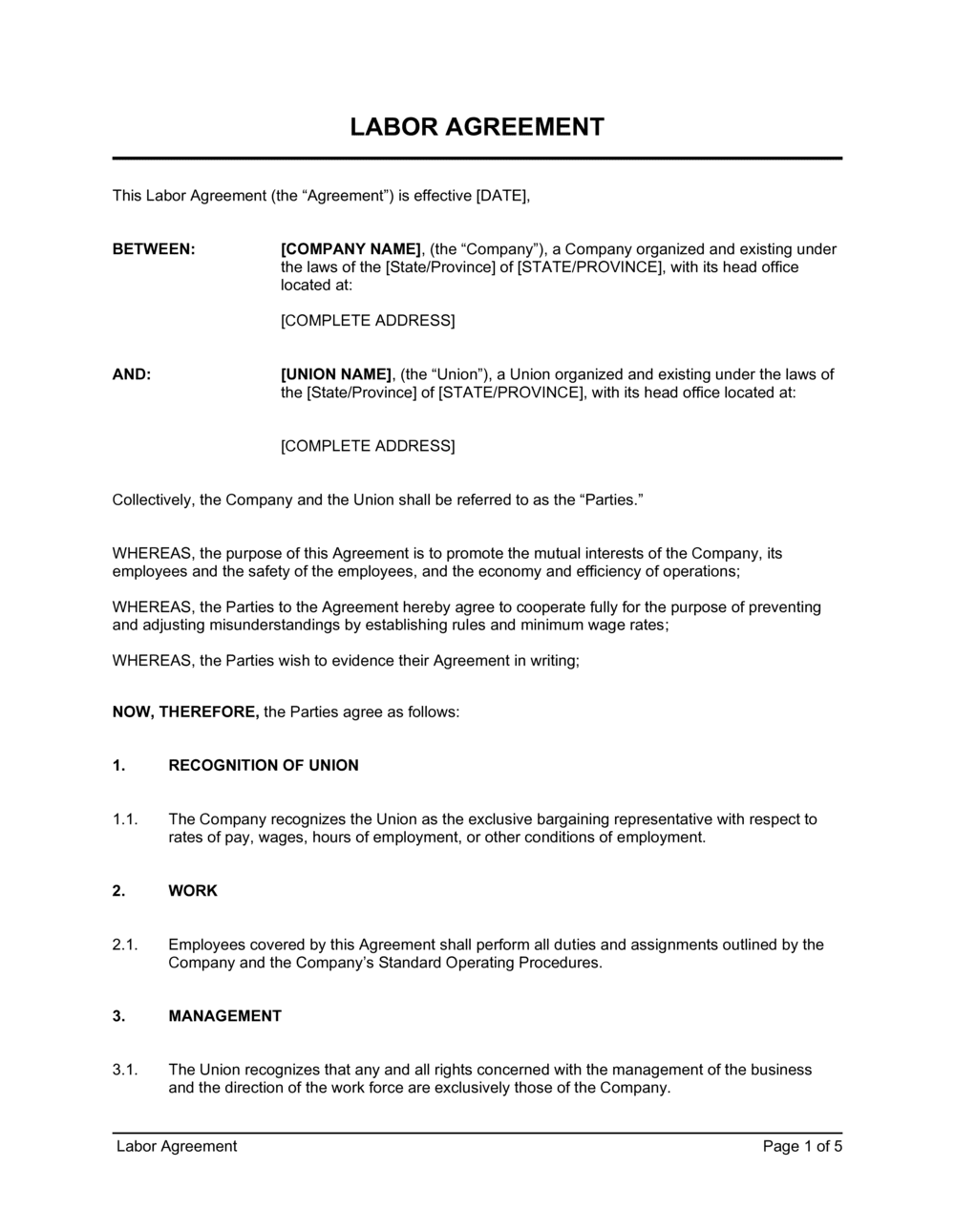
A Labor Agreement is a legally binding contract between an employer and one or more workers — or a recognized union representing them — that formally establishes the terms and conditions of employment. This free Word download covers wages, working hours, job duties, benefits, grievance procedures, and termination rights in a single structured document you can edit online and export as PDF.
When you need it
Use it when onboarding workers under collectively negotiated or individually structured terms, when formalizing an arrangement with a unionized workforce, or when operating in a jurisdiction where a written labor contract is required by statute.
What's inside
Party identification and recognition clause, scope of work and job classification, wages and compensation structure, working hours and overtime, benefits and leave entitlements, grievance and dispute resolution procedures, health and safety obligations, and termination and renewal provisions.

What is a Labor Agreement?

A Labor Agreement is a legally binding contract between an employer and one or more workers — or a union representing them — that formally establishes the terms and conditions governing the employment relationship. It covers wages and scheduled increases, working hours and overtime rules, job classifications, benefits, leave entitlements, grievance and arbitration procedures, health and safety obligations, and the conditions under which either party may terminate or renegotiate the arrangement. Unlike a standard offer letter, a labor agreement creates enforceable rights on both sides that neither party can unilaterally alter during the contract's term.

In unionized settings, a labor agreement is the product of collective bargaining and is typically called a collective agreement or collective bargaining agreement. In non-union workplaces, it functions as a structured employment contract that sets explicit terms for a defined group of workers — providing clarity and legal protection that informal arrangements cannot offer.

Why You Need This Document

Operating without a written labor agreement leaves both employer and worker exposed to costly ambiguity. Without one, wage dispute resolution falls to he-said-she-said credibility contests; overtime entitlements default to the statutory minimum with no agreed premiums or scheduling flexibility; and terminations — even legitimate ones — become vulnerable to wrongful dismissal claims because no just cause standard was ever documented. In jurisdictions where written employment terms are mandated by statute, the absence of a signed agreement is itself a violation. A properly drafted labor agreement eliminates these gaps before they become grievances, arbitration proceedings, or litigation. This template gives you a structured, Word-format starting point that covers every material clause — ready to edit, tailor to your workforce, and execute before your next hire or bargaining cycle begins.

Which variant fits your situation?

If your situation is…Use this template
Hiring a single salaried full-time employeeEmployment Contract
Engaging a self-employed worker for project-based workIndependent Contractor Agreement
Formalizing collectively bargained terms for a unionized workforceCollective Bargaining Agreement
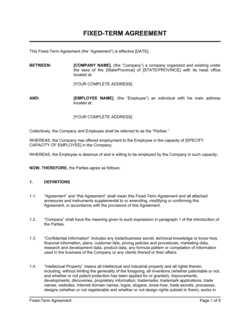
Hiring a worker for a fixed project or season with a defined end dateFixed-Term Employment Contract
Engaging a part-time or hourly worker with variable schedulesPart-Time Employment Contract
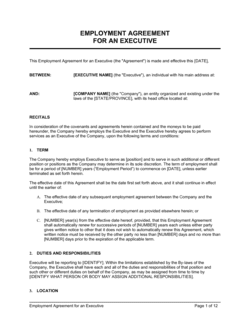
Employing a senior executive with equity and enhanced severanceExecutive Employment Agreement
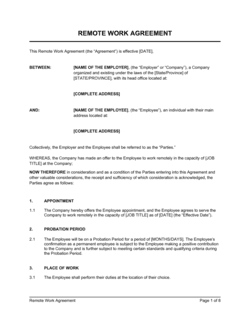
Contracting a remote worker across state or national bordersRemote Work Employment Agreement

Common mistakes to avoid

❌ Using a trade name instead of the registered legal entity

Why it matters: Grievance filings and enforcement actions name the party on the agreement. A mismatch between the agreement name and the corporate registry creates a jurisdictional challenge that can delay or void proceedings.

Fix: Verify the employer's full registered corporate name before drafting and use it verbatim throughout, including in schedules and appendices.

❌ Omitting timelines from the grievance procedure

Why it matters: Without step-by-step deadlines, neither party has a legal obligation to advance the process. Grievances linger for months, resentment builds, and unresolved disputes frequently escalate to arbitration anyway.

Fix: Assign a specific number of business days to each grievance step and include a provision that failure to advance within the deadline constitutes abandonment or automatic escalation.

❌ Embedding specific benefit plan details in the agreement body

Why it matters: When the plan changes at renewal — as it almost always does — any reduction in coverage becomes a potential breach of the labor agreement, exposing the employer to grievance and arbitration liability.

Fix: Reference benefits by category only ('the Employer's health and dental plan in effect from time to time') and attach the current plan summary as a separately amendable schedule.

❌ Setting wage increase dates without specifying the exact calendar date

Why it matters: Vague language like 'at the start of Year 2' or 'upon anniversary' is interpreted differently by each party, creating disputes about whether the increase has been triggered.

Fix: Write every wage increase as a specific calendar date — for example, 'effective January 1, 2027' — with no ambiguity about when the new rate applies.

❌ Failing to include a status-quo clause for the renegotiation period

Why it matters: Without a status-quo provision, an employer may argue it can change wages or conditions once the agreement expires — a position that almost always triggers a work stoppage or unfair labor practice filing.

Fix: Add a clause stating that all terms and conditions remain in force after expiry until a new agreement is ratified or a lawful impasse is declared.

❌ Defining just cause only as 'serious misconduct' without examples or reference to arbitral standards

Why it matters: Arbitrators apply well-developed just cause tests. An employer who terminates under a vaguely worded clause faces a high risk of reinstatement orders and back-pay awards if the arbitrator finds the clause ambiguous.

Fix: Either enumerate the categories of conduct that constitute just cause or explicitly incorporate the recognized seven-factor just cause test by reference in the termination clause.

The 10 key clauses, explained

Parties and recognition

In plain language: Identifies the employer legal entity and the union or worker representative, and records the specific bargaining unit — the group of employees covered by the agreement.

Sample language
This Labor Agreement is entered into between [EMPLOYER LEGAL NAME], a [STATE/PROVINCE] [ENTITY TYPE] ('Employer'), and [UNION NAME / WORKER REPRESENTATIVE] ('Union'), representing all [JOB CLASSIFICATION] employees employed at [LOCATION(S)].

Common mistake: Using a trade name instead of the registered legal entity name. An enforcement action or grievance proceeding filed against the wrong entity name can be dismissed on technical grounds.

Scope of work and job classifications

In plain language: Defines which roles, locations, and categories of workers are covered, and specifies what duties fall within each classification's scope.

Sample language
The bargaining unit consists of all full-time and regular part-time employees classified as [CLASSIFICATION A] and [CLASSIFICATION B] at the Employer's [FACILITY NAME] facility, excluding supervisory, managerial, and confidential employees.

Common mistake: Leaving the scope clause ambiguous about which roles are included versus excluded. Disputes over whether a new job title falls inside or outside the bargaining unit generate grievances and arbitration costs.

Wages and compensation

In plain language: Sets out the base wage rate for each job classification, any scheduled increases, shift differentials, and how overtime is calculated and paid.

Sample language
[CLASSIFICATION A] employees shall be compensated at $[RATE] per hour effective [DATE], increasing to $[RATE] on [DATE]. Overtime shall be paid at 1.5× the regular rate for all hours worked in excess of [40] hours in a workweek.

Common mistake: Stating wage rates without specifying the effective date of each scheduled increase. Missing dates create disputes when the anniversary passes and the increase was never implemented.

Working hours, scheduling, and overtime

In plain language: Defines the standard workday and workweek, how schedules are posted and changed, rest periods, and the rules for mandatory or voluntary overtime.

Sample language
The standard workweek consists of [5] days of [8] hours each, Monday through Friday. Schedules shall be posted no less than [72] hours in advance. Rest periods of [10] minutes shall be provided every [4] hours of continuous work.

Common mistake: Not specifying the minimum notice required before changing a posted schedule. Absent a notice requirement, employers change schedules at will — workers treat it as a violation and file grievances.

Benefits and leave entitlements

In plain language: Lists health, dental, vision, retirement, and other benefits, and sets out paid and unpaid leave entitlements — vacation, sick leave, holidays, parental leave, and bereavement.

Sample language
The Employer shall provide each eligible full-time employee with health benefits as described in the current plan summary, a minimum of [X] days paid vacation accruing at [RATE] per pay period, and [X] paid statutory holidays per year.

Common mistake: Incorporating specific benefit plan details — coverage levels, deductibles, carrier names — directly into the agreement body. When plans change at renewal, the Employer may be in breach of the contract if the new plan is less favorable.

Grievance and arbitration procedure

In plain language: Establishes the step-by-step process for raising, escalating, and resolving workplace disputes, with binding arbitration as the final step.

Sample language
Step 1: Employee submits written grievance to direct supervisor within [10] business days of the incident. Step 2: Management responds in writing within [5] business days. Step 3: Unresolved grievances are referred to binding arbitration administered by [ARBITRATION BODY] within [30] days.

Common mistake: Omitting strict timelines at each step. Without deadlines, grievances stall indefinitely — neither party has an obligation to move the process forward, and the dispute remains unresolved.

Management rights

In plain language: Reserves to the employer the right to direct the workforce, set policies, make operational decisions, and discipline employees on matters not expressly restricted elsewhere in the agreement.

Sample language
The Employer retains the exclusive right to manage and direct the workforce, determine operational requirements, establish and amend work rules, hire, promote, transfer, discipline, and discharge employees for just cause, subject to the terms of this Agreement.

Common mistake: Including the management rights clause as an afterthought without cross-referencing the grievance procedure. Workers will challenge management decisions under the grievance clause regardless — the clause needs to explicitly carve out non-grievable decisions.

Health, safety, and working conditions

In plain language: Commits both parties to maintaining a safe workplace, complying with applicable occupational health and safety laws, and establishing a joint safety committee.

Sample language
The Employer shall maintain the workplace in compliance with all applicable occupational health and safety legislation. A Joint Health and Safety Committee consisting of [X] Employer and [X] Union representatives shall meet at least [quarterly] to review incidents and recommend corrective action.

Common mistake: Treating the safety clause as boilerplate without naming the applicable statute. 'All applicable laws' is fine as a floor, but workers in multiple jurisdictions may be covered by different statutes — specify each.

Discipline and termination

In plain language: Sets out the progressive discipline process — verbal warning, written warning, suspension, termination — and confirms that termination requires just cause and written notice.

Sample language
The Employer shall apply discipline in a progressive manner proportionate to the severity of the infraction: verbal warning, written warning, suspension of [1–5] days, and termination. Termination shall require just cause. Written notice of termination shall be provided no less than [X weeks] in advance or pay in lieu thereof.

Common mistake: Not defining 'just cause' explicitly or by reference to recognized arbitration standards. Vague cause language allows both parties to argue their preferred definition at arbitration — a costly and unpredictable outcome.

Term, renewal, and renegotiation

In plain language: States the start and end date of the agreement, the notice required to reopen negotiations, and what happens if a new agreement is not reached before expiry.

Sample language
This Agreement shall be in effect from [START DATE] to [END DATE] and shall automatically renew for successive one-year terms unless either party provides written notice of intent to renegotiate no less than [60] days prior to expiry.

Common mistake: Setting a renewal notice period shorter than the time realistically needed to negotiate. A 30-day notice window on a 3-year agreement virtually guarantees the parties are still negotiating when the current term expires.

How to fill it out

  1. 1

    Identify the parties and bargaining unit

    Enter the employer's full registered legal name, the union or worker representative's full name, and a precise description of the bargaining unit — which job titles, locations, and classifications are covered and which are excluded.

    💡 Cross-reference your corporate registry and the union's certification order to ensure both party names match the official legal records exactly.

  2. 2

    Set wage rates and scheduled increases

    Enter the current base wage for each job classification, any shift differentials, and the date and amount of each scheduled increase for the full term of the agreement.

    💡 Express wage increases as specific dollar amounts or percentages with calendar dates — avoid language like 'subject to annual review,' which creates a renegotiation trigger.

  3. 3

    Define hours, scheduling, and overtime rules

    Specify the standard workday length, workweek structure, minimum advance notice for schedule changes, rest period frequency, and the overtime threshold and premium rate.

    💡 Check the applicable statutory overtime threshold before drafting — some jurisdictions trigger overtime after 8 hours in a day, not 40 hours in a week.

  4. 4

    List benefits and leave entitlements

    Describe each benefit category (health, dental, vision, retirement) by reference to the current plan document rather than plan specifics. Set minimum vacation accrual, sick day allotment, statutory holidays, and any other leave.

    💡 Reference benefit plans by category and attach the current plan summary as a schedule — this lets you update the plan annually without amending the main agreement.

  5. 5

    Draft the grievance procedure with strict timelines

    Map out each step — informal resolution, supervisor review, management review, arbitration — and assign a deadline to each. Specify the arbitration body and cost-sharing arrangement.

    💡 A three-step procedure with 5–10 business day deadlines at each step is the most commonly enforced structure in North American labor arbitration.

  6. 6

    Tailor the management rights and discipline clauses

    List the specific operational decisions the employer reserves the right to make unilaterally. Define the progressive discipline ladder and confirm just cause as the termination standard.

    💡 Have the union review the management rights clause in negotiation — a clause they sign off on is far harder to grieve later than one imposed unilaterally.

  7. 7

    Confirm health and safety obligations by jurisdiction

    Name the applicable occupational health and safety statute (OSHA, WSIB, HSE, etc.) and specify the joint committee composition, meeting frequency, and incident-reporting obligations.

    💡 Workers in different provinces or states may be covered by different statutes even within one employer — list each applicable law if the agreement covers multiple locations.

  8. 8

    Set the term, renewal notice, and expiry protocol

    Enter the start and end dates of the agreement, the number of days' notice required to reopen negotiations, and a status-quo provision stating that existing terms continue until a new agreement is signed.

    💡 A status-quo clause preventing either party from changing wages or conditions during renegotiation is standard and reduces the risk of industrial action at expiry.

Frequently asked questions

What is a labor agreement?

A labor agreement is a legally binding contract between an employer and a worker — or a union representing a group of workers — that defines the terms and conditions of the employment relationship, including wages, hours, benefits, duties, grievance procedures, and termination rights. In unionized settings it is typically called a collective agreement or collective bargaining agreement. In non-union workplaces it functions as a structured individual employment contract.

What is the difference between a labor agreement and an employment contract?

An employment contract governs the relationship between an employer and a single employee — covering compensation, duties, IP, confidentiality, and termination on an individual basis. A labor agreement typically covers a defined group of workers under collectively negotiated terms and includes union-specific provisions such as recognition, dues checkoff, no-strike clauses, and binding grievance arbitration. The two documents serve different legal purposes and are governed by different bodies of law.

Is a written labor agreement legally required?

In most US states no federal or state law mandates a written labor agreement for non-union employers, though the National Labor Relations Act requires employers to bargain in good faith with a certified union, and the resulting agreement must be reduced to writing. In Canada, the UK, and EU member states, written employment terms are either mandatory or standard practice, and certain minimum terms are required by statute regardless of what the agreement says.

What should a labor agreement include?

A complete labor agreement should cover parties and bargaining unit recognition, job classifications and scope of work, wages and scheduled increases, working hours and overtime rules, benefits and leave entitlements, a multi-step grievance and arbitration procedure, a management rights clause, health and safety obligations, progressive discipline and just cause termination standards, and the term and renewal provisions. Missing any of these creates gaps that arbitrators will fill using jurisdiction-specific defaults.

What does 'just cause' mean in a labor agreement?

Just cause is a termination standard requiring the employer to have a legitimate, documented, and proportionate reason before dismissing a worker covered by the agreement. Arbitrators typically apply a seven-factor test: notice of the rule, consistent enforcement, investigation before discipline, substantial evidence of the violation, equal treatment of comparable cases, proportionality of the penalty, and mitigating circumstances. An employer who terminates without satisfying these factors typically faces a reinstatement and back-pay award.

How long does a labor agreement typically last?

Most labor agreements run for one to three years in North America. Longer terms (up to five years) are common in industries with stable cost structures, such as utilities and manufacturing. Shorter terms allow more frequent wage adjustments in high-inflation periods but require more frequent negotiation. The agreement should include a renewal notice period — typically 60–90 days before expiry — to trigger renegotiation in time to reach a new agreement before the current term ends.

Can a labor agreement restrict the employer's right to manage the workforce?

Yes — and this is the primary source of tension in labor relations. A labor agreement can limit an employer's right to subcontract work, change job classifications, alter shift structures, or lay off workers except in defined circumstances. A well-drafted management rights clause carves out operational decisions the employer retains unilaterally, while the grievance procedure gives workers a mechanism to challenge decisions that cross the contractual line.

What happens when a labor agreement expires without a new one in place?

In most common-law jurisdictions, the existing terms and conditions continue to apply under a status-quo obligation until a new agreement is ratified or a lawful impasse is formally declared. An employer who unilaterally changes wages or conditions during this period typically commits an unfair labor practice. Including a status-quo clause in the agreement itself eliminates ambiguity about this obligation and reduces the risk of industrial action during renegotiation.

Do I need a lawyer to draft a labor agreement?

For any agreement covering a unionized workforce, legal review is strongly recommended — the interplay between the contract language and arbitral jurisprudence is complex, and poorly drafted clauses are routinely exploited in grievance proceedings. For non-union employers using a structured labor agreement as an individual employment contract, a high-quality template reviewed by an employment lawyer for jurisdiction- specific compliance typically costs $300–$800 and is worthwhile for any workforce of five or more employees.

How this compares to alternatives

vs Employment Contract

An employment contract governs the relationship between an employer and a single employee on an individual basis, covering compensation, duties, IP, and termination. A labor agreement covers a defined group of workers under collectively negotiated terms and adds union-specific provisions — recognition, dues checkoff, no-strike clauses, and binding grievance arbitration. The two are governed by different bodies of law and should not be used interchangeably.

vs Independent Contractor Agreement

An independent contractor agreement engages a self-employed individual for project-based work with no employment entitlements — no benefits, no overtime, no grievance rights. A labor agreement covers employees or union members with the full range of statutory and collectively bargained protections. Misclassifying a covered worker as an independent contractor under a labor agreement exposes the employer to back-pay claims, penalties, and unfair labor practice charges.

vs Fixed-Term Employment Contract

A fixed-term contract sets a defined end date for a single employee's engagement, after which employment automatically terminates. A labor agreement typically covers multiple workers, runs for a set term of 1–3 years, and includes renewal and renegotiation provisions rather than automatic termination. Workers on a fixed-term contract generally do not have grievance or arbitration rights unless a labor agreement applies to their classification.

vs Executive Employment Agreement

An executive employment agreement covers senior management with equity, enhanced severance, change-of-control provisions, and heavily negotiated non-compete terms. Labor agreements are specifically designed for non-managerial workers and expressly exclude supervisory and executive personnel from the bargaining unit. Applying a labor agreement structure to an executive hire — or vice versa — creates significant legal and governance problems.

Industry-specific considerations

Construction and trades

Project-based wage rates, apprentice-to-journeyperson ratios, tool and equipment allowances, and jobsite safety committee requirements are all typically embedded in construction labor agreements.

Manufacturing

Shift differential pay, production incentive structures, seniority-based layoff and recall procedures, and detailed job classification hierarchies make manufacturing labor agreements among the most complex in any sector.

Healthcare

Mandatory staffing ratios, on-call and standby pay rules, mandatory overtime restrictions, and credentialing conditions as prerequisites to specific job classifications are distinctive features of healthcare labor agreements.

Retail and hospitality

Variable scheduling provisions, split-shift premiums, tip and gratuity handling, and high workforce turnover make retail and hospitality labor agreements particularly focused on scheduling flexibility and minimum-hours guarantees.

Professional services

Billable-hour expectations, professional development leave, licensing and certification reimbursement, and client non-solicitation provisions are common additions to labor agreements in legal, accounting, and consulting firms.

Transportation and logistics

Hours-of-service compliance, per-diem and away-from-home allowances, equipment assignment rights, and DOT drug-testing obligations are standard features of labor agreements covering drivers and logistics workers.

Jurisdictional notes

United States

The National Labor Relations Act (NLRA) governs collective bargaining for most private-sector employees and requires employers to bargain in good faith with a certified union. At-will employment is the default for non-union arrangements in 49 states, but any written labor agreement creates contractual rights that override at-will. Non-compete and dues-checkoff provisions vary significantly by state — California bans most post-employment non-competes, and several states restrict or ban mandatory union dues.

Canada

Labor relations are primarily provincially regulated in Canada — each province has its own Labor Relations Act or equivalent statute setting certification, bargaining, and strike rules. At-will employment does not exist; minimum notice and severance are governed by provincial Employment Standards Acts. In Ontario, collective agreements must include a grievance arbitration clause by statute. Quebec agreements must be in French for provincially regulated employers, and the Civil Code governs individual labor contracts.

United Kingdom

The Trade Union and Labour Relations (Consolidation) Act 1992 governs collective bargaining in the UK. Collective agreements are generally not legally enforceable as contracts unless expressly incorporated into individual employment contracts. Employers must provide a written statement of employment particulars on or before day one under the Employment Rights Act 1996. Statutory minimum notice, redundancy pay, and unfair dismissal protections apply regardless of what the agreement says.

European Union

The EU Transparent and Predictable Working Conditions Directive requires written employment terms within 7 days of hire across all member states. Collective agreements in Germany, France, Spain, and the Netherlands are often extended by government decree to cover entire sectors — employers may be bound by a sectoral agreement even without direct union membership. Post-employment non-competes typically require financial compensation to the employee to be enforceable, ranging from 25–100% of salary depending on the member state.

Template vs lawyer — what fits your deal?

PathBest forCostTime
Use the templateNon-union employers formalizing individual labor terms for small teams in a single jurisdictionFree1–2 hours
Template + legal reviewSmall businesses with 5–50 employees, first-time labor agreements, or cross-jurisdictional workforces$400–$900 for an employment lawyer review3–5 business days
Custom draftedUnionized workplaces, multi-site employers, heavily regulated industries, or any agreement covering more than 50 workers$2,000–$8,000+ depending on workforce complexity2–8 weeks including negotiation

Glossary

Collective Bargaining
A negotiation process between an employer and a union representing workers to reach a written agreement on wages, hours, and working conditions.
Grievance Procedure
A formal multi-step process outlined in the labor agreement that workers and management follow to resolve workplace disputes without litigation.
Recognition Clause
The section of a labor agreement in which the employer formally acknowledges the union or worker representative as the exclusive bargaining agent for a defined group of employees.
Job Classification
A defined category or title that groups workers by skill level, duties, or pay grade and determines the wage rate and work rules that apply to them.
Seniority
A worker's length of continuous service with an employer, used in labor agreements to determine priority for promotions, shift assignments, and layoff order.
Overtime Rate
A premium wage rate — typically 1.5× the regular rate — paid for hours worked beyond the standard threshold defined by statute or the agreement, commonly 40 hours per week.
Management Rights Clause
A provision reserving to the employer the unilateral right to make operational decisions — such as scheduling, hiring, and disciplinary action — not expressly restricted by the agreement.
No-Strike / No-Lockout Clause
A mutual commitment in which the union agrees not to strike and the employer agrees not to lock out workers during the term of the agreement.
Just Cause
A standard requiring the employer to have a legitimate, documented, and proportionate reason before disciplining or terminating a worker covered by the agreement.
Term and Renewal
The defined duration of the labor agreement — typically 1–3 years — and the conditions under which it automatically renews or must be renegotiated before expiry.
Dues Checkoff
An employer arrangement to deduct union membership dues directly from workers' paychecks and remit them to the union, authorized in writing by each employee.
Work-to-Rule
A form of industrial action in which workers perform only the minimum duties required by the literal terms of the agreement, slowing operations without technically striking.

Part of your Business Operating System

This document is one of 3,000+ business & legal templates included in Business in a Box.

  • Fill-in-the-blanks — ready in minutes
  • 100% customizable Word document
  • Compatible with all office suites
  • Export to PDF and share electronically

Create your document in 3 simple steps.

From template to signed document — all inside one Business Operating System.
1
Download or open template

Access over 3,000+ business and legal templates for any business task, project or initiative.

2
Edit and fill in the blanks with AI

Customize your ready-made business document template and save it in the cloud.

3
Save, Share, Send, Sign

Share your files and folders with your team. Create a space of seamless collaboration.

Save time, save money, and create top-quality documents.

★★★★★

"Fantastic value! I'm not sure how I'd do without it. It's worth its weight in gold and paid back for itself many times."

Managing Director · Mall Farm
Robert Whalley
Managing Director, Mall Farm Proprietary Limited
★★★★★

"I have been using Business in a Box for years. It has been the most useful source of templates I have encountered. I recommend it to anyone."

Business Owner · 4+ years
Dr Michael John Freestone
Business Owner
★★★★★

"It has been a life saver so many times I have lost count. Business in a Box has saved me so much time and as you know, time is money."

Owner · Upstate Web
David G. Moore Jr.
Owner, Upstate Web

Run your business with a system — not scattered tools

Stop downloading documents. Start operating with clarity. Business in a Box gives you the Business Operating System used by over 250,000 companies worldwide to structure, run, and grow their business.

Free Forever Plan · No credit card required