1
Enter the employer's legal entity name and the employee's details
Use the employer's full registered corporate name — not a brand or trade name — and the employee's legal name as it appears on payroll records. Include the employee's job title, department, and original hire date.
💡 Cross-reference the corporate registry to confirm the exact legal name before execution — errors here can affect enforceability of the release.
2
Set the separation date and confirm all final pay obligations
Enter the employee's official last day, then list every component of final pay: earned wages, accrued vacation payout (where required by state or provincial law), and any outstanding expense reimbursements. Make these unconditional — do not tie final pay to signing.
💡 In California, accrued vacation must be paid at separation regardless of the reason for termination. Check the specific rule for every state or province where the employee worked.
3
Define the severance package with a specific payment schedule
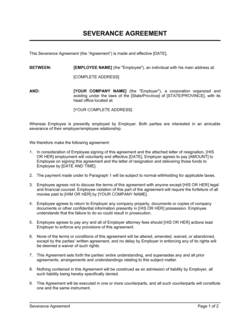
State the total severance amount, the calculation basis (e.g., 2 weeks per year of service), and whether it will be paid as a lump sum or in installments on regular payroll dates. Name the specific date on which the first payment will be made.
💡 Lump-sum severance paid on a fixed date is easier for both parties to track and reduces the employer's risk of payroll-related disputes compared to installment payments.
4
Complete the release of claims with jurisdiction-specific language
List the specific federal and state statutes being waived — Title VII, the ADEA, the ADA, the FMLA, and any applicable state equivalents. For employees aged 40 or older, add the full ADEA/OWBPA disclosure block including the 21-day review period and 7-day revocation right.
💡 For a group layoff involving two or more employees aged 40+, the review period extends to 45 days and requires a written disclosure of the job titles and ages of all selected and non-selected employees in the decisional unit.
5
Add confidentiality and property-return obligations with a hard deadline
Specify the exact date by which all company property — laptops, keycards, documents, and data — must be returned or certified as destroyed. Restate the confidentiality obligation by referencing any prior NDA or confidentiality clause from the employment agreement.
💡 Include cloud storage and personal-device data in the property-return list — departing employees frequently retain company data in personal Dropbox or Google Drive accounts.
6
Draft mutual non-disparagement language
Write the non-disparagement clause as a bilateral obligation — the employee agrees not to disparage the company, and the company agrees to instruct its officers and directors not to disparage the employee to prospective employers or clients.
💡 Some US states and many EU jurisdictions have begun scrutinizing one-sided non-disparagement clauses as coercive. Mutual language is both more defensible and easier to negotiate.
7
Confirm surviving post-employment restrictions
If the original employment agreement contained a non-compete, non-solicit, or IP assignment, cite that agreement by date and state that those provisions survive termination. Do not attempt to add new restrictions for the first time in this document.
💡 In jurisdictions that have recently banned post-employment non-competes — including California, Minnesota, and several EU member states — remove the non-compete confirmation entirely to avoid invalidating the broader agreement.
8
Execute before or on the separation date and retain a fully signed copy
Both parties must sign the agreement. For employees aged 40 or older, do not accept a signature until the 21-day review period has elapsed (or the employee has signed a written, knowing waiver of the waiting period). Record the effective date as the day after the 7-day revocation period expires.
💡 Use Business in a Box eSign to timestamp signatures and automatically calculate the effective date based on the revocation period — this creates a defensible audit trail if the agreement is challenged later.