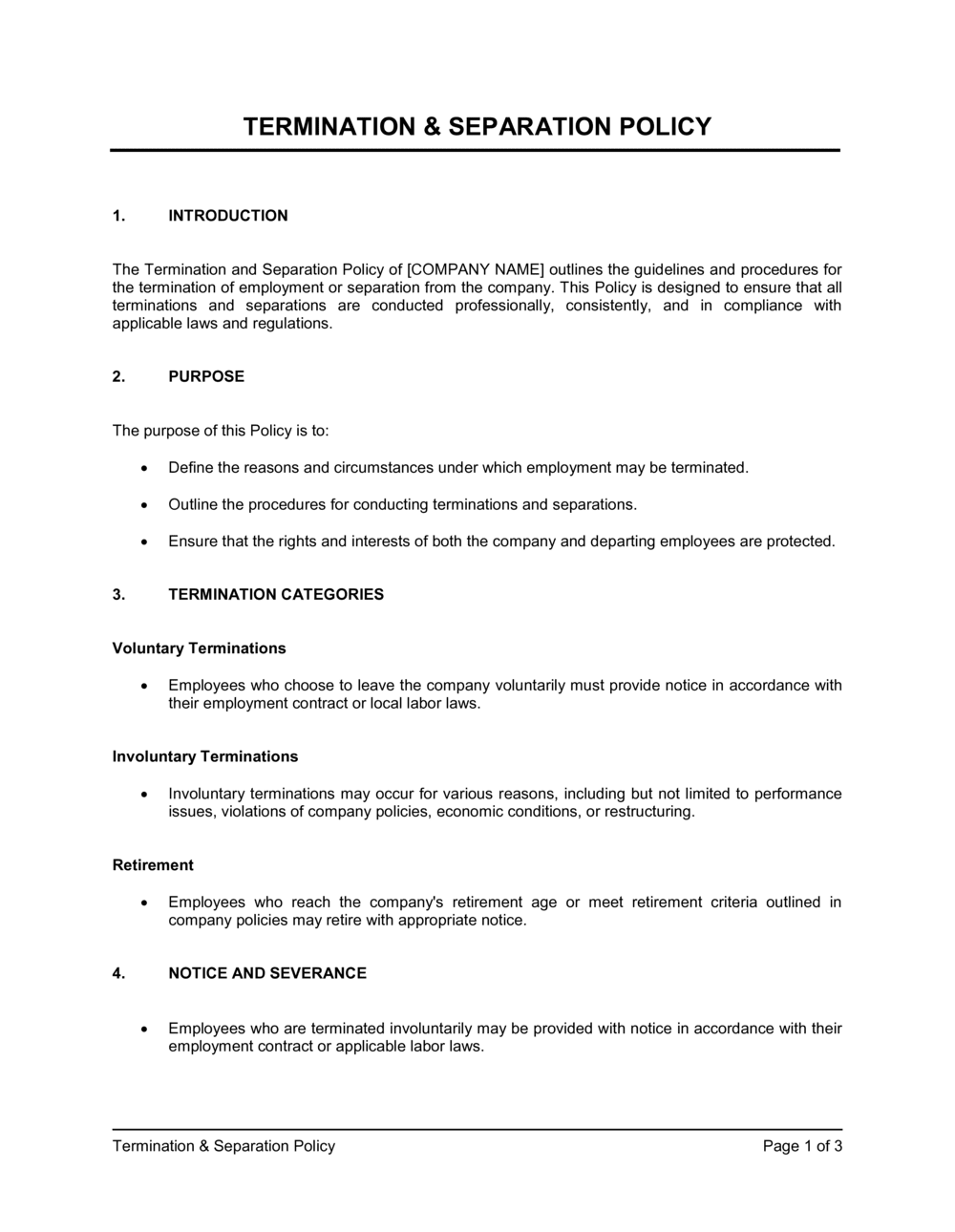
Termination and Separation Policy Template

Free Word download β€’ Edit online β€’ Save & share with Drive β€’ Export to PDF

3 pagesβ€’20–25 min to fillβ€’Difficulty: Standard
Learn more ↓
FreeTermination and Separation Policy Template

At a glance

What it is
A Termination and Separation Policy is an internal HR document that defines how an organization handles all forms of employee departure β€” voluntary resignation, involuntary dismissal, layoff, and retirement. This free Word download gives you a structured, ready-to-edit template you can tailor to your workforce size and export as PDF for your employee handbook or HR portal.
When you need it
Use it when formalizing your HR framework for the first time, updating an outdated termination procedure, or preparing for organizational growth that requires consistent, defensible offboarding practices across managers and departments.
What's inside
The policy covers separation types, notice requirements, final pay and benefits procedures, return of company property, system access revocation, exit interviews, reference check guidelines, and records retention obligations β€” all in a single structured document.

What is a Termination and Separation Policy?

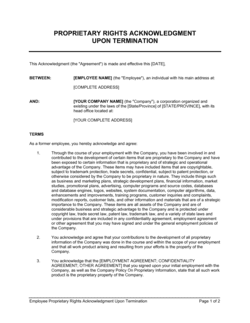
A Termination and Separation Policy is an internal HR document that defines the procedures an organization follows when any employee relationship ends β€” whether through voluntary resignation, involuntary dismissal, layoff, retirement, or job abandonment. It establishes consistent rules for notice periods, final pay, accrued benefit payouts, company property return, system access revocation, exit interviews, and records retention. By codifying these procedures in a single document, the policy ensures every manager follows the same defensible process regardless of the circumstances of the departure.

Why You Need This Document

When termination procedures are left to individual managers to improvise, the results are inconsistent, legally exposed, and operationally disruptive. Missing a final-pay deadline triggers regulatory penalties in most jurisdictions. Failing to deactivate system access on the day of separation creates data security risks that can persist for weeks. Applying different notice periods to employees of the same tenure exposes the company to discrimination claims. And without documented procedures, a wrongful dismissal dispute becomes a credibility contest rather than a process verification. A well-constructed termination and separation policy closes all of these gaps β€” protecting the company, ensuring fair treatment for departing employees, and giving every manager a clear, repeatable checklist to follow from the moment notice is given to the day records are archived.

Which variant fits your situation?

If your situation is…Use this template
General employee departures of any type across a small or mid-size businessTermination And Separation Policy
Formally notifying an employee of involuntary terminationEmployee Dismissal Letter
Documenting the specific grounds for a for-cause dismissalTermination For Cause Letter
Managing a workforce reduction or restructuring eventLayoff Letter
Collecting acknowledgment that the departing employee has read the policyEmployee Acknowledgment Form
Structuring the severance terms negotiated with a departing employeeSeverance Agreement
Documenting a performance improvement plan before termination is consideredPerformance Improvement Plan

Common mistakes to avoid

❌ Forfeiture of accrued vacation on termination

Why it matters: In most US states, Canadian provinces, and EU countries, accrued vacation pay is a vested wage β€” a policy clause forfeiting it is unenforceable and can trigger regulatory fines or back-pay claims.

Fix: Remove any forfeiture language and replace it with a calculation formula for paying out all unused accrued vacation at the employee's regular rate as part of final pay.

❌ A single flat notice period regardless of tenure

Why it matters: Employment standards statutes in virtually every jurisdiction require longer notice for longer-tenured employees β€” a flat two-week provision can be void as below the statutory minimum for a five-year employee.

Fix: Tier notice periods by tenure band and confirm each tier meets or exceeds the applicable statutory minimum before publishing the policy.

❌ Withholding final pay until company property is returned

Why it matters: Wages are a legal obligation β€” conditioning payment on property return violates employment standards legislation in most jurisdictions and exposes the company to penalties and claims.

Fix: Issue final pay on the required deadline regardless of property status. Pursue unreturned items through a separate written demand or civil process.

❌ No defined IT deactivation timeline

Why it matters: Without a documented deactivation window, departing employees β€” particularly those terminated for cause β€” may retain system access for days after separation, creating data security and confidentiality risks.

Fix: Define a specific deactivation deadline (e.g., end of business on the final day for standard departures; within two hours for for-cause terminations) and assign a named role responsible for execution.

The 10 key sections, explained

Purpose and scope

Types of separation

Notice requirements

Final pay and benefits

Severance guidelines

Return of company property

System access and data security

Exit interview process

References and employment verification

Records retention

How to fill it out

  1. 1

    Define scope and covered employment types

    Identify all employee categories this policy governs β€” full-time, part-time, contractors, and fixed-term β€” and list the separation types each section applies to.

    πŸ’‘ If contractors are explicitly excluded, note that in the scope section to prevent managers from applying the policy incorrectly.

  2. 2

    Set notice periods by tenure or role

    Enter specific notice periods for employee-initiated and employer-initiated separations. Tier them by tenure β€” e.g., less than 1 year, 1–5 years, 5+ years β€” to align with statutory minimums in your jurisdiction.

    πŸ’‘ Check your employment standards legislation before filling in any numbers β€” your contractual period cannot be less than the statutory floor.

  3. 3

    Complete the final pay and benefits section

    Specify the final pay deadline (by next regular pay date or earlier if required by law), how accrued vacation is calculated, and the exact date group benefits coverage ends.

    πŸ’‘ State the accrual rate formula β€” e.g., 1.25 days per month β€” so final vacation payout calculations are consistent and auditable.

  4. 4

    Draft the severance formula and release requirement

    Insert the severance calculation (weeks per year of service), the minimum qualifying tenure, the payment cap, and the condition that a signed release is required before payment is issued.

    πŸ’‘ If your jurisdiction sets a statutory severance floor, confirm your formula meets it β€” anything below the floor is void and the statutory minimum applies automatically.

  5. 5

    List all company property to be returned

    Create a checklist of every category of company-owned asset β€” hardware, access cards, vehicles, documents, and software licenses β€” and the deadline for return.

    πŸ’‘ Attach a property return checklist as an appendix rather than listing every item inline β€” this makes it easy to update as your tech stack changes without amending the main policy.

  6. 6

    Define IT deactivation responsibilities and timeline

    Name the role responsible for notifying IT, the notice lead time required, and the deadline for all access deactivation relative to the employee's last day.

    πŸ’‘ For remote employees with access to sensitive data, consider immediate deactivation on the day separation notice is given rather than waiting for the final day.

  7. 7

    Specify records retention periods

    Enter the minimum retention period for each record type β€” personnel file, final pay records, exit interview notes β€” based on the longest applicable legal requirement in your jurisdiction.

    πŸ’‘ When operating in multiple states or provinces, use the longest retention period across all applicable laws as your default to avoid compliance gaps.

  8. 8

    Review with HR and update your employee handbook

    Have your HR lead review the completed policy for consistency with existing policies (disciplinary policy, employee handbook, employment contracts) before publishing.

    πŸ’‘ Cross-reference the notice periods in this policy against those in your standard employment contract template β€” a mismatch between the two creates ambiguity that employees and their counsel will exploit.

Frequently asked questions

What is a termination and separation policy?

A termination and separation policy is an internal HR document that defines how an organization handles all forms of employee departure β€” voluntary resignation, involuntary dismissal, layoff, retirement, and job abandonment. It standardizes notice requirements, final pay procedures, property return, system access revocation, and records retention so every manager follows the same defensible process regardless of the circumstances of departure.

Why do businesses need a termination and separation policy?

Without a written policy, termination procedures vary by manager and situation β€” creating legal exposure, inconsistent employee treatment, and disorganized offboarding. A documented policy protects the company in wrongful dismissal disputes by demonstrating that a consistent, fair process was followed. It also ensures compliance with final-pay deadlines, benefits obligations, and data security requirements that carry regulatory penalties when missed.

What should a termination and separation policy include?

At minimum: a definition of each separation type (voluntary, involuntary for cause, layoff, retirement, job abandonment), notice period requirements tiered by tenure, final pay and accrued vacation procedures, severance guidelines, company property return obligations, IT system deactivation timelines, exit interview procedures, reference check guidelines, and records retention requirements. Missing any of these creates process gaps that expose the business operationally and legally.

Is a termination and separation policy legally required?

No jurisdiction universally mandates a written internal termination policy, but many employment standards statutes require employers to meet specific notice, final pay, and severance minimums β€” which a policy helps enforce consistently. In practice, the absence of a documented policy is a significant liability in wrongful dismissal or discrimination claims, where courts look for evidence that the employer followed a fair and consistent process.

What is the difference between termination for cause and termination without cause?

Termination for cause is dismissal based on specific documented employee misconduct or serious performance failure β€” typically without entitlement to severance or notice beyond what law requires. Termination without cause ends employment for business reasons unrelated to the employee's conduct β€” such as a restructuring or position elimination β€” and generally entitles the employee to notice or pay in lieu, plus severance. Confusing the two in a termination letter or policy is one of the most common and costly HR mistakes.

Can a company withhold final pay until the employee returns company property?

No. In most jurisdictions, wages are a legal obligation that cannot be conditioned on property return. Withholding final pay pending asset recovery violates employment standards legislation in most US states, Canadian provinces, and EU countries, and can trigger regulatory penalties and back-pay claims. Companies should issue final pay on the required deadline and pursue unreturned property through a separate written demand or civil process.

How long should employee termination records be retained?

Retention requirements vary by jurisdiction. In the US, EEOC regulations generally require personnel records for terminated employees to be kept for at least one year; Title VII requirements extend this to two years for larger employers. In Canada, most provinces require payroll and employment records for three to seven years. A practical default for multi-jurisdiction employers is seven years, which typically satisfies the longest applicable requirement without excess burden.

Should exit interviews be mandatory?

Making exit interviews mandatory is generally counterproductive. Voluntary participation produces more candid and useful feedback because employees feel no obligation to be diplomatic. Policy language should invite rather than require participation, while making the process easy and confidential. Aggregate findings β€” rather than individual responses β€” should be shared with leadership to encourage honest input.

How does a termination and separation policy interact with employment contracts?

The policy sets the company-wide baseline procedure; individual employment contracts may override specific terms β€” particularly notice periods and severance amounts β€” where the contract provides greater entitlements. Before publishing the policy, HR should confirm that the policy's notice and severance provisions are consistent with or subordinate to the terms in standard employment agreements. Any conflict between the two is typically resolved in favor of the employee.

How this compares to alternatives

vs Employee Dismissal Letter

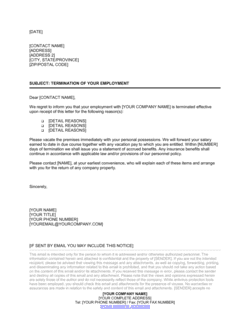
A dismissal letter is the formal written notice sent to a specific employee at the time of termination, documenting the decision, effective date, and any severance offered. A termination and separation policy is the internal governing document that defines the rules all such letters must follow. The policy drives the process; the letter executes it for one individual.

vs Performance Improvement Plan

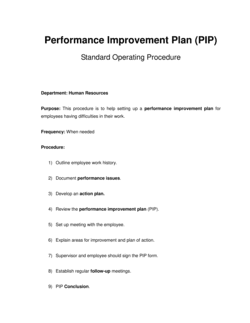
A performance improvement plan is a structured corrective document issued before any termination decision is made, giving an employee a defined timeline and measurable targets to address performance deficiencies. A termination policy governs what happens after all corrective options have been exhausted. The PIP precedes the separation process; the policy picks up where the PIP ends.

vs Severance Agreement

A severance agreement is a binding contract between employer and departing employee, exchanging severance compensation for a release of claims. A termination and separation policy is an internal HR document that sets the company's standard severance formula and conditions. The policy establishes the framework; the agreement is the legally binding instrument executed for each individual separation.

vs Employee Handbook

An employee handbook is a broad reference document covering all HR policies β€” conduct, benefits, leave, compensation, and more. A termination and separation policy is a single dedicated policy document that can stand alone or be incorporated as a chapter in the handbook. When the handbook includes a termination policy, the standalone version serves as the working reference for HR and managers.

Industry-specific considerations

Technology / SaaS

System access deactivation and IP protection provisions are particularly critical given the volume of sensitive data and proprietary code employees can access remotely.

Healthcare

HIPAA obligations require immediate deactivation of access to patient records upon separation, and records retention schedules must align with healthcare-specific regulatory requirements.

Professional Services

Client non-solicitation and client file transfer procedures are typically embedded in or cross-referenced from the separation policy to protect fee relationships.

Retail / Hospitality

High turnover makes a streamlined, easy-to-follow offboarding checklist essential β€” managers must be able to process separations consistently without extended HR involvement.

Manufacturing

Physical asset return β€” tools, protective equipment, vehicle keys, and facility access cards β€” requires a specific checklist built into the offboarding procedure.

Financial Services

Regulatory requirements may mandate immediate access revocation to trading systems and client accounts, with separation records subject to extended retention under FINRA or FCA rules.

Template vs pro β€” what fits your needs?

PathBest forCostTime
Use the templateSmall to mid-size businesses formalizing HR procedures for the first time or updating an outdated termination policyFree2–4 hours to customize and review
Template + professional reviewEmployers operating across multiple states or provinces, or those with recent termination disputes that exposed policy gaps$300–$800 for an HR consultant or employment lawyer review1–3 days
Custom draftedLarge employers, unionized workforces, or heavily regulated industries where standard policies carry significant compliance risk$1,000–$3,500+1–3 weeks

Glossary

Voluntary Separation
An employee-initiated departure β€” resignation or retirement β€” as opposed to a dismissal by the employer.
Involuntary Termination
An employer-initiated end to the employment relationship, including dismissal for cause, layoff, or position elimination.
Termination for Cause
Dismissal based on specific documented employee misconduct or performance failure, typically without entitlement to severance.
Notice Period
The advance warning required before an employment relationship ends β€” either by the employee or the employer β€” as specified in the employment contract or policy.
Final Pay
The last paycheck owed to a departing employee, which may include earned wages, accrued vacation, and other agreed compensation, subject to applicable law.
Severance
Compensation paid to an employee upon termination beyond their final pay, typically calculated as a number of weeks per year of service.
Offboarding
The structured process of transitioning a departing employee out of the organization β€” covering system access, property return, knowledge transfer, and final documentation.
Exit Interview
A structured conversation with a departing employee designed to gather feedback on the organization, role, and reasons for leaving.
COBRA (US Context)
A US federal law allowing departing employees to continue employer-sponsored health coverage for a defined period at their own expense following separation.
Records Retention
The employer's obligation to retain personnel files, termination records, and related documents for a legally specified period after separation.

Part of your Business Operating System

This document is one of 3,000+ business & legal templates included in Business in a Box.

  • Fill-in-the-blanks β€” ready in minutes
  • 100% customizable Word document
  • Compatible with all office suites
  • Export to PDF and share electronically

Create your document in 3 simple steps.

From template to signed document β€” all inside one Business Operating System.
1
Download or open template

Access over 3,000+ business and legal templates for any business task, project or initiative.

2
Edit and fill in the blanks with AI

Customize your ready-made business document template and save it in the cloud.

3
Save, Share, Send, Sign

Share your files and folders with your team. Create a space of seamless collaboration.

Save time, save money, and create top-quality documents.

β˜…β˜…β˜…β˜…β˜…

"Fantastic value! I'm not sure how I'd do without it. It's worth its weight in gold and paid back for itself many times."

Managing Director Β· Mall Farm
Robert Whalley
Managing Director, Mall Farm Proprietary Limited
β˜…β˜…β˜…β˜…β˜…

"I have been using Business in a Box for years. It has been the most useful source of templates I have encountered. I recommend it to anyone."

Business Owner Β· 4+ years
Dr Michael John Freestone
Business Owner
β˜…β˜…β˜…β˜…β˜…

"It has been a life saver so many times I have lost count. Business in a Box has saved me so much time and as you know, time is money."

Owner Β· Upstate Web
David G. Moore Jr.
Owner, Upstate Web

Run your business with a system β€” not scattered tools

Stop downloading documents. Start operating with clarity. Business in a Box gives you the Business Operating System used by over 250,000 companies worldwide to structure, run, and grow their business.

Free Forever PlanΒ Β·Β No credit card required