1
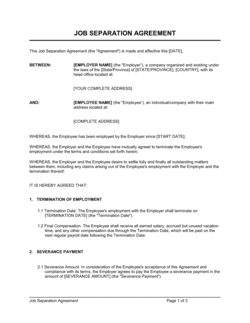
Enter the parties' legal names and the separation date
Use the employer's full registered legal entity name — not a trade name — and the employee's name as it appears on payroll and government ID. Confirm the exact last day of employment, including whether the employee is paid through that date.
💡 Cross-reference the separation date against your payroll schedule to confirm when the final paycheck — including accrued PTO, if required by your jurisdiction — must be issued.
2
Determine and document the severance amount
Enter the severance amount or formula (e.g., 2 weeks per year of service), the payment vehicle (lump sum or installments), and the trigger date — typically the first business day after the revocation period expires.
💡 Condition the payment explicitly on the agreement becoming 'effective' — defined as after the revocation period — to prevent paying out severance that the employee later rescinds.
3
Confirm whether ADEA/OWBPA disclosures are required
If the employee is aged 40 or older, activate the ADEA/OWBPA section: confirm the 21-day review period, the written advisement to consult counsel, and the 7-day revocation window. For group layoffs of employees aged 40+, the review period extends to 45 days.
💡 Even if you are confident the employee is under 40, include the consideration period language anyway — it signals good faith and does not harm enforceability for younger employees.
4
Tailor the release of claims language to your jurisdiction
Enumerate the specific federal and state statutes being waived, including Title VII, the ADA, the ADEA, the FLSA, and any applicable state discrimination and wage laws. Confirm with counsel that your jurisdiction does not prohibit waiver of certain claims — for example, future workers' compensation or unemployment insurance claims cannot be waived in most US states.
💡 Add a California-specific addendum if the employee works in California, as CA Labor Code requires specific wage-claim carve-outs and limits on general release language.
5
Complete the property return and benefits sections
List every company asset the employee holds by type and, where possible, by serial or asset tag number. Confirm the benefits termination date and ensure the COBRA notice timeline is accurate.
💡 If you are extending COBRA premium payments as part of the severance package, state the exact number of months and confirm whether the subsidy is taxable under the applicable tax code.
6
Attach or incorporate the existing restrictive covenants by reference
Rather than redrafting non-compete or non-solicitation terms, reference the specific sections and date of the original employment agreement. State explicitly that those obligations survive separation and are not waived.
💡 If the original employment agreement did not contain restrictive covenants — or if you are adding new ones in the separation agreement — provide separate documented consideration, such as an enhanced severance payment, to support enforceability.
7
Have the agreement reviewed by counsel before presenting it
Employment law varies significantly by state and province. A 1–2 hour attorney review before you present the agreement to the employee is significantly cheaper than defending a lawsuit after a defective release fails to bar a claim.
💡 Present the agreement to the employee in writing and keep a timestamped record of when it was delivered — the 21-day consideration clock starts from that date, not the signing date.
8
Execute, retain, and trigger the payment after the revocation period
Both parties sign the agreement; for employees aged 40+, wait for the 7-day revocation period to expire before releasing any severance. Store the fully executed agreement with a record of the effective date.
💡 Use an eSign platform with timestamping so you have auditable proof of when the employee signed and when the revocation window closed — critical if the release is later challenged.