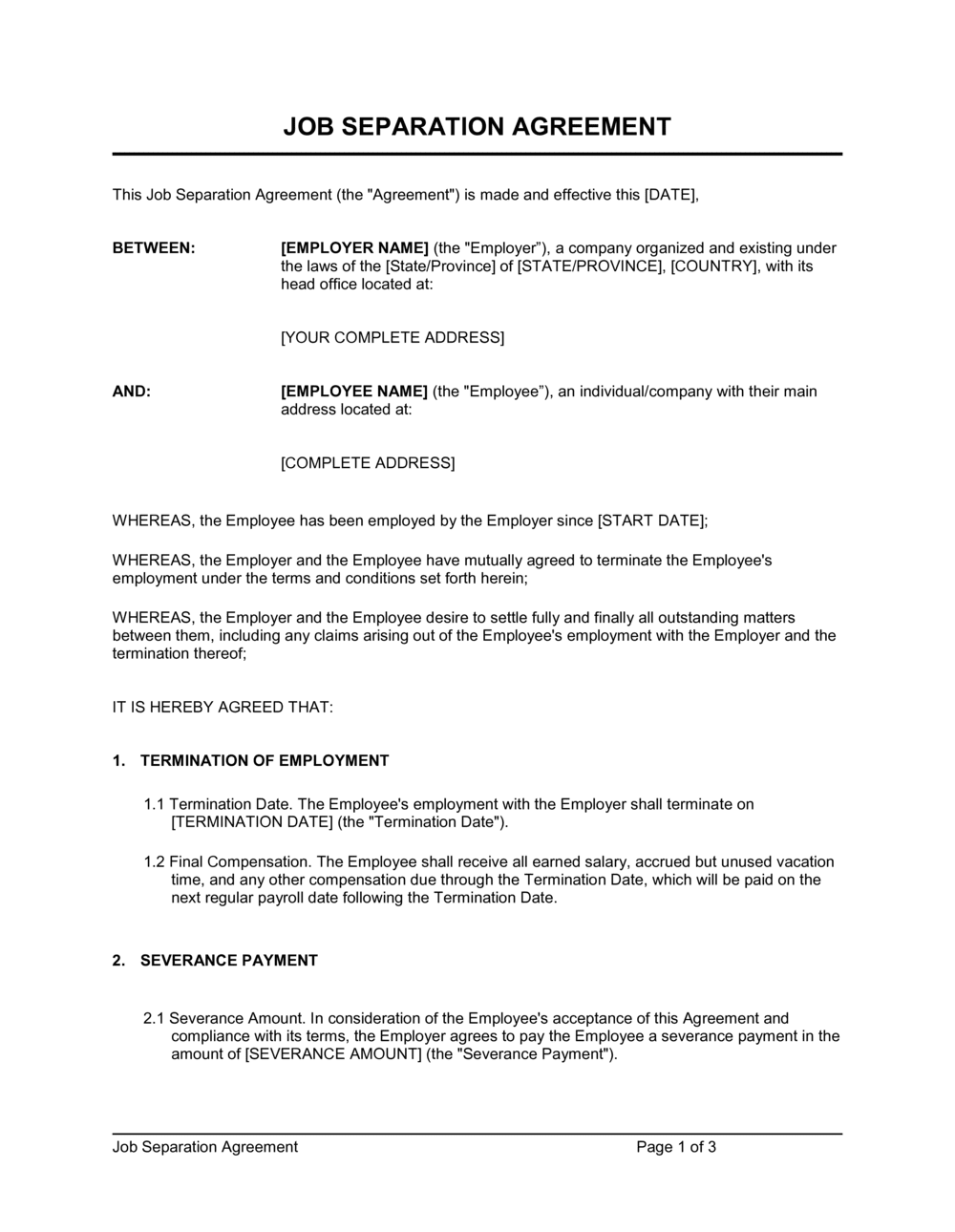
Job Separation Agreement Template

Free Word download β€’ Edit online β€’ Save & share with Drive β€’ Export to PDF

3 pagesβ€’25–30 min to fillβ€’Difficulty: Complexβ€’Signature requiredβ€’Legal review recommended
Learn more ↓
FreeJob Separation Agreement Template

At a glance

What it is
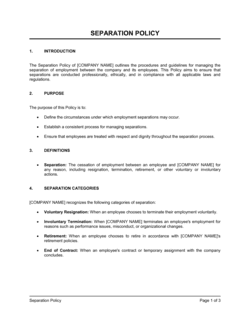
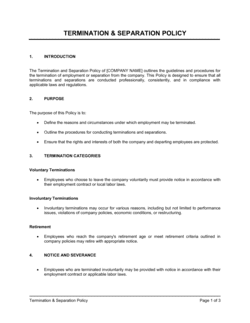
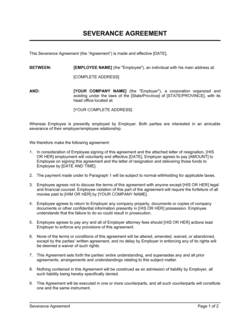
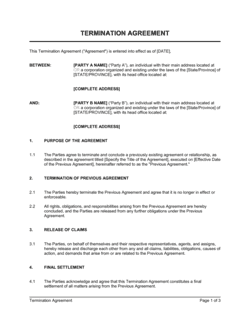
A Job Separation Agreement is a legally binding contract between an employer and a departing employee that formalizes the end of the employment relationship. This free Word download lets you record severance terms, a mutual release of claims, confidentiality obligations, and post-employment restrictions in a single document you can edit online and export as PDF before the employee's last day.
When you need it
Use it when parting ways with any employee β€” whether through layoff, termination without cause, or mutual resignation β€” where the company is offering severance pay or other consideration in exchange for a waiver of claims. It is especially critical when the departure carries litigation risk or involves access to sensitive company information.
What's inside
Separation date and final pay details, severance package terms, a release and waiver of all employment-related claims, confidentiality and non-disparagement obligations, continuation of benefits (COBRA notice), return of company property, and governing law. The agreement also includes the federally required ADEA/OWBPA review period language for employees aged 40 and older.

What is a Job Separation Agreement?

A Job Separation Agreement is a legally binding contract between an employer and a departing employee that formally documents the end of the employment relationship and the terms under which both parties agree to part ways. It records the separation date, final pay obligations, severance package, a mutual release of all employment-related claims, confidentiality and non-disparagement obligations, and any surviving post-employment restrictions. Unlike a dismissal letter β€” which is a one-way communication β€” a separation agreement is a bilateral contract that creates enforceable obligations on both sides and, when properly executed, extinguishes the employee's right to bring future legal claims arising from the employment relationship.

Why You Need This Document

Without a signed separation agreement, every termination is a potential lawsuit waiting to be filed. An employee who leaves without signing a release retains the right to sue for wrongful termination, discrimination, unpaid wages, or breach of contract for years after their last day. The cost of a single employment-related lawsuit β€” even one you ultimately win β€” routinely exceeds $75,000 in legal fees and management time. A separation agreement eliminates that exposure by converting the end of employment into a negotiated, documented resolution. It also protects the confidential information and client relationships the departing employee could otherwise exploit. This template gives you a compliant, attorney-reviewed starting point that covers every material term β€” from ADEA-required review periods to COBRA notification obligations β€” so you can close out the employment relationship cleanly, defensibly, and on a defined timeline.

Which variant fits your situation?

If your situation is…Use this template
Separating an employee aged 40 or older in the United StatesJob Separation Agreement (ADEA-Compliant)
Parting ways with a C-suite executive with equity and enhanced severanceExecutive Separation Agreement
Conducting a group layoff affecting two or more employees simultaneouslyGroup Separation Agreement (OWBPA-Compliant)
Mutually ending employment with no severance on either sideMutual Termination Agreement
Terminating a fixed-term contract before its end dateEarly Contract Termination Agreement
Employee resigning voluntarily with a negotiated departure packageVoluntary Separation Agreement
Settling a disputed termination where litigation has been threatenedEmployment Settlement Agreement

Common mistakes to avoid

❌ Conditioning final wages on signing the agreement

Why it matters: Withholding earned wages as leverage to obtain a signature violates wage-payment laws in most US states, all Canadian provinces, and the UK, exposing the employer to statutory penalties and invalidating the release.

Fix: Pay all earned wages and accrued vacation on the regular payroll date or final day, unconditionally. Severance β€” which is additional consideration β€” can and should be conditioned on signing.

❌ Omitting ADEA/OWBPA language for employees aged 40 or older

Why it matters: Any waiver of age-discrimination claims that does not comply with the specific OWBPA disclosure, review-period, and revocation requirements is voidable by the employee β€” meaning the employer paid severance but holds an unenforceable release.

Fix: Include the full ADEA disclosure block for every employee aged 40 or older: name the statute being waived, advise consultation with counsel, provide the 21- or 45-day review period, and preserve the 7-day revocation right.

❌ Introducing new restrictive covenants for the first time at separation

Why it matters: A non-compete or non-solicitation clause inserted into a separation agreement β€” without a separate, additional benefit beyond severance already owed β€” may be unenforceable for lack of fresh consideration.

Fix: Only reinstate or reconfirm restrictions already in the original employment agreement. If new restrictions are genuinely needed, provide documented additional consideration β€” a separate payment or extended benefit β€” expressly tied to those new obligations.

❌ Using a unilateral release that binds only the employee

Why it matters: One-sided releases are scrutinized more heavily by courts assessing unconscionability, and they create a negotiating disadvantage that can delay or derail execution of the agreement.

Fix: Include a mutual release in which the employer also releases the employee from known claims arising from the employment relationship β€” this is standard practice in most jurisdictions and rarely creates additional risk for the employer.

❌ No specific effective date accounting for the revocation period

Why it matters: Treating the signature date as the effective date for an ADEA-covered employee means the agreement is not yet binding when the employer assumes it is, creating a 7-day window of exposure where obligations are uncertain.

Fix: State explicitly that the effective date is the eighth calendar day after the employee signs, assuming no revocation, and that severance payments will not begin until the effective date has passed.

❌ Omitting COBRA notification from the benefits section

Why it matters: US employers with 20 or more employees are required to provide a written COBRA election notice within 14 days of a qualifying separation event. Failure to do so triggers a $110-per-day statutory penalty per qualified beneficiary.

Fix: Reference COBRA notification obligations in the benefits clause and confirm that the COBRA election packet will be mailed to the employee's home address within the statutory window.

The 10 key clauses, explained

Parties, Separation Date, and Recitals

In plain language: Identifies the employer's legal entity and the employee by full name, states the official last day of employment, and sets out the background facts that explain why the agreement is being entered into.

Sample language
This Separation Agreement ('Agreement') is entered into as of [DATE] by and between [EMPLOYER LEGAL NAME], a [STATE] [ENTITY TYPE] ('Company'), and [EMPLOYEE FULL NAME] ('Employee'). Employee's employment with Company shall terminate effective [SEPARATION DATE] ('Separation Date').

Common mistake: Using a trade name instead of the registered legal entity name. If the releasing party's name does not match corporate records, the release may not bind the correct entity or its subsidiaries.

Final Pay and Accrued Obligations

In plain language: Confirms that the employee will receive all earned wages, accrued and unused vacation (where required by law), expense reimbursements, and any vested benefits through the separation date, regardless of whether the agreement is signed.

Sample language
On or before [FINAL PAY DATE], Company shall pay Employee all earned wages through the Separation Date, accrued unused vacation of [X] days valued at $[AMOUNT], and any approved unreimbursed business expenses submitted by [DATE].

Common mistake: Conditioning final paycheck delivery on signing the agreement. In most US states and many other jurisdictions, withholding earned wages as leverage to obtain a signature is unlawful and exposes the employer to wage-claim penalties.

Severance Pay and Benefits

In plain language: Describes the severance payment amount, payment schedule, and any continuation of benefits (health insurance, equity vesting, outplacement services) that the employer is offering as consideration for the release.

Sample language
In consideration for Employee's execution of this Agreement and the release set forth herein, Company shall pay Employee a severance amount equal to $[AMOUNT], representing [X] weeks of base salary, payable in a lump sum on [DATE] / in equal installments on Company's regular payroll schedule for [X] weeks following the Separation Date.

Common mistake: Omitting a clear payment schedule and trigger. If the agreement says 'severance will be paid' without specifying the date and payment method, disputes about timing are almost certain.

Release and Waiver of Claims

In plain language: The employee broadly releases and waives all employment-related claims against the employer β€” including discrimination, harassment, wrongful termination, wage disputes, and contract claims β€” arising up to the date of signing.

Sample language
In exchange for the consideration described herein, Employee, on behalf of Employee and Employee's heirs, executors, and assigns, hereby releases and forever discharges Company and its affiliates, officers, directors, and employees from any and all claims, demands, and causes of action arising out of or related to Employee's employment or separation therefrom, including but not limited to claims under Title VII, the ADEA, the ADA, the FMLA, and any applicable state or local law.

Common mistake: Using a unilateral release without a mutual release clause. Courts in several jurisdictions scrutinize one-sided releases more carefully; a mutual release β€” the employer also releasing the employee from known claims β€” strengthens enforceability and signals good faith.

ADEA / OWBPA Acknowledgment (Age 40+)

In plain language: For employees aged 40 or older, discloses the specific rights being waived under the ADEA, confirms the employee has 21 days to review the agreement (45 days for group layoffs), and preserves the 7-day revocation right.

Sample language
Employee acknowledges that this Agreement includes a waiver of claims under the Age Discrimination in Employment Act. Employee has been advised to consult with an attorney. Employee has [21 / 45] days to consider this Agreement. Employee may revoke this Agreement within 7 days of signing by delivering written notice to [EMPLOYER CONTACT]. This Agreement shall not become effective until the 7-day revocation period has expired.

Common mistake: Omitting ADEA language entirely for employees who are 40 or older. Any release of age-discrimination claims that does not comply with OWBPA requirements is voidable by the employee β€” meaning the employer paid severance but retained no enforceable waiver.

Confidentiality and Return of Property

In plain language: Reaffirms the employee's obligation to protect the company's confidential information and trade secrets after separation, and requires the return or certified destruction of all company property and data by a specific date.

Sample language
Employee shall return all Company property β€” including laptops, access credentials, documents, and data β€” no later than [DATE]. Employee shall continue to hold in strict confidence all Confidential Information of Company and shall not use or disclose it for any purpose following the Separation Date.

Common mistake: Failing to specify a hard deadline for return of property. Vague language like 'promptly return' generates disputes about timing and leaves the employer without a clear breach trigger for the clawback clause.

Non-Disparagement

In plain language: Prohibits both parties from making false, negative, or damaging statements about the other to third parties β€” including on social media, in the press, or to prospective employers or clients.

Sample language
Employee agrees not to make any negative, disparaging, or misleading statements, whether oral or written, about Company, its products, services, or personnel. Company agrees to instruct its officers and directors not to make disparaging statements about Employee to prospective employers.

Common mistake: Drafting a one-sided non-disparagement clause that binds only the employee. Many states β€” including California β€” require mutual non-disparagement provisions in settlement contexts, and a lopsided clause signals bad faith during any subsequent review.

Post-Employment Restrictions

In plain language: Confirms or reinstates any surviving non-compete, non-solicitation, or IP assignment obligations from the original employment agreement that continue after the separation date.

Sample language
Employee acknowledges that the Non-Solicitation and Confidentiality provisions set forth in the Employment Agreement dated [DATE] survive termination of employment and remain in full force and effect. Nothing in this Agreement modifies those obligations.

Common mistake: Attempting to introduce new post-employment restrictions β€” such as a non-compete β€” for the first time in the separation agreement. Courts generally require fresh consideration beyond severance already owed to enforce new restrictions at separation.

No Admission of Liability

In plain language: Confirms that the agreement and the payment of severance do not constitute an admission of wrongdoing by either party, and cannot be used as evidence of fault in any proceeding.

Sample language
This Agreement does not constitute an admission of liability, wrongdoing, or the violation of any law, regulation, or duty by either party. Neither this Agreement nor the payment of any consideration hereunder shall be admissible as evidence of any such admission in any proceeding.

Common mistake: Omitting this clause entirely. Without it, a plaintiff's attorney may argue in a later proceeding that the severance payment itself was an implicit acknowledgment of wrongful conduct.

Governing Law, Entire Agreement, and Severability

In plain language: Specifies which jurisdiction's law governs the agreement, confirms that it supersedes all prior agreements and understandings between the parties, and states that if any provision is found unenforceable, the rest of the agreement remains valid.

Sample language
This Agreement shall be governed by the laws of [STATE / PROVINCE / COUNTRY]. This Agreement constitutes the entire agreement between the parties regarding the subject matter hereof and supersedes all prior agreements. If any provision of this Agreement is found unenforceable, the remaining provisions shall remain in full force and effect.

Common mistake: Choosing a governing law that has no connection to the state or country where the employee works. Several jurisdictions β€” including California and New York β€” apply their own employment law regardless of a contrary choice-of-law clause.

How to fill it out

  1. 1

    Enter the employer's legal entity name and the employee's details

    Use the employer's full registered corporate name β€” not a brand or trade name β€” and the employee's legal name as it appears on payroll records. Include the employee's job title, department, and original hire date.

    πŸ’‘ Cross-reference the corporate registry to confirm the exact legal name before execution β€” errors here can affect enforceability of the release.

  2. 2

    Set the separation date and confirm all final pay obligations

    Enter the employee's official last day, then list every component of final pay: earned wages, accrued vacation payout (where required by state or provincial law), and any outstanding expense reimbursements. Make these unconditional β€” do not tie final pay to signing.

    πŸ’‘ In California, accrued vacation must be paid at separation regardless of the reason for termination. Check the specific rule for every state or province where the employee worked.

  3. 3

    Define the severance package with a specific payment schedule

    State the total severance amount, the calculation basis (e.g., 2 weeks per year of service), and whether it will be paid as a lump sum or in installments on regular payroll dates. Name the specific date on which the first payment will be made.

    πŸ’‘ Lump-sum severance paid on a fixed date is easier for both parties to track and reduces the employer's risk of payroll-related disputes compared to installment payments.

  4. 4

    Complete the release of claims with jurisdiction-specific language

    List the specific federal and state statutes being waived β€” Title VII, the ADEA, the ADA, the FMLA, and any applicable state equivalents. For employees aged 40 or older, add the full ADEA/OWBPA disclosure block including the 21-day review period and 7-day revocation right.

    πŸ’‘ For a group layoff involving two or more employees aged 40+, the review period extends to 45 days and requires a written disclosure of the job titles and ages of all selected and non-selected employees in the decisional unit.

  5. 5

    Add confidentiality and property-return obligations with a hard deadline

    Specify the exact date by which all company property β€” laptops, keycards, documents, and data β€” must be returned or certified as destroyed. Restate the confidentiality obligation by referencing any prior NDA or confidentiality clause from the employment agreement.

    πŸ’‘ Include cloud storage and personal-device data in the property-return list β€” departing employees frequently retain company data in personal Dropbox or Google Drive accounts.

  6. 6

    Draft mutual non-disparagement language

    Write the non-disparagement clause as a bilateral obligation β€” the employee agrees not to disparage the company, and the company agrees to instruct its officers and directors not to disparage the employee to prospective employers or clients.

    πŸ’‘ Some US states and many EU jurisdictions have begun scrutinizing one-sided non-disparagement clauses as coercive. Mutual language is both more defensible and easier to negotiate.

  7. 7

    Confirm surviving post-employment restrictions

    If the original employment agreement contained a non-compete, non-solicit, or IP assignment, cite that agreement by date and state that those provisions survive termination. Do not attempt to add new restrictions for the first time in this document.

    πŸ’‘ In jurisdictions that have recently banned post-employment non-competes β€” including California, Minnesota, and several EU member states β€” remove the non-compete confirmation entirely to avoid invalidating the broader agreement.

  8. 8

    Execute before or on the separation date and retain a fully signed copy

    Both parties must sign the agreement. For employees aged 40 or older, do not accept a signature until the 21-day review period has elapsed (or the employee has signed a written, knowing waiver of the waiting period). Record the effective date as the day after the 7-day revocation period expires.

    πŸ’‘ Use Business in a Box eSign to timestamp signatures and automatically calculate the effective date based on the revocation period β€” this creates a defensible audit trail if the agreement is challenged later.

Frequently asked questions

What is a job separation agreement?

A job separation agreement is a legally binding contract between an employer and a departing employee that formalizes the end of the employment relationship. It typically documents severance pay, a release of all employment-related claims, confidentiality obligations, non-disparagement terms, and the return of company property. The agreement protects the employer from future litigation and provides the employee with a clear, negotiated exit package.

Is a job separation agreement required by law?

No jurisdiction requires employers to offer a separation agreement for every termination. However, if an employer wants to obtain an enforceable release of claims β€” particularly age-discrimination claims in the US β€” a written agreement with specific statutory language is the only legally recognized method. In Canada and the UK, written separation terms are standard practice even when not technically mandatory, because oral agreements are difficult to enforce.

What makes a separation agreement legally enforceable?

Four elements must be present: mutual consent (both parties sign voluntarily), consideration (the employer offers something of value β€” typically severance β€” beyond what is already owed), a knowing and voluntary waiver (the employee had adequate time and opportunity to consult counsel), and compliance with any applicable statutory requirements (such as ADEA/OWBPA for employees aged 40 or older in the US). An agreement missing any of these elements is at risk of being voided by a court.

How long does an employee have to sign a separation agreement?

In the US, employees under age 40 can be given any reasonable period to review and sign. For employees aged 40 or older, the OWBPA requires a minimum of 21 calendar days to consider the agreement (45 days in a group layoff context) and 7 days after signing to revoke. In the UK, the ACAS Code of Practice recommends a minimum of 10 calendar days. Most employers allow 14–21 days as standard practice regardless of age.

Can an employee negotiate a separation agreement?

Yes. A separation agreement is a negotiated contract, not a take-it-or-leave-it form. Employees commonly negotiate higher severance amounts, extended health benefits, accelerated equity vesting, a neutral reference letter, or the removal of a non-compete clause. Employers should expect and accommodate good-faith negotiation β€” courts view agreements reached through genuine negotiation as more enforceable than those signed under pressure.

What claims can a separation agreement release?

A well-drafted release typically covers all federal and state employment claims β€” discrimination under Title VII, the ADA, and the ADEA; wage and hour disputes; wrongful termination; breach of contract; and any claim under applicable state employment statutes. It generally cannot release future claims, claims that arise after signing, the right to file a charge with the EEOC (though it can waive the right to monetary recovery), workers' compensation claims, or vested pension benefits.

What is the difference between a separation agreement and a severance agreement?

The terms are often used interchangeably, but a separation agreement is broader β€” it covers the entire end-of-employment arrangement including property return, post-employment restrictions, and mutual releases. A severance agreement focuses more narrowly on the financial package and the release of claims in exchange for that payment. In practice, most employers use a single document that serves both functions.

Does a separation agreement prevent an employee from filing an EEOC charge?

No. A release cannot bar an employee from filing a charge with the EEOC or a state equivalent agency, as those rights are protected by federal statute. What the release does eliminate is the employee's ability to recover monetary damages or other individual relief in a subsequent lawsuit based on claims released in the agreement. Employers should not include language purporting to prohibit EEOC filings β€” such clauses are void and their presence can undermine the enforceability of the entire release.

Do I need a lawyer to prepare a separation agreement?

For straightforward separations of employees under 40 in a single US state, a high-quality template handled carefully is generally sufficient. Legal review is strongly recommended when the employee is 40 or older (ADEA/OWBPA compliance), the separation involves equity, executive compensation, or a pending legal dispute, or the employee works in a jurisdiction with complex statutory requirements β€” such as Ontario, California, the UK, or France. A 1–2 hour attorney review typically costs $300–$700 and is worthwhile whenever litigation exposure is material.

How this compares to alternatives

vs Employment Contract

An employment contract governs the beginning and duration of the working relationship β€” defining duties, compensation, and restrictions from day one. A separation agreement governs the end β€” documenting the final pay, severance, release of claims, and surviving obligations. The two documents should be read together, as the separation agreement typically reaffirms obligations created in the employment contract.

vs Mutual Termination Agreement

A mutual termination agreement records a consensual parting where both parties agree to end the relationship without dispute and typically without severance. A job separation agreement is used when the employer is providing severance in exchange for a formal release of claims β€” it is a more protective document designed to reduce litigation exposure. Use a separation agreement whenever monetary consideration changes hands at departure.

vs Resignation Letter

A resignation letter is a one-page notice from the employee announcing their voluntary departure β€” it creates no binding obligations beyond confirming intent to leave. A separation agreement is a bilateral contract that binds both parties, documents all exit terms, and extinguishes legal claims. A resignation letter alone provides the employer with no protection against future lawsuits.

vs Employee Dismissal Letter

A dismissal letter notifies the employee of termination and states the effective date β€” it is a one-way communication, not a contract. A separation agreement follows the dismissal letter and converts the termination into a negotiated, binding arrangement with a release. Use the dismissal letter first to communicate the decision; follow it with the separation agreement to secure the release.

Industry-specific considerations

Technology / SaaS

IP assignment reaffirmation is critical given departing engineers' access to source code, algorithms, and unreleased product roadmaps; equity treatment at separation must be explicitly addressed.

Financial Services

Regulatory reporting obligations (FINRA Form U5, FCA notifications) must be coordinated with the separation timeline; bonus clawback provisions and garden leave are standard for senior roles.

Healthcare

HIPAA confidentiality obligations survive termination and must be explicitly reaffirmed; patient non-solicitation clauses are common and subject to professional licensing board rules.

Professional Services

Client non-solicitation clauses are especially material given fee-based relationships; reference letter terms are often negotiated as part of the separation package.

Retail / Hospitality

High turnover means standardized separation templates are operationally important; state wage-payment deadlines for final pay vary and must be embedded in the agreement timeline.

Manufacturing

Trade secret and process confidentiality obligations are particularly sensitive; safety incident history and workers' compensation claim status must be reviewed before finalizing the release scope.

Jurisdictional notes

United States

OWBPA requires that any waiver of ADEA claims for employees aged 40 or older include specific statutory disclosures, a 21-day consideration period (45 days for group layoffs), and a 7-day post-signature revocation right. Final pay timing is governed by individual state law β€” California requires payment on the last day of employment, while other states allow up to the next regular pay date. The FTC's 2024 non-compete rule has faced ongoing litigation; check current enforceability in your state.

Canada

At-will employment does not exist in Canada. Employment Standards Acts in each province set minimum notice and severance pay floors β€” contractual severance must meet or exceed these minimums or the statutory floor applies. Ontario common-law reasonable notice can reach 1 month per year of service for long-tenured employees, making the entire-agreement clause and working-notice election especially important. Quebec employees must receive all separation documents in French.

United Kingdom

Settlement agreements (formerly compromise agreements) must be in writing, must relate to a specific complaint, and the employee must have received independent legal advice from a qualified adviser before signing β€” otherwise the waiver is void. Statutory redundancy pay applies to employees with two or more years of continuous service and cannot be waived. The ACAS Code of Practice recommends a minimum 10-calendar-day review period. Payments up to Β£30,000 may be tax-free depending on structure.

European Union

Member state law governs separation agreements, and requirements vary significantly β€” France mandates a rupture conventionnelle process with mandatory administrative filings and a 15-day withdrawal period; Germany requires written form and individual negotiation. GDPR obligations must be addressed in the confidentiality clause, particularly regarding the employee's right to their own personal data. Post-employment non-competes typically require ongoing monthly compensation during the restriction period in France and Germany.

Template vs lawyer β€” what fits your deal?

PathBest forCostTime
Use the templateStandard separations of employees under 40 in a single US state or Canadian province, where no litigation has been threatenedFree30–60 minutes
Template + legal reviewEmployees aged 40 or older, cross-border separations, roles with equity or executive compensation, or any situation where a complaint has been filed$300–$7001–3 days
Custom draftedC-suite executives, group reductions-in-force under the WARN Act, multi-jurisdiction separations, or active litigation$1,500–$5,000+1–3 weeks

Glossary

Release of Claims
A contractual provision in which the departing employee gives up the right to sue the employer for any employment-related claim arising before the agreement's effective date.
Severance Pay
Compensation paid by the employer to the employee upon termination, beyond the final paycheck, typically calculated as a number of weeks' salary per year of service.
ADEA (Age Discrimination in Employment Act)
A US federal law prohibiting employment discrimination against workers aged 40 and older, which imposes specific disclosure and review-period requirements on separation agreements.
OWBPA (Older Workers Benefit Protection Act)
A US federal amendment to the ADEA requiring that employees aged 40 or older be given 21 days to review a separation agreement and 7 days to revoke it after signing.
COBRA
A US federal law allowing employees and their dependents to continue group health coverage for a defined period after leaving employment, at the employee's expense.
Non-Disparagement Clause
A provision preventing either party from making negative, misleading, or damaging public statements about the other after separation.
Effective Date
The date on which the separation agreement becomes binding and enforceable β€” typically the later of the signature date or the expiration of any mandatory review period.
Consideration
Something of value β€” usually severance pay or extended benefits β€” that the employer provides in exchange for the employee's release of claims, making the agreement legally enforceable.
Clawback Provision
A clause requiring the employee to return severance payments already received if they breach a specific term of the agreement, such as the confidentiality or non-disparagement obligation.
Constructive Termination
A situation in which an employer makes working conditions so intolerable that the employee is effectively forced to resign β€” treated legally as an involuntary termination in most jurisdictions.
At-Will Employment
A US employment doctrine allowing either party to end the relationship at any time for any lawful reason without advance notice or cause.
Mutual Release
A bilateral waiver in which both the employer and the employee release each other from all known and unknown claims arising from the employment relationship.

Part of your Business Operating System

This document is one of 3,000+ business & legal templates included in Business in a Box.

  • Fill-in-the-blanks β€” ready in minutes
  • 100% customizable Word document
  • Compatible with all office suites
  • Export to PDF and share electronically

Create your document in 3 simple steps.

From template to signed document β€” all inside one Business Operating System.
1
Download or open template

Access over 3,000+ business and legal templates for any business task, project or initiative.

2
Edit and fill in the blanks with AI

Customize your ready-made business document template and save it in the cloud.

3
Save, Share, Send, Sign

Share your files and folders with your team. Create a space of seamless collaboration.

Save time, save money, and create top-quality documents.

β˜…β˜…β˜…β˜…β˜…

"Fantastic value! I'm not sure how I'd do without it. It's worth its weight in gold and paid back for itself many times."

Managing Director Β· Mall Farm
Robert Whalley
Managing Director, Mall Farm Proprietary Limited
β˜…β˜…β˜…β˜…β˜…

"I have been using Business in a Box for years. It has been the most useful source of templates I have encountered. I recommend it to anyone."

Business Owner Β· 4+ years
Dr Michael John Freestone
Business Owner
β˜…β˜…β˜…β˜…β˜…

"It has been a life saver so many times I have lost count. Business in a Box has saved me so much time and as you know, time is money."

Owner Β· Upstate Web
David G. Moore Jr.
Owner, Upstate Web

Run your business with a system β€” not scattered tools

Stop downloading documents. Start operating with clarity. Business in a Box gives you the Business Operating System used by over 250,000 companies worldwide to structure, run, and grow their business.

Free Forever PlanΒ Β·Β No credit card required