I Must Reschedule our Meeting Template

Free Word download β€’ Edit online β€’ Save & share with Drive β€’ Export to PDF

1 pageβ€’15–25 min to fillβ€’Difficulty: Standard
Learn more ↓
FreeI Must Reschedule our Meeting Template

At a glance

What it is
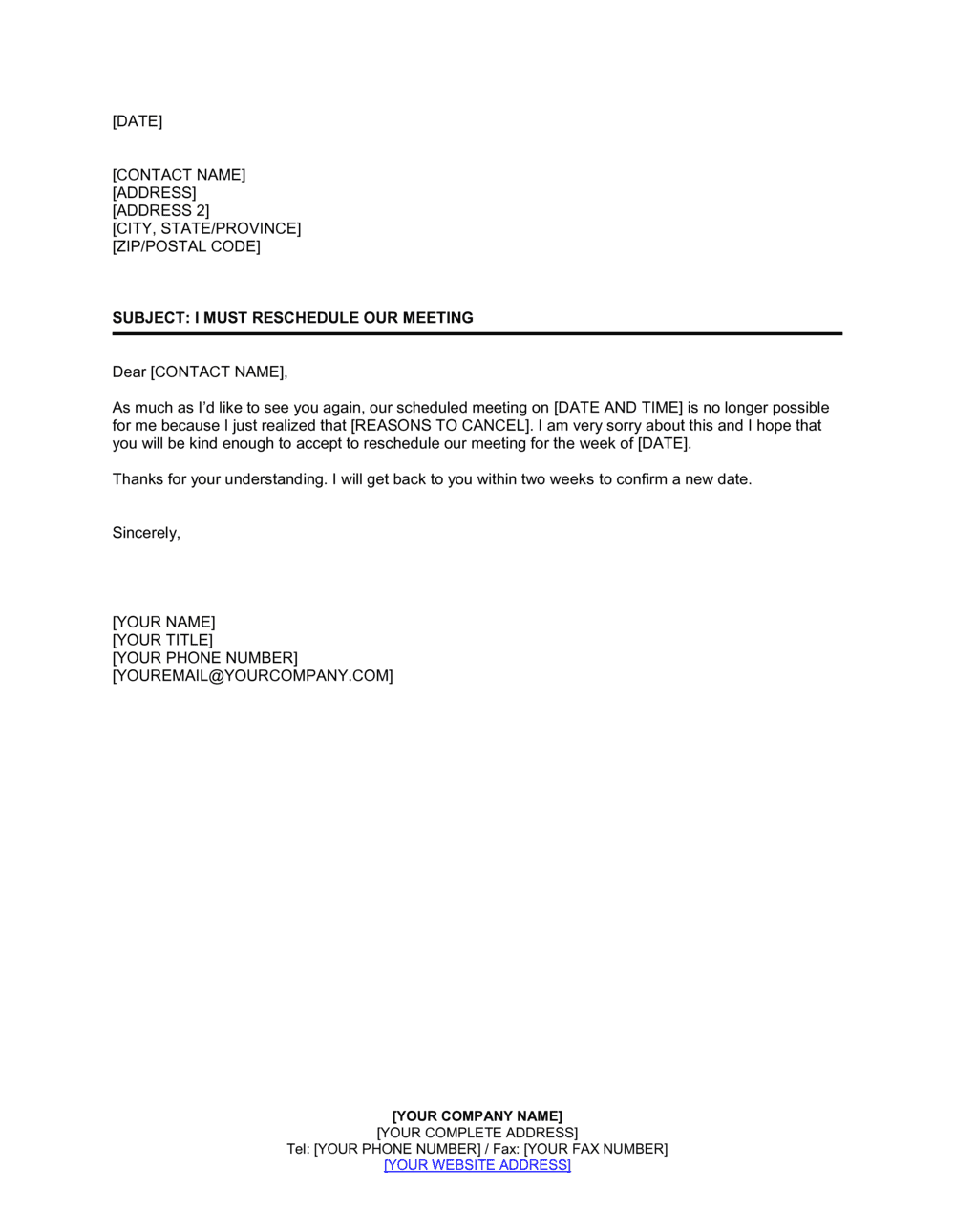
A Letter to Reschedule a Meeting is a short formal letter notifying a counterparty that a previously confirmed meeting must be moved to a new date and time. This free Word download is ready to edit in minutes β€” fill in your names, original meeting details, reason, and proposed alternatives, then send by email or post.
When you need it
Use it whenever an unavoidable conflict β€” schedule clash, travel delay, illness, or urgent business matter β€” prevents you from keeping a confirmed meeting and you need to notify the other party promptly and professionally.
What's inside
A structured letter covering a polite opening, a clear statement of the rescheduling request, a brief explanation of the cause, two or three alternative date and time proposals, and a closing that reaffirms commitment to the meeting.

What is a Letter to Reschedule a Meeting?

A Letter to Reschedule a Meeting is a short formal letter notifying a counterparty that a previously confirmed meeting must be moved to a new date and time. It identifies the original meeting clearly, provides a brief explanation of the conflict, proposes two or three specific alternative slots, and reaffirms the sender's commitment to the meeting and the relationship. Unlike a casual email message, a formal reschedule letter creates a written record of the change and signals that the sender takes the meeting β€” and the other party's time β€” seriously.

Why You Need This Document

Failing to notify a counterparty promptly and professionally when a meeting must change carries real costs: wasted travel, blocked calendar time, and the impression that you treat their schedule as expendable. A vague or informal message β€” "something came up, can we push this?" β€” leaves the recipient uncertain about next steps and puts the scheduling burden back on them. This template gives you a ready-to-send letter that acknowledges the inconvenience, proposes specific alternatives, and preserves goodwill with the other party. It takes five minutes to complete and eliminates the back-and-forth that an informal rescheduling message typically creates.

Which variant fits your situation?

If your situation is…Use this template
Rescheduling a one-on-one business meetingLetter to Reschedule a Meeting
Requesting a new date for a job interviewInterview Reschedule Letter
Cancelling a meeting with no intention to rescheduleMeeting Cancellation Letter
Confirming a newly agreed meeting after reschedulingMeeting Confirmation Letter
Requesting an initial meeting that has not yet been scheduledLetter to Request a Meeting
Sending a formal agenda ahead of a rescheduled meetingMeeting Agenda Template

Common mistakes to avoid

❌ Waiting too long to send the notice

Why it matters: A last-minute rescheduling letter β€” sent the day before or the morning of the meeting β€” wastes the recipient's preparation time and signals poor planning on your part.

Fix: Send the letter as soon as you know the original date is unworkable, even if your preferred alternative slots are not yet confirmed β€” a preliminary heads-up followed by a full proposal is better than a single late notice.
❌ Offering only one alternative date

Why it matters: If that single option doesn't work for the recipient, you've added another round of back-and-forth to the scheduling process, delaying the meeting further.

Fix: Always propose two or three specific alternatives with dates, times, and format β€” this typically resolves rescheduling in one exchange.

❌ Omitting the original meeting details from the subject line

Why it matters: Recipients with busy calendars may not immediately recall which meeting is being rescheduled, leading to confusion and follow-up questions that slow the process.

Fix: Include the original meeting date, time, and purpose in the subject line so the letter is immediately identifiable without reading the body.

❌ Skipping the acknowledgement of inconvenience

Why it matters: Receiving a rescheduling notice without any expression of regret reads as dismissive and can damage professional goodwill, especially when the recipient arranged their schedule around the original meeting.

Fix: Include a single, sincere sentence acknowledging the disruption β€” it takes five words and preserves the relationship.

The 9 key clauses, explained

Header and date line

In plain language: Sender's name and address, the date the letter is written, and the recipient's name, title, organization, and address.

Sample language
[YOUR NAME] [YOUR TITLE], [COMPANY NAME] [ADDRESS] [DATE] [RECIPIENT NAME] [RECIPIENT TITLE], [RECIPIENT COMPANY] [ADDRESS]

Common mistake: Using only a first name in the header rather than the recipient's full name and title β€” this looks careless in any formal business context.

Subject line

In plain language: A one-line reference identifying the letter's purpose and the original meeting date so the recipient can file and locate it easily.

Sample language
Re: Rescheduling of [MEETING PURPOSE] β€” Originally Scheduled for [ORIGINAL DATE AND TIME]

Common mistake: Omitting the subject line entirely, forcing the recipient to read the full letter before understanding the purpose β€” especially problematic when the letter is forwarded to an assistant or filed for later action.

Salutation

In plain language: A formal greeting addressed to the recipient by name, setting the appropriate level of formality.

Sample language
Dear [RECIPIENT FIRST NAME / Mr. / Ms. LAST NAME],

Common mistake: Using 'To Whom It May Concern' when you know the recipient's name β€” this signals the letter is a template and not personally addressed, undermining the relationship.

Opening statement of rescheduling

In plain language: The first sentence clearly states that the writer must reschedule the meeting and identifies the meeting by its original date and time.

Sample language
I am writing to inform you that, regrettably, I must reschedule our meeting currently set for [ORIGINAL DATE] at [ORIGINAL TIME].

Common mistake: Burying the rescheduling notice in the second or third paragraph after excessive pleasantries β€” the recipient needs to understand the purpose immediately so they can update their calendar.

Explanation of cause

In plain language: A brief, honest explanation of why the meeting must be moved β€” kept concise to be respectful of the reader's time without oversharing personal detail.

Sample language
This is due to [BRIEF REASON β€” e.g., an urgent matter requiring my immediate attention / a prior commitment that cannot be moved / an unexpected travel delay].

Common mistake: Providing an overly detailed or apologetic explanation that runs several sentences β€” one or two sentences is sufficient; excessive explanation can come across as insincere.

Acknowledgement of inconvenience

In plain language: A sincere one-sentence apology recognizing that the change disrupts the recipient's schedule and expressing genuine regret.

Sample language
I sincerely apologize for any inconvenience this change may cause to your schedule and appreciate your understanding.

Common mistake: Skipping this clause entirely to save space β€” omitting it reads as dismissive, particularly when the original meeting was arranged at the recipient's initiative.

Alternative date and time proposals

In plain language: Two or three specific alternative slots offered for the recipient to choose from, including date, time, and location or format (in-person, video call, phone).

Sample language
I would like to propose the following alternative times for your consideration: β€” [DATE 1] at [TIME 1] ([LOCATION / FORMAT]) β€” [DATE 2] at [TIME 2] ([LOCATION / FORMAT]) β€” [DATE 3] at [TIME 3] ([LOCATION / FORMAT]) Please let me know which option works best for you, or suggest an alternative that suits your schedule.

Common mistake: Offering only one alternative date β€” if that slot doesn't work, the conversation loops back unnecessarily; two or three options resolve the scheduling in a single exchange.

Reaffirmation of meeting importance

In plain language: A brief statement confirming that the sender remains committed to the meeting and values the relationship or the agenda.

Sample language
I remain fully committed to [MEETING PURPOSE / DISCUSSING OUR PARTNERSHIP / MOVING THIS MATTER FORWARD] and look forward to connecting with you at the rescheduled time.

Common mistake: Using generic language like 'looking forward to speaking soon' without referencing the specific purpose β€” this makes the reaffirmation feel perfunctory rather than genuine.

Closing and signature block

In plain language: A complimentary close, the sender's handwritten or digital signature, and their full name, title, company, and contact details.

Sample language
Yours sincerely, [SIGNATURE] [YOUR FULL NAME] [YOUR TITLE] | [COMPANY NAME] [PHONE NUMBER] | [EMAIL ADDRESS]

Common mistake: Closing with 'Regards' on a letter that used formal salutation conventions β€” match the formality level throughout; 'Yours sincerely' or 'Respectfully yours' suits a formal business letter.

How to fill it out

  1. 1

    Complete the header with accurate contact details

    Enter your full name, title, company name, and address, then add the date and the recipient's full name, title, organization, and address. Confirm the recipient's correct title and spelling before sending.

    πŸ’‘ Write the date in full β€” 'May 15, 2026' rather than '05/15/26' β€” to avoid date-format confusion in international correspondence.

  2. 2

    Fill in the subject line with the original meeting details

    Reference the meeting purpose and the original confirmed date and time. This allows the recipient to immediately identify which meeting is affected without reading the full letter.

    πŸ’‘ If the meeting had a formal agenda title or reference number, include it here β€” it makes filing and forwarding much easier.

  3. 3

    Write the opening sentence clearly

    State in the first sentence that you are rescheduling the meeting and identify it by original date and time. Do not open with pleasantries before delivering the news.

    πŸ’‘ Keep the opening sentence to one clause β€” clarity matters more than elegance here.

  4. 4

    Add a brief, honest explanation

    Insert one to two sentences explaining the reason for rescheduling. You do not need to disclose sensitive details β€” 'an urgent business matter requiring my immediate attention' is sufficient.

    πŸ’‘ Avoid vague reasons like 'unforeseen circumstances' if you can be slightly more specific β€” even 'a scheduling conflict with a prior commitment' is more credible.

  5. 5

    Propose two or three specific alternative slots

    Offer at least two date and time options and specify whether each is in-person, by video call, or by phone. Include the time zone if the recipient is in a different region.

    πŸ’‘ Choose alternatives that fall within 5–7 days of the original meeting where possible β€” longer delays can signal that the meeting is a low priority.

  6. 6

    Add the reaffirmation and closing

    Confirm your commitment to the meeting in one sentence, then close with an appropriate complimentary close and your full signature block including phone and email.

    πŸ’‘ Match your complimentary close to your salutation β€” if you used 'Dear Mr. Smith,' close with 'Yours sincerely,' not 'Cheers.'

  7. 7

    Review and send promptly

    Proofread for spelling errors β€” especially the recipient's name and the proposed dates β€” then send as soon as the conflict is confirmed. The more lead time you give, the easier it is for the recipient to adjust.

    πŸ’‘ Send the letter by the same channel used to confirm the original meeting β€” if the meeting was set by email, send the reschedule notice by email, not only by post.

Frequently asked questions

What should a letter to reschedule a meeting include?

A letter to reschedule a meeting should include a clear subject line referencing the original meeting date, an opening sentence stating the rescheduling request, a brief explanation of the reason, a sincere acknowledgement of the inconvenience, two or three specific alternative date and time proposals, a reaffirmation of commitment to the meeting, and a professional closing with full contact details. Missing any of these elements typically leads to a follow-up question from the recipient.

How far in advance should I send a meeting reschedule letter?

Send it as soon as you know the original slot is unworkable β€” ideally at least 48 hours before the scheduled meeting, and preferably 5–7 business days in advance for formal or high-stakes meetings. If the conflict arises with less than 24 hours' notice, send the letter immediately and follow up by phone. The more lead time you give, the less disruption you cause.

Is it better to reschedule a meeting by letter, email, or phone?

Use the same channel that was used to confirm the original meeting. If the meeting was set by email, send the reschedule notice by email. For formal business meetings or situations involving senior stakeholders, a formal letter (delivered by email as a Word or PDF attachment) reinforces the professional tone. A phone call is appropriate for urgent last-minute changes, but always follow up in writing to confirm the new arrangement.

How do I reschedule a meeting without damaging the relationship?

Give as much advance notice as possible, offer specific alternatives rather than putting the scheduling burden on the other party, acknowledge the inconvenience sincerely, and reaffirm that the meeting remains a priority. Avoid rescheduling the same meeting more than once β€” repeated rescheduling signals that the counterparty's time is not valued.

Do I need to explain why I am rescheduling?

A brief reason is professional courtesy and prevents the recipient from wondering whether the rescheduling reflects a change in priorities. One or two sentences is sufficient β€” you do not need to disclose sensitive personal or business details. Phrases like 'an urgent matter requiring my immediate attention' or 'a prior commitment that cannot be moved' are widely accepted and require no further elaboration.

What is the difference between rescheduling and cancelling a meeting?

Rescheduling moves the meeting to a new date and time β€” both parties intend to meet, just not at the originally confirmed slot. Cancelling ends the meeting entirely with no replacement scheduled. A rescheduling letter should always include proposed alternative dates to make the intent clear; a cancellation letter should explain whether a future meeting may be requested or whether the matter has been resolved another way.

Can this template be used to reschedule a job interview?

Yes. The structure applies to any formal meeting, including job interviews. Adapt the subject line to reference the position and original interview date, keep the explanation of cause brief and professional, and offer at least two alternative slots. For interview reschedules, it is also good practice to reaffirm your interest in the role in the reaffirmation clause.

Should I include all three proposed alternative dates even if I have a preferred one?

Yes. Listing two or three options β€” even if you have a strong preference β€” gives the recipient agency and makes it more likely the meeting is confirmed quickly. If you have a preferred slot, list it first. You can add a line such as 'I find the first option most convenient, but I am happy to accommodate whichever works best for you.'

How this compares to alternatives

vs Meeting cancellation letter

A cancellation letter ends the meeting with no replacement scheduled, while a reschedule letter explicitly proposes new dates and reaffirms intent to meet. Use a cancellation letter only when the meeting will not take place at all; use a reschedule letter when you intend to meet but need to move the date. Sending the wrong type creates ambiguity about whether the counterparty should expect to hear from you again.

vs Meeting confirmation letter

A confirmation letter is sent to lock in a date that both parties have already agreed to. A reschedule letter is sent to move a date that was already confirmed. The two documents are often used in sequence β€” you send the reschedule letter first, then follow up with a confirmation letter once the new slot is agreed.

vs Letter to request a meeting

A request letter initiates a meeting that has not yet been scheduled; a reschedule letter modifies a meeting that was already confirmed. The reschedule letter references an existing commitment and a prior relationship, which changes the tone β€” it must acknowledge the disruption caused rather than simply proposing a time.

vs Meeting agenda template

A meeting agenda defines the topics, timing, and structure of the meeting itself. A reschedule letter is an administrative communication that manages the logistics of when and where the meeting occurs. The agenda is typically sent after the reschedule is resolved and the new date confirmed.

Industry-specific considerations

Professional Services

Law firms, consultancies, and accounting practices use formal reschedule letters to maintain client confidence when a partner or lead advisor has a schedule conflict.

Financial Services

Advisors and relationship managers reschedule client review meetings with a formal letter to preserve the compliance paper trail and demonstrate professionalism.

Healthcare

Practice managers and clinic administrators use reschedule letters to notify patients or referring physicians of appointment changes while maintaining a respectful tone.

Corporate / Enterprise

Executive assistants and operations teams send reschedule letters on behalf of senior leaders to counterparts at partner organizations, preserving the formal record of the change.

Template vs pro β€” what fits your needs?

PathBest forCostTime
Use the templateAnyone rescheduling a standard business, client, or professional meetingFree5 minutes
Template + professional reviewHigh-stakes meetings with major clients, investors, or senior executives where tone is critical$0–$50 (a colleague or communications advisor review)15–30 minutes
Custom draftedOrganizations with brand voice guidelines requiring all external correspondence to be reviewed by communications or legal teams$50–$200 (internal comms team or external copywriter)1–2 hours

Glossary

Rescheduling notice
A written communication informing the recipient that a previously confirmed appointment must be moved to a new date or time.
Alternative date proposal
One or more specific date and time options offered to the recipient so they can confirm a replacement meeting slot.
Counterparty
The other individual or organization involved in the meeting β€” the person or group receiving the rescheduling letter.
Lead time
The amount of advance notice given before the original meeting date; more lead time reduces inconvenience to the recipient.
Goodwill statement
A sentence or two expressing regret for the inconvenience caused and reaffirming the value placed on the meeting and relationship.
Complimentary close
The sign-off phrase used before the sender's name β€” such as 'Yours sincerely' or 'Best regards' β€” which sets the tone of formality.
Acknowledgement of inconvenience
A brief, sincere statement recognizing that a last-minute change creates disruption for the recipient's schedule.
Meeting reference
The specific details β€” original date, time, location, and purpose β€” used to identify the meeting being rescheduled so there is no ambiguity.

Part of your Business Operating System

This document is one of 3,000+ business & legal templates included in Business in a Box.

  • Fill-in-the-blanks β€” ready in minutes
  • 100% customizable Word document
  • Compatible with all office suites
  • Export to PDF and share electronically

Create your document in 3 simple steps.

From template to signed document β€” all inside one Business Operating System.
1
Download or open template

Access over 3,000+ business and legal templates for any business task, project or initiative.

2
Edit and fill in the blanks with AI

Customize your ready-made business document template and save it in the cloud.

3
Save, Share, Send, Sign

Share your files and folders with your team. Create a space of seamless collaboration.

Save time, save money, and create top-quality documents.

β˜…β˜…β˜…β˜…β˜…

"Fantastic value! I'm not sure how I'd do without it. It's worth its weight in gold and paid back for itself many times."

Managing Director Β· Mall Farm
Robert Whalley
Managing Director, Mall Farm Proprietary Limited
β˜…β˜…β˜…β˜…β˜…

"I have been using Business in a Box for years. It has been the most useful source of templates I have encountered. I recommend it to anyone."

Business Owner Β· 4+ years
Dr Michael John Freestone
Business Owner
β˜…β˜…β˜…β˜…β˜…

"It has been a life saver so many times I have lost count. Business in a Box has saved me so much time and as you know, time is money."

Owner Β· Upstate Web
David G. Moore Jr.
Owner, Upstate Web

Run your business with a system β€” not scattered tools

Stop downloading documents. Start operating with clarity. Business in a Box gives you the Business Operating System used by over 250,000 companies worldwide to structure, run, and grow their business.

Free Forever PlanΒ Β·Β No credit card required