May I Introduce our New Employee to You Template

Free Word download • Edit online • Save & share with Drive • Export to PDF

1 page20–25 min to fillDifficulty: StandardSignature requiredLegal review recommended
Learn more ↓
FreeMay I Introduce our New Employee to You Template

At a glance

What it is
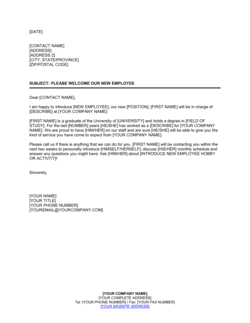
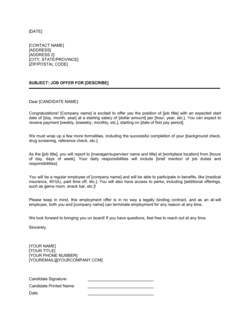
A "May I Introduce Our New Employee To You" letter is a formal business communication sent by a company to its clients, customers, or partners to announce the arrival of a new staff member and facilitate a warm handover of the relationship. This free Word download gives you a professionally structured template you can edit online and export as PDF or send directly by email or post.
When you need it
Use it whenever a new employee takes over an existing client relationship, joins a client-facing role, or when you want to formally introduce a new hire to your external network. It is especially important when a previous point of contact is departing and a smooth transition is needed to preserve client confidence.
What's inside
Company letterhead block, formal salutation, introduction of the new employee with role and background, context for any relationship handover, contact details for the new employee, a call to action encouraging the recipient to reach out, and a closing sign-off from a senior representative.

What is a "May I Introduce Our New Employee To You" Letter?

A "May I Introduce Our New Employee To You" letter is a formal business communication sent by a company to its existing clients, customers, or partners to announce the arrival of a new employee and establish them as the recipient's new or additional point of contact. Signed by a senior representative rather than the new hire themselves, the letter provides a concise professional profile of the incoming employee, explains any relationship handover from a predecessor, and gives the recipient direct contact details so they can engage without friction. It functions as both a relationship-management tool and, in regulated industries, a compliance communication — creating a documented record that clients were formally notified of a personnel change.

Why You Need This Document

Without a formal introduction letter, client relationships are left to chance during one of their most vulnerable moments — a personnel transition. Clients who discover a change in their point of contact through an unexpected phone call, a bounce-back email, or word of mouth feel the change was not planned or managed, and that instability reflects on your entire organization. In regulated sectors such as financial services, healthcare, and legal services, failure to formally notify clients of advisor or representative changes can trigger compliance breaches with material consequences. A well-structured introduction letter sent before the new employee makes first contact preserves trust, gives the incoming employee instant credibility, and creates a paper trail that protects the company if the transition is later disputed. This template gives you a professionally formatted, immediately editable starting point that takes under 20 minutes to complete and sends the right signal to every client on the list.

Which variant fits your situation?

If your situation is…Use this template
Introducing a new employee to existing clients with a departing predecessorNew Employee Introduction Letter (Client Handover)
Announcing a new hire internally to staff and teamsNew Employee Announcement (Internal)
Welcoming a new employee with a letter directed to the employee themselvesWelcome Letter to New Employee
Introducing a new senior executive or C-suite hire to stakeholdersExecutive Announcement Letter
Notifying clients of a change in their primary contact due to restructuringChange of Contact Letter
Introducing the company itself and a key representative to a new prospectBusiness Introduction Letter
Sending a mass announcement to a broad contact list via emailNew Employee Announcement Email

Common mistakes to avoid

❌ Sending a generic, non-personalized letter

Why it matters: A letter addressed to 'Dear Client' or using identical content for every recipient signals that the client is not individually valued, eroding the trust the introduction is meant to build.

Fix: Personalize at minimum the salutation, the recipient's company name, and the relationship context paragraph for each recipient. Mail merge handles this at scale without manual rewriting.

❌ Delaying the introduction until after the new employee has already contacted clients

Why it matters: Clients who receive a call from an unknown person before receiving a formal introduction feel caught off guard and may question whether the change was planned or reactive.

Fix: Send the introduction letter at least two to three business days before the new employee makes first contact, so recipients have context when the call or email arrives.

❌ Having the new employee sign and send their own introduction letter

Why it matters: An introduction letter signed by the person being introduced carries no third-party endorsement and reads more like a cold sales email than a trusted handover.

Fix: Have a senior leader — the new employee's manager, a director, or a partner — sign the letter. This signals organizational backing and gives the recipient confidence in the new relationship.

❌ Omitting the predecessor's name when a handover is occurring

Why it matters: Clients who had a close working relationship with the previous point of contact feel the relationship is being discarded if their name disappears from communications without acknowledgment.

Fix: Name the outgoing contact, briefly explain the transition, and if possible, have the outgoing employee co-sign or add a personal postscript to the letter to reinforce continuity.

❌ Providing vague or incomplete contact details for the new employee

Why it matters: A letter that says 'please contact our team' without a direct name, email, or number forces the client to do extra work and signals disorganization.

Fix: Include the new employee's direct email address, direct phone number, and working hours or time zone so the client can act on the introduction immediately.

❌ Using informal language or a casual tone

Why it matters: An introduction letter that reads like an internal email or a social media post undermines the professional standing of both the new employee and the company in the eyes of the client.

Fix: Follow standard business letter conventions — full sentences, formal salutation, professional closing — regardless of how informally you communicate with the client day-to-day.

The 8 key clauses, explained

Letterhead and date

In plain language: Identifies the sending organization and establishes the formal date of communication, anchoring the letter in time for record-keeping purposes.

Sample language
[COMPANY NAME] | [ADDRESS LINE 1] | [CITY, STATE/PROVINCE, ZIP/POSTAL CODE] | [PHONE] | [EMAIL] | [DATE]

Common mistake: Using a personal email address or informal header instead of official company letterhead — this undermines the professionalism of the introduction and may cause the letter to be disregarded.

Recipient address and salutation

In plain language: Addresses the letter to the specific client or partner contact by full name and title, establishing a personal and respectful tone from the outset.

Sample language
[RECIPIENT FULL NAME] | [RECIPIENT TITLE] | [COMPANY NAME] | [ADDRESS] | Dear [TITLE] [SURNAME],

Common mistake: Using a generic salutation such as 'To Whom It May Concern' instead of the recipient's name — this signals that the relationship is not valued and reduces the letter's impact.

Opening — purpose statement

In plain language: States clearly and directly why the letter is being sent, naming the new employee and their role without burying the lead.

Sample language
I am pleased to introduce [NEW EMPLOYEE FULL NAME], who has recently joined [COMPANY NAME] as our new [JOB TITLE] effective [START DATE].

Common mistake: Opening with lengthy company background before naming the new employee — recipients lose interest quickly and the core message is delayed unnecessarily.

New employee profile

In plain language: Provides a concise professional background for the new employee, highlighting credentials and experience most relevant to the recipient's industry or needs.

Sample language
[NEW EMPLOYEE FIRST NAME] brings [X] years of experience in [FIELD/INDUSTRY], most recently serving as [PREVIOUS ROLE] at [PREVIOUS COMPANY], where [he/she/they] [KEY ACHIEVEMENT]. [He/She/They] holds [QUALIFICATION] from [INSTITUTION].

Common mistake: Including irrelevant personal details or a full career history — one or two targeted accomplishments build more credibility than a comprehensive resume summary.

Relationship context and handover statement

In plain language: Explains how the new employee fits into the recipient's existing relationship with the company, including any handover from a predecessor if applicable.

Sample language
[NEW EMPLOYEE FIRST NAME] will be your primary point of contact going forward, taking over from [PREDECESSOR NAME] who [reason for transition — e.g., has moved to a new role / has left the company]. [PREDECESSOR NAME] and [NEW EMPLOYEE FIRST NAME] will work together during a transition period until [DATE] to ensure continuity.

Common mistake: Omitting the handover context entirely when a predecessor is departing — clients who discover the change without explanation feel blindsided and may question the stability of the relationship.

New employee contact details

In plain language: Provides the recipient with the new employee's direct contact information so they can reach out immediately without having to search for it.

Sample language
[NEW EMPLOYEE FIRST NAME] can be reached directly at [EMAIL ADDRESS] or [DIRECT PHONE NUMBER]. [He/She/They] is available [HOURS / TIME ZONE] and looks forward to connecting with you.

Common mistake: Providing only a general company phone number or switchboard email — this creates friction and delays the first contact, undermining the purpose of the introduction.

Call to action

In plain language: Invites the recipient to take a specific next step — typically to reach out to or schedule a call with the new employee — to move the relationship forward actively.

Sample language
We encourage you to reach out to [NEW EMPLOYEE FIRST NAME] at your earliest convenience. [He/She/They] would welcome the opportunity to introduce [himself/herself/themselves] personally and discuss how we can continue to support [RECIPIENT COMPANY NAME]'s needs.

Common mistake: Ending the letter without any call to action — passive closings such as 'we hope this finds you well' leave the recipient with no prompt to engage and the relationship stalls.

Closing and sign-off

In plain language: Closes the letter formally with the signature of a senior representative who carries sufficient authority to convey the importance the company places on the relationship.

Sample language
Yours sincerely, | [SENDER FULL NAME] | [SENDER TITLE] | [COMPANY NAME] | [SIGNATURE]

Common mistake: Having the new employee sign their own introduction letter — the endorsement loses credibility when it comes from the person being introduced rather than an established senior contact.

How to fill it out

  1. 1

    Add your company letterhead and the letter date

    Insert your company's official name, address, phone number, and email in the header block. Enter the date the letter will be sent — use the full format (e.g., May 2, 2026) for professional correspondence.

    💡 If your company uses a branded Word template with a pre-set header, paste the letter body into that file rather than recreating the letterhead from scratch.

  2. 2

    Enter the recipient's full name, title, and address

    Look up the correct spelling and current title of the client or partner contact before filling in the recipient block. An incorrectly spelled name or outdated title starts the introduction on the wrong foot.

    💡 For bulk sends to multiple clients, create a mail-merge list in Excel so each letter is personalized without manual re-entry.

  3. 3

    Write the opening purpose statement

    State the new employee's full name, job title, and start date in the first paragraph. Keep this sentence direct — one sentence is sufficient to open the letter.

    💡 Confirm the employee's official job title with HR before sending — titles on introduction letters are sometimes referenced in future correspondence and should match the employment contract.

  4. 4

    Complete the new employee profile section

    Include two to three sentences on the new employee's relevant background — previous role, industry experience, and one quantified achievement. Source this content directly from the employee to ensure accuracy.

    💡 Ask the new employee to draft their own profile paragraph and then edit for tone — they know their background best and will feel more represented in the letter.

  5. 5

    Insert the handover and relationship context

    If the new employee is replacing an existing point of contact, name the predecessor, give a brief and neutral reason for the transition, and specify the overlap period if one exists.

    💡 Keep the reason for the predecessor's departure positive and brief — 'has moved to a new role within the organization' or 'has left to pursue new opportunities' is sufficient and professional.

  6. 6

    Add the new employee's direct contact details

    Enter the new employee's direct email address and phone number. Confirm these are active and monitored before the letter goes out — sending clients contact details that don't work damages credibility immediately.

    💡 Include the new employee's time zone and availability if your clients are in different regions — this prevents missed calls and sets realistic response expectations.

  7. 7

    Finalize the call to action and senior sign-off

    Write a specific invitation for the recipient to contact the new employee and close with the signature of a director, manager, or partner — not the new employee themselves.

    💡 If the outgoing point of contact is still with the company, consider co-signing the letter with both their name and the new employee's name to reinforce continuity.

  8. 8

    Proofread and send via the appropriate channel

    Check names, titles, contact details, and dates carefully before sending. Send by email as a PDF attachment or by post on company letterhead depending on the formality expected by each client.

    💡 For your most important accounts, follow up the letter with a personal phone call from the new employee within 48 hours of the letter being received.

Frequently asked questions

What is a new employee introduction letter to clients?

A new employee introduction letter to clients is a formal business letter sent by a company to notify existing clients, customers, or partners that a new staff member has joined and will be their point of contact. It provides the new employee's professional background, direct contact details, and any relevant handover context, helping to maintain client confidence during a transition and giving the new employee a credible first impression.

When should I send a new employee introduction letter?

Send the letter on or just before the new employee's first day, or within the first week of their start date. If the new employee is replacing a departing contact, send the letter before the predecessor's last day so the handover feels planned and organized. For senior hires or key account transitions, a letter sent two to three business days before the new employee's first client contact gives recipients enough lead time to prepare.

Who should sign a new employee introduction letter?

The letter should be signed by a senior representative of the company — typically the new employee's direct manager, a department director, or a partner — rather than the new employee themselves. The senior signature carries an implicit endorsement and signals to the client that the company stands behind the new hire. For your most important accounts, consider co-signing the letter with both the outgoing and incoming contact to reinforce continuity.

Is a new employee introduction letter legally binding?

A standard introduction letter is not a legally binding contract — it does not create obligations or rights between the parties. However, if the letter makes representations about service levels, pricing, or ongoing commitments to a client, those statements could potentially be relied upon in a contractual dispute. For this reason, it is advisable to avoid making specific commercial promises in an introduction letter without legal review, particularly for high-value client relationships.

What is the difference between a new employee introduction letter and an offer letter?

An offer letter is sent by the employer to the prospective employee, outlining the terms of employment before the hire begins. An introduction letter is sent by the employer to external clients or partners to announce the new hire after they have joined. They serve entirely different audiences and purposes — one is an internal HR document, the other is an external relationship-management communication.

Should I send the introduction letter by email or post?

For most modern business relationships, email is the accepted and fastest channel — send the letter as a professionally formatted PDF attachment rather than pasting it into the email body, which preserves the letterhead and formal structure. For clients in industries where formal correspondence is standard — legal, financial services, government — a printed letter on company letterhead sent by post is more appropriate and often expected.

Can I use one template for all clients, or do I need to personalize each letter?

A single template provides the structure, but each letter should be personalized at minimum with the recipient's name and title, the client's company name, and any relationship-specific context such as the name of the outgoing contact or the account history. Mail-merge functionality in Word makes it straightforward to personalize at scale without rewriting each letter manually.

What should I include in the new employee's profile section?

Two to three sentences is sufficient. Include the new employee's most recent role and company, the number of years of relevant experience, and one or two specific achievements or credentials that are most relevant to the recipient's industry or needs. Avoid a full resume summary — targeted, relevant details build more credibility than a comprehensive career history.

Do I need a lawyer to draft a new employee introduction letter?

For standard client introductions, a high-quality template is sufficient without legal review. Consider consulting a lawyer if the letter will be sent to clients governed by strict communication regulations (financial services, healthcare), if the letter references specific commercial commitments or service-level changes, or if the transition involves a sensitive departure that could trigger non-solicitation or confidentiality concerns under existing employment contracts.

How this compares to alternatives

vs Welcome letter to new employee

A welcome letter to a new employee is sent by the employer to the new hire, expressing enthusiasm for their arrival and outlining what to expect in the first days. A new employee introduction letter is sent by the employer to external clients or partners to introduce the hire. They serve opposite audiences — one is inward-facing HR communication, the other is outward-facing client relationship management.

vs Business introduction letter

A business introduction letter introduces the company itself — its services, capabilities, and value proposition — to a new prospect or partner. A new employee introduction letter assumes the recipient already has a relationship with the company and focuses specifically on introducing a named individual within it. Use the business introduction letter to open new relationships; use this template to manage transitions within existing ones.

vs Change of contact letter

A change of contact letter focuses narrowly on notifying the recipient that their point of contact has changed and providing the new contact's details — it typically does not introduce the new employee in depth. A new employee introduction letter goes further by profiling the incoming person, providing background and credentials, and actively positioning the transition as positive. Use the change of contact letter for administrative updates; use this template for relationship-critical handovers.

vs Job offer letter

A job offer letter is an internal HR document sent from the employer to the prospective employee, setting out the terms of employment before the hire begins. A new employee introduction letter is an external-facing communication sent to clients after the employee has already joined. The two documents serve entirely different audiences at entirely different points in the employment lifecycle.

Industry-specific considerations

Professional Services

Law firms, accounting firms, and consultancies use introduction letters to maintain client confidence when an associate or partner transitions accounts, where personal relationships are a core part of service delivery.

Financial Services

Regulated financial advisors and wealth managers must often notify clients of advisor changes in writing under FCA, SEC, or IIROC guidelines, making a formal introduction letter both best practice and a compliance requirement.

Healthcare

Clinics and healthcare practices introduce new practitioners to patients through formal letters to satisfy duty-of-care obligations and maintain trust during a provider transition, particularly for ongoing treatment relationships.

Retail / E-commerce

B2B retailers and wholesale suppliers use introduction letters to notify trade buyers of new account managers, ensuring that purchasing relationships are maintained and order continuity is not disrupted.

Jurisdictional notes

United States

No federal law mandates client introduction letters, but regulated industries such as broker-dealers and registered investment advisors may be required by FINRA or SEC rules to notify clients of advisor changes in writing. Non-solicitation clauses in the departing employee's contract may limit what can be said about the outgoing contact's new employer — review existing employment agreements before drafting.

Canada

In Canada, regulated financial advisors and insurance professionals are typically required by provincial securities commissions (such as the OSC or AMF in Quebec) to notify clients of representative changes. For Quebec clients, formal correspondence from provincially regulated entities may need to be provided in French under the Charter of the French Language. Review any non-solicitation provisions in the outgoing employee's employment contract under the applicable provincial Employment Standards Act.

United Kingdom

FCA-regulated firms are required to notify clients of material changes to their advisory or account management relationships in accordance with COBS (Conduct of Business Sourcebook) rules. Introduction letters sent to clients should not contain misleading statements about the outgoing employee's departure, as this could trigger liability under the Misrepresentation Act 1967. Garden leave provisions in the outgoing employee's contract may affect how their departure is described.

European Union

EU financial services firms regulated under MiFID II have client notification obligations when there are material changes to the individual responsible for managing a client relationship. GDPR applies when the letter references the new employee's personal data or the client's personal relationship history — ensure the data processing basis for sending the letter is documented. Member states vary in their specific requirements, so local counsel should be consulted for cross-border client bases.

Template vs lawyer — what fits your deal?

PathBest forCostTime
Use the templateStandard client introductions for new hires in non-regulated industriesFree10–20 minutes per letter
Template + legal reviewRegulated industries (financial services, healthcare) or letters referencing service-level commitments$150–$400 for a brief legal or compliance review1–2 business days
Custom draftedHigh-value client transitions involving non-solicitation concerns, sensitive departures, or complex contractual obligations$500–$1,5003–5 business days

Glossary

Relationship Handover
The formal transfer of responsibility for a client or partner relationship from one employee to another, typically documented to maintain continuity and trust.
Point of Contact
The named individual within a company whom a client or partner contacts for day-to-day queries, support, or account management.
Warm Introduction
An introduction facilitated by a mutual or existing contact, which carries an implicit endorsement and is more likely to be well-received than a cold outreach.
Salutation
The opening greeting of a formal letter, addressing the recipient by name and title — for example, 'Dear Ms. [SURNAME]'.
Company Letterhead
The printed or digital header on formal correspondence showing the company's name, logo, address, and contact details, establishing the official source of the communication.
Call to Action
A sentence or phrase in a letter that directs the recipient to take a specific next step, such as contacting the new employee or scheduling an introductory call.
Sign-Off Authority
The seniority level of the person who closes and signs the letter — typically a manager, director, or partner — which signals the importance the company places on the relationship.
Transition Period
A defined window during which both the outgoing and incoming employees are available to support the client, reducing the risk of service disruption.
Professional Profile
A brief summary of the new employee's relevant qualifications, experience, and background included in the letter to build credibility with the recipient.
Confidential Information
Client data, account history, or commercial terms that may be referenced internally during a handover but should not be disclosed in external introduction letters.

Part of your Business Operating System

This document is one of 3,000+ business & legal templates included in Business in a Box.

  • Fill-in-the-blanks — ready in minutes
  • 100% customizable Word document
  • Compatible with all office suites
  • Export to PDF and share electronically

Create your document in 3 simple steps.

From template to signed document — all inside one Business Operating System.
1
Download or open template

Access over 3,000+ business and legal templates for any business task, project or initiative.

2
Edit and fill in the blanks with AI

Customize your ready-made business document template and save it in the cloud.

3
Save, Share, Send, Sign

Share your files and folders with your team. Create a space of seamless collaboration.

Save time, save money, and create top-quality documents.

★★★★★

"Fantastic value! I'm not sure how I'd do without it. It's worth its weight in gold and paid back for itself many times."

Managing Director · Mall Farm
Robert Whalley
Managing Director, Mall Farm Proprietary Limited
★★★★★

"I have been using Business in a Box for years. It has been the most useful source of templates I have encountered. I recommend it to anyone."

Business Owner · 4+ years
Dr Michael John Freestone
Business Owner
★★★★★

"It has been a life saver so many times I have lost count. Business in a Box has saved me so much time and as you know, time is money."

Owner · Upstate Web
David G. Moore Jr.
Owner, Upstate Web

Run your business with a system — not scattered tools

Stop downloading documents. Start operating with clarity. Business in a Box gives you the Business Operating System used by over 250,000 companies worldwide to structure, run, and grow their business.

Free Forever Plan · No credit card required