1
Identify all services and products the policy must cover
List every service type, booking category, or subscription tier your business offers. Confirm whether each one needs a different notice period or fee threshold, or whether a single set of terms applies across the board.
💡 If you have more than three distinct service categories with different cost structures, consider creating separate policy sections for each rather than a single blended rule.
2
Set your notice period based on your re-fill lead time
Calculate how long it typically takes you to fill a cancelled slot or offset a lost booking — this is your minimum notice period. For high-demand appointments, 24–48 hours is standard; for multi-day events or project engagements, 5–10 business days is more appropriate.
💡 Survey your booking data: if 80% of re-fills happen within 24 hours of a cancellation, a 24-hour notice period is defensible. If re-fills rarely happen, extend it.
3
Build the fee schedule with a tiered structure
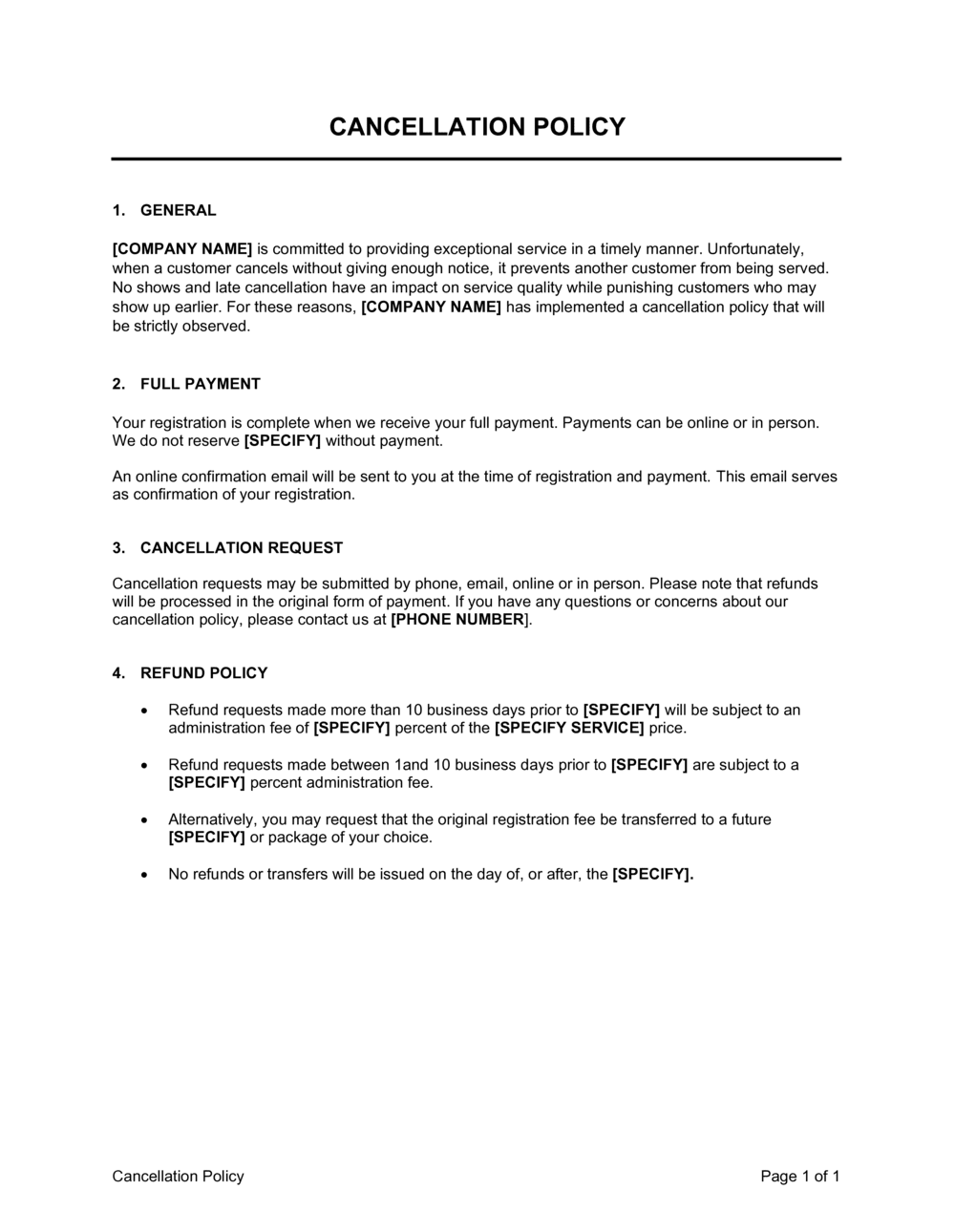
Define at least two fee tiers — one for cancellations that give you enough time to re-fill (lower or zero fee) and one for cancellations within your critical window (partial or full fee). Add a no-show tier that is equal to or greater than the last-minute cancellation tier.
💡 Express fees as both a percentage and a dollar cap so high-value bookings don't produce disproportionate penalties that customers will dispute.
4
Define refund conditions and timelines precisely
Specify the refund form (original payment method, store credit, or voucher), the exact processing window in business days, and any amounts excluded from refund eligibility (deposits, booking fees, service charges).
💡 Check your payment processor's actual refund timeline before committing to a customer-facing promise — credit card refunds typically take 5–10 business days regardless of when you initiate them.
5
Write the exceptions clause with documentation requirements
List the specific circumstances that trigger a fee waiver and state whether supporting documentation is required. Limit the list to events genuinely outside the customer's control to avoid creating a loophole.
💡 Phrase exceptions as 'at [COMPANY NAME]'s sole discretion' to retain the right to evaluate borderline cases without creating an automatic entitlement.
6
State the cancellation submission channel and confirmation process
Choose a single primary cancellation channel (email is strongly recommended) and specify the exact contact address, the information the customer must include, and the timeframe for your confirmation response.
💡 An automated confirmation email with a timestamp is your strongest protection against 'I cancelled on time' disputes — set one up before you publish the policy.
7
Add a policy update and notification clause
Specify how many days' notice you will give customers before a material policy change takes effect, and how you will notify them — email, in-app notice, or website banner.
💡 30 days' notice for policy changes is sufficient for most consumer-facing businesses; subscription services that auto-renew may need 60 days to stay ahead of regulatory expectations in certain markets.
8
Publish and integrate the policy into every customer touchpoint
Embed the policy in your booking confirmation emails, service agreement, website footer, and any intake forms clients sign before their first appointment. A policy customers haven't seen is unenforceable in a dispute.
💡 Add a checkbox acknowledgment to your online booking flow — 'I have read and agree to the Cancellation Policy' — and log the timestamp for every booking.