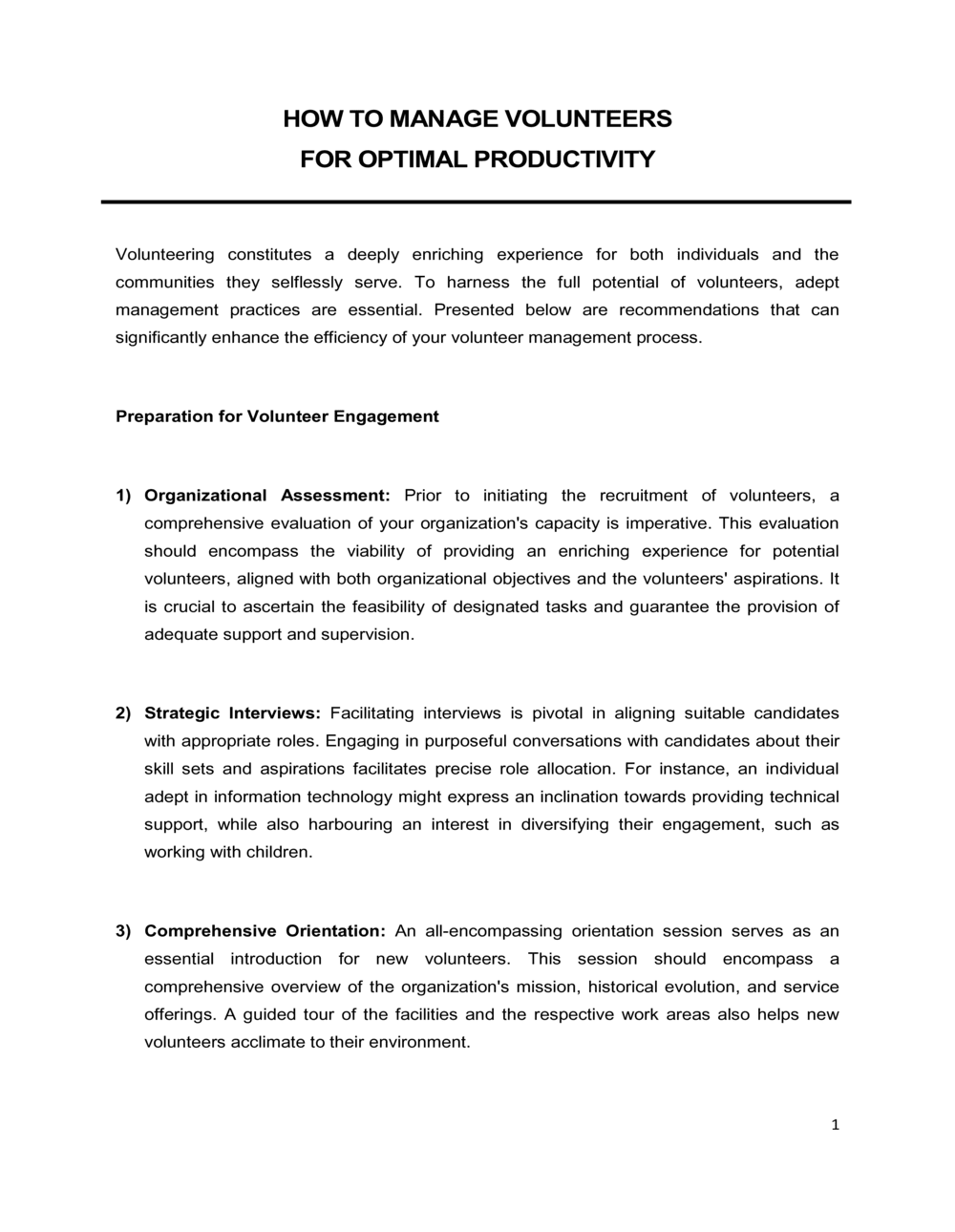
How To Manage Volunteers For Optimal Productivity

Free to read β€’ Save or share with one click

FreeHow To Manage Volunteers For Optimal Productivity Template

At a glance

What it is
This document is a structured operational guide that walks volunteer coordinators and program managers through every stage of managing volunteers β€” from recruitment and onboarding through scheduling, performance feedback, and retention. It is a free Word download you can edit online and export as PDF to share with staff, board members, or funding partners.
When you need it
Use it when launching a new volunteer program, standardizing an existing one that has grown informally, or preparing for an audit or grant review that requires documented volunteer management practices.
What's inside
Sections covering volunteer recruitment strategy, role definitions, onboarding and training, scheduling and coordination, communication protocols, performance recognition, conflict resolution, and program evaluation metrics β€” giving coordinators a complete operating framework in a single document.

What is a volunteer management guide?

A volunteer management guide is an operational document that gives coordinators and program managers a structured framework for recruiting, onboarding, scheduling, supervising, and retaining volunteers at every stage of a program lifecycle. Rather than leaving volunteer coordination to informal habits and institutional memory, this guide codifies the decisions, processes, and responsibilities that determine whether a volunteer program runs smoothly or burns out its staff. It covers everything from writing role descriptions and screening applicants through setting recognition milestones and evaluating program outcomes β€” in a single editable Word file you can adapt to your organization's specific context.

Why You Need This Document

Without a documented volunteer management framework, programs grow in ways that are hard to replicate, audit, or hand off. Coordinators rely on personal relationships and informal routines that disappear when they change roles. Scheduling gaps go unnoticed until the day of an event. Volunteers who receive no structured feedback or recognition quietly stop returning β€” and the organization loses the institutional knowledge and community goodwill they represented. Grant funders increasingly require evidence of systematic volunteer oversight, and accreditation bodies for healthcare and social service organizations audit volunteer management practices directly. This template gives coordinators a proven operational structure from day one β€” reducing the time spent on ad-hoc firefighting and producing the documentation that funders, boards, and auditors need to see.

Which variant fits your situation?

If your situation is…Use this template
Running a one-time community event with 50+ volunteersEvent Volunteer Coordination Plan
Onboarding new volunteers to an ongoing weekly programVolunteer Onboarding Checklist
Documenting rules and expectations for all volunteersVolunteer Handbook
Tracking volunteer hours and contributions for grant reportingVolunteer Hours Log
Evaluating the effectiveness of a volunteer program annuallyVolunteer Program Evaluation Report
Assigning and managing ongoing volunteer roles by departmentVolunteer Role Description Template
Recognizing and retaining high-performing long-term volunteersVolunteer Recognition Plan

Common mistakes to avoid

❌ Recruiting without defined role descriptions

Why it matters: Volunteers who sign up for an undefined role arrive without knowing what to do, require constant direction from coordinators, and rarely return after their first shift.

Fix: Complete a written role description for every volunteer position before any recruitment outreach begins. Even a single paragraph of clarity dramatically improves first-shift retention.

❌ Using informal group chats as the primary scheduling system

Why it matters: Text threads and group chats produce no auditable attendance record, make it impossible to identify capacity gaps, and fail silently when messages are missed or ignored.

Fix: Adopt a single scheduling tool β€” even a shared Google Sheet β€” that requires explicit shift confirmation and produces a report you can attach to a grant application.

❌ Skipping the volunteer agreement

Why it matters: Without a signed agreement, there is no documented record that the volunteer acknowledged the code of conduct, confidentiality expectations, or safety procedures β€” creating liability and behavioral ambiguity.

Fix: Have every volunteer sign an agreement before their first shift. Keep signed copies on file and reference specific clauses when addressing conduct issues.

❌ Providing recognition only at year-end

Why it matters: Volunteers who receive no acknowledgment for five or six months will quietly stop showing up β€” the attrition happens weeks before the annual appreciation event, not after.

Fix: Build at least two recognition touchpoints into the first 90 days of a volunteer's tenure β€” a post-first-shift thank-you and a milestone acknowledgment at the 10-hour or 5-shift mark.

❌ Collecting program evaluation data but not acting on it

Why it matters: Volunteers who complete satisfaction surveys and see no changes in the following quarter stop responding to surveys and reduce their engagement β€” the feedback loop becomes a signal of organizational indifference.

Fix: For every survey cycle, document at least one concrete change made in response to volunteer feedback and communicate it directly back to the volunteer group.

❌ Treating offboarding as an afterthought

Why it matters: A volunteer who leaves without an exit process takes institutional knowledge, potential referrals, and unaddressed grievances with them β€” and may share negative impressions publicly.

Fix: Conduct a 10-minute exit conversation or send a short exit survey to every departing volunteer. Record the reason for departure and use it to identify systemic retention issues.

The 10 key sections, explained

Program Overview and Objectives

Volunteer Role Definitions

Recruitment Strategy

Screening and Application Process

Onboarding and Training

Scheduling and Coordination

Communication and Reporting

Performance Feedback and Recognition

Conflict Resolution and Offboarding

Program Evaluation and Continuous Improvement

How to fill it out

  1. 1

    Define the program's purpose and measurable goals

    Start by writing a two-to-three sentence program overview that connects volunteer activity to a specific organizational outcome. Set at least two numeric targets β€” volunteer headcount and total hours β€” for the current period.

    πŸ’‘ Anchor your goals to a program need, not a round number. 'Enough volunteers to run two weekly food distribution shifts' is more defensible than '20 volunteers.'

  2. 2

    Write a role description for each volunteer position

    List every distinct volunteer function separately. For each, specify the tasks, required availability, skills needed, and the staff supervisor responsible.

    πŸ’‘ If a role requires more than eight tasks, it probably needs to be split into two roles β€” overloaded role descriptions produce confused volunteers.

  3. 3

    Map your recruitment channels and set a timeline

    Identify two to four recruitment channels that have historically produced engaged volunteers for your organization type. Set a target number of recruits per channel and an application deadline.

    πŸ’‘ Partner organizations (universities, corporate volunteer programs, faith communities) consistently produce better-retained volunteers than cold social media outreach.

  4. 4

    Document the screening steps required for each role

    Specify which roles require background checks, reference calls, or interviews. Note the provider and turnaround time for any background screening so new recruits know what to expect.

    πŸ’‘ Include a conditional-acceptance step β€” allow volunteers to begin non-sensitive tasks while background results are pending, rather than making them wait weeks before their first engagement.

  5. 5

    Build a staged onboarding sequence

    Break onboarding into at least two stages: a general orientation (mission, policies, safety) and a role-specific training session. Assign a named trainer or buddy for the role-specific stage.

    πŸ’‘ Send a brief welcome email 48 hours before orientation that confirms logistics and sets expectations β€” it reduces no-shows by giving recruits a concrete first commitment to honor.

  6. 6

    Set up the scheduling system and cancellation policy

    Choose a single scheduling tool and document how shifts are published, confirmed, and adjusted. Write a specific cancellation notice requirement β€” e.g., 24 hours' minimum notice β€” and name the contact for last-minute changes.

    πŸ’‘ Require shift confirmation (not just publication) β€” coordinators who must chase confirmations lose an average of 2–3 hours per scheduling cycle.

  7. 7

    Define recognition milestones and feedback touchpoints

    Choose at least two recognition moments β€” one early (after the 5th shift) and one annual. Schedule brief coordinator check-ins after the first shift and at the 30-day mark.

    πŸ’‘ A handwritten thank-you note after a volunteer's first shift costs nothing and has a measurable impact on whether they return for a second.

  8. 8

    Set the evaluation cadence and assign ownership

    Choose your three to five program metrics, set a review frequency (monthly for active programs, quarterly for smaller ones), and name the person responsible for pulling and presenting the data.

    πŸ’‘ Share aggregated program metrics with volunteers quarterly β€” transparency about impact is one of the strongest drivers of volunteer retention.

Frequently asked questions

What does volunteer management involve?

Volunteer management covers every stage of the volunteer lifecycle: recruiting and screening applicants, defining roles, onboarding and training new volunteers, scheduling shifts, communicating expectations, providing feedback and recognition, resolving conflicts, and evaluating program outcomes. A structured management approach reduces coordinator workload, improves volunteer retention, and produces the documentation that grant funders and auditors require.

How is managing volunteers different from managing paid employees?

Volunteers are motivated by purpose, connection, and impact rather than compensation β€” which means recognition, mission clarity, and flexible scheduling carry more weight than they do for paid staff. Coordinators cannot rely on financial incentives to drive behavior, so role clarity and genuine acknowledgment become the primary management tools. Volunteers also have legal protections that differ from employees, particularly around liability and reimbursement, depending on jurisdiction.

What is a good volunteer retention rate?

Industry benchmarks vary by sector, but a retention rate of 65–70% or higher from one engagement period to the next is generally considered healthy for ongoing programs. Event-based programs typically see lower repeat rates (40–55%) because the engagement is inherently transactional. Tracking retention by cohort β€” new volunteers vs. returning volunteers β€” gives a more actionable picture than a single blended rate.

How many volunteers should one coordinator manage?

For active, ongoing programs, a single coordinator can typically manage 30–50 volunteers effectively when supported by a scheduling system and lead volunteers in the field. Programs requiring close supervision β€” those involving children, clinical settings, or complex logistics β€” should aim for a lower ratio of 15–25 volunteers per coordinator. Beyond 50, a second coordinator or a structured lead-volunteer layer is usually necessary.

Do volunteers need to sign any documents?

At minimum, volunteers should sign a volunteer agreement that acknowledges the code of conduct, confidentiality expectations, and safety procedures before their first shift. Roles involving vulnerable populations, physical risk, or access to sensitive data typically also require a background check consent form and, in some jurisdictions, a waiver of liability. Keeping signed copies on file protects the organization and gives coordinators a documented basis for addressing conduct issues.

What tools are commonly used to manage volunteers?

Purpose-built volunteer management platforms such as VolunteerHub, SignUpGenius, Better Impact, and Galaxy Digital handle scheduling, communication, hours tracking, and reporting in one system. Smaller programs often start with a combination of Google Sheets for scheduling and a group email tool for communication. The right choice depends on program size, budget, and the reporting granularity required for funders.

How should volunteer performance issues be handled?

Address performance issues the same day or within 24 hours of the incident β€” delay signals that the behavior is acceptable. Start with a private, specific conversation rather than a group correction. Document the conversation and the expected behavior change. For repeated issues, follow a written warning process and have a clear threshold for ending the volunteer relationship. Well-managed exits protect the program's culture and the safety of the populations served.

How do you calculate the in-kind value of volunteer hours?

Multiply total volunteer hours by the current Independent Sector volunteer hourly rate, which is published annually (the 2024 figure is $33.49 per hour in the US). Skilled volunteer roles β€” legal, medical, IT β€” can be valued at the market rate for that skill. In-kind value reporting is required or encouraged by most major grant funders and is used to demonstrate matching contributions in federal grants.

What metrics should a volunteer program track?

The five most commonly required metrics are: total volunteer hours per period, number of active volunteers, volunteer retention rate, volunteer satisfaction score, and capacity gap (unfilled hours as a percentage of required hours). Grant funders also frequently request program outcome metrics that link volunteer activity to beneficiary results β€” for example, meals served per volunteer hour or students tutored per volunteer per term.

How this compares to alternatives

vs Volunteer Handbook

A volunteer handbook is a reference document written for the volunteer β€” covering organizational policies, expectations, and conduct rules. This management guide is written for the coordinator, covering how to run the program operationally. Both documents are typically used together: the handbook is given to volunteers at onboarding; this guide is used by staff to manage the program end-to-end.

vs Nonprofit Business Plan

A nonprofit business plan covers the full organizational strategy, including funding model, program theory, and financial projections. A volunteer management guide focuses exclusively on the operational mechanics of engaging and retaining volunteers. The business plan sets the strategic direction; this guide operationalizes one specific program function within it.

vs Employee Onboarding Checklist

An employee onboarding checklist guides HR through the legal, payroll, and administrative steps for a new paid hire β€” including tax forms, benefits enrollment, and system access. A volunteer onboarding process omits payroll and legal employment steps but adds mission orientation, role-specific safety training, and volunteer agreement execution. The two documents serve parallel but legally distinct processes.

vs Event Planning Template

An event planning template organizes the full logistics of a single event β€” venue, vendors, timeline, and budget. A volunteer management guide addresses the ongoing program infrastructure needed to recruit, train, and retain volunteers across multiple events or a continuous program. Event coordinators typically need both: this guide to manage the volunteer pool and an event plan to coordinate the specific day.

Industry-specific considerations

Nonprofit and Social Services

Volunteer hours serve as in-kind match for federal and foundation grants, making hours-tracking accuracy a compliance requirement, not just a best practice.

Healthcare

Patient-facing volunteer roles require HIPAA training, background checks, and documented competency sign-offs before placement β€” all of which must be tracked per Joint Commission standards.

Education

Parent and community volunteer programs must be coordinated around school-calendar constraints, and all roles involving minors require criminal background screening under state law in most US jurisdictions.

Event Management and Sports

Large-scale events require volunteer role tiering (general, skilled, lead), credential verification for certain posts, and a real-time check-in system to manage hundreds of volunteers across multiple venues simultaneously.

Template vs pro β€” what fits your needs?

PathBest forCostTime
Use the templateVolunteer coordinators at nonprofits, schools, and community organizations managing programs of up to 50 volunteersFree2–4 hours to customize and complete
Template + professional reviewPrograms subject to grant reporting requirements or those serving vulnerable populations requiring compliance documentation$200–$600 for a nonprofit consultant or program manager review3–5 business days
Custom draftedLarge institutions with 200+ volunteers, multi-site programs, or organizations undergoing accreditation that requires documented volunteer management standards$1,500–$5,000 for a nonprofit operations consultant2–4 weeks

Glossary

Volunteer Coordinator
The staff member or designated lead responsible for recruiting, scheduling, supervising, and retaining volunteers within a program.
Role Description
A written summary of a volunteer position's tasks, time commitment, required skills, and reporting structure β€” the volunteer equivalent of a job description.
Onboarding
The structured process of orienting new volunteers to the organization's mission, policies, safety procedures, and their specific assignment before they begin.
Volunteer Retention Rate
The percentage of volunteers who return for a second engagement period, used as a key indicator of program health and volunteer satisfaction.
Capacity Gap
The difference between the number of volunteer hours a program needs and the hours currently committed by active volunteers.
Recognition
Formal or informal acknowledgment of a volunteer's contribution β€” including thank-you notes, hours certificates, or public appreciation β€” shown to increase retention.
Supervision Ratio
The number of volunteers assigned to each supervising staff member or lead volunteer, typically 1:8 to 1:15 depending on task complexity.
Volunteer Agreement
A document signed by the volunteer confirming their understanding of the role, schedule, code of conduct, and confidentiality expectations.
Screening
Background checks, reference verification, or skills assessments conducted before placing a volunteer in a role β€” required in most settings involving children or vulnerable populations.
In-Kind Value
The dollar equivalent of volunteer hours contributed to an organization, calculated at the Independent Sector's published hourly rate β€” used in grant applications and annual reports.

Part of your Business Operating System

This document is one of 3,000+ business & legal templates included in Business in a Box.

  • Fill-in-the-blanks β€” ready in minutes
  • Compatible with all office suites
  • Export to PDF and share electronically

Create your document in 3 simple steps.

From template to signed document β€” all inside one Business Operating System.
1
Download or open template

Access over 3,000+ business and legal templates for any business task, project or initiative.

2
Edit and fill in the blanks with AI

Customize your ready-made business document template and save it in the cloud.

3
Save, Share, Send, Sign

Share your files and folders with your team. Create a space of seamless collaboration.

Save time, save money, and create top-quality documents.

β˜…β˜…β˜…β˜…β˜…

"Fantastic value! I'm not sure how I'd do without it. It's worth its weight in gold and paid back for itself many times."

Managing Director Β· Mall Farm
Robert Whalley
Managing Director, Mall Farm Proprietary Limited
β˜…β˜…β˜…β˜…β˜…

"I have been using Business in a Box for years. It has been the most useful source of templates I have encountered. I recommend it to anyone."

Business Owner Β· 4+ years
Dr Michael John Freestone
Business Owner
β˜…β˜…β˜…β˜…β˜…

"It has been a life saver so many times I have lost count. Business in a Box has saved me so much time and as you know, time is money."

Owner Β· Upstate Web
David G. Moore Jr.
Owner, Upstate Web

Run your business with a system β€” not scattered tools

Stop downloading documents. Start operating with clarity. Business in a Box gives you the Business Operating System used by over 250,000 companies worldwide to structure, run, and grow their business.

Start freeΒ Β·Β No credit card required