Work Hours and Attendance Policy Template

Free Word download β€’ Edit online β€’ Save & share with Drive β€’ Export to PDF

3 pagesβ€’20–25 min to fillβ€’Difficulty: Standard
Learn more ↓
FreeWork Hours and Attendance Policy Template

At a glance

What it is
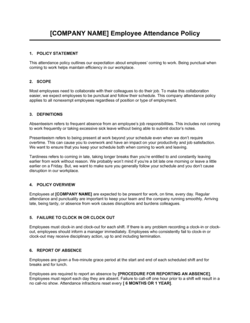
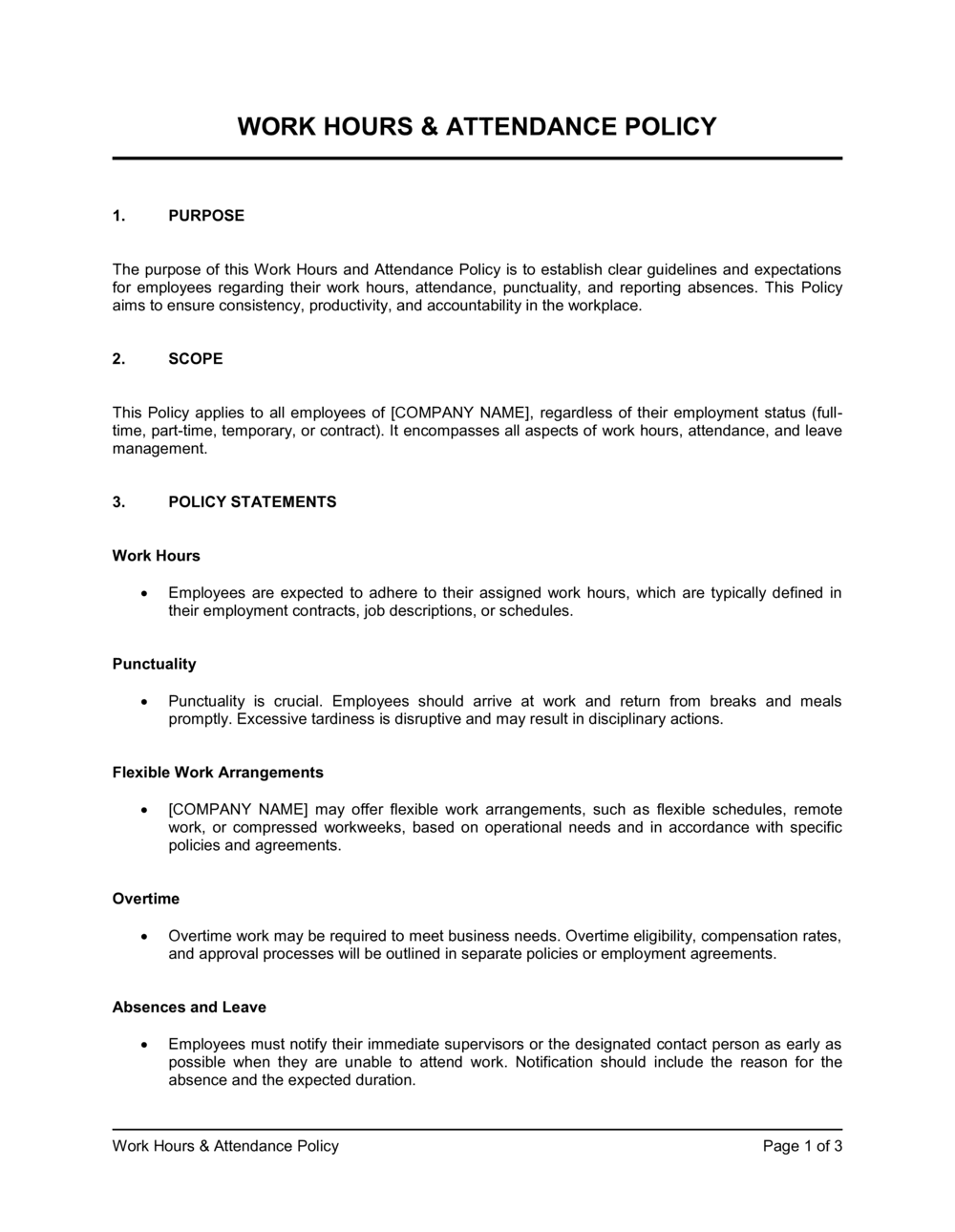
A Work Hours and Attendance Policy is a formal internal document that defines when employees are expected to be present, how to request time off or report absences, and what consequences apply for tardiness or unexcused absences. This free Word download gives you a structured, editable template you can tailor to your organization and export as PDF for employee handbooks or standalone distribution.
When you need it
Use it when onboarding new staff, updating an employee handbook, or when inconsistent attendance or timekeeping is creating operational or legal exposure. Any employer with more than one employee benefits from a written policy that sets clear, consistently applied expectations.
What's inside
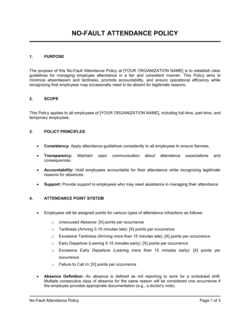
Standard work schedule and hours, remote and flexible work provisions, procedures for reporting absences and late arrivals, definitions of excused and unexcused absences, a progressive discipline ladder, leave interaction guidance, and a manager responsibilities section.

What is a Work Hours and Attendance Policy?

A Work Hours and Attendance Policy is a formal internal document that establishes when employees are expected to be at work, how they must report absences and late arrivals, what types of absences are considered excused, and what progressive consequences apply when expectations are not met. It converts informal scheduling norms into a written standard that every manager applies the same way β€” creating a defensible record for disciplinary decisions and a clear reference point for employees who want to understand what is expected of them. The policy typically covers standard and flexible schedules, remote work interactions, core hours, absence reporting deadlines, a points or occurrence ladder, and manager documentation obligations.

Why You Need This Document

Without a written attendance policy, managers fill the gap with personal judgment β€” and personal judgment applied inconsistently across a team is a discrimination claim waiting to happen. An employee terminated for excessive absences can challenge the decision if no written standard existed, if the rules were never formally communicated, or if another employee with similar attendance was treated differently. Unemployment insurance boards and employment tribunals routinely ask for the written policy the employee violated; the absence of one weakens or defeats the employer's position. Beyond legal exposure, unmanaged attendance issues carry a direct operational cost: unplanned absenteeism in US workplaces costs employers an estimated $1,685 per employee per year in lost productivity, overtime, and temporary staffing. A well-structured policy, distributed at onboarding and enforced consistently, reduces that cost by setting expectations before the first absence occurs rather than reacting after patterns have already formed. This template gives you a complete, editable starting point β€” ready to customize to your schedule, your industry, and your workforce in under two hours.

Which variant fits your situation?

If your situation is…Use this template
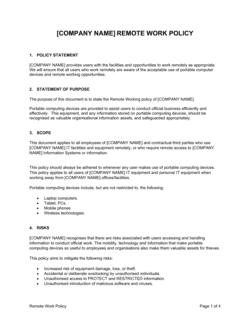
Remote-first team with flexible asynchronous schedulesRemote Work Policy
Shift-based workforce in manufacturing or retailShift Schedule Policy
Policy for paid and unpaid time-off accrualVacation and Leave Policy
Documenting a single formal warning for attendanceEmployee Written Warning
Comprehensive rules for all HR topics in one documentEmployee Handbook
Tracking hours worked against a scheduleEmployee Timesheet

Common mistakes to avoid

❌ Vague absence notification language

Why it matters: Phrases like 'notify your supervisor promptly' are interpreted inconsistently β€” some employees call at 9 a.m. for an 8 a.m. shift and argue they complied, making discipline difficult to sustain.

Fix: Replace all vague timing language with a specific deadline β€” for example, 'no later than 30 minutes before your scheduled start time' β€” and name the required communication method.

❌ Excluding protected leave from the excused absence list

Why it matters: Counting FMLA, ADA accommodation days, or state-mandated leave as unexcused absences and applying points to them exposes the company to federal and state enforcement actions and retaliation claims.

Fix: Explicitly list every federally and state-protected leave category as automatically excused and instruct managers to flag any absence that may qualify before assigning points.

❌ Informal flexible arrangements undocumented in the policy

Why it matters: When one employee's informal 7-to-3 schedule is granted but a similar request is denied to another, the inconsistency can support a discrimination claim even if both decisions were made in good faith.

Fix: Document all approved flexible arrangements in writing and reference the policy's approval process each time β€” consistency of process is the legal protection, not just consistency of outcomes.

❌ No manager documentation requirements

Why it matters: Without written occurrence logs and documented counseling records, a termination for attendance cannot be defended against a wrongful-dismissal or unemployment insurance claim.

Fix: Add a mandatory manager documentation section naming the specific system, the logging deadline, and the HR escalation trigger β€” and train managers on it before the policy launches.

The 10 key sections, explained

Purpose and scope

Standard work schedule

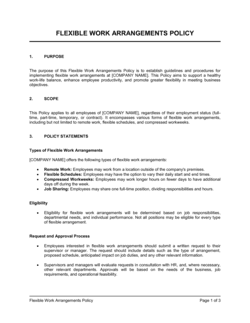
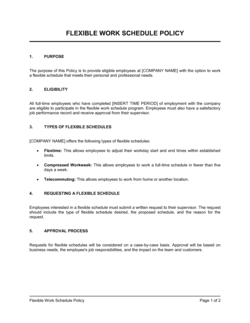
Flexible and remote work provisions

Reporting absences and late arrivals

Excused and unexcused absence definitions

Tardiness and early departure definitions

Progressive discipline schedule

No-call no-show procedure

Manager responsibilities

Policy acknowledgment and review

How to fill it out

  1. 1

    Define scope and covered employees

    Replace all [COMPANY NAME] and [LOCATION] placeholders. Specify whether the policy covers full-time, part-time, temporary, and remote workers, and whether separate shift or department schedules apply.

    πŸ’‘ If shift workers follow different rules than office staff, create a separate schedule addendum rather than trying to fit both into the main policy body.

  2. 2

    Set the standard work schedule

    Enter the default start time, end time, meal break duration, and days of the week. If departments vary, note that department-specific schedules are defined separately.

    πŸ’‘ Align the standard schedule with your payroll system's default settings to prevent discrepancies that confuse managers and trigger overtime disputes.

  3. 3

    Document flexible and remote work rules

    Decide whether flexible scheduling is permitted, define core hours, and state who approves exceptions. Cross-reference your Remote Work Policy if one exists.

    πŸ’‘ If flexible work is approved informally today, this is your opportunity to formalize it consistently β€” reducing future discrimination or favoritism claims.

  4. 4

    Write the absence reporting procedure

    Specify the exact notification deadline (e.g., 30 minutes before shift), acceptable methods (phone call only vs. text or email), and who must be notified. Remove any vague language like 'as soon as practicable.'

    πŸ’‘ Require a phone call rather than a text for absences β€” verbal communication confirms the employee is reachable and reduces no-call-no-show ambiguity.

  5. 5

    Define excused absence categories explicitly

    List every category of absence that will not count against the employee's attendance record. Confirm that FMLA, ADA accommodations, jury duty, and bereavement leave are explicitly included.

    πŸ’‘ Have HR or legal counsel confirm that your excused absence list reflects current federal and state or provincial leave requirements for your jurisdiction.

  6. 6

    Calibrate the progressive discipline thresholds

    Set the number of occurrences that trigger each disciplinary step and the rolling lookback period (typically 12 months). Ensure the no-call no-show threshold is distinct and more severe.

    πŸ’‘ Use a 12-month rolling window rather than a calendar year β€” a calendar year reset on January 1 incentivizes employees to exhaust absences in December.

  7. 7

    Assign manager documentation obligations

    Name the specific HR system or log where occurrences must be recorded, the deadline for logging, and the escalation path for warnings and termination.

    πŸ’‘ Run one tabletop drill with managers before launch β€” walk through a sample scenario step by step to confirm everyone understands what to log and when to call HR.

  8. 8

    Attach an acknowledgment form and publish

    Add a sign-and-return acknowledgment as Attachment A. Distribute the policy to all employees, collect signed acknowledgments, and file them in each employee's personnel record.

    πŸ’‘ Use an electronic acknowledgment system if available β€” digital timestamps are easier to produce as evidence than scanned paper forms stored in a filing cabinet.

Frequently asked questions

What is a work hours and attendance policy?

A work hours and attendance policy is a written internal document that defines when employees are expected to work, how they should report absences or tardiness, what types of absences are excused, and what consequences apply when expectations are not met. It gives managers a consistent, documented framework for enforcing attendance standards and protects the company if attendance-related discipline is challenged.

Why do small businesses need a written attendance policy?

Without a written policy, attendance decisions are made informally and inconsistently β€” leaving the company exposed to claims that one employee was disciplined differently from another for the same behavior. A written policy sets equal expectations for every employee, creates a paper trail for disciplinary actions, and is often required by unemployment insurance boards and employment tribunals as evidence that the employee was aware of the rules they violated.

What should an attendance policy include?

At minimum: the standard work schedule and hours, the procedure for reporting absences and late arrivals with a specific deadline, a clear list of excused and unexcused absence categories, the progressive discipline schedule with specific occurrence thresholds, no-call no-show rules, manager documentation requirements, and a signed employee acknowledgment. Omitting any of these creates gaps that managers will fill differently, undermining consistent enforcement.

How do I handle FMLA and ADA absences under an attendance policy?

Absences that qualify under the Family and Medical Leave Act, the Americans with Disabilities Act, or equivalent state laws must be designated as excused and excluded from your points or discipline system. Applying points to protected leave is an independent legal violation regardless of whether the employee otherwise meets your attendance thresholds. Train managers to flag any absence that may qualify for protected leave and route it to HR for designation before assigning an occurrence.

What is a no-call no-show policy and how should it be handled?

A no-call no-show occurs when an employee is absent without notifying anyone in advance. Most policies treat it as a more severe infraction than a reported absence β€” typically skipping one or more steps in the progressive discipline ladder. Define in writing how many consecutive no-call no-show days constitute voluntary resignation, and require managers to attempt contact and document each attempt before treating the separation as voluntary.

Should I use an attendance points system?

An attendance points system is consistent and defensible β€” each absence type carries a defined point value, and consequences trigger automatically at defined thresholds. It reduces the risk of inconsistent manager discretion and is easier to explain to employees. The main drawback is rigidity: a points system that cannot account for context (a flu outbreak, a family emergency) can damage morale if applied without any manager judgment. Consider a hybrid approach where points trigger a review conversation, not automatic discipline.

How often should an attendance policy be updated?

Review the policy at least once per year, and update it whenever a new federal or state leave law takes effect, when your workforce structure changes significantly (e.g., adding a remote or hybrid component), or when disciplinary decisions based on the current policy are successfully challenged. Outdated policies that conflict with current law are more dangerous than no policy at all.

Can I discipline an employee for excessive tardiness?

Yes, provided the policy clearly defines what constitutes tardiness (e.g., more than five minutes past the scheduled start time), specifies the point value assigned to each tardy event, and applies the rules consistently to all employees. Discipline is harder to sustain if the tardiness definition is vague, if some employees were informally excused for the same behavior, or if the employee's tardiness was caused by a condition requiring accommodation under the ADA.

Do employees need to sign the attendance policy?

A signed acknowledgment is not legally required in most jurisdictions, but it is strongly recommended. Without one, an employee can claim they were never informed of the rules β€” a defense that routinely succeeds in unemployment and wrongful-termination proceedings. Collect acknowledgments at onboarding and each time the policy is materially updated, and store the signed forms in each employee's personnel file.

How this compares to alternatives

vs Employee Handbook

An employee handbook is an omnibus document covering all HR policies β€” code of conduct, benefits, compensation, and more β€” in a single reference. A work hours and attendance policy is a focused standalone document covering only scheduling and absence rules. Use the standalone policy when you need a quick-to-update document employees can sign separately, or embed it as a chapter in a full handbook.

vs Remote Work Policy

A remote work policy addresses where employees work and the equipment, security, and communication expectations for off-site work. A work hours and attendance policy addresses when employees work and what happens when they do not. For hybrid teams, both documents are needed β€” the attendance policy sets the schedule and reporting rules; the remote work policy governs the physical location.

vs Employee Timesheet

An employee timesheet is an operational record-keeping tool used to log hours actually worked each day. A work hours and attendance policy is the governing document that defines expected hours, absence procedures, and discipline rules. The timesheet provides the data; the policy provides the standard against which that data is evaluated.

vs Employee Written Warning

An employee written warning is a disciplinary document issued to an individual after a specific policy violation has occurred. A work hours and attendance policy is the preventive framework that defines the rules and discipline ladder before any violation takes place. The warning references the policy; without the policy, the warning has no documented standard to cite.

Industry-specific considerations

Manufacturing

Shift-based scheduling means unplanned absences directly halt production lines; points systems with same-day notification requirements and shift-coverage protocols are standard.

Retail and hospitality

High turnover and variable schedules require clear on-call and schedule-change notification rules alongside the standard absence procedure.

Professional services

Billable-hour tracking and client-facing availability make tardiness definitions and flexible-work core hours especially important for utilization and client satisfaction.

Healthcare

Patient safety and regulatory staffing ratios make no-call no-show procedures and mandatory overtime rules critical components requiring close coordination with HR and legal counsel.

Template vs pro β€” what fits your needs?

PathBest forCostTime
Use the templateSmall and mid-size employers establishing or updating a written attendance policy for the first timeFree1–2 hours
Template + professional reviewEmployers in heavily regulated industries or states with complex leave laws (California, New York, Ontario)$200–$500 for an HR consultant or employment attorney review2–5 business days
Custom draftedEnterprise employers with multi-state or multi-country workforces, union contracts, or documented history of attendance-related litigation$1,000–$3,000+1–3 weeks

Glossary

Excused Absence
A pre-approved or properly reported absence that does not count against an employee's attendance record under the policy.
Unexcused Absence
A full or partial workday absence that was not reported according to the policy's call-out procedure and is not covered by an approved leave type.
Tardiness
Arriving at work after the scheduled start time, typically measured from the first minute past the defined clock-in window.
No-Call No-Show
A situation in which an employee neither reports to work nor notifies the employer in advance β€” typically treated as the most severe attendance infraction.
Progressive Discipline
A structured sequence of increasingly serious consequences β€” verbal warning, written warning, final warning, and termination β€” applied consistently for repeated policy violations.
Flexible Work Arrangement
A schedule that allows employees to vary their start and end times or work location within defined boundaries, subject to manager approval.
FMLA (Family and Medical Leave Act)
A US federal law entitling eligible employees at covered employers to up to 12 weeks of unpaid, job-protected leave per year for qualifying health or family reasons.
ADA (Americans with Disabilities Act)
A US federal law requiring employers to provide reasonable accommodations to qualified employees with disabilities, which may include modified attendance requirements.
Attendance Points System
A tracking method that assigns a numerical value to each absence or tardy occurrence; an employee who accumulates points above a threshold triggers a defined disciplinary response.
Core Hours
A defined window β€” often 10 a.m. to 3 p.m. β€” during which all employees on a flexible schedule are expected to be available and reachable, regardless of their start and end times.

Part of your Business Operating System

This document is one of 3,000+ business & legal templates included in Business in a Box.

  • Fill-in-the-blanks β€” ready in minutes
  • 100% customizable Word document
  • Compatible with all office suites
  • Export to PDF and share electronically

Create your document in 3 simple steps.

From template to signed document β€” all inside one Business Operating System.
1
Download or open template

Access over 3,000+ business and legal templates for any business task, project or initiative.

2
Edit and fill in the blanks with AI

Customize your ready-made business document template and save it in the cloud.

3
Save, Share, Send, Sign

Share your files and folders with your team. Create a space of seamless collaboration.

Save time, save money, and create top-quality documents.

β˜…β˜…β˜…β˜…β˜…

"Fantastic value! I'm not sure how I'd do without it. It's worth its weight in gold and paid back for itself many times."

Managing Director Β· Mall Farm
Robert Whalley
Managing Director, Mall Farm Proprietary Limited
β˜…β˜…β˜…β˜…β˜…

"I have been using Business in a Box for years. It has been the most useful source of templates I have encountered. I recommend it to anyone."

Business Owner Β· 4+ years
Dr Michael John Freestone
Business Owner
β˜…β˜…β˜…β˜…β˜…

"It has been a life saver so many times I have lost count. Business in a Box has saved me so much time and as you know, time is money."

Owner Β· Upstate Web
David G. Moore Jr.
Owner, Upstate Web

Run your business with a system β€” not scattered tools

Stop downloading documents. Start operating with clarity. Business in a Box gives you the Business Operating System used by over 250,000 companies worldwide to structure, run, and grow their business.

Start freeΒ Β·Β No credit card required