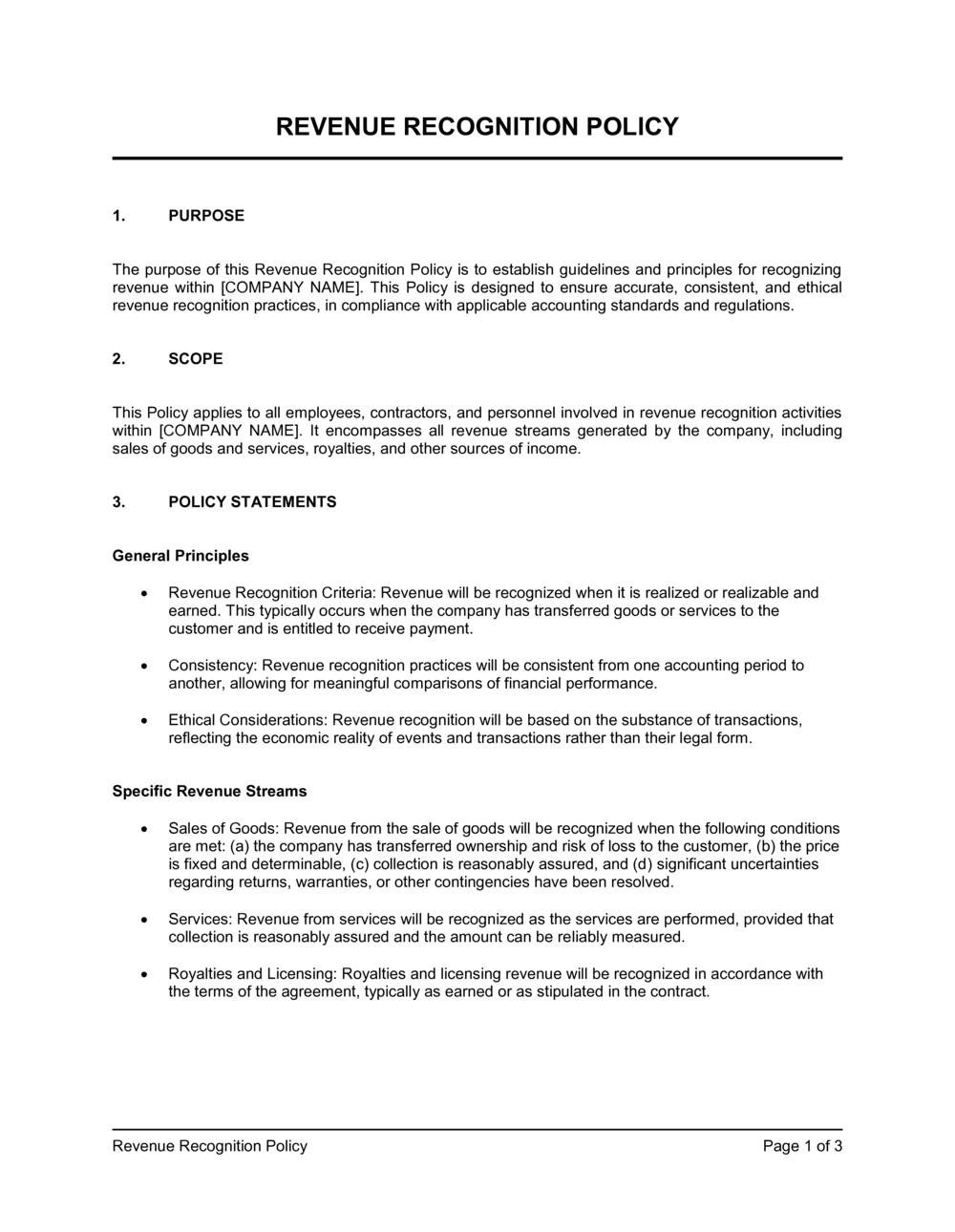
Revenue Recognition Policy Template

Free Word download β€’ Edit online β€’ Save & share with Drive β€’ Export to PDF

3 pagesβ€’20–30 min to fillβ€’Difficulty: Standard
Learn more ↓
FreeRevenue Recognition Policy Template

At a glance

What it is
A Revenue Recognition Policy is an internal accounting policy document that defines the specific rules, criteria, and timing your organization uses to record revenue in its financial statements. This free Word download follows the five-step model under ASC 606 and IFRS 15, giving you a structured, auditor-ready starting point you can edit online and export as PDF to share with your finance team, auditors, or board.
When you need it
Use it when your business first adopts formal accrual accounting, when preparing for an audit or financial due diligence, or when revenue streams grow complex enough that consistent recognition timing becomes critical to accurate financial reporting.
What's inside
Purpose and scope, applicable accounting standards (ASC 606 / IFRS 15), the five-step revenue recognition model, contract identification criteria, performance obligation definitions, transaction price allocation rules, timing of recognition (point-in-time vs. over time), and disclosure requirements. Each section includes guidance notes and worked examples.

What is a Revenue Recognition Policy?

A Revenue Recognition Policy is an internal accounting policy document that defines the specific rules, criteria, and timing a company uses to record revenue in its financial statements. It operationalizes the five-step model required under ASC 606 (US GAAP) and IFRS 15 by translating those standards into company-specific procedures for each contract type and revenue stream β€” subscriptions, project services, product sales, licenses, or multi-element bundles. Without a written policy, different members of the finance team may apply different rules to identical transactions across periods, producing financial statements that are neither consistent nor auditable.

Why You Need This Document

Omitting a formal revenue recognition policy creates compounding risk across every financial reporting cycle. Auditors treat undocumented revenue recognition as a material weakness in internal controls, which can delay or qualify an audit opinion. Investors and acquirers conducting due diligence examine revenue recognition methodology in the first round β€” inconsistent recognition is one of the most common reasons deal valuations are adjusted downward or transactions are restructured. For SaaS and services businesses specifically, the timing difference between cash collected and revenue earned is often the largest single reconciling item on the balance sheet; without a policy, that difference is impossible to track or defend. This template gives your finance team a structured, auditor-ready framework covering all five steps of ASC 606, balance sheet presentation of contract assets and liabilities, required disclosures, and a governance process to keep the policy current as your business grows.

Which variant fits your situation?

If your situation is…Use this template
SaaS company with annual and monthly subscription plansRevenue Recognition Policy (SaaS)
Professional services firm billing on time-and-materials contractsRevenue Recognition Policy (Services)
Product manufacturer with bill-and-hold or consignment arrangementsRevenue Recognition Policy (Manufacturing)
Construction or long-term contract business using percentage-of-completionRevenue Recognition Policy (Long-Term Contracts)
Nonprofit recognizing grant revenue and contributionsRevenue Recognition Policy (Nonprofit)
Multi-entity group needing a consolidated group-wide policyGroup Accounting Policy Manual
Early-stage company setting up its first accounting policiesAccounting Policies Manual

Common mistakes to avoid

❌ Recognizing subscription revenue in full on the invoice date

Why it matters: A 12-month subscription paid upfront creates a performance obligation satisfied over time β€” booking it all in Month 1 overstates revenue and understates deferred revenue, distorting the balance sheet and income statement simultaneously.

Fix: Record the full invoice as deferred revenue on receipt and release it ratably (or per the pattern of delivery) over the subscription term, crediting revenue each period.

❌ Treating a multi-element bundle as a single performance obligation

Why it matters: Bundling a software license, implementation, and annual support into one unit defers all revenue until the last obligation is complete, understating current-period revenue and misrepresenting gross margin by product line.

Fix: Assess each promised good or service for distinctness under ASC 606 Step 2, document the analysis, and allocate the transaction price to each using standalone selling prices before recognizing any element.

❌ Failing to constrain variable consideration

Why it matters: Booking the maximum possible contract value before usage-based fees or performance bonuses are earned inflates revenue and almost always requires a reversal in a subsequent period, creating earnings volatility and audit findings.

Fix: Apply the constraint test at each reporting date: include variable amounts in the transaction price only to the extent it is probable that a significant revenue reversal will not occur when the uncertainty is resolved.

❌ Never updating the policy after adding new revenue streams

Why it matters: A policy written for a product-sales business that later adds SaaS subscriptions, professional services, or marketplace transactions will be silently applying the wrong recognition rules to the new streams β€” often undetected until an audit or acquisition due diligence.

Fix: Add a new-product launch checklist that requires a revenue recognition assessment for any new offering before the first invoice is issued, with the policy updated before go-live.

❌ Netting contract assets and liabilities across separate contracts

Why it matters: ASC 606 requires gross presentation of contract assets and liabilities at the individual contract level. Netting them understates both sides of the balance sheet and is a recurring audit adjustment that triggers additional testing.

Fix: Configure your accounting system to track contract assets and contract liabilities at the contract ID level and present them gross in the financial statements unless you have a legal right of offset.

❌ Omitting disclosure of significant judgments from the financial statement footnotes

Why it matters: Auditors and investors rely on footnotes to evaluate whether revenue is recognized on a reasonable basis. Missing disclosures on SSP estimation methods, variable consideration constraints, or remaining performance obligations is one of the most common restatement triggers under ASC 606.

Fix: Maintain a disclosure workpaper throughout the year β€” not just at year-end β€” that captures each required disclosure item and the underlying data, so the footnotes can be drafted in days rather than weeks.

The 10 key sections, explained

Purpose and scope

Applicable accounting standards

Step 1 β€” Identify the contract with a customer

Step 2 β€” Identify performance obligations

Step 3 β€” Determine the transaction price

Step 4 β€” Allocate the transaction price

Step 5 β€” Recognize revenue when (or as) performance obligations are satisfied

Contract assets, contract liabilities, and deferred revenue

Disclosures and financial statement presentation

Policy governance, review, and updates

How to fill it out

  1. 1

    Define the scope and effective date

    Name the legal entity or entities covered, list the revenue streams included, and specify the effective date. Explicitly exclude revenue streams governed by other standards (leases, interest, investments).

    πŸ’‘ If your business operates in both GAAP and IFRS jurisdictions, note both standards in scope rather than creating two separate documents β€” a dual-standard policy reduces version-control risk.

  2. 2

    List your typical contract types

    Identify the three to five most common contract structures your business uses β€” subscriptions, project-based services, product sales, licensing, or multi-element bundles. Each type may require different recognition treatment.

    πŸ’‘ Run a sample of your last 20 invoices to identify every distinct contract type before drafting the policy. It is easier to map each to the five-step model than to write the policy and discover gaps later.

  3. 3

    Map each contract type through the five-step model

    For each contract type, document how you apply each of the five steps: contract identification, performance obligation identification, transaction price, allocation, and recognition timing. Include a worked example for complex arrangements.

    πŸ’‘ Worked examples are the most-read part of any revenue recognition policy. A two-paragraph example for your largest revenue stream saves hours of auditor back-and-forth.

  4. 4

    Set your standalone selling prices

    Establish and document the SSP for each distinct performance obligation using one of the four permitted methods. Record the determination date and schedule an annual review.

    πŸ’‘ If you cannot observe SSPs directly, use the adjusted market assessment approach with competitor pricing data as support β€” document your sources so the rationale survives staff turnover.

  5. 5

    Define your variable consideration estimates

    For each source of variable consideration (discounts, rebates, returns, penalties), choose the expected value or most likely amount method and document the constraint analysis used to limit recognition.

    πŸ’‘ Set a return reserve percentage based on at least 12 months of historical return data, and update it quarterly. An unsupported reserve is a common audit adjustment.

  6. 6

    Document practical expedients elected

    List every ASC 606 or IFRS 15 practical expedient your company has elected β€” financing component waiver, costs-to-obtain amortization, or full retrospective adoption. Unapplied expedients cannot be adopted mid-period without disclosure.

    πŸ’‘ The portfolio approach practical expedient is useful for high-volume, homogeneous contracts (e.g., monthly SaaS subscriptions under $500). Document the criteria your contracts must meet to qualify for portfolio treatment.

  7. 7

    Specify balance sheet presentation and disclosure requirements

    Define how contract assets, contract liabilities, and deferred revenue are classified, labeled, and disclosed in the financial statements and footnotes.

    πŸ’‘ Ask your auditor for a disclosure checklist specific to your industry at the start of each fiscal year β€” standards interpretations evolve and checklist gaps are easier to close before year-end than after.

  8. 8

    Assign ownership and set a review cadence

    Name the policy owner (typically the controller or CFO), specify the approval authority for amendments, and set a formal annual review date tied to the fiscal year-end close cycle.

    πŸ’‘ Build the annual policy review into your year-end close calendar as a standing task β€” teams that treat the review as optional routinely miss it until the next audit.

Frequently asked questions

What is a revenue recognition policy?

A revenue recognition policy is an internal accounting document that defines the specific rules and timing your organization uses to record revenue in its financial statements. It translates the requirements of ASC 606 (US GAAP) or IFRS 15 into company-specific procedures for each contract type and revenue stream. Without one, different team members may apply different rules to identical transactions, creating inconsistencies that surface during audits or investor due diligence.

What is the five-step revenue recognition model under ASC 606?

The five steps are: (1) identify the contract with a customer, (2) identify the distinct performance obligations within the contract, (3) determine the transaction price including any variable consideration, (4) allocate the transaction price to each performance obligation based on standalone selling prices, and (5) recognize revenue when β€” or as β€” each performance obligation is satisfied. All five steps must be applied consistently across every revenue-generating contract your business enters.

Is a revenue recognition policy required by GAAP?

ASC 606 and IFRS 15 require entities to apply a consistent set of principles to revenue from contracts with customers, but they do not mandate a single written policy document by name. In practice, auditors require documented evidence of how the five-step model has been applied, and a written policy is the most efficient way to provide that evidence. For SEC registrants, revenue recognition accounting policies must also be disclosed in the financial statement footnotes.

When should revenue be recognized at a point in time vs. over time?

Revenue is recognized over time when any one of three criteria is met: the customer simultaneously receives and consumes the benefit as the company performs, the company's performance creates or enhances an asset the customer controls, or the company's performance has no alternative use and the company has an enforceable right to payment for work completed to date. If none of these apply, revenue is recognized at the point in time when control transfers to the customer β€” typically on delivery or acceptance.

How does a revenue recognition policy apply to SaaS subscriptions?

For a standard SaaS subscription, the performance obligation is typically satisfied over time as the customer has continuous access to the software. Revenue is recognized ratably over the subscription term β€” so a $12,000 annual contract generates $1,000 per month of recognized revenue. If the subscription is bundled with implementation or onboarding services, each element must be assessed for distinctness and allocated a standalone selling price before any revenue is recognized.

What is deferred revenue and how is it treated under this policy?

Deferred revenue (also called a contract liability) arises when a customer pays before the performance obligation is satisfied β€” the most common example being an annual subscription billed upfront. The payment is recorded as a liability on the balance sheet and released to the income statement as revenue only as the obligation is fulfilled. Deferred revenue is not revenue until earned; treating it as such is one of the most common misstatements in early-stage company financials.

Do small businesses need a formal revenue recognition policy?

Any business preparing accrual-basis financial statements for external purposes β€” bank financing, investor reporting, or audit β€” should have a documented revenue recognition policy. Cash-basis businesses are generally exempt, since revenue equals cash received. Once a business adopts GAAP for any reporting purpose, ASC 606 applies regardless of size, and a written policy is the most practical way to ensure consistent application across periods and across team members.

How often should a revenue recognition policy be updated?

The policy should be reviewed at least annually, typically aligned with the fiscal year-end close. It must also be updated whenever the business adds a materially new revenue stream, changes a pricing model (e.g., moving from perpetual licenses to subscriptions), or when the FASB or IASB issues new interpretive guidance that affects existing streams. A policy that has not been reviewed in more than 18 months is very likely out of date for a growing business.

What is the difference between a revenue recognition policy and an accounting policies manual?

An accounting policies manual covers the full range of a company's accounting elections β€” fixed asset capitalization thresholds, inventory costing methods, lease classification, and more. A revenue recognition policy is a focused standalone document covering only how and when revenue is recorded. For most businesses, a dedicated revenue recognition policy is appropriate even when a full accounting manual does not yet exist, because revenue is the line item most scrutinized by auditors, investors, and lenders.

What are standalone selling prices and why do they matter?

A standalone selling price (SSP) is the price at which a company would sell a specific good or service on its own, without bundling. Under ASC 606 Step 4, when a contract includes multiple performance obligations, the total transaction price must be allocated to each obligation in proportion to its SSP. If SSPs are not documented and consistently applied, the allocation between elements is arbitrary β€” understating revenue on high-margin items and overstating it on low-margin ones, which distorts both reported revenue and gross margin.

How this compares to alternatives

vs Accounting Policies Manual

An accounting policies manual covers the full range of accounting elections across all balance sheet and income statement lines β€” depreciation methods, inventory costing, lease classification, and more. A revenue recognition policy is a focused document covering only how and when revenue is recorded. Most businesses need a dedicated revenue policy first because revenue receives more auditor and investor scrutiny than any other line. Once the revenue policy is established, it is typically incorporated as a chapter in the broader manual.

vs Revenue Forecast

A revenue forecast projects how much revenue the business expects to generate in future periods, based on sales pipeline and growth assumptions. A revenue recognition policy defines the rules for when already-contracted revenue is recorded in the financial statements. The two documents serve entirely different purposes: one is a planning tool; the other is an accounting control. Both reference revenue, but a forecast does not substitute for a recognition policy.

vs Financial Reporting Policy

A financial reporting policy addresses how financial statements are prepared, presented, and distributed β€” including materiality thresholds, reporting calendar, and internal controls over financial reporting. A revenue recognition policy is narrowly scoped to a single accounting principle. In practice, the revenue recognition policy feeds into the financial reporting policy as a component, but the two are maintained as separate documents because the revenue policy requires more frequent updates and more technical accounting detail.

vs Sales Commission Policy

A sales commission policy defines how sales representatives are compensated for closed contracts. Under ASC 606, costs to obtain a contract (including commissions) must be capitalized and amortized over the period of benefit if the amortization period exceeds one year β€” so the two policies intersect directly. A company that pays commissions on multi-year contracts and has a revenue recognition policy but no commission capitalization guidance is very likely misreporting expenses alongside revenue.

Industry-specific considerations

SaaS / Technology

Multi-element bundles of licenses, implementation, and support require SSP allocation; usage-based pricing introduces variable consideration constraints that must be re-estimated quarterly.

Professional Services

Time-and-materials contracts typically qualify for over-time recognition using the input method; fixed-fee projects require a reliable cost-to-complete estimate to apply percentage-of-completion correctly.

Manufacturing

Bill-and-hold arrangements, consignment sales, and customer-acceptance clauses each require specific policy guidance to determine whether control has transferred before physical delivery.

Retail / E-commerce

Gift card breakage, right-of-return reserves, loyalty point obligations, and principal vs. agent determinations for marketplace transactions each create distinct recognition timing questions.

Healthcare / MedTech

Third-party payor contracts, variable reimbursement rates, and bundled device-and-service arrangements require careful transaction price estimation and constraint analysis.

Construction

Long-term contracts almost always qualify for over-time recognition; the choice between input (cost incurred) and output (milestones achieved) methods materially affects the revenue profile of multi-year projects.

Template vs pro β€” what fits your needs?

PathBest forCostTime
Use the templateSmall and mid-size businesses with straightforward revenue streams preparing for their first external audit or lender reviewFree2–4 hours to complete and review internally
Template + professional reviewCompanies with multi-element arrangements, variable consideration, or complex SaaS pricing preparing for a Series A or annual audit$500–$2,000 for a CPA or technical accounting consultant review1–2 weeks
Custom draftedSEC registrants, pre-IPO companies, or businesses with highly complex revenue streams requiring Big 4 or national firm technical accounting support$5,000–$25,000+4–10 weeks

Glossary

ASC 606
The US GAAP standard (Accounting Standards Codification Topic 606) that establishes a five-step framework for recognizing revenue from contracts with customers.
IFRS 15
The international accounting standard (International Financial Reporting Standard 15) that mirrors ASC 606 and governs revenue recognition for entities reporting under IFRS.
Performance Obligation
A distinct promise in a contract to transfer a good or service to a customer β€” the unit of account for revenue recognition under ASC 606 and IFRS 15.
Transaction Price
The total consideration a company expects to receive in exchange for transferring promised goods or services, net of discounts, refunds, and variable amounts.
Variable Consideration
Revenue that may vary based on future events β€” such as discounts, rebates, penalties, or sales-based royalties β€” which must be estimated and constrained before recognition.
Standalone Selling Price
The price at which a company would sell a distinct good or service separately, used to allocate the transaction price across multiple performance obligations.
Point-in-Time Recognition
Revenue recorded in full at the single moment when control of a good or service transfers to the customer.
Over-Time Recognition
Revenue recorded progressively as a performance obligation is satisfied, using an output or input method to measure progress.
Contract Asset
A company's right to receive consideration in exchange for goods or services already transferred, when that right is conditional on something other than the passage of time.
Contract Liability (Deferred Revenue)
An obligation to transfer goods or services for which the company has already received payment β€” recorded as a liability until the performance obligation is satisfied.
Practical Expedient
A simplified accounting option permitted by ASC 606 or IFRS 15 that reduces compliance complexity for qualifying transactions, such as ignoring financing components in contracts under 12 months.

Part of your Business Operating System

This document is one of 3,000+ business & legal templates included in Business in a Box.

  • Fill-in-the-blanks β€” ready in minutes
  • 100% customizable Word document
  • Compatible with all office suites
  • Export to PDF and share electronically

Create your document in 3 simple steps.

From template to signed document β€” all inside one Business Operating System.
1
Download or open template

Access over 3,000+ business and legal templates for any business task, project or initiative.

2
Edit and fill in the blanks with AI

Customize your ready-made business document template and save it in the cloud.

3
Save, Share, Send, Sign

Share your files and folders with your team. Create a space of seamless collaboration.

Save time, save money, and create top-quality documents.

β˜…β˜…β˜…β˜…β˜…

"Fantastic value! I'm not sure how I'd do without it. It's worth its weight in gold and paid back for itself many times."

Managing Director Β· Mall Farm
Robert Whalley
Managing Director, Mall Farm Proprietary Limited
β˜…β˜…β˜…β˜…β˜…

"I have been using Business in a Box for years. It has been the most useful source of templates I have encountered. I recommend it to anyone."

Business Owner Β· 4+ years
Dr Michael John Freestone
Business Owner
β˜…β˜…β˜…β˜…β˜…

"It has been a life saver so many times I have lost count. Business in a Box has saved me so much time and as you know, time is money."

Owner Β· Upstate Web
David G. Moore Jr.
Owner, Upstate Web

Run your business with a system β€” not scattered tools

Stop downloading documents. Start operating with clarity. Business in a Box gives you the Business Operating System used by over 250,000 companies worldwide to structure, run, and grow their business.

Start freeΒ Β·Β No credit card required