1
Define scope and assign ownership
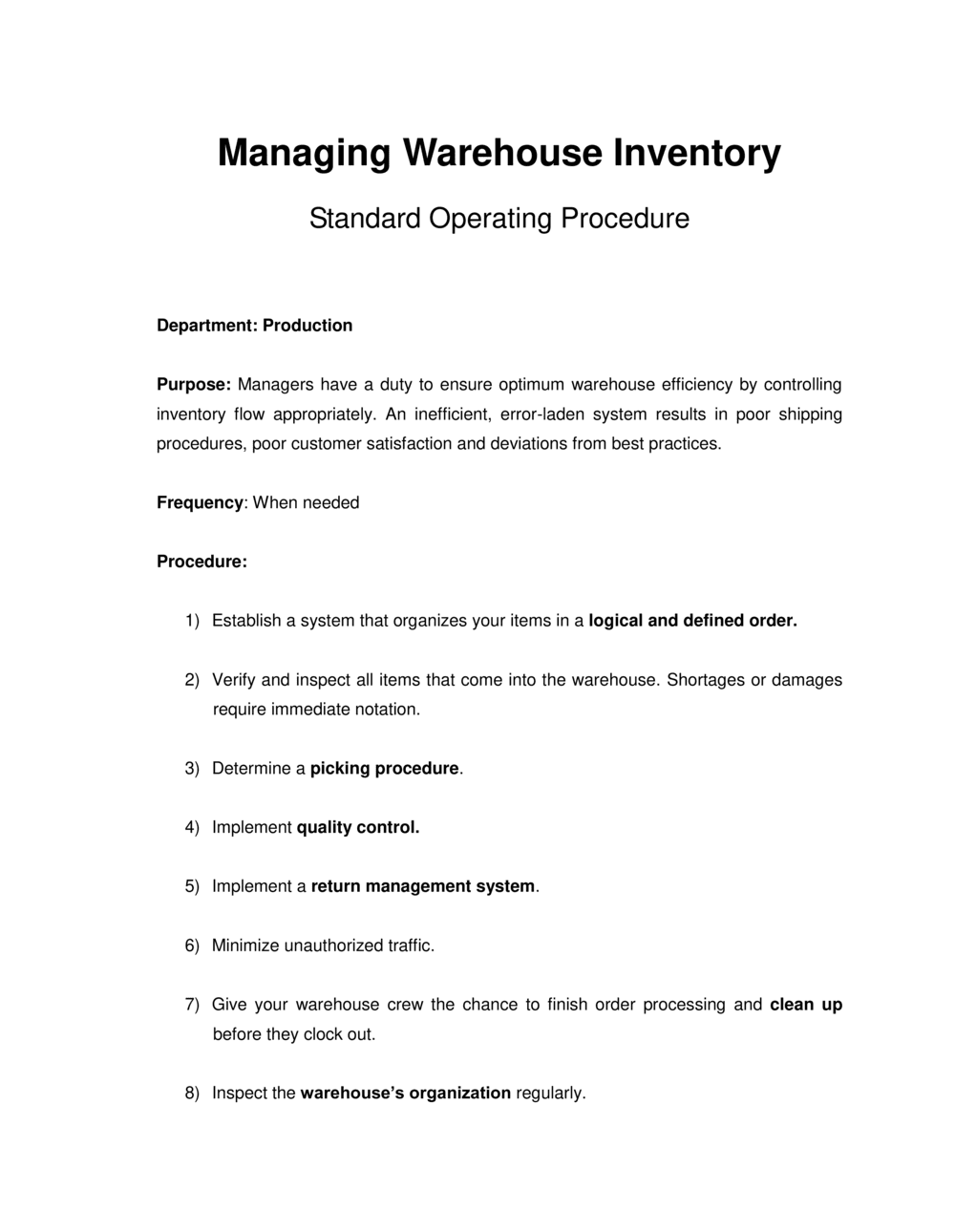
Enter the facility name and address, the product categories and inventory types the procedure covers, and the roles responsible for following and enforcing each section.
💡 Name specific job titles rather than individuals — the document stays current through staff turnover without requiring an amendment.
2
Document your receiving and inspection process
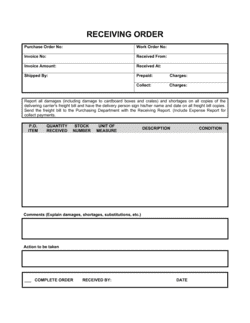
Map each step from carrier arrival to putaway, including who verifies quantities, what form records discrepancies, and the escalation path for damaged or short shipments.
💡 Set a hard time limit — e.g., 'inspection completed within 2 hours of arrival' — so receiving bottlenecks are visible as a process failure, not just a busy day.
3
Assign and map storage locations
Run an ABC analysis on your SKU catalog to classify items by velocity or value, then assign A-class items to the closest, most accessible bin locations. Record every location in your WMS or tracking spreadsheet.
💡 Photograph the labeled warehouse floor plan and attach it to the document as an appendix — new staff orient themselves in minutes instead of days.
4
Configure your reorder points for each SKU
For each SKU, calculate reorder point using average daily usage, supplier lead time, and a safety stock buffer. Enter the values in the replenishment section and in your tracking system.
💡 Start with a 20% safety stock buffer on your top-20 SKUs by revenue and refine based on three months of actual demand data.
5
Set the cycle count schedule
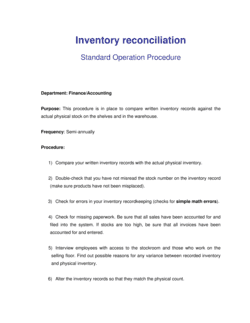
List every SKU in the A, B, and C tiers with its count frequency. Assign count responsibility to a named role and identify the form or system screen used to record and reconcile results.
💡 Schedule A-class counts on the same day each month so they become a predictable routine rather than an ad hoc interruption.
6
Define pick, pack, and dispatch steps
Write out each fulfillment step in sequence — pick list source, pick route method, pack spec (box size, void fill, label format), and carrier handoff time. Include the escalation path for pick shortages.
💡 Walk the process physically before finalizing the steps — procedures written from memory at a desk often omit two or three real steps that staff do automatically.
7
Set shrinkage controls and KPI targets
Enter your target thresholds for inventory accuracy, fill rate, and shrinkage rate. Specify who reviews each metric, at what frequency, and what action is triggered when a threshold is breached.
💡 Set your initial KPI targets based on your last three months of actuals, then raise the bar by 5% each quarter — starting with an aspirational target you have never hit creates frustration, not improvement.
8
Distribute, train, and schedule reviews
Share the completed document with all warehouse staff, conduct a walk-through to confirm understanding, and set a calendar reminder for the next scheduled review date — typically every six months.
💡 Post a one-page visual summary of the core receiving, putaway, and cycle count steps at the relevant work stations — most floor staff reference a wall card, not a 20-page policy document.