How to Develop a Marketing Campaign

Free to read β€’ Save or share with one click

FreeHow to Develop a Marketing Campaign Template

At a glance

What it is
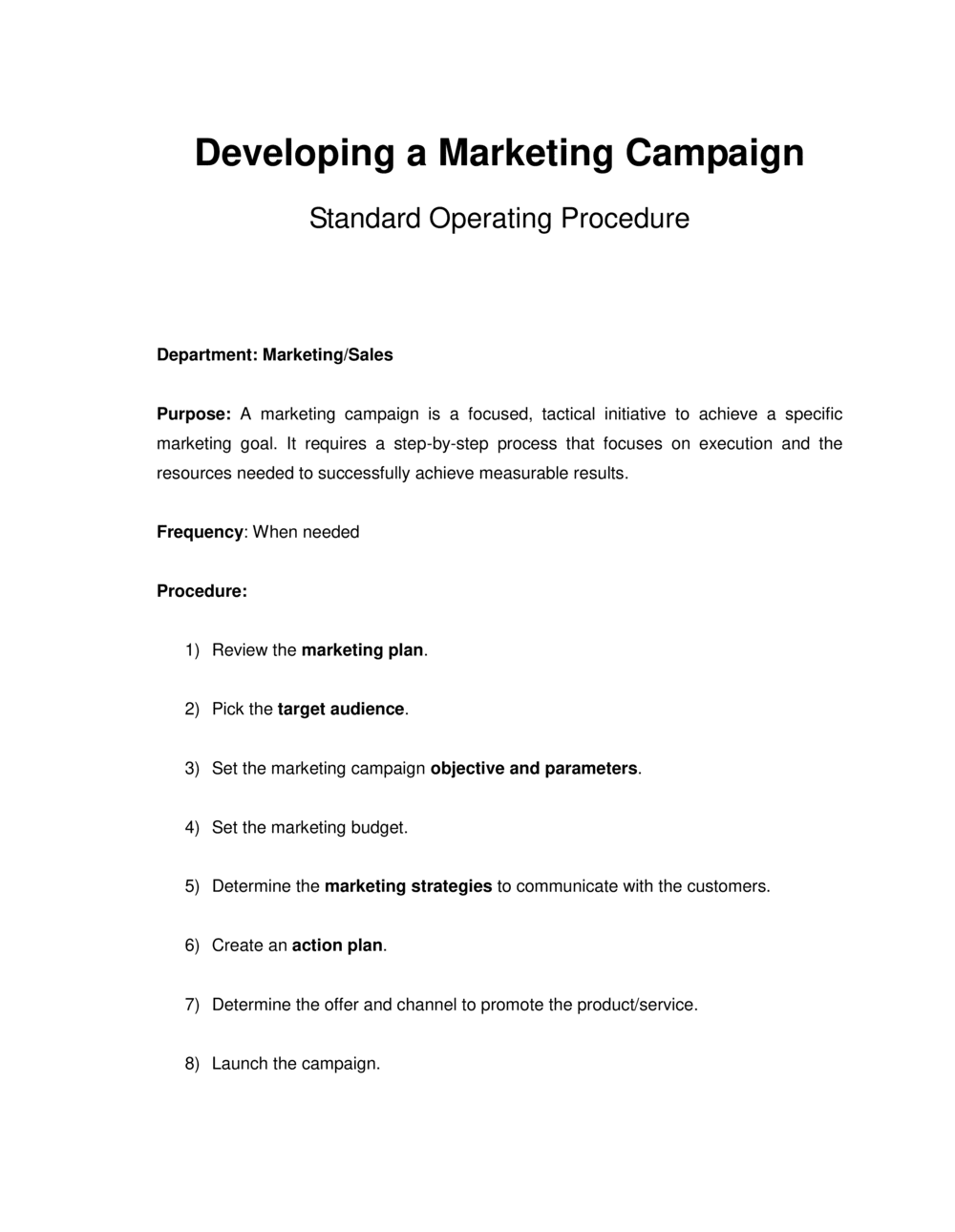
A How To Develop A Marketing Campaign document is a structured planning guide that walks you through every stage of a campaign β€” from defining goals and audiences to selecting channels, setting a budget, and measuring results. This free Word download gives you a repeatable framework you can edit online and export as PDF to align your marketing, sales, and leadership teams before launch.
When you need it
Use it whenever you are planning a product launch, seasonal promotion, brand awareness push, or lead-generation drive that involves more than one channel or stakeholder. It is equally useful for a solo marketer mapping out a 6-week campaign and a team of ten coordinating across paid, owned, and earned media.
What's inside
Campaign objectives and SMART goals, target audience profiles, core messaging and value proposition, channel strategy, content and creative plan, budget allocation, timeline and milestones, and KPIs with measurement methodology.

What is a How To Develop A Marketing Campaign document?

A How To Develop A Marketing Campaign document is a structured planning framework that guides marketers, founders, and business owners through every stage of building and executing a targeted marketing campaign β€” from setting measurable objectives and defining audience personas to allocating budget across channels, scheduling creative delivery, and establishing the KPIs used to evaluate results. It functions as both an internal alignment tool and an operational guide, ensuring that every person involved in a campaign β€” from the copywriter to the CFO β€” is working from the same goals, constraints, and success criteria before a single dollar is spent or an asset is published.

Why You Need This Document

Running a campaign without a written plan is one of the most expensive habits in marketing. Teams that skip the planning stage routinely overspend on channels their audience does not use, launch with inconsistent messaging that confuses rather than converts, and have no agreed benchmark to evaluate whether the campaign worked. The absence of a pre-defined KPI means any result can be rationalized as a success, and the same ineffective tactics get funded in the next cycle. A completed campaign plan closes these gaps before they become budget line items: it forces you to validate that your audience, message, channels, and budget are internally consistent before the clock starts. For teams working with external agencies or freelancers, the plan also serves as a contractual brief β€” reducing revision cycles and keeping production on schedule. This template gives you the structure to build that plan in hours rather than days.

Which variant fits your situation?

If your situation is…Use this template
Planning a digital-only paid acquisition campaignDigital Marketing Plan
Mapping a full-year marketing strategy across all channelsMarketing Plan
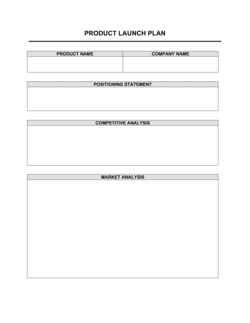
Launching a new product to marketProduct Launch Plan
Planning a social media–focused campaignSocial Media Marketing Plan
Coordinating a brand awareness or PR campaignPublic Relations Plan
Tracking campaign performance against agreed KPIsMarketing Report
Briefing a creative team or external agency on campaign deliverablesCreative Brief

Common mistakes to avoid

❌ Launching without a defined primary KPI

Why it matters: Without a pre-agreed success metric, every result can be rationalized as acceptable. Budgets get renewed for campaigns that did not actually move the business.

Fix: Define the primary KPI and its numeric target before approving the budget. Tie campaign renewal decisions to that metric, not to activity volume.

❌ Targeting too broad an audience

Why it matters: Broad targeting raises CPM and CPL while lowering conversion rates β€” the campaign spends more and acquires fewer customers than a narrower approach would.

Fix: Start with the highest-LTV customer segment from your existing base and use it to build the initial targeting parameters. Expand after you have a converting core.

❌ Building the creative plan after setting the media schedule

Why it matters: When asset delivery is late, media placements run with placeholder or repurposed content that was not designed for the campaign β€” depressing performance from day one.

Fix: Set asset-completion deadlines five business days before each channel's go-live date, and include a formal approval checkpoint in the timeline.

❌ Allocating nothing to contingency

Why it matters: Channel costs fluctuate, bids increase during peak periods, and creative tests fail β€” a campaign with zero contingency budget has no room to adapt and either overspends or goes dark early.

Fix: Reserve 10% of total budget as contingency and define the trigger conditions under which it can be deployed β€” for example, CPL exceeding target by 25% for five consecutive days.

❌ Defining KPIs after the campaign ends

Why it matters: Retroactively selected metrics justify any outcome and prevent honest performance analysis. Teams repeat the same mistakes campaign after campaign.

Fix: Lock KPIs in the plan document before launch and share them with all stakeholders. Post-campaign reporting should measure only the metrics agreed in advance.

❌ No post-campaign review scheduled

Why it matters: Without a structured debrief, learnings are informal and institutional knowledge is lost. The next campaign starts from the same assumptions as the last.

Fix: Schedule a 60-minute post-campaign review within five business days of end date. Capture what worked, what missed targets, and the three changes to make next time β€” in writing.

The 9 key sections, explained

Campaign Overview and Objectives

Target Audience and Buyer Personas

Core Messaging and Value Proposition

Channel Strategy

Content and Creative Plan

Budget Allocation

Campaign Timeline and Milestones

KPIs and Measurement Plan

Risk and Contingency Plan

How to fill it out

  1. 1

    Define the campaign objective with a SMART goal

    Write the primary objective in SMART format β€” specific outcome, numeric target, and deadline. Tie it to a business goal (revenue, pipeline, signups) so stakeholders understand why the campaign exists.

    πŸ’‘ One campaign, one primary objective. Teams that try to optimize for brand awareness and lead generation simultaneously typically achieve neither.

  2. 2

    Build or select the target audience profile

    Name the primary persona, describe their demographics and pain points, and identify where they consume content. If you have existing customer data, pull the top-performing segment by LTV and use it as the anchor.

    πŸ’‘ Add a 'who this campaign is NOT for' line β€” excluding irrelevant audiences is as important as including the right ones for paid media efficiency.

  3. 3

    Write the core message and proof points

    Draft one sentence that captures the campaign's central value proposition: what you offer, for whom, and the outcome they get. Then list three supporting proof points β€” a stat, a case study, and a testimonial are a reliable combination.

    πŸ’‘ Test the core message on someone outside the marketing team. If they cannot repeat it back accurately after one read, simplify it.

  4. 4

    Select channels and assign funnel roles

    Choose two to four channels based on where your audience is active and the campaign's funnel stage. Assign each channel a specific role β€” awareness, consideration, or conversion β€” and set a target metric for each.

    πŸ’‘ Resist adding channels because they feel current. Every channel you add requires creative assets, monitoring, and budget. Start focused, expand in the next campaign.

  5. 5

    List every required asset with an owner and due date

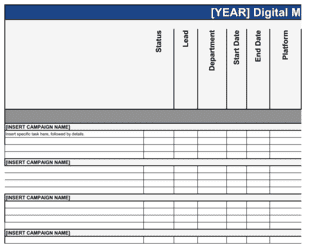
    Create a row for every deliverable β€” ad creative, landing page, email sequence, social posts β€” and assign an owner and a due date that is at least five business days before channel launch.

    πŸ’‘ Build a creative sign-off checkpoint into the timeline. Campaigns that skip formal approval routinely launch with errors that require costly corrections mid-flight.

  6. 6

    Allocate budget across channels and production

    Split the total budget into paid media, content production, tools, and a 10% contingency. For each paid channel, calculate the maximum CPL or CPA you can afford given your target CAC.

    πŸ’‘ If production costs exceed 30% of total budget, reassess the asset plan β€” simpler creative often outperforms high-production assets in direct-response campaigns.

  7. 7

    Set KPIs and the reporting cadence before launch

    Lock in primary and secondary KPIs in the plan before the campaign goes live. Assign a reporting owner and schedule weekly check-ins plus a post-campaign summary within five business days of the end date.

    πŸ’‘ Create a live dashboard before launch β€” not after. Waiting until Week 2 to set up tracking means your first week of data is lost.

  8. 8

    Document at least two contingency triggers

    Identify the two most likely failure modes β€” a channel missing its CPL target and a creative asset delayed past launch β€” and write a pre-agreed response for each, including the person responsible for calling it.

    πŸ’‘ Pre-agreed triggers remove the politics from mid-campaign decisions. Teams move faster when the response protocol is already written down.

Frequently asked questions

What is a marketing campaign?

A marketing campaign is a coordinated set of activities designed to achieve a specific business goal β€” such as generating leads, launching a product, or driving seasonal sales β€” over a defined time period using one or more channels. Unlike ongoing marketing programs, a campaign has a fixed start and end date, a discrete budget, and measurable success criteria established before launch.

What should a marketing campaign plan include?

A complete campaign plan covers the campaign objective and SMART goal, target audience profile, core messaging and value proposition, channel strategy with funnel roles, content and creative asset list, budget allocation by channel and category, timeline with milestones, KPIs with tracking methodology, and a risk or contingency plan. Missing any of these sections leaves gaps that surface as misalignment, overspend, or unmeasurable results.

How long should a marketing campaign run?

Campaign duration depends on the objective and channel mix. Lead generation campaigns typically run 4–8 weeks β€” long enough to gather statistically significant data, short enough to iterate quickly. Brand awareness campaigns often run 8–12 weeks to build frequency. Seasonal promotions are tied to the event window. As a rule, run campaigns long enough to reach your sample size threshold before drawing conclusions and making budget changes.

What is the difference between a marketing campaign and a marketing plan?

A marketing plan is an annual or multi-year document covering all marketing activity across every channel and objective. A marketing campaign is a time-limited initiative within that plan, focused on one specific goal. You might run four to eight campaigns per year, each with its own brief, budget, and KPIs β€” all operating within the broader strategy defined in the marketing plan.

How do I set a marketing campaign budget?

Start from your target CAC and work backward. If you need 200 leads and your historical lead-to-customer rate is 20%, you need 1,000 leads. If your target CPL is $25, the media budget is $25,000. Add 20–30% for content production and tools, and 10% contingency. If the resulting number exceeds available budget, reduce the lead target or extend the timeline β€” do not reduce the contingency reserve.

What KPIs should I track for a marketing campaign?

Choose one primary KPI that directly measures the campaign objective β€” cost per lead, conversion rate, revenue attributed, or signups generated. Add two to three secondary KPIs that track leading indicators β€” click- through rate, landing page conversion rate, email open rate β€” that signal whether you are on track before the final results are in. Avoid tracking more than five KPIs per campaign; more than that splits attention and slows optimization decisions.

How do I measure marketing campaign success?

Compare final results against the numeric targets set in the campaign plan before launch. Primary KPI at or above target means the campaign succeeded on its core objective. Secondary KPIs tell you where performance was gained or lost in the funnel β€” a high CTR with a low landing-page conversion rate, for example, points to a messaging or offer problem on the page rather than an audience or targeting problem.

Can a small business develop a marketing campaign without an agency?

Yes. A small business with one to two people managing marketing can run effective campaigns using this template as the planning backbone. Focus on one to two channels where your audience is most active, limit creative assets to what can be produced in-house, and set a realistic budget. The discipline of completing a written campaign plan β€” even a brief one β€” consistently outperforms ad-hoc spend regardless of team size.

What is a campaign brief and how does it differ from a campaign plan?

A campaign brief is a short, one-to-two-page summary of the campaign's goals, audience, messaging, channels, and timeline β€” used to align stakeholders or brief an agency. A campaign plan is the full working document that includes detailed asset lists, budget breakdowns, KPIs, and contingency protocols. The brief is derived from the plan; both should be completed before any creative or media work begins.

How this compares to alternatives

vs Marketing Plan

A marketing plan is an annual strategic document covering all channels, programs, and budgets for the full year. A marketing campaign plan is a time-limited brief for a single initiative within that strategy. Build the annual plan first to set direction, then use a campaign plan for each individual initiative to manage execution and measurement.

vs Product Launch Plan

A product launch plan coordinates all functions β€” product, engineering, sales, support, and marketing β€” for a new release. A marketing campaign plan covers only the marketing execution layer. For a product launch, you need both: the launch plan to align the full organization and the campaign plan to execute the marketing component.

vs Creative Brief

A creative brief distills the campaign's audience, message, tone, and deliverables into a single page for a designer, copywriter, or agency. A campaign plan is the upstream document from which the brief is derived β€” the plan drives strategy; the brief drives production. Creative should never start without both documents in place.

vs Digital Marketing Plan

A digital marketing plan covers the full online channel strategy across SEO, paid, email, social, and content over a sustained period. A marketing campaign plan is narrower β€” a single campaign across any mix of channels for a defined duration. Use the digital marketing plan for ongoing channel management and the campaign plan for specific initiative execution.

Industry-specific considerations

SaaS / Technology

Free trial and demo-request campaigns with MQL targets, multi-touch attribution across paid search, email nurture, and retargeting, and CAC payback benchmarks by segment.

Retail / E-commerce

Seasonal and promotional campaigns tied to retail calendar events, ROAS targets by channel, and creative asset volumes driven by SKU count and offer complexity.

Professional Services

Long sales-cycle campaigns focused on thought-leadership content and event-driven lead generation, with lead quality scored by firm size and service fit.

Food & Beverage

Localized campaigns tied to store openings, menu launches, or seasonal items, with heavy reliance on social proof, influencer content, and geotargeted paid social.

Healthcare / Wellness

Patient acquisition and wellness program enrollment campaigns with strict compliance requirements for claims, channel restrictions on sensitive health targeting, and trust-building content.

Nonprofit

Donor acquisition and fundraising campaigns with matched-gift mechanics, email-heavy channel mix, and campaign success measured by cost per dollar raised rather than CPL.

Template vs pro β€” what fits your needs?

PathBest forCostTime
Use the templateMarketing managers, small business owners, and founders planning campaigns with an internal teamFree2–4 hours to complete the full plan
Template + professional reviewTeams running their first major campaign or planning a spend above $20,000 who want an external sanity check$300–$1,500 for a marketing consultant review session1–3 days
Custom draftedBrands with complex multi-market campaigns, agencies developing campaign strategies for enterprise clients, or campaigns requiring advanced media planning$3,000–$15,000+ for a full agency campaign strategy engagement2–6 weeks

Glossary

Campaign Objective
A specific, measurable outcome the campaign is designed to achieve β€” such as generating 500 leads or increasing website traffic by 30% over 8 weeks.
SMART Goal
A goal that is Specific, Measurable, Achievable, Relevant, and Time-bound β€” used to make campaign objectives concrete and trackable.
Target Audience
The defined group of people the campaign is designed to reach, described by demographics, psychographics, behaviors, and pain points.
Buyer Persona
A semi-fictional profile of an ideal customer built from market research and real customer data, used to guide messaging and channel selection.
Value Proposition
A clear statement of the specific benefit your product or service delivers to the target audience and why it is better than the alternatives.
Channel Mix
The combination of paid, owned, and earned media channels selected to distribute campaign messages β€” for example, email, paid social, SEO, and events.
KPI (Key Performance Indicator)
A quantifiable metric used to evaluate whether the campaign is achieving its objectives β€” such as click-through rate, cost per lead, or conversion rate.
Conversion Rate
The percentage of people who complete a desired action β€” such as filling out a form or making a purchase β€” out of the total who were exposed to the campaign.
CAC (Customer Acquisition Cost)
Total campaign spend divided by the number of new customers acquired, used to measure cost efficiency.
A/B Test
A controlled experiment that shows two versions of an ad, email, or landing page to different audience segments to determine which performs better.
Campaign Brief
A concise document that summarizes a campaign's goals, audience, messaging, channels, timeline, and budget for internal or agency alignment.

Part of your Business Operating System

This document is one of 3,000+ business & legal templates included in Business in a Box.

  • Fill-in-the-blanks β€” ready in minutes
  • Compatible with all office suites
  • Export to PDF and share electronically

Create your document in 3 simple steps.

From template to signed document β€” all inside one Business Operating System.
1
Download or open template

Access over 3,000+ business and legal templates for any business task, project or initiative.

2
Edit and fill in the blanks with AI

Customize your ready-made business document template and save it in the cloud.

3
Save, Share, Send, Sign

Share your files and folders with your team. Create a space of seamless collaboration.

Save time, save money, and create top-quality documents.

β˜…β˜…β˜…β˜…β˜…

"Fantastic value! I'm not sure how I'd do without it. It's worth its weight in gold and paid back for itself many times."

Managing Director Β· Mall Farm
Robert Whalley
Managing Director, Mall Farm Proprietary Limited
β˜…β˜…β˜…β˜…β˜…

"I have been using Business in a Box for years. It has been the most useful source of templates I have encountered. I recommend it to anyone."

Business Owner Β· 4+ years
Dr Michael John Freestone
Business Owner
β˜…β˜…β˜…β˜…β˜…

"It has been a life saver so many times I have lost count. Business in a Box has saved me so much time and as you know, time is money."

Owner Β· Upstate Web
David G. Moore Jr.
Owner, Upstate Web

Run your business with a system β€” not scattered tools

Stop downloading documents. Start operating with clarity. Business in a Box gives you the Business Operating System used by over 250,000 companies worldwide to structure, run, and grow their business.

Free Forever PlanΒ Β·Β No credit card required