Checklist Direct Mail Campaign

Free download β€’ Use as a template β€’ Print or share

1 pageβ€’20–25 min to useβ€’Difficulty: Standard
Learn more ↓
FreeChecklist Direct Mail Campaign Template

At a glance

What it is
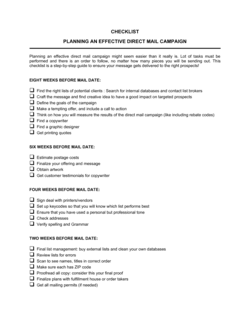
A Direct Mail Campaign Checklist is a structured planning and tracking form that walks you through every task required to execute a physical mailing β€” from defining the target audience and writing copy to approving artwork, selecting a mail house, and measuring response. This free Word download is editable online and exportable as PDF so your team can review and sign off at each stage.
When you need it
Use it any time you are preparing a direct mail drop β€” whether a postcard promotion, a product catalog, a fundraising letter, or a targeted sales letter β€” to ensure no step is skipped before pieces go to print and post.
What's inside
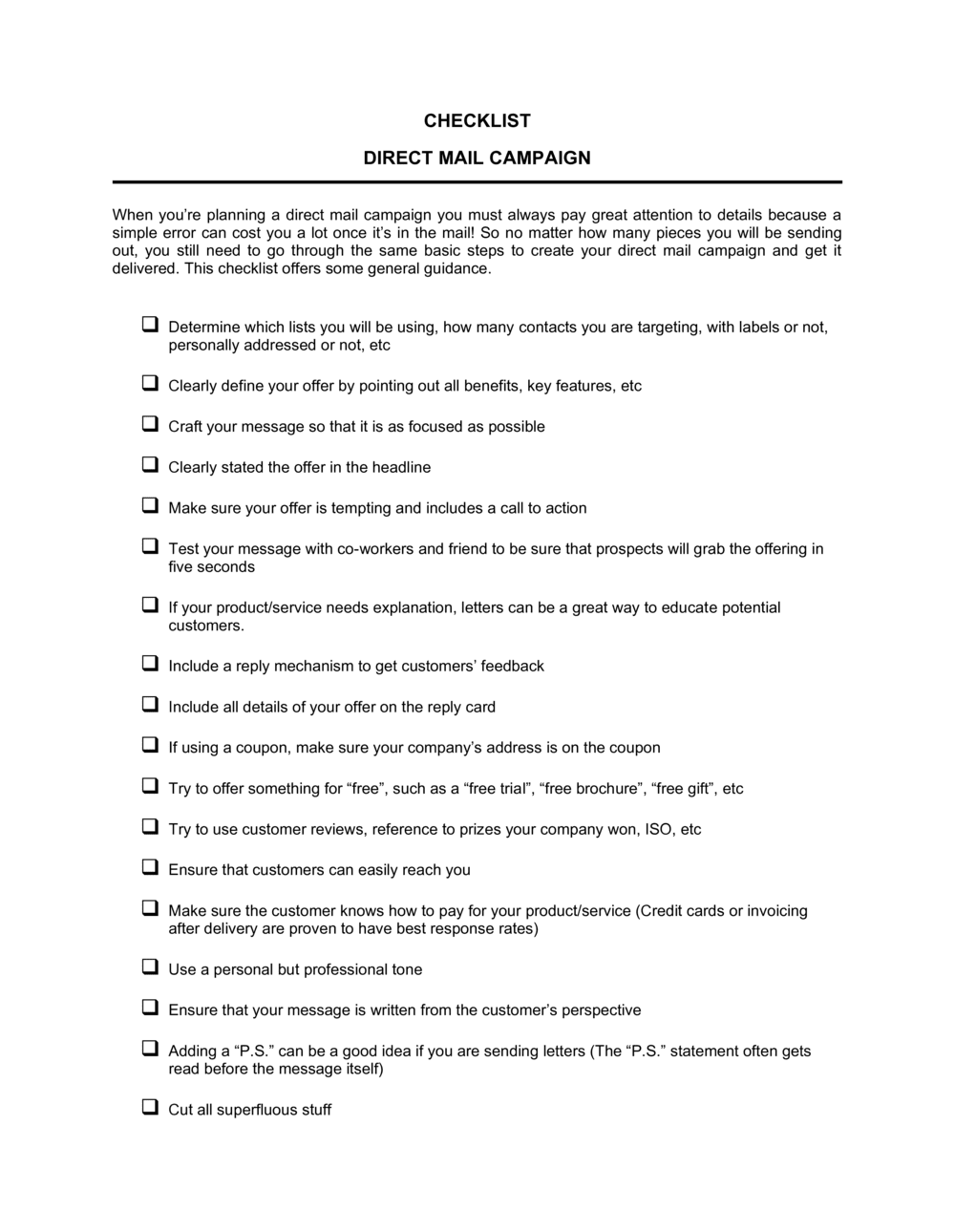
Campaign objectives, target audience and list criteria, offer and call to action, copy and design approval checkpoints, print specifications, mailing logistics, budget tracking, and response measurement fields.

What is a Direct Mail Campaign Checklist?

A Direct Mail Campaign Checklist is a structured planning and execution form that walks a marketing team through every task required to produce and deploy a physical mailing campaign β€” from defining the target audience and offer through copy approval, print production, mail house handoff, and post-drop response tracking. It functions as both a project coordination tool and an accountability record, ensuring that each vendor touchpoint, approval step, and budget line is documented before pieces go to print and post.

Why You Need This Document

Direct mail campaigns involve a chain of interdependent steps across list vendors, copywriters, designers, print suppliers, and mail houses β€” and a missed step at any point can delay the drop date, inflate the budget, or make campaign results impossible to measure. Running a campaign without a checklist means relying on memory and email threads to coordinate five or more external parties, which routinely results in artwork sent to print with unapproved copy, postage budgets that omit list and design costs, and campaigns that generate responses with no tracking code to attribute them. This template gives every stakeholder a shared, sequential task list with sign-off fields so nothing falls through the gaps between teams.

Which variant fits your situation?

If your situation is…Use this template
Planning a single postcard promotion to an existing customer listChecklist Direct Mail Campaign
Drafting the sales letter that will be mailedSales Letter Template
Budgeting the full campaign spend across print and postageMarketing Budget Template
Tracking overall marketing activity across multiple channelsMarketing Plan Template
Measuring ROI and response rate after the campaign dropsMarketing Report Template
Planning a multi-channel campaign that includes email alongside mailIntegrated Marketing Campaign Plan
Managing a fundraising drive that uses direct mail as the primary channelFundraising Campaign Plan

Common mistakes to avoid

❌ No unique tracking mechanism

Why it matters: Without a promo code, dedicated phone number, or PURL, you cannot attribute responses to the mailing β€” making ROI calculation impossible and future campaign decisions guesswork.

Fix: Assign a unique tracking identifier to every campaign before the copy goes to design, and confirm it appears on the final proof.

❌ Skipping list deduplication

Why it matters: Duplicate records mean some recipients receive two or three identical pieces, wasting print and postage spend while signaling poor data hygiene to your audience.

Fix: Run a deduplication pass on your list file before sending to the mail house, and request confirmation that the mail house performs its own CASS certification check.

❌ Approving artwork before a physical proof

Why it matters: Colors, font sizes, and bleed alignment visible on screen often look materially different when printed β€” errors discovered after a full print run typically require a costly reprint.

Fix: Request a hard-copy proof at full size and actual paper stock before authorizing the full press run.

❌ Building no response-rate buffer into the budget

Why it matters: Campaigns planned to break even at a 2% response rate leave no margin β€” if response comes in at 1.5%, the campaign generates a loss with no contingency.

Fix: Build your budget around a conservative response estimate (typically 50–70% of your target rate) and treat anything above that as upside.

The 9 key fields, explained

Campaign objective

Target audience and list criteria

Offer and call to action

Copy and messaging approval

Design and artwork specifications

Print quantity and vendor

Mailing logistics and drop date

Budget tracking

Response tracking and results

How to fill it out

  1. 1

    Define the campaign objective

    Write a single, measurable goal with a number and a deadline β€” leads, coupons redeemed, donations received, or orders placed. This number drives every subsequent decision on list size, offer strength, and budget.

    πŸ’‘ A response rate of 1–2% is typical for cold prospect lists; 3–5% is achievable for warm customer lists. Back-calculate the list size you need from your goal.

  2. 2

    Identify and source your mailing list

    Decide whether to use your own customer database, rent a list from a data broker, or use EDDM for geographic saturation. Record the list source, selection criteria, total count, and whether deduplication has been run.

    πŸ’‘ Always request a sample of 100–200 records from a rented list before purchasing β€” check for completeness and address quality before committing to the full count.

  3. 3

    Finalize the offer and call to action

    Document one offer and one primary CTA. Include any expiration date, redemption method, and the unique tracking code or dedicated phone number that will be used to measure response.

    πŸ’‘ Offers with a clear expiration date consistently outperform open-ended offers β€” 10–15% urgency lift is common.

  4. 4

    Review and approve copy and design

    Route the draft copy to at least one proofreader outside the project and confirm all legal disclaimers, contact details, and offer terms are accurate. Record approver name and date in the checklist.

    πŸ’‘ Print a physical proof at full size before approving final artwork β€” screen colors and proportions rarely match printed output exactly.

  5. 5

    Confirm print specifications with your vendor

    Lock in format, dimensions, color profile, bleed, file format, quantity with overage, unit cost, and the artwork delivery deadline. Get the vendor's confirmation in writing.

    πŸ’‘ Ask the print vendor for a hard-copy press proof before the full run β€” a $50–$100 proof can prevent a $2,000 reprint.

  6. 6

    Schedule mailing logistics and drop date

    Select mail class, confirm presort requirements with the mail house, book the drop date, and verify that the timeline from artwork approval through printing to mail drop is achievable.

    πŸ’‘ Build in a two-day buffer between the print completion date and the mail house pickup β€” courier delays and production overruns are common.

  7. 7

    Record budget estimates and actuals

    Enter estimated costs for every line item before the campaign launches, then update with actual spend as invoices arrive. Compare total actual cost against total responses to calculate true cost per response.

    πŸ’‘ Save all vendor invoices to the same campaign folder as the checklist β€” you will need them for the post-campaign ROI calculation.

  8. 8

    Track responses and calculate results

    After the drop, monitor the tracking code, dedicated number, or PURL daily during the response window. Enter total responses, conversion rate, revenue, and ROI into the results section of the checklist.

    πŸ’‘ Most direct mail responses arrive within 10–14 days of the drop date. Keep tracking open for 30 days before closing the campaign record.

Frequently asked questions

What is a direct mail campaign checklist?

A direct mail campaign checklist is a structured form that lists every task required to plan, produce, and measure a physical mailing campaign. It covers campaign objectives, list sourcing, offer development, copy and design approval, print specifications, mailing logistics, budget tracking, and response measurement β€” giving campaign managers a single document to coordinate vendors and track sign-offs.

What should a direct mail campaign checklist include?

At minimum: a defined campaign objective with a measurable target, mailing list source and selection criteria, the offer and call to action with expiration date, copy and artwork approval sign-offs, print format and quantity, mail class and scheduled drop date, a line-item budget with estimated and actual columns, and a response tracking section. Missing any of these commonly results in untracked spend or unmeasured results.

What is a typical response rate for direct mail?

Response rates vary by list quality and offer strength. Cold prospect lists typically generate 1–2% response. Warm customer or house lists commonly achieve 3–5%. Highly targeted, personalized pieces with strong offers can exceed 5–10%. Industry averages from the Data & Marketing Association put the overall direct mail response rate at approximately 4.4% for house lists and 0.12% for prospect lists β€” significantly higher than most digital channels.

What is EDDM and when should I use it?

EDDM (Every Door Direct Mail) is a USPS program that delivers a mail piece to every address on one or more selected mail carrier routes, eliminating the need to purchase or build an individual address list. It is best suited for local businesses targeting a geographic area β€” restaurants, real estate agents, home service contractors, and retailers β€” where demographic selectivity matters less than saturation within a radius.

How far in advance should I plan a direct mail campaign?

Allow a minimum of four to six weeks from campaign kick-off to mail drop for a standard postcard or letter campaign. Complex self-mailers or catalogs often require eight to twelve weeks. The timeline must account for list sourcing (up to two weeks for rented lists), copy and design cycles, print production (five to ten business days), and presort processing at the mail house (an additional three to five days for Marketing Mail).

What is the difference between First Class Mail and USPS Marketing Mail for campaigns?

First Class Mail is faster (delivery in 1–3 days), forwarded if the recipient has moved, and returned undeliverable pieces at no charge β€” making it useful for time-sensitive offers and list hygiene. USPS Marketing Mail (formerly Standard Mail) is significantly cheaper per piece but takes three to ten days, is not forwarded, and undeliverables are discarded. Most volume campaigns use Marketing Mail for cost efficiency and reserve First Class for high-value prospect or retention mailings.

How do I measure the ROI of a direct mail campaign?

Divide total campaign cost (list, design, print, postage, mail house fees) by the number of responses to get cost per response. Then divide cost by revenue generated to calculate ROI: (Revenue - Cost) / Cost Γ— 100. You need a unique tracking mechanism β€” promo code, dedicated phone number, or personalized URL β€” to attribute revenue accurately. Without one, ROI cannot be calculated reliably.

Can I use this checklist for email campaigns as well?

This checklist is designed specifically for physical direct mail and includes fields for print specifications, mail class, mail house logistics, and postage β€” none of which apply to email. For email campaigns, use a dedicated email marketing checklist that covers deliverability, list segmentation, subject line testing, CAN-SPAM compliance, and ESP platform settings. The two formats share objective-setting and offer-development steps but diverge significantly in execution.

How this compares to alternatives

vs Marketing Plan Template

A marketing plan covers the full strategic framework across all channels β€” positioning, budget allocation, and annual campaign calendar. A direct mail checklist is a tactical execution tool for a single mailing campaign. Use the marketing plan to decide whether and when to run a direct mail campaign, then use the checklist to execute it.

vs Marketing Budget Template

A marketing budget template tracks spend across all marketing channels for a full period. A direct mail checklist tracks only the costs specific to one mailing campaign β€” list, design, print, postage, and mail house. The checklist's budget section feeds into the broader marketing budget but is not a substitute for it.

vs Email Marketing Checklist

An email marketing checklist covers deliverability, list segmentation, subject line testing, CAN-SPAM compliance, and ESP platform settings β€” none of which apply to physical mail. A direct mail checklist covers print specs, mail class selection, presort requirements, and postage. The two documents serve parallel but entirely distinct execution workflows.

vs Event Marketing Checklist

An event marketing checklist coordinates venue, speakers, registration, and on-site logistics. A direct mail checklist is focused on producing and delivering a physical mailing. Direct mail is often one tactic within an event promotion plan, with the checklist covering only that component.

Industry-specific considerations

Retail and E-commerce

Seasonal catalog drops, coupon mailers, and store-opening announcements where geographic targeting and offer expiration dates drive foot traffic.

Real Estate

Neighborhood farming postcards, just-listed and just-sold announcements, and market report mailers sent on a recurring monthly or quarterly cadence.

Nonprofit and Fundraising

Donor appeal letters with reply envelopes, year-end giving campaigns, and event invitation mailers where segmentation by giving history is critical.

Healthcare and Wellness

Patient recall letters, new practice announcements, and health screening promotions targeted by age and geography with HIPAA-compliant list handling.

Template vs pro β€” what fits your needs?

PathBest forCostTime
Use the templateSmall businesses, nonprofits, and marketing coordinators managing direct mail campaigns in-houseFree15 minutes to complete per campaign
Template + professional reviewOrganizations running high-volume or multi-drop campaigns who want a marketing consultant to validate list strategy and offer$200–$800 for a consultant review session1–3 days
Custom draftedAgencies or large enterprises with complex multi-location campaigns requiring a fully customized workflow integrated into a project management system$500–$2,000 for custom workflow development1–2 weeks

Glossary

Mail House
A third-party vendor that handles printing, addressing, sorting, and depositing physical mail pieces with the postal service.
Mailing List
A compiled set of postal addresses β€” either from your own customer database or a rented/purchased list β€” used to target recipients.
Call to Action (CTA)
The specific instruction telling the recipient what to do next β€” call a phone number, visit a URL, return a reply card, or redeem a coupon.
EDDM (Every Door Direct Mail)
A USPS program that delivers mail to every address on a mail carrier route without requiring individual names or addresses, reducing list costs.
Response Rate
The percentage of mailed pieces that generate a measurable action β€” reply card returned, call placed, or coupon redeemed.
Offer
The incentive or proposition that motivates the recipient to respond β€” a discount, free trial, gift, or exclusive information.
Indicia
The printed postal permit mark on a mail piece that substitutes for a physical stamp and indicates pre-sorted bulk postage has been paid.
Variable Data Printing (VDP)
A print method that personalizes each piece with recipient-specific information β€” name, address, or tailored offer β€” pulled from a data file.
Saturation Mailing
A direct mail strategy that targets every deliverable address within a defined geographic area rather than a segmented list.
Tracking Code
A unique identifier β€” promo code, dedicated phone number, or personalized URL (PURL) β€” embedded in a mail piece to attribute responses to that campaign.

Part of your Business Operating System

This document is one of 3,000+ business & legal templates included in Business in a Box.

  • Fill-in-the-blanks β€” ready in minutes
  • 100% customizable Word document
  • Compatible with all office suites
  • Export to PDF and share electronically

Create your document in 3 simple steps.

From template to signed document β€” all inside one Business Operating System.
1
Download or open template

Access over 3,000+ business and legal templates for any business task, project or initiative.

2
Edit and fill in the blanks with AI

Customize your ready-made business document template and save it in the cloud.

3
Save, Share, Send, Sign

Share your files and folders with your team. Create a space of seamless collaboration.

Save time, save money, and create top-quality documents.

β˜…β˜…β˜…β˜…β˜…

"Fantastic value! I'm not sure how I'd do without it. It's worth its weight in gold and paid back for itself many times."

Managing Director Β· Mall Farm
Robert Whalley
Managing Director, Mall Farm Proprietary Limited
β˜…β˜…β˜…β˜…β˜…

"I have been using Business in a Box for years. It has been the most useful source of templates I have encountered. I recommend it to anyone."

Business Owner Β· 4+ years
Dr Michael John Freestone
Business Owner
β˜…β˜…β˜…β˜…β˜…

"It has been a life saver so many times I have lost count. Business in a Box has saved me so much time and as you know, time is money."

Owner Β· Upstate Web
David G. Moore Jr.
Owner, Upstate Web

Run your business with a system β€” not scattered tools

Stop downloading documents. Start operating with clarity. Business in a Box gives you the Business Operating System used by over 250,000 companies worldwide to structure, run, and grow their business.

Start freeΒ Β·Β No credit card required