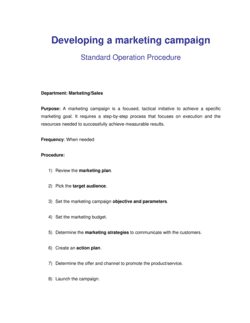
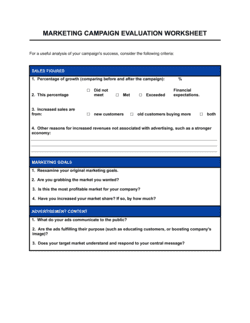
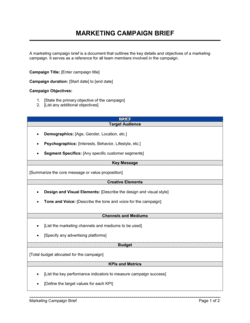
How To Do A Marketing Campaign

Free to read β€’ Save or share with one click

FreeHow To Do A Marketing Campaign Template

At a glance

What it is
A How To Do A Marketing Campaign template is a structured Word document that guides you through planning, executing, and measuring a marketing campaign from start to finish. This free download gives you a step-by-step framework covering campaign objectives, audience definition, channel selection, messaging, budget allocation, timeline, and KPIs β€” all in a single editable file you can export as PDF and share with your team or stakeholders.
When you need it
Use it whenever you are launching a new product, promoting a seasonal offer, entering a new market, or running any coordinated marketing push that requires aligning budget, channels, and team responsibilities around a common goal.
What's inside
Campaign objectives and success metrics, target audience profiles, channel and media mix, creative messaging framework, budget breakdown, execution timeline with milestones, and a post-campaign performance review section.

What is a Marketing Campaign Plan?

A Marketing Campaign Plan is a structured operational document that guides a team through every phase of a campaign β€” from defining objectives and audience to selecting channels, allocating budget, and measuring results. It translates a business goal (generate leads, launch a product, grow revenue from an existing segment) into a coordinated set of activities with specific owners, deadlines, and success metrics. Unlike a broad marketing strategy, a campaign plan is time-bound and execution-focused: it answers who you are targeting, what you are saying, where you are saying it, how much you are spending, and how you will know whether it worked.

Why You Need This Document

Running a campaign without a written plan is the single most reliable way to overspend, underdeliver, and be unable to explain why. Without documented objectives and KPIs set before launch, there is no agreed definition of success β€” results get interpreted selectively and the same mistakes repeat in the next campaign. Without a channel plan tied to audience data, budget defaults to wherever it was spent last time rather than where it performs best. Without a timeline built backward from launch, production steps get compressed, review cycles get skipped, and campaigns go live with tracking gaps that make attribution impossible. This template gives your team a single source of truth before the first dollar is spent β€” ensuring everyone from the media buyer to the creative director is executing against the same brief, the same message, and the same measurable goal.

Which variant fits your situation?

If your situation is…Use this template
Planning a full-year integrated marketing strategyMarketing Plan
Running a single digital advertising campaign on paid channelsDigital Marketing Campaign Plan
Launching a new product to marketProduct Launch Plan
Planning a social media-specific campaignSocial Media Marketing Plan
Coordinating a promotional event tied to a campaignEvent Marketing Plan
Measuring and reporting campaign results to stakeholdersMarketing Report
Briefing a creative agency or internal design teamCreative Brief

Common mistakes to avoid

❌ Launching without conversion tracking in place

Why it matters: Without UTM parameters and pixel events firing before day one, you cannot attribute leads or sales to specific channels or ads. Budget optimization becomes guesswork.

Fix: Complete a tracking QA checklist before any spend goes live β€” confirm every conversion event appears in your analytics platform under real test conditions.

❌ Skipping the post-campaign review

Why it matters: Without a documented retrospective, targeting errors, budget imbalances, and messaging gaps repeat in every subsequent campaign, compounding wasted spend over time.

Fix: Schedule the post-campaign review meeting on the same day you schedule the campaign launch. Block the time before the next project begins.

❌ Defining the target audience too broadly

Why it matters: Campaigns aimed at a vague audience produce low click-through rates, high cost-per-acquisition, and messaging that resonates with no one strongly enough to convert.

Fix: Write a one-paragraph profile of a single real person in your target audience β€” name, role, specific pain point, and what they need to believe to take action.

❌ Allocating budget equally across all channels by default

Why it matters: Equal distribution ignores differences in channel efficiency. Spreading $20,000 across six channels often yields weaker results than concentrating $16,000 on two proven channels.

Fix: Rank channels by historical CPA or industry benchmarks and weight spend toward the top two before distributing the remainder to supporting channels.

❌ Setting objectives after the campaign brief is approved

Why it matters: Retroactively defining success metrics allows teams to report on whatever happened to go well, masking underperformance and misaligning the campaign with actual business goals.

Fix: Define numeric objectives before briefing any channel or creative team. Objectives drive every downstream decision β€” audience, message, channel, and budget.

❌ Writing a different core message for each channel

Why it matters: Inconsistent messaging across touchpoints prevents the cumulative reinforcement that builds recall and trust. Prospects who see different claims on different channels lose confidence.

Fix: Write one core message and one primary CTA, then adapt the format and length for each channel β€” not the underlying claim.

The 9 key sections, explained

Campaign Overview and Objectives

Target Audience Definition

Campaign Messaging and Creative Framework

Channel and Media Mix

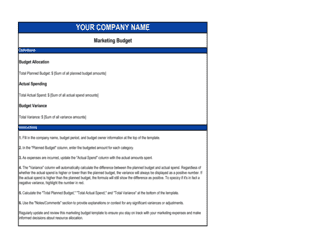
Budget Allocation

Campaign Timeline and Milestones

Roles and Responsibilities

KPIs and Measurement Framework

Post-Campaign Review

How to fill it out

  1. 1

    Define the campaign objective with a numeric target

    Write one to three objectives using the SMART format β€” specific, measurable, achievable, relevant, and time-bound. Each objective must include a numeric target and a deadline.

    πŸ’‘ Limit yourself to three objectives maximum. More than three dilutes focus and makes it harder to prioritize budget and channel decisions.

  2. 2

    Profile your target audience with behavioral detail

    Go beyond age and job title. Describe the specific pain point your campaign addresses, the trigger event that makes your offer relevant right now, and where this audience spends time online and offline.

    πŸ’‘ Pull data from your CRM to profile your best existing customers before describing the audience you want to reach β€” they are often not the same person.

  3. 3

    Write the core message and call to action first

    Before briefing designers or media buyers, lock in a one-sentence value proposition and a single primary CTA. Every channel and creative execution must reinforce these.

    πŸ’‘ Test your core message with five people outside your company. If they cannot repeat the main benefit back to you in their own words, the message is not clear enough.

  4. 4

    Select channels based on audience data, not assumptions

    Match each channel to a funnel stage β€” awareness, consideration, or decision β€” and confirm the channel reaches your defined audience at a viable cost. Pull benchmark CPCs and CPMs from your past campaigns or industry sources before committing.

    πŸ’‘ Start with two or three channels you can execute well rather than spreading the budget thin across six. Depth beats breadth for most campaign budgets under $50K.

  5. 5

    Build the budget from channel costs up

    Estimate the spend required on each channel to hit your KPI target β€” working from cost-per-click or cost-per-thousand-impressions benchmarks β€” then sum to the total. Reserve 10% as a contingency for optimization mid-flight.

    πŸ’‘ If the bottom-up total exceeds your available budget, cut channels before cutting per-channel depth. A thin presence on many channels underperforms a strong presence on fewer.

  6. 6

    Set the timeline working backward from the launch date

    Start with your desired launch date and work backward to assign deadlines for stakeholder approval, asset production, copy review, and creative brief sign-off. Build in at least three business days for each review cycle.

    πŸ’‘ Add a 'freeze date' β€” the last day changes can be made to copy or creative before launch. Changes after this date delay go-live and create version-control chaos.

  7. 7

    Install tracking before any spend goes live

    Set up UTM parameters for every URL, confirm conversion tracking fires correctly in your analytics platform, and test all landing page forms and pixels before the campaign flight begins.

    πŸ’‘ Run a 24-hour pre-launch QA checklist: click every ad destination link, submit every lead form, and confirm events appear in your analytics dashboard in real time.

  8. 8

    Complete the post-campaign review within 10 days

    Pull final results against each objective, document the top three findings, and record specific recommendations for the next campaign's budget, targeting, and messaging.

    πŸ’‘ Store the completed review alongside the original campaign brief so future planners can reference both the intent and the outcome in a single file.

Frequently asked questions

What is a marketing campaign?

A marketing campaign is a coordinated set of activities across one or more channels designed to achieve a specific business objective β€” such as generating leads, launching a product, or driving repeat purchases β€” within a defined time period and budget. Unlike ongoing brand-building activity, a campaign has a clear start date, end date, and measurable success criteria.

What should a marketing campaign plan include?

A complete campaign plan covers campaign objectives with numeric targets, a defined target audience, a core messaging framework and CTA, channel and media mix, budget broken down by channel, an execution timeline with milestones, assigned roles and responsibilities, KPIs and tracking setup, and a post-campaign review structure. Missing any of these elements creates execution gaps that show up as missed targets or unattributable spend.

How long should a marketing campaign run?

Campaign length depends on the objective and funnel stage. Promotional or seasonal campaigns typically run 2–6 weeks. Lead generation or awareness campaigns often run 6–12 weeks to build sufficient frequency. Product launch campaigns typically span 4–8 weeks of active promotion. The campaign should run long enough to reach the audience at least three to five times across channels before drawing conclusions about performance.

How do I set a marketing campaign budget?

Build the budget from the bottom up: estimate the number of conversions you need, multiply by your target CPA, and that is the minimum paid media spend required. Add production costs (creative, copy, landing pages) and a 10% contingency. If the total exceeds your available budget, reduce the number of channels rather than spreading spend too thin across all of them.

What KPIs should I track for a marketing campaign?

Choose one primary KPI tied directly to the campaign objective β€” leads generated, revenue attributed, or app installs, for example. Support it with two to four secondary KPIs that explain the primary metric: CTR, CPA, ROAS, conversion rate, and cost per lead are the most common. Avoid tracking more than six KPIs per campaign β€” reporting on too many metrics dilutes focus and makes optimization harder.

What is the difference between a marketing campaign and a marketing plan?

A marketing plan is a 12-month strategic document covering all marketing activity, channel investment, and brand goals for the year. A marketing campaign is a time-bound tactical execution within that plan targeting a specific objective. A plan sets the annual direction; individual campaigns are the executions that deliver against it. You can run a campaign without an annual plan, but campaigns without strategic context tend to lack coherent positioning.

How many channels should a marketing campaign use?

For most campaign budgets under $50,000, two to three channels is the practical optimum. Using more channels than your team can execute and optimize well produces diluted results. Select channels based on where your target audience spends time and where you have reliable cost-per- acquisition data β€” not based on which channels are trending.

Do I need a marketing agency to run a campaign?

A structured template handles the planning framework for any team size. Engage an agency when the campaign requires specialist skills you don't have in-house β€” paid media buying at scale, video production, or PR outreach β€” or when the budget exceeds $100,000 and full-time oversight of multiple channel partners is needed. For campaigns under $30,000, a well-briefed in-house team with a solid template typically outperforms an agency relationship that lacks the context to make fast decisions.

What is a post-campaign review and why does it matter?

A post-campaign review compares actual results against each stated objective, identifies the top performing and underperforming elements, and documents specific recommendations for future campaigns. It matters because without it, teams repeat the same targeting errors and budget allocation decisions that underperformed last time. A 60-minute review meeting within 10 days of campaign end is typically sufficient.

How this compares to alternatives

vs Marketing Plan

A marketing plan is a 12-month strategic document covering all channels, budget allocation, and brand positioning for the year. A marketing campaign template is a tactical execution document for a single time-bound initiative within that plan. Build the annual plan first to set strategic context, then use the campaign template to execute individual initiatives within it.

vs Product Launch Plan

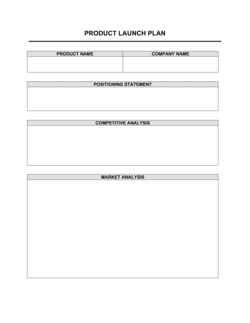
A product launch plan coordinates the full cross-functional launch β€” engineering, sales enablement, customer success, and marketing β€” across a 60–90 day window. A marketing campaign template focuses specifically on the marketing and communication activities within that launch. For a product launch, use both: the launch plan governs overall coordination, the campaign template governs the marketing execution.

vs Creative Brief

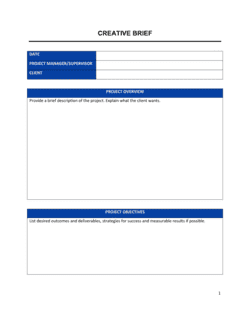
A creative brief is a focused 1–2 page document given to designers and copywriters to guide asset production for a specific campaign. A marketing campaign template is the upstream planning document that the creative brief is derived from. Complete the campaign plan first, then extract the messaging, audience, and channel requirements into a creative brief for your production team.

vs Marketing Report

A marketing report captures historical performance across channels over a defined period. A marketing campaign template is a forward-looking planning document used before and during a campaign. Use the campaign template to set targets and structure, then use the marketing report to communicate results to stakeholders once the campaign flight ends.

Industry-specific considerations

SaaS / Technology

Free trial activation, demo request generation, and product-led growth campaigns with conversion tracking across self-serve and sales-assisted funnels.

Retail / E-commerce

Seasonal promotional campaigns with time-limited offers, cart abandonment retargeting, and revenue attribution across paid and organic channels.

Professional Services

Thought leadership and lead generation campaigns combining gated content, LinkedIn sponsored content, and email nurture sequences targeting decision-makers.

Food & Beverage

New product launch campaigns coordinating in-store promotions, social media, influencer seeding, and PR with a compressed 4–6 week flight window.

Healthcare / MedTech

Patient acquisition and HCP engagement campaigns with regulatory compliance requirements governing claims, disclaimers, and channel restrictions.

Nonprofit / Education

Donor acquisition, fundraising drive, and enrollment campaigns where cost per acquisition must be justified against donor lifetime value or program outcomes.

Template vs pro β€” what fits your needs?

PathBest forCostTime
Use the templateIn-house marketing teams and small business owners planning campaigns with budgets under $50,000Free4–8 hours to complete the plan
Template + professional reviewFirst-time campaign managers or teams launching in a new channel or market segment$500–$2,000 for a marketing consultant review session1–2 days
Custom draftedCampaigns with budgets over $100,000, multi-market launches, or complex integrated programs requiring agency coordination$3,000–$15,000 for agency strategy and planning2–4 weeks

Glossary

Campaign Objective
A specific, measurable outcome the campaign is designed to achieve β€” such as generating 500 leads or increasing brand awareness by 20% in a target segment.
Target Audience
The defined group of people the campaign is intended to reach, described by demographics, psychographics, behavior, or purchase intent.
Channel Mix
The combination of marketing channels β€” email, paid search, social media, display, events, PR β€” used to deliver campaign messages to the target audience.
KPI (Key Performance Indicator)
A quantifiable metric used to evaluate whether the campaign is achieving its objective, such as click-through rate, cost per acquisition, or return on ad spend.
Conversion Rate
The percentage of people who take a desired action β€” sign up, purchase, download β€” out of the total who were exposed to the campaign.
Cost Per Acquisition (CPA)
Total campaign spend divided by the number of conversions generated, expressing the cost of acquiring each customer or lead.
Return on Ad Spend (ROAS)
Revenue generated directly from a campaign divided by the total spend on that campaign, expressed as a ratio or multiple.
Media Brief
A document given to media buyers or channel managers specifying targeting parameters, formats, placements, and flight dates for paid campaign placements.
Campaign Flight
The defined period during which a campaign is actively running, from the first scheduled touchpoint to the last.
A/B Test
A controlled experiment in which two versions of a campaign element β€” subject line, ad creative, landing page β€” are run simultaneously to determine which performs better.
Funnel Stage
The position in the buyer journey a campaign targets β€” awareness (top of funnel), consideration (middle), or decision (bottom).

Part of your Business Operating System

This document is one of 3,000+ business & legal templates included in Business in a Box.

  • Fill-in-the-blanks β€” ready in minutes
  • Compatible with all office suites
  • Export to PDF and share electronically

Create your document in 3 simple steps.

From template to signed document β€” all inside one Business Operating System.
1
Download or open template

Access over 3,000+ business and legal templates for any business task, project or initiative.

2
Edit and fill in the blanks with AI

Customize your ready-made business document template and save it in the cloud.

3
Save, Share, Send, Sign

Share your files and folders with your team. Create a space of seamless collaboration.

Save time, save money, and create top-quality documents.

β˜…β˜…β˜…β˜…β˜…

"Fantastic value! I'm not sure how I'd do without it. It's worth its weight in gold and paid back for itself many times."

Managing Director Β· Mall Farm
Robert Whalley
Managing Director, Mall Farm Proprietary Limited
β˜…β˜…β˜…β˜…β˜…

"I have been using Business in a Box for years. It has been the most useful source of templates I have encountered. I recommend it to anyone."

Business Owner Β· 4+ years
Dr Michael John Freestone
Business Owner
β˜…β˜…β˜…β˜…β˜…

"It has been a life saver so many times I have lost count. Business in a Box has saved me so much time and as you know, time is money."

Owner Β· Upstate Web
David G. Moore Jr.
Owner, Upstate Web

Run your business with a system β€” not scattered tools

Stop downloading documents. Start operating with clarity. Business in a Box gives you the Business Operating System used by over 250,000 companies worldwide to structure, run, and grow their business.

Start freeΒ Β·Β No credit card required