High School Teacher Job Description Template

Free Word download • Edit online • Save & share with Drive • Export to PDF

2 pages20–30 min to fillDifficulty: StandardSignature requiredLegal review recommended
Learn more ↓
FreeHigh School Teacher Job Description Template

At a glance

What it is
A High School Teacher Job Description is a formal document that defines the duties, qualifications, reporting structure, compensation range, and employment conditions for a secondary-level teaching position. This free Word download gives school administrators and HR teams a structured, legally grounded starting point they can edit online and export as PDF for posting, hiring, and onboarding purposes.
When you need it
Use it when opening a new teaching vacancy, replacing a departing educator, expanding a department, or standardizing role definitions across a school or district. It is also required when issuing a formal offer or employment contract to a selected candidate.
What's inside
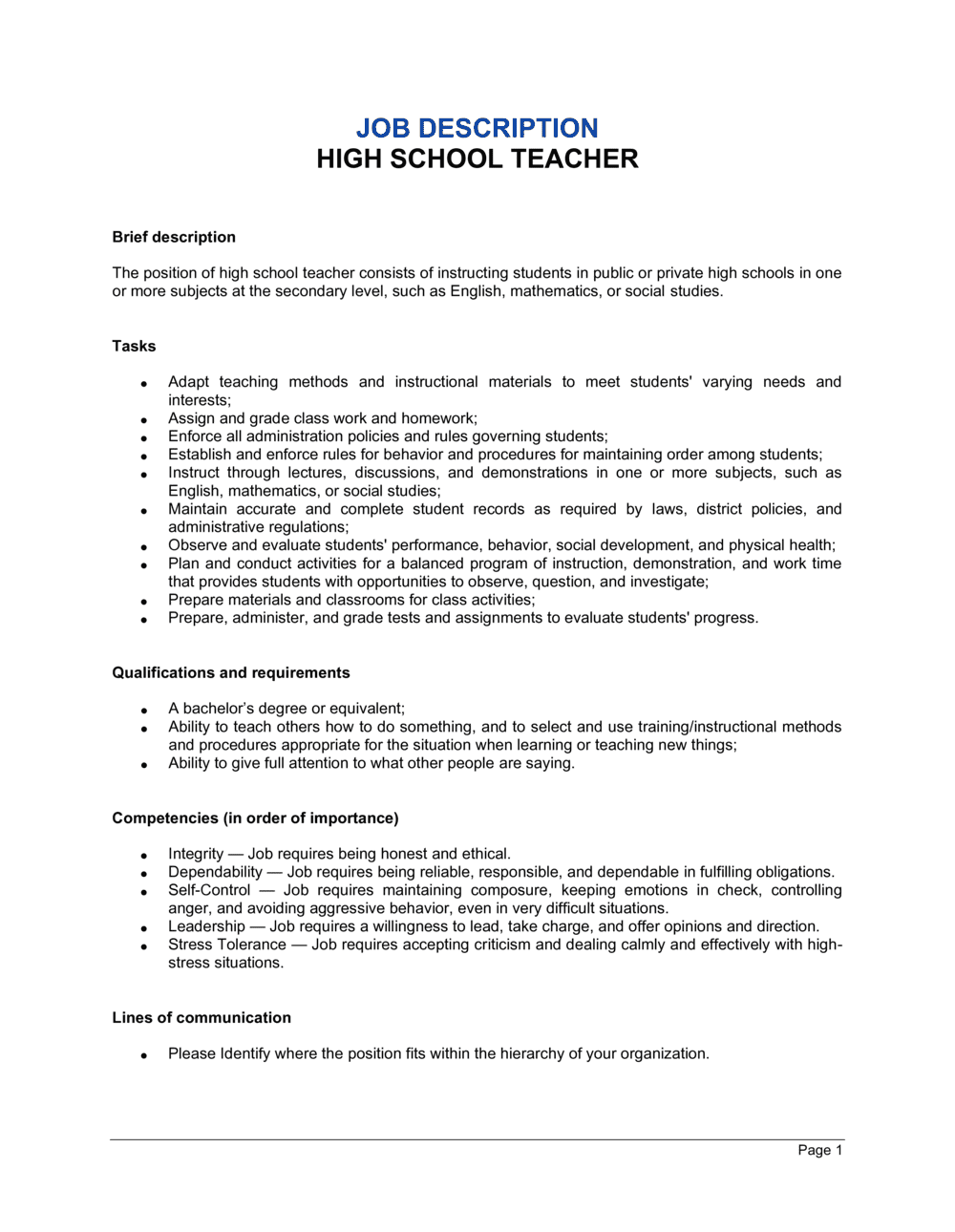
Position title and department, summary of role purpose, detailed instructional and administrative duties, required and preferred qualifications, certification and licensure requirements, reporting structure, compensation and benefits overview, and working conditions including schedule and physical demands.

What is a High School Teacher Job Description?

A High School Teacher Job Description is a formal employment document that defines the duties, qualifications, certifications, reporting structure, compensation range, and working conditions for a secondary-level teaching position. It functions as the authoritative reference document throughout the entire employment lifecycle — from recruitment posting and candidate screening through onboarding, performance evaluation, and, where necessary, disciplinary proceedings. Unlike a generic job posting, a well-drafted teacher job description carries legal weight: it documents the agreed scope of work, establishes the baseline for performance assessments, and protects the school in grievance and arbitration proceedings.

Why You Need This Document

Operating without a formal, institution-specific teacher job description exposes a school to cascading risks. Teachers who were not informed of accommodation responsibilities at hire — IEP duties, 504 plan implementation, ELL support — routinely challenge those obligations as outside their agreed scope, creating compliance exposure under federal and provincial disability law. Principals who attempt performance-based dismissals without a documented evaluation framework tied to defined duties face significantly higher arbitration loss rates. In unionized districts, a job description that contradicts or ignores the applicable collective bargaining agreement is superseded by the CBA and signals bad faith to arbitrators. And without explicit background check conditions on record, a school's duty of care to students is difficult to demonstrate if a safeguarding incident occurs. This template gives school administrators a structured, legally grounded starting point — ready to customize for subject area, grade band, and governing jurisdiction — so every hire begins with clear documented expectations on both sides.

Which variant fits your situation?

If your situation is…Use this template
Hiring a full-time permanent classroom teacherHigh School Teacher Job Description
Filling a temporary or substitute teaching roleSubstitute Teacher Job Description
Recruiting a department head or curriculum leadDepartment Head Job Description
Hiring a teacher's aide or classroom assistantTeacher's Aide Job Description
Engaging a private tutor on a contract basisIndependent Contractor Agreement
Hiring an elementary-level classroom teacherElementary School Teacher Job Description
Recruiting a special education teacherSpecial Education Teacher Job Description

Common mistakes to avoid

❌ Omitting IEP and accommodation duties from the duties list

Why it matters: A teacher hired without explicit notice of accommodation responsibilities may dispute those duties as outside their agreed scope, complicating performance management and creating compliance exposure under IDEA and Section 504.

Fix: Add a specific bullet under instructional duties naming IEP, 504, and ELL responsibilities. Reference the applicable federal or provincial legal framework so the obligation is documented from day one.

❌ Listing required certifications as 'preferred'

Why it matters: If state or accreditation rules mandate a specific license and you hire someone without it, the school faces regulatory penalties, accreditation risk, and potential liability if a student outcome is later challenged.

Fix: Audit your state's certification requirements before posting. Mark anything the law or accreditor requires as 'required' — not 'preferred' — and confirm every finalist holds the credential before extending an offer.

❌ No background check contingency clause

Why it matters: Hiring a teacher without a documented safeguarding condition undermines the school's duty of care to students. If an incident occurs, the absence of a written clearance requirement significantly increases institutional liability.

Fix: Include a named list of every background check required in your jurisdiction and state explicitly that employment does not begin until all results are satisfactory and on file.

❌ Copying a job description from another school without tailoring it

Why it matters: Borrowed descriptions often reference the wrong curriculum standards, accreditation bodies, or union agreements — creating misaligned expectations that surface during onboarding, evaluation, or grievance proceedings.

Fix: Use the template as a structure, then replace every bracketed placeholder with your school's specific curriculum framework, evaluation system, and governing agreements before publishing.

❌ No reference to the collective bargaining agreement

Why it matters: In unionized districts, the CBA governs working conditions, grievance procedures, and compensation. A job description that omits or contradicts CBA terms is superseded by the CBA — and signals to arbitrators that the employer was not operating in good faith.

Fix: Reference the applicable CBA by name and effective date in the governing law clause and confirm that every duty, schedule reference, and compensation note is consistent with current CBA language.

❌ Salary stated as a single fixed figure instead of a range or schedule reference

Why it matters: A fixed salary in a job description conflicts with negotiated offers, creates peer-equity issues if multiple teachers are hired at different steps, and can expose the school to pay discrimination claims.

Fix: State a salary range tied to your salary schedule (e.g., '$48,000–$72,000 based on years of experience and degree level per the 2025–2026 salary schedule') rather than a single dollar amount.

The 10 key clauses, explained

Position title and department

In plain language: Identifies the exact job title, the academic department, the school name, and whether the role is full-time, part-time, or contract.

Sample language
Position: High School [SUBJECT] Teacher | Department: [DEPARTMENT NAME] | School: [SCHOOL NAME] | Employment Type: Full-Time, [SCHOOL YEAR START]–[SCHOOL YEAR END]

Common mistake: Using a generic title like 'Teacher' without specifying grade level or subject. This creates ambiguity when assigning duties or evaluating performance against role-specific standards.

Role summary and purpose

In plain language: A 3–5 sentence overview of why the position exists, what the teacher is accountable for at the highest level, and how the role serves the school's educational mission.

Sample language
[SCHOOL NAME] seeks a dedicated [SUBJECT] teacher for grades [X–X] to deliver rigorous, engaging instruction aligned with [STATE/PROVINCE] curriculum standards. The teacher is responsible for student academic progress, classroom management, and contributing to the school's culture of continuous learning.

Common mistake: Copying the role summary from another school's posting without tailoring it to the institution's curriculum framework, values, or accreditation standards.

Instructional duties

In plain language: Lists the core teaching responsibilities: lesson planning, delivering instruction, differentiating for diverse learners, assessing student work, and maintaining grade records.

Sample language
Plan and deliver daily lessons aligned to [CURRICULUM FRAMEWORK]; design formative and summative assessments; differentiate instruction for students with IEPs, ELL designations, or gifted classifications; maintain accurate grade records in [GRADEBOOK PLATFORM].

Common mistake: Omitting IEP and accommodation responsibilities from the duties list. A teacher hired without awareness of these obligations may claim the duties were outside the agreed scope.

Administrative and co-curricular duties

In plain language: Covers non-instructional expectations: attending faculty meetings, parent-teacher conferences, extracurricular supervision, and reporting obligations.

Sample language
Attend all scheduled faculty meetings, department meetings, and professional development days; participate in [X] parent-teacher conference days per year; supervise assigned extracurricular activities or study halls as directed by the principal.

Common mistake: Leaving co-curricular supervision unspecified. Disputes over whether coaching, club supervision, or after-school duties are included in the base role are among the most common teacher grievances.

Required qualifications and certifications

In plain language: States the minimum education credentials, valid teaching certificate or license, and any subject-area endorsements the candidate must hold at the time of hire.

Sample language
Bachelor's degree in [SUBJECT] or Education required; valid [STATE/PROVINCE] teaching certificate with [SUBJECT] endorsement for grades [X–X]; current first aid/CPR certification preferred.

Common mistake: Listing a certification as 'preferred' when applicable law or accreditation standards actually require it. This exposes the school to regulatory penalties and limits the defensibility of a hire.

Background check and child protection requirements

In plain language: States that employment is conditional on passing a criminal background check, sex offender registry screening, and any jurisdiction-specific child protection clearances.

Sample language
Employment is contingent upon satisfactory completion of a criminal background check, [STATE] sex offender registry check, and [APPLICABLE CLEARANCE — e.g., FBI fingerprint clearance, DBS check]. Results must be on file before the first day of instruction.

Common mistake: Omitting the background check condition from the job description. Hiring without documented clearance conditions creates liability if an incident occurs and the school cannot show it met its duty of care.

Reporting structure and evaluation

In plain language: Identifies who the teacher reports to, how performance will be assessed, the evaluation frequency, and the consequences of unsatisfactory ratings.

Sample language
The teacher reports directly to the [DEPARTMENT HEAD / PRINCIPAL]. Performance will be evaluated [annually / biannually] using the [EVALUATION FRAMEWORK — e.g., Danielson Framework, district rubric]. Unsatisfactory ratings trigger a [90-day] improvement plan before further action.

Common mistake: Not specifying the evaluation framework by name. Vague performance standards make it significantly harder to document and defend a termination-for-cause decision.

Compensation and benefits

In plain language: States the salary range or pay scale step, payment frequency, and a reference to benefits eligibility — health, dental, pension, and PTO — without locking in specific plan details.

Sample language
Annual salary: $[MIN]–$[MAX] per the [DISTRICT / SCHOOL] salary schedule, placement based on years of verified experience and degree level. Eligible for the school's standard benefits program including health, dental, and [PENSION / RETIREMENT PLAN], subject to plan terms.

Common mistake: Stating a specific salary figure rather than a range or schedule reference. A fixed number in the job description can conflict with negotiated offer terms and creates misaligned expectations.

Working conditions and physical requirements

In plain language: Describes the work schedule (instructional days, duty-free periods, planning periods), the physical environment, and any physical demands relevant to the role.

Sample language
Work schedule: [X] instructional days per school year, [X] planning periods per week. Classroom environment: standard indoor setting. Physical requirements: ability to stand for extended periods, move through classroom, and occasionally lift up to [30] lbs of instructional materials.

Common mistake: Omitting physical requirements entirely. Without this clause, disability accommodation requests and fitness-for-duty assessments lack a documented baseline to evaluate against.

Governing law, CBA reference, and equal opportunity statement

In plain language: States the governing jurisdiction, references any applicable collective bargaining agreement, and includes a standard equal opportunity employment statement.

Sample language
This position is governed by the laws of [STATE / PROVINCE] and, where applicable, the terms of the [UNION NAME] Collective Bargaining Agreement effective [DATE]. [SCHOOL NAME] is an equal opportunity employer and does not discriminate on the basis of race, color, religion, sex, national origin, disability, or any other protected class.

Common mistake: Omitting the CBA reference in a unionized school district. If the district has a CBA and the job description conflicts with its terms, the CBA prevails — and the omission signals to candidates and arbitrators that the employer did not review the contract.

How to fill it out

  1. 1

    Enter school name, position title, and employment type

    Fill in the full legal name of the school or district, the exact job title including subject area and grade band, and whether the role is full-time, part-time, or fixed-term. Include the school year dates if the position is term-limited.

    💡 Confirm the job title matches the exact language in your district's salary schedule or CBA — discrepancies create classification disputes at hiring.

  2. 2

    Write the role summary specific to your school

    Draft 3–5 sentences describing why this position exists, what curriculum framework or standards it serves, and how it fits the school's mission. Avoid copying a generic summary from an online posting.

    💡 Mention your school's accreditation body (e.g., IB, AP, state standards) — this signals to candidates that the role has defined academic benchmarks.

  3. 3

    List all instructional duties including accommodation responsibilities

    Detail daily and periodic teaching responsibilities: lesson planning, instruction, differentiation, assessment, and grade recording. Explicitly include IEP, 504 plan, and ELL accommodation duties if applicable.

    💡 Review your district's most recent compliance audit findings — commonly cited gaps in teacher duties often appear here and should be addressed proactively.

  4. 4

    Define co-curricular and administrative expectations

    List all non-instructional duties the teacher is expected to perform — faculty meetings, parent conferences, extracurricular supervision, and reporting obligations. Specify frequency and whether these are compensated separately.

    💡 If co-curricular stipends apply, note the stipend range here rather than in the offer letter — transparency at the description stage reduces negotiation friction.

  5. 5

    State required certifications and verify legal minimums

    Enter the exact certification or licensure required by your state, province, or country — including grade level and subject endorsements. Mark any items that are legally required (not merely preferred) as required.

    💡 Cross-reference your state's department of education website to confirm current endorsement requirements before publishing — certification requirements change periodically.

  6. 6

    Add background check and child protection conditions

    Explicitly state that employment is contingent on satisfactory completion of all legally required background and safeguarding checks. Name each check type required in your jurisdiction.

    💡 List the specific clearances by name (e.g., Pennsylvania Child Abuse History Clearance, DBS Enhanced Check) — generic language like 'standard checks' is insufficient in most jurisdictions.

  7. 7

    Set the compensation range and benefits reference

    Enter a salary range tied to your salary schedule or a market range. Reference benefits by category only. Avoid embedding specific plan names or contribution amounts that may change annually.

    💡 Publishing a salary range increases qualified applicant volume by an average of 30% compared to 'competitive salary' postings, according to multiple recruiter surveys.

  8. 8

    Add governing law, CBA reference, and EEO statement

    State the governing jurisdiction, reference any applicable collective bargaining agreement by name and effective date, and include your institution's standard equal opportunity employer statement.

    💡 Have your district's legal counsel or HR director review the EEO statement annually — protected class language expands with legislation, and outdated statements create compliance gaps.

Frequently asked questions

What is a high school teacher job description?

A high school teacher job description is a formal document that defines the duties, required qualifications, certifications, reporting structure, compensation range, and employment conditions for a secondary-level teaching position. It serves as the authoritative reference for recruitment postings, offer letters, performance evaluations, and — in the event of a dispute — documentation of what the employee agreed to perform.

What should a high school teacher job description include?

At minimum: position title and department, a role summary tied to the school's curriculum framework, detailed instructional and administrative duties (including IEP and accommodation responsibilities), required and preferred qualifications, certification and licensure requirements, background check conditions, reporting structure and evaluation framework, compensation range or salary schedule reference, working conditions, and an equal opportunity employer statement. Missing any of these creates compliance gaps or candidate expectation mismatches.

Is a job description a legally binding document?

A job description is not a standalone employment contract, but it carries significant legal weight. In many jurisdictions, duties listed in a job description are treated as the agreed scope of work and can be introduced in arbitration or litigation to support or contest a termination-for-cause decision or a grievance claim. In unionized settings, a job description that contradicts the collective bargaining agreement can be challenged as a violation of the CBA.

What certifications does a high school teacher need?

Requirements vary by jurisdiction. In the US, teachers typically need a state-issued teaching license with a subject-area endorsement for the relevant grade band (grades 9–12). Most states require a bachelor's degree, completion of a state-approved teacher preparation program, and passage of subject-matter and pedagogy exams. In Canada, a provincial Certificate of Qualification is required. In the UK, Qualified Teacher Status (QTS) is the standard credential. International schools may accept International Baccalaureate or Cambridge qualifications in lieu of local certification.

Do I need to include a background check requirement in the job description?

Yes — in virtually every jurisdiction that permits teachers to work with minors, background and safeguarding checks are legally mandated before employment begins. Including the specific required checks in the job description documents the school's awareness of its duty of care and sets clear expectations for candidates. The description should name each check type (criminal history, sex offender registry, child abuse clearance, etc.) and state that employment is contingent on satisfactory results.

How does a job description interact with a collective bargaining agreement?

In unionized school districts, the collective bargaining agreement (CBA) governs wages, hours, and working conditions. Where any term in a job description conflicts with the CBA, the CBA prevails. A well-drafted job description cross-references the applicable CBA by name and effective date and ensures that duties, schedule references, and compensation language are consistent with current CBA provisions. Discrepancies discovered during a grievance proceeding typically favor the employee.

Can a job description be used as the basis for a performance evaluation?

Yes — and it should be. The duties and qualifications listed in the job description form the baseline against which performance is measured during formal evaluations. Evaluation frameworks like the Danielson Framework or district rubrics are most defensible when tied directly to the documented scope of the role. Teachers whose evaluations reference duties not listed in their job description have successfully challenged adverse ratings in arbitration on that basis.

What is the difference between a job description and an employment contract for a teacher?

A job description defines the role — what the teacher is expected to do, the qualifications required, and the compensation range. An employment contract is a binding agreement signed by both parties that creates legal obligations, including notice periods, IP and confidentiality terms, non-solicitation provisions, and severance. Schools should use both: the job description for recruitment and role definition, and a signed employment contract (or union-governed appointment letter) to govern the binding terms of the relationship.

Do private schools have different job description requirements than public schools?

Private schools generally have more flexibility in drafting job descriptions because they are not bound by district CBAs or the same tenure statutes that apply to public school teachers. However, private schools must still comply with applicable state or provincial certification requirements, federal employment anti-discrimination laws, and child safeguarding mandates. Private schools in some US states may hire non-certified teachers if they meet alternative qualifications, but this should be stated explicitly in the job description to avoid candidate confusion.

How this compares to alternatives

vs Employment Contract

A job description defines role scope, duties, and qualifications for recruitment purposes. An employment contract is a binding agreement signed by both parties that governs notice periods, severance, confidentiality, and termination. Schools need both — the job description to attract and screen candidates, the employment contract to create enforceable obligations once a candidate is selected.

vs Offer Letter

An offer letter confirms the specific terms extended to a selected candidate — salary, start date, and benefits. A job description is the broader role definition shared with all applicants. The offer letter should reference the job description to confirm that the candidate accepts the documented scope of duties, not just the compensation terms.

vs Independent Contractor Agreement

An independent contractor agreement is used when engaging a tutor, curriculum developer, or specialist on a project basis without employee status. A high school teacher job description governs an employee relationship with associated benefits, pension, and CBA entitlements. Misclassifying a teacher as a contractor triggers back taxes, benefit liability, and potential certification compliance issues.

vs Performance Evaluation Form

A performance evaluation form is used after hire to assess how well the teacher is meeting the role's expectations. The job description is the source document that defines those expectations. Without a detailed job description, evaluation criteria lack an agreed baseline, making adverse ratings significantly harder to defend in a grievance or dismissal proceeding.

Industry-specific considerations

Public K–12 school districts

Job descriptions must align with district salary schedules, union CBA terms, state certification requirements, and federal IDEA accommodation obligations.

Private and independent schools

Greater flexibility in certification requirements and at-will employment terms, but must still document safeguarding conditions and meet anti-discrimination law standards.

Charter schools

Often operate outside district CBAs, requiring standalone job descriptions that define all working conditions explicitly rather than deferring to union agreements.

International and boarding schools

Must address multi-jurisdiction certification recognition, relocation conditions, housing allowances, and the safeguarding standards of the host country.

Jurisdictional notes

United States

Each state sets its own teacher certification requirements, including subject endorsements and grade-level bands. Public school teachers in most states are covered by collective bargaining agreements that govern working conditions, evaluation procedures, and tenure protections. IDEA and Section 504 legally require accommodation duties for teachers serving students with disabilities — these must be reflected in the job description. Non-compete clauses are generally unenforceable for teachers in most states.

Canada

Each province issues its own Certificate of Qualification or equivalent credential; credentials are not automatically transferable across provinces. Most public school teachers are covered by provincial collective agreements negotiated between teachers' federations and school boards. Quebec requires all employment documentation to be provided in French for provincially-regulated employers. Background check requirements include a Vulnerable Sector Check under the Criminal Records Act.

United Kingdom

Qualified Teacher Status (QTS) is required to teach in state-maintained schools in England and Wales; Scotland uses a General Teaching Council for Scotland (GTCS) registration. Enhanced Disclosure and Barring Service (DBS) checks are legally required before any teacher begins work with students. The School Staffing Regulations 2009 set specific requirements for maintained schools on appointment and employment documentation. Independent schools have more flexibility but must still conduct enhanced DBS checks.

European Union

Teacher qualification recognition varies significantly by member state, though the EU Professional Qualifications Directive provides a framework for cross-border recognition. GDPR applies to candidate data collected during recruitment — job descriptions and application forms must reference how personal data will be processed. Several member states, including France and Germany, have strict civil servant frameworks for public school teachers that govern appointment, probation, and dismissal through administrative rather than employment law.

Template vs lawyer — what fits your deal?

PathBest forCostTime
Use the templatePrivate or charter schools hiring for standard classroom teaching roles in a single jurisdictionFree30–60 minutes
Template + legal reviewPublic school districts, any school in a unionized environment, or cross-jurisdiction international schools$300–$700 (HR consultant or education attorney review)1–3 days
Custom draftedLarge district-wide job description overhauls, schools with complex CBAs, or international schools operating under multiple national education frameworks$1,000–$3,500+1–3 weeks

Glossary

Certification / Licensure
A state- or province-issued credential confirming a teacher has met the academic and practical training requirements to teach in a specific grade band or subject area.
Tenure
A form of employment protection granted after a probationary period that limits dismissal to documented cause and requires due-process procedures.
Collective Bargaining Agreement (CBA)
A negotiated contract between a school district and a teachers' union that governs wages, hours, working conditions, and grievance procedures.
Individualized Education Program (IEP)
A legally mandated plan under US federal law (IDEA) outlining the educational goals and support services for a student with a disability.
Professional Development
Ongoing training, coursework, or workshops that teachers complete to maintain licensure and improve instructional practice.
At-Will Employment
An employment arrangement — common in US non-union private schools — where either party may end the relationship at any time for any lawful reason.
Scope of Duties
The defined set of responsibilities and tasks a position holder is expected to perform, used as the baseline for performance evaluations.
Probationary Period
An initial employment term — typically one to three years in education — during which a new teacher can be released with reduced procedural formality.
Background Check Requirement
A mandatory pre-hire screening — including criminal history and, in many jurisdictions, a sex offender registry check — required by law before a teacher may work with minors.
Grievance Procedure
A formal multi-step process, typically defined in a CBA, by which an employee can dispute a disciplinary action or alleged contract violation.

Part of your Business Operating System

This document is one of 3,000+ business & legal templates included in Business in a Box.

  • Fill-in-the-blanks — ready in minutes
  • 100% customizable Word document
  • Compatible with all office suites
  • Export to PDF and share electronically

Create your document in 3 simple steps.

From template to signed document — all inside one Business Operating System.
1
Download or open template

Access over 3,000+ business and legal templates for any business task, project or initiative.

2
Edit and fill in the blanks with AI

Customize your ready-made business document template and save it in the cloud.

3
Save, Share, Send, Sign

Share your files and folders with your team. Create a space of seamless collaboration.

Save time, save money, and create top-quality documents.

★★★★★

"Fantastic value! I'm not sure how I'd do without it. It's worth its weight in gold and paid back for itself many times."

Managing Director · Mall Farm
Robert Whalley
Managing Director, Mall Farm Proprietary Limited
★★★★★

"I have been using Business in a Box for years. It has been the most useful source of templates I have encountered. I recommend it to anyone."

Business Owner · 4+ years
Dr Michael John Freestone
Business Owner
★★★★★

"It has been a life saver so many times I have lost count. Business in a Box has saved me so much time and as you know, time is money."

Owner · Upstate Web
David G. Moore Jr.
Owner, Upstate Web

Run your business with a system — not scattered tools

Stop downloading documents. Start operating with clarity. Business in a Box gives you the Business Operating System used by over 250,000 companies worldwide to structure, run, and grow their business.

Start free · No credit card required