Elementary School Teacher Job Description Template

Free Word download • Edit online • Save & share with Drive • Export to PDF

2 pages20–30 min to fillDifficulty: StandardSignature requiredLegal review recommended
Learn more ↓
FreeElementary School Teacher Job Description Template

At a glance

What it is
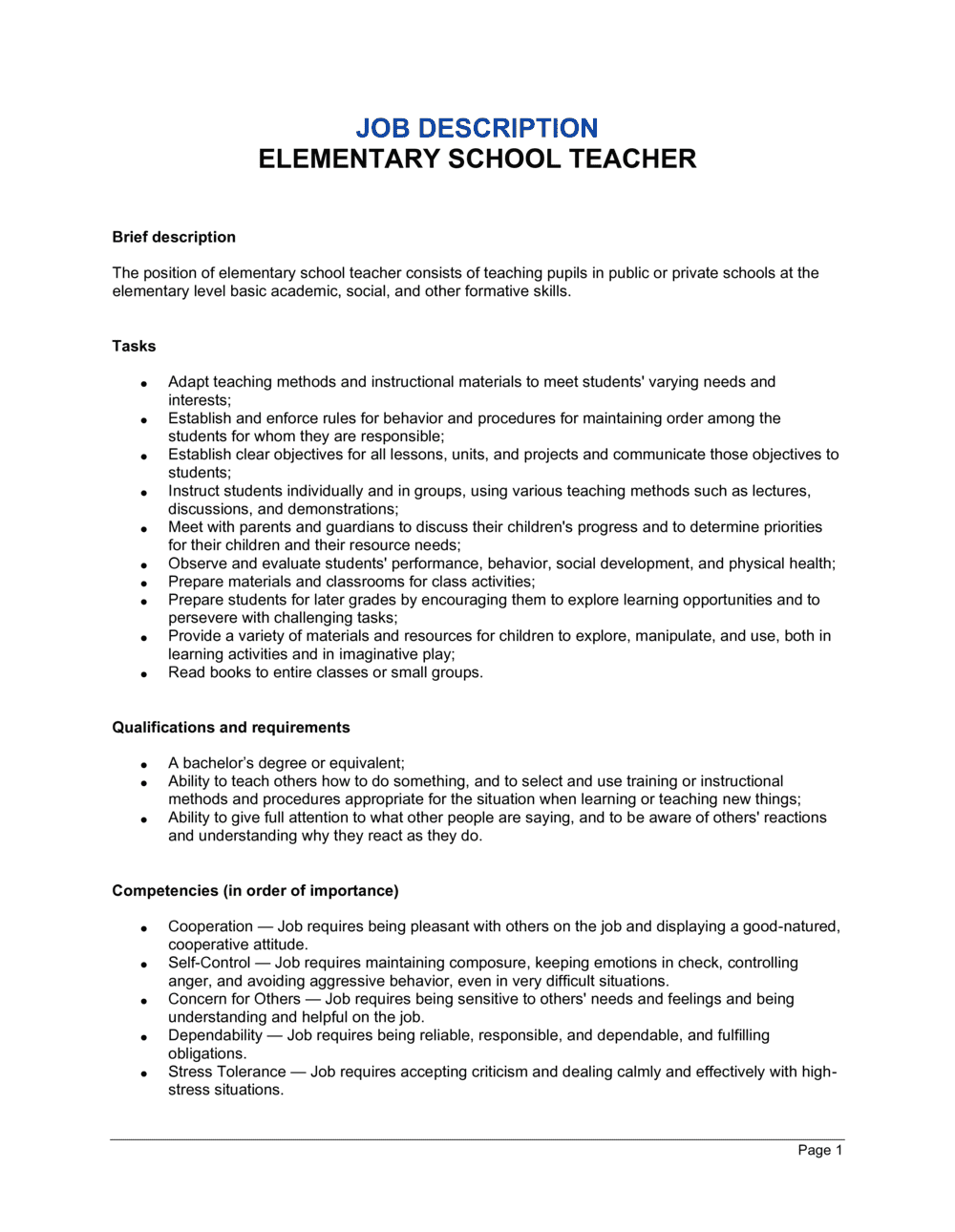
An Elementary School Teacher Job Description is a formal employment document that defines the duties, qualifications, reporting structure, compensation range, and legal obligations for a classroom teaching role in a K–6 setting. This free Word download gives principals, HR directors, and school administrators a structured, legally defensible starting point they can edit online and export as PDF for job postings, offer letters, or personnel files.
When you need it
Use it when opening a new teaching position, replacing a departing educator, or formalizing an existing informal role — especially before posting the vacancy, extending an offer, or onboarding a new hire. Schools and districts that operate without a written job description expose themselves to misclassification claims, ADA accommodation disputes, and wrongful-termination liability when performance expectations were never documented.
What's inside
Position title and reporting line, a detailed list of classroom and administrative duties, required and preferred qualifications including certification and licensure, compensation range and benefits summary, working hours and physical requirements, equal-opportunity and non-discrimination statements, and signature blocks for employer acknowledgment.

What is an Elementary School Teacher Job Description?

An Elementary School Teacher Job Description is a formal employment document that defines the duties, qualifications, compensation, physical requirements, and legal obligations for a classroom teaching role serving students in kindergarten through grade six. It establishes the authoritative record of what the school expects from the teacher before a single day of instruction begins, covering everything from lesson planning and parent communication to FERPA confidentiality obligations and state mandated-reporter requirements. Unlike a general offer letter or employment contract, the job description focuses on role content — what the teacher does, what credentials they must hold, and what legal obligations attach to the position — and is typically incorporated by reference into the binding employment agreement.

Why You Need This Document

Operating without a written, signed elementary school teacher job description creates measurable legal and operational risk on four fronts. First, without documented essential functions, the school cannot mount a defensible response to an ADA reasonable-accommodation request — courts have repeatedly held that schools must demonstrate a function is essential before concluding it cannot be accommodated. Second, a missing mandatory-reporter clause undermines the school's position if a teacher later claims ignorance of their reporting obligation, exposing administrators to regulatory sanction. Third, undocumented or inconsistently worded qualifications invite disparate-impact discrimination claims when hiring decisions are challenged. Fourth, in performance management and termination proceedings, the absence of a specific duties list means the school cannot point to a written standard the employee failed to meet. This template gives principals, HR directors, and charter school operators a legally defensible, fully structured foundation — ready to customize in minutes and sign before day one.

Which variant fits your situation?

If your situation is…Use this template
Hiring a full-time permanent classroom teacherElementary School Teacher Job Description
Engaging a substitute or day-to-day replacement teacherSubstitute Teacher Job Description
Hiring a long-term replacement during a leave of absenceLong-Term Substitute Teacher Agreement
Describing the role of a teacher's aide or paraprofessionalTeacher Assistant Job Description
Posting a middle or high school subject-specialist roleSecondary School Teacher Job Description
Hiring a special education teacher under IDEA complianceSpecial Education Teacher Job Description
Defining the duties of a curriculum coordinator or instructional coachInstructional Coach Job Description

Common mistakes to avoid

❌ Omitting essential physical functions

Why it matters: Without documented physical requirements, the school cannot legally deny an ADA accommodation request on the basis that a function is essential — because that essentialness was never established in writing.

Fix: List every physical demand with specific metrics (hours standing, maximum lift weight, outdoor supervision) and include the 'with or without reasonable accommodation' qualifier to trigger the interactive process correctly.

❌ Conflating required and preferred qualifications

Why it matters: Merging mandatory and preferred credentials into a single list causes qualified candidates to self-screen out and exposes the school to disparate-impact claims if the inflated bar disproportionately excludes a protected group.

Fix: Use clearly labeled, separate sections — 'Required Qualifications' and 'Preferred Qualifications' — and review each required item against documented business necessity.

❌ Publishing a fixed salary instead of a range

Why it matters: A single salary figure creates an implied contract that complicates salary schedule adjustments, and violates pay transparency laws in states including Colorado, New York, California, and Washington.

Fix: Reference the applicable salary schedule by name and publish the minimum-to-maximum range for the relevant education and experience band.

❌ Using a generic EEO statement that omits state protected categories

Why it matters: Many states and municipalities protect additional characteristics — sexual orientation, gender identity, pregnancy, military status — not listed in the federal boilerplate. A gap in the statement creates a compliance deficiency visible to any plaintiff's attorney.

Fix: Append 'and any other characteristic protected by applicable state or local law' after the federal protected categories, and review state-specific requirements annually.

❌ No mandatory reporter acknowledgment in the document

Why it matters: If a teacher fails to report suspected abuse and claims they were unaware of their legal obligation, the school faces regulatory and civil liability for inadequate notice.

Fix: Include a named, state-specific mandatory reporting clause and require a separate signed acknowledgment at onboarding to create two independent records of notice.

❌ Signing the job description after the employee's start date

Why it matters: A job description signed after employment begins may not constitute effective legal notice of the terms it contains, particularly the mandatory reporting obligations and confidentiality requirements.

Fix: Execute the job description before or on the employee's first day of work and retain the dated, signed original in the personnel file.

The 10 key clauses, explained

Position identification and reporting structure

In plain language: States the official job title, the grade level or homeroom assignment, the school name, and the direct supervisory chain — typically the building principal.

Sample language
Position: Elementary School Teacher — Grade [GRADE LEVEL] | School: [SCHOOL NAME] | Reports to: Principal, [PRINCIPAL NAME] | Classification: [Full-Time / Part-Time], [Exempt / Non-Exempt]

Common mistake: Omitting the exempt or non-exempt FLSA classification. Teachers at public schools are generally exempt, but misclassifying a part-time or hourly aide as exempt creates overtime liability.

Position summary

In plain language: A two-to-three sentence overview of the role's primary purpose — who the teacher serves, what subject or grade they cover, and the overarching educational outcome they are responsible for.

Sample language
The Grade [X] Teacher is responsible for delivering standards-aligned instruction in [SUBJECTS] to approximately [NUMBER] students, managing a safe and inclusive classroom environment, and supporting the academic and social-emotional development of every learner.

Common mistake: Writing a position summary that is indistinguishable from a marketing tagline. A vague summary creates performance management ambiguity and weakens the document's use in a termination-for-cause proceeding.

Core duties and responsibilities

In plain language: An itemized list of the teacher's primary instructional, administrative, and professional obligations — the section courts and HR tribunals examine when a termination or accommodation dispute arises.

Sample language
Plan, prepare, and deliver daily lesson plans aligned to [STATE] Common Core or [CURRICULUM FRAMEWORK] standards; assess student progress using formative and summative assessments; maintain accurate attendance and grade records in [SIS PLATFORM]; communicate regularly with parents and guardians; participate in IEP and 504 meetings as required; comply with all mandatory reporting obligations under [STATE] law.

Common mistake: Listing only instructional duties and omitting administrative obligations like attendance tracking, report card completion, and mandatory reporting. Missing functions cannot be cited as cause for discipline if they were never documented.

Required qualifications and certifications

In plain language: Specifies the minimum education, licensure, and experience a candidate must hold to be considered — the legally defensible floor below which the school will not hire.

Sample language
Bachelor's degree in Elementary Education or related field required. Valid [STATE] teaching license with [GRADE LEVEL K–6 / Elementary Education] endorsement required. Minimum [X] years of classroom teaching experience preferred. CPR and first-aid certification required within 90 days of hire.

Common mistake: Requiring credentials beyond what the role actually demands — e.g., a master's degree for a standard K–3 position — without a documented business necessity. Inflated requirements can constitute disparate-impact discrimination under Title VII.

Preferred qualifications

In plain language: Lists additional credentials and experiences that strengthen a candidate's application but are not eliminatory — giving hiring managers flexibility without creating a legally enforceable bar.

Sample language
Master's degree in Education or Curriculum and Instruction preferred. Bilingual proficiency in [LANGUAGE] preferred. Experience with [SPECIFIC CURRICULUM, e.g., Reading Recovery, Singapore Math] preferred. Google Certified Educator or equivalent preferred.

Common mistake: Blending required and preferred qualifications into a single list without distinguishing them. Candidates may self-screen out on preferred items they read as requirements, narrowing the applicant pool unnecessarily.

Physical requirements and working conditions

In plain language: Documents the physical demands of the role — standing, lifting, supervision of outdoor activities — and the work environment. This section is legally required for ADA compliance to define what constitutes a reasonable accommodation request.

Sample language
Must be able to stand and walk for up to 6 hours per day; lift and carry materials weighing up to [30] lbs; supervise students in outdoor settings including playgrounds and field trips; work in a standard classroom environment with moderate noise levels.

Common mistake: Omitting physical requirements entirely. Without documented essential physical functions, the school cannot deny an accommodation request as an undue hardship — because it never defined what the job physically requires.

Compensation, benefits, and working hours

In plain language: States the salary range or placement on the district's salary schedule, the contract term (typically 10 months), daily working hours, and an overview of benefits eligibility.

Sample language
Annual salary: $[MIN]–$[MAX], placement on [DISTRICT] Salary Schedule based on education and years of experience. Contract term: [10-month / academic year]. Working hours: [7:30 AM – 3:30 PM], Monday through Friday, plus required professional development days. Benefits: health, dental, vision, and [STATE] teacher retirement system participation.

Common mistake: Stating a single salary figure instead of a range on the applicable schedule. A fixed number creates an implied contract that complicates future merit or cost-of-living adjustments, and several US states now require salary ranges in job postings by law.

Confidentiality and FERPA compliance

In plain language: Requires the teacher to maintain the confidentiality of student records and personally identifiable information in accordance with FERPA and any applicable state privacy law.

Sample language
Employee agrees to maintain the confidentiality of all student educational records and personally identifiable information in compliance with the Family Educational Rights and Privacy Act (FERPA), 20 U.S.C. § 1232g, and [STATE] student privacy statutes. Unauthorized disclosure of student records may result in disciplinary action up to and including termination.

Common mistake: Referencing 'FERPA compliance' without defining what constitutes a prohibited disclosure. Teachers who share classroom photos on personal social media without consent routinely violate FERPA — a specific example in training and documentation significantly reduces incidents.

Mandatory reporting obligations

In plain language: Formally puts the teacher on notice of their legal duty as a mandated reporter to report suspected child abuse or neglect to the appropriate child protective services authority.

Sample language
As a condition of employment, Employee acknowledges their status as a mandated reporter under [STATE] [CHILD ABUSE REPORTING STATUTE] and agrees to immediately report any reasonable suspicion of child abuse, neglect, or endangerment to [STATE AGENCY] and notify the building principal. Failure to report is a [MISDEMEANOR / FELONY] under [STATE] law.

Common mistake: Treating mandatory reporting as an HR policy rather than a legal obligation with criminal consequences. Embedding it in the job description and requiring a signature creates documented notice that is defensible if a failure-to-report allegation arises.

Equal opportunity and non-discrimination statement

In plain language: States that employment decisions are made without regard to any protected characteristic under applicable federal, state, or local law, and references the school's accommodation process.

Sample language
[SCHOOL NAME] is an Equal Opportunity Employer. Employment decisions are made without regard to race, color, religion, sex, national origin, age, disability, genetic information, or any other characteristic protected by federal, state, or local law. Applicants requiring accommodation in the application or interview process should contact [HR CONTACT / TITLE].

Common mistake: Using a generic EEO boilerplate that omits state and local protected categories. Many states and municipalities add sexual orientation, gender identity, pregnancy, and military status to the protected class list — omissions create compliance gaps.

How to fill it out

  1. 1

    Confirm the position classification and reporting line

    Enter the official job title, the grade level or subject assignment, the school name, and the direct supervisor's title. Verify the FLSA exempt or non-exempt classification with your district HR office before publishing.

    💡 For public schools, cross-reference the classification against the applicable collective bargaining agreement — CBA language on classification supersedes what the job description says.

  2. 2

    Write a specific position summary

    Draft two to three sentences identifying the grade or subject taught, the approximate number of students, and the primary educational outcome the teacher is accountable for. Avoid generic language that could apply to any school or grade level.

    💡 Reference the specific curriculum framework or standards (e.g., Common Core, Next Generation Science Standards) your school uses — this anchors performance expectations from day one.

  3. 3

    List all core duties, including administrative obligations

    Document every instructional and non-instructional duty: lesson planning, grading, parent communication, IEP participation, mandatory reporting, and attendance at professional development. Use active verbs — 'plan,' 'assess,' 'document' — rather than passive constructions.

    💡 Review the most recent performance evaluation rubric used at your school and align the duties list to its competency categories so the job description and evaluation instrument are internally consistent.

  4. 4

    Define required qualifications precisely

    State the exact license or endorsement required, the minimum degree level, and any mandatory certifications such as CPR. Separate required qualifications from preferred ones in distinct labeled sections.

    💡 Check your state's department of education website for the current licensure endorsement codes — using outdated or informal license names can generate applications from candidates who technically don't qualify.

  5. 5

    Document physical requirements for ADA compliance

    List every essential physical function: hours of standing, weight-lifting limits, outdoor supervision duties, and any sensory requirements. Frame each as a function, not a medical condition, to stay within ADA-compliant language.

    💡 The phrase 'with or without reasonable accommodation' should appear in this section — it signals that the school will engage in the interactive accommodation process before concluding a function cannot be performed.

  6. 6

    Enter compensation range and contract term

    Insert the salary range from the applicable salary schedule, the contract term in months, daily working hours, and a brief benefits summary. If your state requires salary range disclosure in job postings, confirm compliance before publishing.

    💡 Several states — including Colorado, New York, and California — now require salary ranges in all job postings. Publishing a range that does not reflect actual pay creates legal exposure and damages trust with candidates.

  7. 7

    Add FERPA and mandatory reporting clauses

    Insert the FERPA confidentiality clause and the state-specific mandatory reporter acknowledgment. Reference the specific state statute and reporting agency by name.

    💡 Have new hires sign the mandatory reporter acknowledgment as a standalone document at onboarding in addition to the job description — two separate signed documents are harder to contest than one.

  8. 8

    Obtain signatures and file in the personnel record

    Collect signatures from the hiring authority (principal or HR director) and the new hire before or on the first day of employment. Retain the signed original in the employee's personnel file and provide a copy to the employee.

    💡 Store a dated, signed copy digitally in your HRIS or document management system — physical-only storage in a school office is vulnerable to loss and makes compliance audits unnecessarily difficult.

Frequently asked questions

What is an elementary school teacher job description?

An elementary school teacher job description is a formal employment document that defines the duties, qualifications, compensation, physical requirements, and legal obligations for a classroom teaching role in a K–6 setting. It serves as the authoritative record of what the school expects from the teacher, supports legally defensible hiring and performance management, and documents compliance obligations such as FERPA confidentiality and mandatory child-abuse reporting.

What should an elementary school teacher job description include?

A complete job description covers the position title and reporting structure, a position summary, a detailed list of instructional and administrative duties, required and preferred qualifications including licensure, physical requirements, compensation range, FERPA confidentiality obligations, mandatory reporter acknowledgment, and an equal-opportunity statement. Missing any of these creates compliance gaps or weakens the document's usefulness in a dispute.

Is a job description a legally binding document?

A job description is generally not a standalone employment contract, but it carries significant legal weight. Courts and HR tribunals routinely examine job descriptions in wrongful-termination, ADA accommodation, and FLSA misclassification cases. The duties and physical requirements listed in a signed job description establish the factual record of what the employer documented and communicated to the employee before hire.

Do public school teachers need a different job description than private school teachers?

Public school teachers are subject to additional statutory requirements — state licensure mandates, FLSA exempt classification, collective bargaining agreement terms, and civil service rules — that may not apply to private school teachers. Private schools have more flexibility on compensation structure and credentialing but must still comply with federal anti-discrimination laws. The template should be reviewed against the applicable CBA for any unionized public school district.

What qualifications should an elementary school teacher job description require?

At minimum: a bachelor's degree in elementary education or a closely related field, a valid state teaching license with the appropriate grade-level endorsement, and any state-mandated safety certifications such as CPR. Preferred qualifications commonly include a master's degree, bilingual proficiency, and experience with specific curriculum frameworks. Required qualifications must reflect genuine business necessity — inflating them beyond what the role demands can constitute disparate-impact discrimination.

How does a job description relate to an employment contract?

A job description documents role expectations, qualifications, and legal obligations; an employment contract or letter of appointment creates the binding agreement to employ on stated terms. The job description is typically incorporated by reference into the employment contract or offer letter. Together, they form the complete record of agreed employment terms. Relying on the job description alone, without a signed offer letter or contract, leaves compensation and termination terms undocumented.

What FERPA obligations should appear in a teacher job description?

The job description should require the teacher to maintain the confidentiality of all student educational records and personally identifiable information in compliance with FERPA (20 U.S.C. § 1232g) and any applicable state student privacy statute. It should state that unauthorized disclosure may result in disciplinary action up to termination, and reference the school's procedure for responding to third-party records requests.

What is a mandated reporter clause and why does it belong in a job description?

A mandated reporter clause formally notifies the teacher of their legal obligation under state law to report suspected child abuse or neglect to the appropriate child protective services agency. Including it in the job description and requiring a signature creates documented evidence that the employee received and acknowledged this obligation before beginning work — which is the school's primary defense if a failure-to-report allegation arises later.

Do I need a lawyer to draft a teacher job description?

For standard classroom teaching roles at established schools, a high-quality template is typically sufficient if it is reviewed against the applicable collective bargaining agreement and state licensure requirements. Engage an employment attorney when the school is unionized and the description may conflict with CBA language, when the role involves significant special education duties under IDEA, or when the school operates in a jurisdiction with complex pay transparency or protected-category obligations.

How this compares to alternatives

vs Employment Contract

An employment contract creates the binding legal agreement to employ on stated terms — salary, benefits, term, and termination conditions. A job description documents role expectations and legal obligations but is not a standalone employment agreement. Both are needed: the job description defines the role; the employment contract commits the employer and employee to its terms. Relying on a job description alone leaves compensation and termination conditions undocumented.

vs Offer Letter

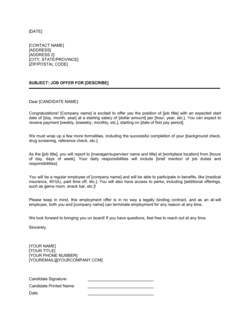
An offer letter extends employment and confirms the key financial terms — salary, start date, and benefits — to trigger acceptance. A job description defines the ongoing duties, qualifications, and legal obligations of the role. The offer letter references the job description but does not replace it. Together they form the complete pre-employment record; each alone creates significant legal gaps.

vs Teacher Assistant Job Description

A teacher assistant job description covers a paraprofessional role with a narrower instructional scope, different licensure requirements, and typically a non-exempt hourly compensation structure. An elementary school teacher job description governs a fully licensed, lead-classroom role with primary instructional accountability. Using the wrong template misclassifies the role, creating overtime liability or credential compliance gaps depending on which direction the error runs.

vs Employee Handbook

An employee handbook sets school-wide policies — conduct, leave, technology use, and grievance procedures — that apply to all staff. A job description defines the specific duties, qualifications, and legal obligations of a single role. The handbook cannot substitute for a role-specific job description in a performance management or accommodation proceeding, because it does not document what this particular role is expected to do.

Industry-specific considerations

Public K–12 School Districts

Job descriptions must align with collective bargaining agreements, district salary schedules, state certification mandates, and ESEA highly-qualified-teacher requirements.

Private and Independent Schools

Greater flexibility on compensation structure and credentialing, but federal anti-discrimination and FERPA obligations still apply; accreditation bodies often require standardized role documentation.

Charter Schools

Charter authorization agreements often specify staffing documentation requirements; some charters are unionized with CBA constraints while others operate as at-will employers under a nonprofit structure.

International and Bilingual Schools

Language proficiency requirements and international teaching credentials (e.g., IB authorization, Cambridge endorsement) must be documented alongside host-country employment law compliance.

Jurisdictional notes

United States

Every state sets its own teaching licensure and endorsement requirements — there is no federal teaching license. Public school teachers in most states are FLSA-exempt but subject to tenure protections after a probationary period that prevents at-will termination. Mandatory reporter obligations and the specific reporting agency vary by state. Several states including Colorado, New York, California, and Washington now require salary ranges in job postings, and Title IX, ADA, and IDEA impose additional documentation requirements on schools receiving federal funding.

Canada

Teaching certification is provincially regulated — an Ontario Certificate of Qualification is not automatically recognized in British Columbia or Alberta. Most public school teachers are unionized under provincial teachers' federations, and collective agreements set minimum notice, salary grids, and working conditions that supersede the individual job description. Quebec employers must provide French-language documentation for roles in provincially regulated sectors. Mandatory reporting obligations for child abuse are set by provincial child welfare legislation in each province.

United Kingdom

Qualified Teacher Status (QTS) is required to teach in maintained schools in England; Scotland, Wales, and Northern Ireland have separate registration bodies (GTCS, EWC, GTCNI). Employers must provide a written statement of employment particulars on or before the first day of work. Safer recruitment requirements under Keeping Children Safe in Education mandate DBS enhanced checks and specific safeguarding language in job descriptions. The Equality Act 2010 governs protected characteristics and reasonable adjustments, replacing the previous disability discrimination framework.

European Union

Teacher qualification requirements and recognition vary significantly by member state — the EU Professional Qualifications Directive provides a framework for cross-border recognition but each country's education ministry sets the substantive standards. The EU Transparent and Predictable Working Conditions Directive requires written employment terms within 7 days of hire. GDPR applies to all student and employee personal data, and job descriptions should reference the school's data protection policy. France, Germany, and Spain impose statutory minimum notice periods and strong employee protections that cannot be contracted away.

Template vs lawyer — what fits your deal?

PathBest forCostTime
Use the templateNon-unionized private schools and charter schools filling standard classroom teaching roles in a single stateFree30–60 minutes
Template + legal reviewPublic school districts, unionized environments, or roles with significant special education duties under IDEA$300–$600 for an employment attorney review against the applicable CBA and state law2–5 days
Custom draftedMulti-state school networks, international schools navigating dual-jurisdiction employment law, or districts undergoing collective bargaining$1,000–$3,000+1–3 weeks

Glossary

State Teaching License
A government-issued credential authorizing an individual to teach in public schools within a specific state or province, typically requiring a bachelor's degree in education and a passed certification exam.
Highly Qualified Teacher (HQT)
A US standard under the Every Student Succeeds Act requiring teachers in core academic subjects to hold full state licensure and demonstrated subject-matter competency.
IEP (Individualized Education Program)
A federally mandated written plan under IDEA specifying the special education services, accommodations, and measurable goals for a student with a qualifying disability.
504 Plan
A school accommodation plan under Section 504 of the Rehabilitation Act providing adjustments — extended time, preferential seating — for students with disabilities who do not qualify for special education.
Differentiated Instruction
A teaching approach that adapts content, process, and assessment to meet the varying readiness levels, learning styles, and interests of students in the same classroom.
Essential Functions
The fundamental job duties an employee must be able to perform, with or without reasonable accommodation, as defined under the Americans with Disabilities Act.
FERPA
The Family Educational Rights and Privacy Act, a US federal law protecting the privacy of student education records and restricting their disclosure without parental consent.
Mandated Reporter
A person legally required by state or provincial law to report suspected child abuse or neglect to the appropriate authorities — a status that applies to all classroom teachers in most jurisdictions.
Tenure
A protected employment status granted to teachers after a probationary period, typically requiring cause and a formal hearing process before termination.
At-Will Employment
An employment arrangement terminable by either party at any time for any lawful reason — applicable to private school teachers in most US states but generally not to tenured public school teachers.
Continuing Education Units (CEUs)
Standardized measures of professional development credit that many states require teachers to accumulate to maintain active licensure.
Collective Bargaining Agreement (CBA)
A negotiated contract between a school district and a teachers' union setting minimum wages, working conditions, benefits, and grievance procedures that override individual employment documents.

Part of your Business Operating System

This document is one of 3,000+ business & legal templates included in Business in a Box.

  • Fill-in-the-blanks — ready in minutes
  • 100% customizable Word document
  • Compatible with all office suites
  • Export to PDF and share electronically

Create your document in 3 simple steps.

From template to signed document — all inside one Business Operating System.
1
Download or open template

Access over 3,000+ business and legal templates for any business task, project or initiative.

2
Edit and fill in the blanks with AI

Customize your ready-made business document template and save it in the cloud.

3
Save, Share, Send, Sign

Share your files and folders with your team. Create a space of seamless collaboration.

Save time, save money, and create top-quality documents.

★★★★★

"Fantastic value! I'm not sure how I'd do without it. It's worth its weight in gold and paid back for itself many times."

Managing Director · Mall Farm
Robert Whalley
Managing Director, Mall Farm Proprietary Limited
★★★★★

"I have been using Business in a Box for years. It has been the most useful source of templates I have encountered. I recommend it to anyone."

Business Owner · 4+ years
Dr Michael John Freestone
Business Owner
★★★★★

"It has been a life saver so many times I have lost count. Business in a Box has saved me so much time and as you know, time is money."

Owner · Upstate Web
David G. Moore Jr.
Owner, Upstate Web

Run your business with a system — not scattered tools

Stop downloading documents. Start operating with clarity. Business in a Box gives you the Business Operating System used by over 250,000 companies worldwide to structure, run, and grow their business.

Free Forever Plan · No credit card required