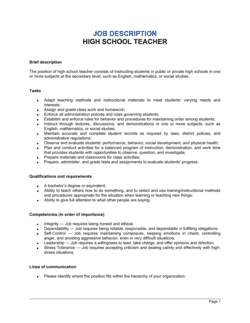
School Principal Job Description Template

Free Word download β€’ Edit online β€’ Save & share with Drive β€’ Export to PDF

2 pagesβ€’20–30 min to fillβ€’Difficulty: Standardβ€’Signature requiredβ€’Legal review recommended
Learn more ↓
FreeSchool Principal Job Description Template

At a glance

What it is
A School Principal Job Description is a formal document that defines the scope of the principal role, including core duties, reporting structure, required qualifications, performance expectations, and compensation terms. This free Word download can be edited online and exported as PDF β€” giving school boards, private school operators, and education authorities a legally grounded and professionally structured hiring document ready to attach to an employment contract.
When you need it
Use it when posting a vacancy for a school principal, formalizing an internal appointment, or replacing an outdated role description that no longer reflects current legal or operational requirements. It is also essential when onboarding a new principal to establish clear expectations before the first day of service.
What's inside
The template covers position title and reporting line, school overview, core responsibilities and leadership duties, required and preferred qualifications, key performance indicators, compensation and benefits summary, equal opportunity statement, and acknowledgement signature block.

What is a School Principal Job Description?

A School Principal Job Description is a formal document that defines the full scope of the principal role β€” covering position title, reporting structure, core instructional and administrative duties, required licensure and qualifications, performance expectations, and compensation terms. It functions as both a hiring instrument and a governance baseline, establishing the agreed foundation against which the principal's performance is assessed throughout their tenure. When signed by both parties and incorporated into or attached to an employment contract, it carries legal weight in performance management, disciplinary proceedings, and non-renewal decisions.

Why You Need This Document

Without a clear, signed job description, schools lose the documented baseline that performance reviews, improvement plans, and termination proceedings depend on. A principal who was never given a formal description of their duties can credibly dispute whether specific responsibilities were ever part of their role β€” and arbitration panels and employment tribunals regularly side with employees when that documentation is absent. In the US, an incomplete description that omits physical requirements creates ADA compliance gaps; in jurisdictions with pay transparency laws, failing to include a salary range in a posted vacancy is a direct legal violation. Beyond legal exposure, an underdefined principal role produces misaligned expectations between the school board, the principal, and the community β€” the most common source of leadership turnover in education. This template gives school boards, private school operators, and education authorities a professionally structured, legally grounded document they can adapt, sign, and file in under an hour.

Which variant fits your situation?

If your situation is…Use this template
Hiring a principal for a public K–12 district schoolSchool Principal Job Description (Public District)
Appointing a principal for a private or independent schoolSchool Principal Job Description (Private School)
Defining a vice-principal or deputy head roleVice Principal Job Description
Hiring a head of a single early childhood or pre-K centerEarly Childhood Center Director Job Description
Formalizing the full employment terms once the candidate acceptsEmployment Contract
Recruiting a superintendent to oversee multiple principalsSchool Superintendent Job Description
Hiring a principal for a charter school with authorizer requirementsCharter School Principal Job Description

Common mistakes to avoid

❌ Using a generic administrator job description instead of a principal-specific one

Why it matters: A generic description fails to capture the instructional leadership, regulatory compliance, and community accountability dimensions unique to the principal role β€” weakening its use in performance management.

Fix: Tailor every section β€” duties, KPIs, qualifications β€” to the specific grade span, school type, and jurisdiction before posting or presenting to a candidate.

❌ Omitting licensure requirements or stating them incorrectly

Why it matters: Hiring a principal without valid licensure violates state or provincial education regulations, can trigger accreditation issues, and may void the employment contract.

Fix: Verify current principal licensure requirements in your jurisdiction before drafting the qualifications section, and specify any provisional or grace-period provisions that apply.

❌ Leaving the salary field blank or vague

Why it matters: In jurisdictions with pay transparency legislation, omitting the salary range from a posted description is a legal violation. Even where not required, vague compensation language prolongs negotiation and attracts misaligned candidates.

Fix: Enter a specific salary range based on district pay scales, collective bargaining agreements, or market benchmarks β€” and confirm it meets applicable pay equity and transparency requirements.

❌ Failing to collect a signed acknowledgement

Why it matters: Without a signed acknowledgement, a principal can credibly argue they were never formally informed of specific duties or performance expectations β€” undermining disciplinary or non-renewal proceedings.

Fix: Make signed acknowledgement of the job description a condition of completing onboarding, and store the signed copy in the personnel file before the first day of duties.

❌ Setting KPIs in the job description that conflict with the collective bargaining agreement

Why it matters: In unionized districts, individual performance targets that contradict CBA evaluation frameworks can be grieved and invalidated, leaving the school without an enforceable performance baseline.

Fix: Review the applicable CBA before finalizing the KPI section and align individual targets with the evaluation framework the agreement requires.

❌ Mixing required and preferred qualifications in a single list

Why it matters: Blurred qualification tiers make hiring decisions legally indefensible β€” if a candidate who meets all listed qualifications is rejected, the school cannot clearly show they fell short of a required threshold.

Fix: Use two clearly labeled, separate sections β€” 'Required Qualifications' and 'Preferred Qualifications' β€” and ensure every item in the required list is genuinely non-negotiable for the role.

The 10 key clauses, explained

Position Title and Reporting Structure

In plain language: States the official job title, the school or campus to which the principal is assigned, and the chain of command above the role.

Sample language
Position: School Principal β€” [SCHOOL NAME]. Reports to: [SUPERINTENDENT / BOARD OF GOVERNORS / EXECUTIVE DIRECTOR]. Effective Date: [DATE].

Common mistake: Listing the reporting line as a person's name rather than a title. When leadership turns over, the document becomes immediately inaccurate and must be reissued.

School Overview and Context

In plain language: A brief description of the school's type, size, grade levels, student population, and any distinguishing characteristics such as faith affiliation, charter status, or magnet designation.

Sample language
[SCHOOL NAME] is a [PUBLIC / PRIVATE / CHARTER] [K–8 / 6–12 / K–12] school serving approximately [NUMBER] students in [CITY, STATE]. The school holds [ACCREDITATION STATUS] and is committed to [MISSION STATEMENT].

Common mistake: Omitting enrollment size and grade span. These details directly affect the complexity of the role and are used by candidates to self-screen β€” leaving them out increases unqualified applications.

Core Responsibilities and Leadership Duties

In plain language: An enumerated list of the principal's primary obligations β€” academic leadership, staff supervision, community relations, budget oversight, and regulatory compliance.

Sample language
The Principal shall: (a) provide instructional leadership to achieve student performance goals; (b) supervise, evaluate, and develop all instructional and non-instructional staff; (c) maintain a safe and inclusive school environment in accordance with [APPLICABLE POLICY]; (d) manage the school's annual operating budget of approximately $[AMOUNT]; and (e) serve as the primary liaison to parents, community stakeholders, and the governing board.

Common mistake: Writing responsibilities so broadly that they cover everything and constrain nothing. Vague duties make performance evaluation subjective and disciplinary proceedings harder to defend.

Required Qualifications

In plain language: The mandatory education, licensure, certification, and experience thresholds that a candidate must meet to be eligible for the role.

Sample language
Minimum requirements: (a) Master's degree in Educational Leadership, Administration, or a related field; (b) valid [STATE / PROVINCE] principal licensure or eligibility for licensure within [90] days of appointment; (c) minimum [5] years of certified teaching experience; (d) minimum [2] years of school administration or leadership experience.

Common mistake: Setting required qualifications below what the role actually demands to widen the applicant pool. This exposes the school to discrimination claims when a minimally qualified candidate is rejected in favor of a more experienced one.

Preferred Qualifications

In plain language: Additional experience, skills, or credentials that distinguish stronger candidates but are not eliminatory β€” used to rank among eligible applicants.

Sample language
Preferred: (a) Doctorate in Education or a related field; (b) demonstrated experience improving [SPECIFIC METRIC, e.g., standardized test scores] in a comparable school setting; (c) bilingual proficiency in [LANGUAGE]; (d) experience managing Title I or federally funded programs.

Common mistake: Blending preferred qualifications with required ones, creating ambiguity about who is actually eligible β€” this undermines the legal defensibility of hiring decisions.

Key Performance Indicators and Evaluation Criteria

In plain language: Quantified or observable targets against which the principal's performance will be formally assessed, typically in annual or biannual reviews.

Sample language
Annual performance will be evaluated against: (a) student proficiency rates in [SUBJECT] meeting or exceeding [X]% on [ASSESSMENT]; (b) staff retention rate of [X]% or greater; (c) budget variance within [+/- X]% of approved allocation; (d) parent satisfaction survey scores averaging [X] or above on a [SCALE] scale.

Common mistake: Omitting KPIs from the job description entirely and deferring them to a separate evaluation tool. Without documented targets, principals and boards disagree on what constitutes satisfactory performance.

Compensation, Benefits, and Contract Term

In plain language: States the salary range or band, any performance bonus eligibility, key benefits, and the initial contract term β€” typically one, two, or three years for a principal appointment.

Sample language
Compensation: Salary range $[MIN]–$[MAX] per year, commensurate with qualifications and experience, payable bi-weekly. Eligible for annual performance bonus of up to [X]% of base salary. Benefits: [HEALTH / DENTAL / VISION / RETIREMENT PLAN]. Initial contract term: [1 / 2 / 3] year(s), subject to annual renewal based on performance review.

Common mistake: Stating only a single fixed salary rather than a range. A fixed figure eliminates negotiating flexibility and makes it difficult to attract candidates with above-minimum experience without issuing a revised document.

Working Conditions and Physical Requirements

In plain language: Describes the environment in which the principal works, expected hours, travel requirements, and any physical demands relevant to the role.

Sample language
The Principal works primarily on-site at [SCHOOL NAME]. The role requires regular attendance at evening events, weekend activities, and district meetings. Occasional travel to [DISTRICT OFFICE / CONFERENCES] is expected. The position requires the ability to [STAND / WALK THROUGH CAMPUS / LIFT UP TO X LBS] as part of normal duties.

Common mistake: Skipping physical requirements entirely. In the US, omitting this section creates ADA compliance gaps β€” if a candidate later requests an accommodation, there is no documented baseline to assess reasonableness.

Equal Opportunity and Non-Discrimination Statement

In plain language: A legally required affirmation that the employer does not discriminate on the basis of race, color, religion, sex, national origin, disability, age, or other protected classes.

Sample language
[SCHOOL / DISTRICT NAME] is an Equal Opportunity Employer. All qualified applicants will receive consideration without regard to race, color, religion, sex, national origin, age, disability, veteran status, or any other characteristic protected by applicable federal, state, or local law.

Common mistake: Using a generic EEO boilerplate that omits protected classes added by recent state or provincial legislation β€” e.g., gender identity and expression, which are now protected in most US states and all Canadian provinces.

Acknowledgement and Signature Block

In plain language: A section where the appointed principal signs to confirm they have received, read, and understood the job description β€” creating a documented baseline for performance management.

Sample language
I acknowledge that I have received and reviewed this job description and understand the duties and expectations of the School Principal role at [SCHOOL NAME]. Signature: _________________________ Date: _______________ Printed Name: _________________________

Common mistake: Treating the acknowledgement as optional or collecting it months after hire. An unsigned job description cannot be referenced in a performance improvement plan or termination proceeding without the principal disputing whether they ever agreed to the terms.

How to fill it out

  1. 1

    Enter the school's legal name and position details

    Replace all [PLACEHOLDERS] in the position title and school overview sections with the registered name of the school or district, the campus assignment, and the official start date.

    πŸ’‘ Use the school's full registered legal name β€” not a brand name or common abbreviation β€” to ensure the document matches payroll and licensing records.

  2. 2

    Define the reporting structure by title, not by name

    Identify the role title the principal reports to β€” Superintendent, Board Chair, Executive Director β€” and enter it in the reporting line clause. Do not use an individual's name.

    πŸ’‘ Linking the reporting line to a title rather than a person means the document remains valid through leadership transitions without requiring a reissue.

  3. 3

    Customize the core responsibilities to the school's context

    Review the enumerated duties list and add, remove, or modify items to reflect your school's actual operating model β€” including budget authority, grade span, and any federal program responsibilities.

    πŸ’‘ Keep the list to 8–12 specific, action-verb-led duties. Longer lists dilute accountability and make performance evaluation harder.

  4. 4

    Set legally defensible minimum and preferred qualifications

    Enter the specific degree, licensure, and experience thresholds that reflect what the role genuinely requires. Separate required and preferred qualifications clearly.

    πŸ’‘ Check your jurisdiction's principal licensure requirements before finalizing β€” some states require licensure before appointment; others allow a provisional period.

  5. 5

    Populate the KPI and evaluation criteria section

    Enter at least three measurable performance targets with specific thresholds β€” student achievement percentages, staff retention rates, or budget variance limits β€” that will govern the first annual review.

    πŸ’‘ Align KPIs with existing district or school improvement plan goals so the principal's targets connect directly to broader institutional accountability.

  6. 6

    Complete the compensation and contract term fields

    Enter the salary range, payment frequency, bonus eligibility percentage, benefits summary, and initial contract term. Confirm the salary range complies with any applicable collective bargaining agreement or pay equity requirements.

    πŸ’‘ In jurisdictions with pay transparency laws β€” California, Colorado, New York β€” including the salary range in the job description is legally required for any externally posted vacancy.

  7. 7

    Verify the equal opportunity statement covers all required classes

    Review the EEO clause against the most current federal, state or provincial, and local non-discrimination requirements. Add any protected classes mandated by recent legislation in your jurisdiction.

    πŸ’‘ Many US states and all Canadian provinces now explicitly protect gender identity and expression β€” confirm these classes are included before posting.

  8. 8

    Obtain a signed acknowledgement before or on the first day

    Present the completed job description to the appointed principal before or on their start date and collect a dated signature on the acknowledgement block. File the signed copy with HR records.

    πŸ’‘ Store the signed original in the principal's personnel file and provide them with a copy β€” a document they haven't received cannot be cited in a subsequent performance or disciplinary process.

Frequently asked questions

What is a school principal job description?

A school principal job description is a formal document that defines the scope, duties, qualifications, reporting structure, performance expectations, and compensation terms for a school principal role. It is used in the hiring process, embedded in or attached to the employment contract, and referenced throughout the principal's tenure for performance management and accountability purposes. A well-drafted description protects both the school and the principal by establishing clear, agreed expectations from day one.

What should a school principal job description include?

At minimum: position title and reporting line, school overview, core responsibilities and leadership duties, required and preferred qualifications (including licensure), key performance indicators, compensation and contract term, working conditions, an equal opportunity statement, and a signed acknowledgement block. Missing any of these elements creates gaps that complicate hiring decisions, performance reviews, and potential termination proceedings.

Is a school principal required to be licensed?

In most US states, Canada, and the UK, a principal must hold a current government-issued administrative credential or licensure to serve in the role. Requirements vary significantly by jurisdiction β€” some states allow a provisional appointment pending licensure completion, while others require the credential before the first day of service. Always verify the current requirements in your jurisdiction before finalizing the qualifications section.

Can a job description serve as a binding employment document?

A job description alone is generally not a substitute for a full employment contract. However, when signed by both parties and attached to or referenced in an employment agreement, it becomes an incorporated term of that contract. Courts and arbitration panels regularly reference signed job descriptions in disputes over duties, performance expectations, and termination grounds.

How often should a school principal job description be updated?

Review it at least every two to three years, or whenever the role changes materially β€” for example, when a school adds grade levels, gains or loses federal program funding, or undergoes significant enrollment growth. An outdated description that no longer reflects actual duties weakens its value in performance management and may not satisfy current regulatory or accreditation requirements.

What is the difference between a job description and a job posting?

A job description is an internal governance document that defines the full scope of the role, including performance expectations and compensation β€” it travels with the employment contract. A job posting is the external advertisement distilled from the description, written to attract applicants. The posting is typically shorter and more promotional; the description is the authoritative, legally referenced version.

Do I need a lawyer to create a school principal job description?

For most private and charter schools, a well-structured template is sufficient for a standard appointment. Legal review is advisable when the school is in a heavily regulated jurisdiction, when the role intersects with a collective bargaining agreement, when the position carries significant budget or legal authority, or when a previous hiring process was legally challenged. A brief review by an education employment attorney typically costs $200–$500 and is worthwhile for any externally posted senior leadership role.

How does a principal job description interact with a collective bargaining agreement?

In unionized public school districts, principal positions may be covered by a CBA that governs evaluation criteria, notice periods, and grievance rights. The job description must align with β€” not contradict β€” the CBA's evaluation framework. Any performance KPIs or duties that conflict with CBA terms can be grieved by the principal or their union representative. Review the applicable agreement before finalizing the description.

What performance indicators should be included for a school principal?

Common KPIs include student proficiency rates on standardized assessments, year-over-year improvement in identified subject areas, staff retention and satisfaction scores, budget variance within a defined percentage of approved allocation, parent and community engagement metrics, and compliance with accreditation or regulatory audit requirements. Select indicators that are measurable, tied to existing school improvement plan goals, and reviewed at least annually in a documented evaluation process.

How this compares to alternatives

vs Employment Contract

An employment contract is the binding legal agreement that governs the entire working relationship β€” compensation, termination, IP, and confidentiality. A job description defines the scope and expectations of the role and is typically attached to or incorporated into the contract. You need both: the description establishes what the principal is accountable for; the contract establishes the legal terms under which they are employed.

vs Job Offer Letter

A job offer letter summarizes key terms to secure acceptance β€” salary, start date, and reporting line. It is not a complete governance document. A job description provides the full scope of duties, qualifications, KPIs, and working conditions that the offer letter references but does not detail. Both are required for a complete and defensible hiring process.

vs Employee Performance Review

A performance review evaluates how well the principal fulfilled their role during a defined period. The job description is the baseline document the review measures against β€” without a clear, signed description, the review has no agreed reference point. Write the description first; the review scores performance against it.

vs School Superintendent Job Description

A superintendent job description covers district-wide strategic leadership, board relations, multi-school oversight, and policy development β€” functions that operate above the school campus level. A principal description focuses on campus-level instructional leadership, staff management, and community accountability. Use the superintendent description when the role spans multiple schools or the full district.

Industry-specific considerations

Public K–12 Education

Principal descriptions must align with state licensure mandates, Title I requirements, and β€” in unionized districts β€” applicable collective bargaining agreements governing evaluation criteria.

Private and Independent Schools

Private school descriptions often incorporate mission alignment and values criteria, board governance relationships, and fundraising responsibilities not present in public school roles.

Charter Schools

Charter authorizer oversight agreements frequently mandate specific accountability metrics and reporting duties that must be reflected in the principal's job description to meet compliance requirements.

Faith-Based and Parochial Schools

Denominational schools typically include explicit mission and values alignment requirements, religious education oversight duties, and β€” where applicable β€” canonical or diocesan governance obligations.

Jurisdictional notes

United States

Principal licensure requirements are set at the state level and vary significantly β€” most states require an administrative credential, but provisional appointment windows range from 90 days to two years. The ADA requires that job descriptions include physical requirements to serve as the baseline for accommodation assessments. In states with pay transparency laws β€” California, Colorado, New York, and others β€” salary ranges must be disclosed in any externally posted description.

Canada

Each province regulates principal certification independently through its College of Teachers or equivalent body. Ontario requires Ontario Qualified Status and Supervisory Officer qualifications for public school principals. Quebec descriptions must be issued in French for provincially regulated schools. All provinces' Human Rights Codes require the EEO statement to include gender identity and expression as explicitly protected classes.

United Kingdom

Headteacher (the UK equivalent of school principal) appointments in maintained schools must comply with the School Teachers' Pay and Conditions Document and the Headteachers' Standards issued by the Department for Education. Independent schools have more flexibility but must still meet Equality Act 2010 requirements in the EEO statement. Safer recruitment obligations β€” including DBS check requirements β€” should be referenced in the qualifications section.

European Union

EU member states regulate school leadership appointments under national education law, with significant variation between countries. GDPR requires that any personal data collected during the hiring process β€” including application materials referencing the job description β€” be processed under a lawful basis and disclosed in a privacy notice. France, Germany, and the Netherlands each impose distinct civil service or collective agreement frameworks for public school leadership that must be reflected in the description.

Template vs lawyer β€” what fits your deal?

PathBest forCostTime
Use the templatePrivate schools, small charter schools, and faith-based institutions making a standard principal appointment in a single jurisdictionFree30–60 minutes
Template + legal reviewPublic district schools, unionized environments, or any role subject to a collective bargaining agreement or state-specific licensure requirements$200–$500 (education employment attorney review)2–5 business days
Custom draftedMulti-campus charter networks, heavily regulated jurisdictions, or schools with a prior hiring dispute that established legal precedent$800–$2,5001–2 weeks

Glossary

Job Description
A formal document that defines a position's title, duties, reporting structure, qualifications, and expectations β€” used in hiring, performance management, and employment law compliance.
Reporting Line
The management hierarchy specifying to whom the principal is directly accountable β€” typically the superintendent, school board, or board of governors.
Essential Functions
The core duties that define the job and cannot be removed without fundamentally changing the role β€” legally significant in ADA and disability accommodation assessments in the US.
Minimum Qualifications
The non-negotiable credentials, certifications, or experience an applicant must hold to be considered for the position.
Preferred Qualifications
Additional credentials or experience that strengthen a candidate's application but are not required β€” used to differentiate among qualified applicants.
Principal Licensure
A state-, province-, or country-issued credential authorizing the holder to serve as a school principal β€” requirements vary significantly by jurisdiction.
Key Performance Indicators (KPIs)
Measurable targets used to evaluate the principal's performance, such as student achievement scores, staff retention rates, or budget variance.
At-Will Employment
An employment arrangement in most US states allowing either party to end the relationship at any time for any lawful reason β€” relevant to how the job description frames tenure.
Collective Bargaining Agreement (CBA)
A negotiated contract between an employer and a union that governs wages, hours, and conditions β€” in unionized districts, principal roles may be partially governed by a CBA.
Equal Opportunity Statement
A required declaration affirming that the employer does not discriminate on the basis of race, gender, religion, disability, or other protected characteristics.
Acknowledgement Block
A signature section at the end of the job description where the appointed principal confirms they have read, understood, and accepted the role's terms.

Part of your Business Operating System

This document is one of 3,000+ business & legal templates included in Business in a Box.

  • Fill-in-the-blanks β€” ready in minutes
  • 100% customizable Word document
  • Compatible with all office suites
  • Export to PDF and share electronically

Create your document in 3 simple steps.

From template to signed document β€” all inside one Business Operating System.
1
Download or open template

Access over 3,000+ business and legal templates for any business task, project or initiative.

2
Edit and fill in the blanks with AI

Customize your ready-made business document template and save it in the cloud.

3
Save, Share, Send, Sign

Share your files and folders with your team. Create a space of seamless collaboration.

Save time, save money, and create top-quality documents.

β˜…β˜…β˜…β˜…β˜…

"Fantastic value! I'm not sure how I'd do without it. It's worth its weight in gold and paid back for itself many times."

Managing Director Β· Mall Farm
Robert Whalley
Managing Director, Mall Farm Proprietary Limited
β˜…β˜…β˜…β˜…β˜…

"I have been using Business in a Box for years. It has been the most useful source of templates I have encountered. I recommend it to anyone."

Business Owner Β· 4+ years
Dr Michael John Freestone
Business Owner
β˜…β˜…β˜…β˜…β˜…

"It has been a life saver so many times I have lost count. Business in a Box has saved me so much time and as you know, time is money."

Owner Β· Upstate Web
David G. Moore Jr.
Owner, Upstate Web

Run your business with a system β€” not scattered tools

Stop downloading documents. Start operating with clarity. Business in a Box gives you the Business Operating System used by over 250,000 companies worldwide to structure, run, and grow their business.

Free Forever PlanΒ Β·Β No credit card required