Preschool Teacher Job Description Template

Free Word download • Edit online • Save & share with Drive • Export to PDF

2 pages20–30 min to fillDifficulty: StandardSignature requiredLegal review recommended
Learn more ↓
FreePreschool Teacher Job Description Template

At a glance

What it is
A Preschool Teacher Job Description is a formal employment document that defines the role, responsibilities, qualifications, and compliance requirements for a preschool or early childhood educator position. This free Word download gives childcare centers, private preschools, and nonprofit programs a professionally structured starting point they can edit online and export as PDF for job postings, HR files, and regulatory inspections.
When you need it
Use it when hiring a new preschool teacher, updating an existing role to reflect changed duties or licensing requirements, or when an accreditation body or licensing authority requests written documentation of staff responsibilities and qualifications.
What's inside
Position title and reporting structure, summary of role purpose, detailed daily duties and age-group responsibilities, required and preferred qualifications, mandatory certifications and background check requirements, physical and environmental demands, compensation range, and equal opportunity statement.

What is a Preschool Teacher Job Description?

A Preschool Teacher Job Description is a formal employment document that defines the role, essential duties, required qualifications, mandatory certifications, physical demands, and compliance obligations for an early childhood educator position in a licensed childcare or preschool setting. Unlike a simple job posting, it functions as a binding HR record that satisfies childcare licensing documentation requirements, anchors the ADA essential-functions analysis, and establishes the enforceable performance standard against which the teacher is evaluated. This free Word template gives preschool directors, childcare center owners, and HR managers in education a professionally structured, jurisdiction-aware starting point they can customize and retain as a permanent staff file document.

Why You Need This Document

Operating a preschool without a signed, current job description exposes your facility on several fronts at once. State and provincial licensing inspectors routinely request written job descriptions during annual reviews — a missing or outdated document can trigger a compliance citation even when your classroom operations are spotless. Without documented essential functions, you cannot conduct a legally defensible ADA reasonable accommodation analysis, which means a physical demand dispute can become a discrimination claim with no paper trail to defend you. Performance management and termination for cause become difficult to sustain without a signed role definition the employee acknowledged at hire. And in an ECE labor market where qualified candidates have options, a clear, professionally drafted job description with a posted salary range attracts stronger applicants faster. This template gives you the foundation to hire confidently, document thoroughly, and protect your program.

Which variant fits your situation?

If your situation is…Use this template
Hiring a lead teacher for a classroom of 3–5 year oldsPreschool Teacher Job Description
Hiring a classroom assistant or aide to support the lead teacherTeacher's Aide Job Description
Hiring a director to oversee the entire preschool programPreschool Director Job Description
Hiring an infant or toddler caregiver (0–2 years)Childcare Worker Job Description
Hiring a special education teacher for an inclusion preschool classroomSpecial Education Teacher Job Description
Hiring a kindergarten teacher for a school-age programKindergarten Teacher Job Description
Engaging an ECE professional on a contract basis for a defined termFixed-Term Employment Contract

Common mistakes to avoid

❌ Setting credential requirements above the licensing floor

Why it matters: Requiring a bachelor's degree when the state only mandates a CDA credential narrows your candidate pool and may create disparate-impact liability if the higher requirement disproportionately screens out a protected class.

Fix: Check your state or provincial childcare licensing authority's minimum qualification table annually and use it as the threshold for 'required' credentials. Move anything above the floor to 'preferred.'

❌ Omitting mandatory clearance specifics

Why it matters: A vague 'background check required' clause may leave out a legally required child abuse registry check or fingerprint clearance, exposing the facility to a licensing violation and putting children at risk.

Fix: List every required clearance type by name, referencing the specific state or provincial regulation that mandates it, and confirm the list with your licensing specialist before publishing.

❌ Mixing essential and non-essential duties

Why it matters: Listing non-essential tasks (fundraising, facility deep-cleaning) alongside essential functions muddies the ADA reasonable accommodation analysis and makes it harder to document performance failures.

Fix: Separate the job description into an 'Essential Functions' section and an 'Additional Duties' section. Only functions that are fundamental to the role belong in the essential list.

❌ Publishing a salary range that conflicts with actual offers

Why it matters: Candidates who applied based on a posted range and receive an offer below it lose trust in the employer, and in jurisdictions with pay transparency laws, the discrepancy can trigger a regulatory complaint.

Fix: Set the posted range using current regional ECE wage data and confirm with your budget before publishing. Never post a range you are not prepared to honor at the lower bound.

❌ Using an outdated job description for an active hire

Why it matters: A job description that references a curriculum or ratio requirement that changed since the last hire creates confusion about actual expectations and may not satisfy current licensing documentation requirements.

Fix: Review and update the job description before each hire cycle. Add a 'Last Revised' date to the header so licensing inspectors and HR staff can confirm currency.

❌ Failing to obtain a signature before publishing

Why it matters: An unsigned job description has no clear owner and may not be accepted as authoritative HR documentation by a licensing inspector, unemployment adjudicator, or employment tribunal.

Fix: Route the finalized document to the preschool director or HR authority for signature and dating before any job posting is published or any candidate is evaluated against the criteria.

The 9 key clauses, explained

Position title and reporting structure

In plain language: Identifies the exact job title and the supervisor or role the teacher reports to, establishing the formal chain of command.

Sample language
Position: Preschool Teacher | Classification: Full-Time, Non-Exempt | Reports To: [PRESCHOOL DIRECTOR NAME / TITLE] | Location: [FACILITY NAME AND ADDRESS]

Common mistake: Using an informal title like 'Lead Teacher' that conflicts with the payroll classification, creating confusion during licensing inspections or wage disputes.

Position summary

In plain language: A 2–4 sentence overview of the role's purpose — what the teacher does, for which age group, and within what program context.

Sample language
The Preschool Teacher is responsible for planning and delivering developmentally appropriate educational experiences for children aged [AGE RANGE] in a [PROGRAM TYPE] setting at [FACILITY NAME], in accordance with [STATE/PROVINCE] licensing standards and [CURRICULUM MODEL, e.g., Creative Curriculum].

Common mistake: Writing a vague summary that omits the age group served and the curriculum framework, making it impossible to assess candidate fit or defend a performance-management decision.

Essential duties and responsibilities

In plain language: The core functions the teacher must perform daily — lesson planning, classroom management, parent communication, documentation, and safety supervision.

Sample language
Essential duties include: planning and implementing weekly lesson plans aligned to [CURRICULUM]; maintaining a safe, organized classroom environment; observing and documenting child development milestones; communicating daily with parents/guardians; and maintaining required child-to-staff ratios at all times.

Common mistake: Listing non-essential duties (e.g., fundraising, facility cleaning) alongside essential functions. Mixing the two weakens ADA accommodation analysis and complicates performance reviews.

Required qualifications and credentials

In plain language: The minimum educational background, certifications, and experience the employer will accept — the threshold a candidate must meet to be considered.

Sample language
Required: Associate's or Bachelor's degree in Early Childhood Education or a related field, or a Child Development Associate (CDA) credential; [X] years of experience in a licensed childcare or preschool setting; current CPR and First Aid certification; valid [STATE/PROVINCE] childcare worker permit.

Common mistake: Setting credential requirements that exceed what the licensing authority actually mandates, unnecessarily narrowing the candidate pool and potentially creating disparate-impact liability.

Preferred qualifications

In plain language: Desirable but non-mandatory skills or experience that differentiate stronger candidates — listed separately from required qualifications to avoid confusion.

Sample language
Preferred: Bachelor's degree in Early Childhood Education; experience with children with special needs or IEP implementation; bilingual proficiency in [LANGUAGE]; NAEYC-accredited program experience.

Common mistake: Blending preferred qualifications with required ones in a single list. Candidates who lack 'preferred' items self-select out, and employers face discrimination claims if they reject candidates who met all stated requirements.

Mandatory background check and clearance requirements

In plain language: States the legally required pre-employment screenings — criminal background check, child abuse registry clearance, health screening, and any immunization requirements — as conditions of employment.

Sample language
Employment is contingent upon satisfactory completion of: a [STATE/PROVINCE] criminal background check; a child abuse and neglect registry clearance; a current TB test or health screening; and proof of required immunizations per [FACILITY NAME] policy and applicable licensing regulations.

Common mistake: Omitting the specific type of clearance required by the jurisdiction (e.g., FBI fingerprint check vs. state-level check). An incomplete clearance process can result in a licensing violation or put children at risk.

Physical and environmental demands

In plain language: Describes the physical requirements of the role — lifting, kneeling, outdoor supervision — necessary to defend essential-functions claims under the ADA and equivalent disability laws.

Sample language
This position requires the ability to: lift and carry children weighing up to [X] lbs; sit on the floor, kneel, and crouch for extended periods; stand and walk for the majority of the work day; and supervise children outdoors in varying weather conditions.

Common mistake: Omitting physical demands entirely. Without them, the employer cannot demonstrate that a specific physical requirement is essential, making it harder to deny accommodation requests or defend hiring decisions.

Compensation, benefits, and schedule

In plain language: States the pay rate or salary range, whether the position is full- or part-time, the typical working hours, and the benefit categories the employee is eligible for.

Sample language
Compensation: $[MIN]–$[MAX] per hour / annually, commensurate with experience and qualifications. Schedule: [DAYS AND HOURS]. Benefits: [HEALTH / DENTAL / VISION / PTO / PROFESSIONAL DEVELOPMENT ALLOWANCE] per [FACILITY NAME] policy.

Common mistake: Publishing a salary range that conflicts with actual offers extended, which creates wage discrimination exposure and undermines trust with candidates who negotiated in good faith.

Equal opportunity and accommodation statement

In plain language: Affirms the employer's legal commitment to non-discriminatory hiring and its willingness to provide reasonable accommodations for qualified applicants with disabilities.

Sample language
[FACILITY NAME] is an Equal Opportunity Employer. We do not discriminate on the basis of race, color, religion, sex, national origin, age, disability, or any other characteristic protected by applicable law. Applicants requiring a reasonable accommodation to participate in the hiring process should contact [HR CONTACT / EMAIL].

Common mistake: Including the EOE statement as boilerplate at the bottom of the document without updating the contact information — making the accommodation pathway inaccessible and potentially creating liability.

How to fill it out

  1. 1

    Enter the facility name, address, and reporting structure

    Replace all [FACILITY NAME], [ADDRESS], and [DIRECTOR TITLE] placeholders with the exact legal name of the employing entity and the direct supervisor's title. Confirm the payroll classification (full-time, part-time, exempt, or non-exempt) matches your state or provincial wage laws.

    💡 Use the employer's registered legal entity name — not the program trade name — so the document is enforceable and consistent with payroll records.

  2. 2

    Confirm the age group and curriculum model

    Specify the exact age range served (e.g., 3–5 years) and the curriculum framework used (e.g., Creative Curriculum, HighScope, Reggio-inspired). These details anchor the position summary and set expectations that prevent disputes about scope.

    💡 Naming the curriculum framework also signals to qualified candidates that the program is structured, which improves application quality.

  3. 3

    Verify required credentials against your licensing authority

    Look up your state, provincial, or local childcare licensing authority's minimum qualification requirements for lead teachers. Enter only the credentials your license actually mandates as 'required' — move anything beyond the floor to the 'preferred' section.

    💡 Cross-reference your licensing certificate's staff qualification table annually — requirements change and a job description that overstates minimums can create disparate-impact claims.

  4. 4

    List mandatory background checks for your jurisdiction

    Identify every required clearance — state criminal background check, FBI fingerprint check if required, child abuse registry, TB test, and immunization records. List each one explicitly rather than using a general reference.

    💡 If your facility is licensed in multiple states or operates a Head Start program, list each jurisdiction's clearance requirements separately to avoid gaps.

  5. 5

    Document physical demands with specific measurements

    Enter the maximum lifting weight (typically 30–50 lbs for children), describe floor-level work requirements, and note outdoor supervision duties. Use 'ability to' phrasing and include 'with or without reasonable accommodation' where appropriate.

    💡 Have your current lead teacher review the physical demands section to confirm it reflects actual daily requirements — not an idealized or outdated version of the role.

  6. 6

    Set the compensation range and schedule

    Enter the pay range using current market data for your region and program type. Include the standard weekly schedule and identify which benefits categories apply. Where salary range disclosure is required by law (Colorado, California, New York), confirm the range is posted.

    💡 Listing a salary range increases application volume by 30–40% in competitive ECE markets and reduces negotiation friction during the offer stage.

  7. 7

    Update the EOE statement with a working accommodation contact

    Replace [HR CONTACT / EMAIL] with the actual name and direct email of the person who handles accommodation requests. Confirm this person is aware of their responsibilities under the ADA and applicable provincial human rights codes.

    💡 Test the accommodation contact email address before publishing the job description — a bounced message from an applicant with a disability is an immediate liability trigger.

  8. 8

    Obtain director signature and file in the HR record

    Have the preschool director or hiring authority sign and date the finalized job description before it is published or used for a hiring decision. Store the signed copy in the employee's HR file and in your licensing documentation folder.

    💡 Many state licensing inspectors will ask to see signed, current job descriptions for all staff classifications during an annual inspection — keep them in a dedicated compliance binder.

Frequently asked questions

What is a preschool teacher job description?

A preschool teacher job description is a formal HR and compliance document that defines the duties, required qualifications, mandatory certifications, physical demands, and reporting structure for an early childhood educator role. It serves as the basis for recruiting, performance management, licensing inspections, and accommodation analysis under disability law. A well-drafted job description protects the employer legally and sets clear expectations for candidates and current staff.

What should be included in a preschool teacher job description?

At minimum: the position title and classification, a role summary with the age group served, essential duties and responsibilities, required and preferred qualifications, mandatory background check and clearance requirements, physical and environmental demands, compensation range and schedule, and an equal opportunity and accommodation statement. Missing any of these can create gaps in licensing documentation or employment law compliance.

Are preschool teachers considered mandated reporters?

Yes. Preschool teachers are mandated reporters in every US state, all Canadian provinces, England, Wales, Scotland, and across EU member states under their respective child protection frameworks. This means they are legally required to report any reasonable suspicion of child abuse or neglect to the appropriate child protective services authority. The job description should reference this obligation explicitly so it is documented as an essential function of the role.

What qualifications do I need to hire a preschool teacher?

Minimum qualifications are set by your state or provincial childcare licensing authority — not by the employer alone. In most US states, a Child Development Associate (CDA) credential or an associate's degree in early childhood education is the floor for a lead teacher. Head Start programs have federally mandated degree requirements. In Canada, a registered Early Childhood Educator (RECE) designation is required in most provinces. Verify your jurisdiction's current requirements before setting the 'required qualifications' section of the job description.

What background checks are required for preschool teachers?

Requirements vary by jurisdiction but typically include a state or provincial criminal background check, a child abuse and neglect registry clearance, and in many cases an FBI fingerprint check for federally funded programs. Most US states and Canadian provinces also require a current TB test or health screening. Head Start programs follow federal guidelines that mandate clearance before an employee begins work. List each required check specifically in the job description.

Does a preschool teacher job description need to be signed?

Yes, in most contexts. A signed job description is required by many state licensing authorities as part of staff file documentation and is typically requested during annual licensing inspections. It also functions as the baseline for performance reviews and progressive discipline, and as evidence in any employment dispute. Best practice is to have the hiring authority sign it before publishing and to have the employee acknowledge receipt at onboarding.

How often should a preschool teacher job description be updated?

At minimum, review it before each new hire and annually at the start of the program year. Update it immediately whenever your state or provincial licensing authority changes minimum qualification or ratio requirements, when the curriculum model changes, or when the role's essential duties shift materially. Add a 'Last Revised' date to the document header so licensing inspectors and HR staff can confirm it is current.

Can I use this job description as a standalone employment contract?

No. A job description defines the role and its requirements; it is not a substitute for a full employment contract, which governs compensation, benefits, termination, IP, confidentiality, and other binding terms. For a legally complete hiring package, pair this job description with an employment agreement or offer letter. Having only a job description on file leaves the employer without enforceable restrictive covenants and ambiguous termination obligations.

How this compares to alternatives

vs Employment Contract

A job description defines the role, duties, and qualifications but is not a binding employment agreement. An employment contract sets the legally enforceable terms — compensation, termination notice, IP assignment, and non-solicitation. For a legally complete hiring package, you need both: the job description to define the role and the employment contract to govern the relationship.

vs Offer Letter

An offer letter confirms that a specific candidate has been selected and summarizes the compensation and start date. A job description applies to the role itself, not to an individual, and is used in recruiting, licensing documentation, and performance management. The offer letter references the job description but does not replace it.

vs Employee Handbook

An employee handbook sets organization-wide policies — conduct, leave, safety, and benefits — that apply to all staff. A job description is role-specific and details what a particular position requires. Both documents belong in every employee's file, but they serve different functions and should not be merged.

vs Performance Review Template

A performance review evaluates how well an employee is meeting the standards set in their job description. The job description is the source document that defines what 'good performance' looks like; the review measures actual performance against it. You cannot conduct a defensible performance review without an up-to-date, signed job description on file.

Industry-specific considerations

Private and independent preschools

Tuition-driven programs use the job description as a marketing tool to signal program quality and curriculum credentials to prospective families, as well as for licensing compliance.

Nonprofit early childhood programs

Head Start and state-funded pre-K programs face federal and state credential mandates that must be reflected precisely in the job description to satisfy grant compliance audits.

Corporate childcare centers

Employer-sponsored childcare facilities operated by corporations or hospitals need job descriptions that align with both the childcare licensing authority and the parent organization's HR classification system.

Faith-based and community preschools

These programs may include values-alignment or ministerial exception clauses that must be carefully drafted to stay within the bounds of applicable religious organization exemptions under employment discrimination law.

Jurisdictional notes

United States

Minimum qualification requirements for preschool teachers are set by each state's childcare licensing office and vary significantly — from a CDA credential in some states to a bachelor's degree in ECE for Head Start lead teachers under federal regulations. The Americans with Disabilities Act (ADA) requires that physical demands be documented as essential functions. Several states, including Colorado, California, and New York, now require salary ranges to be posted in job descriptions. All 50 states classify preschool teachers as mandated reporters.

Canada

Most provinces require that early childhood educators hold a recognized ECE diploma or degree and be registered with the provincial regulatory college (e.g., College of Early Childhood Educators in Ontario). Background check requirements include a Vulnerable Sector Check under the Criminal Records Act, which is mandatory for anyone working with children. Provincial human rights codes prohibit discrimination in hiring on the basis of all protected grounds. Quebec employers must ensure the job description is available in French for regulated sector postings.

United Kingdom

Ofsted-registered early years providers must ensure all staff meet the qualification requirements set out in the Early Years Foundation Stage (EYFS) statutory framework. Lead practitioners typically require at least a Level 3 early years qualification. Enhanced DBS (Disclosure and Barring Service) checks are mandatory before any unsupervised access to children. The Equality Act 2010 requires that job descriptions do not indirectly discriminate against protected characteristics, and physical requirements must be justified as proportionate.

European Union

Qualification and staffing requirements for preschool teachers are set at the member state level — Germany, France, and the Netherlands each impose distinct national credential frameworks. GDPR applies to the collection and processing of candidate personal data gathered during the hiring process, including background check data; job descriptions should reference the facility's privacy notice. Several EU member states, including France and Germany, require pay transparency disclosures in job postings following the EU Pay Transparency Directive, which member states must implement by June 2026.

Template vs lawyer — what fits your deal?

PathBest forCostTime
Use the templatePrivate preschools and childcare centers with straightforward domestic hiring needs in a single US state or Canadian provinceFree20–30 minutes
Template + legal reviewMulti-site programs, Head Start or publicly funded programs, or facilities in states with complex wage transparency or pay equity laws$200–$500 for an employment attorney or HR consultant review1–3 days
Custom draftedLarge nonprofit networks, faith-based organizations relying on religious exemptions, or cross-border programs operating in multiple jurisdictions$500–$2,000+1–2 weeks

Glossary

Early Childhood Education (ECE)
A field of education focused on the care and development of children from birth to age 8, governed by specialized training standards and licensing frameworks.
Child Development Associate (CDA)
A nationally recognized credential in the US issued by the Council for Professional Recognition, verifying competency in caring for children from birth to age 5.
Essential Functions
The fundamental job duties an employee must be able to perform, with or without reasonable accommodation — a legally significant term under the ADA and equivalent statutes.
Staff-to-Child Ratio
The required number of caregiving adults per child in a classroom, set by state or provincial licensing regulations to ensure adequate supervision and safety.
Criminal Background Check
A mandatory screening of an applicant's criminal history required by law for anyone working with children in most jurisdictions, typically conducted before the start date.
NAEYC Accreditation
A voluntary quality designation awarded by the National Association for the Education of Young Children, recognizing early childhood programs that meet high professional standards.
Individualized Education Program (IEP)
A federally mandated plan for a child with a disability that outlines accommodations, services, and measurable goals — preschool teachers in inclusion classrooms may be required to implement IEPs.
Mandated Reporter
A person required by law to report suspected child abuse or neglect to the appropriate authority; preschool teachers are mandated reporters in every US state, all Canadian provinces, and the UK.
Reasonable Accommodation
A modification to a job, work environment, or the way duties are performed that enables a qualified employee with a disability to perform essential functions without causing undue hardship.
Equal Opportunity Employer (EOE)
A designation indicating that an employer does not discriminate based on race, color, religion, sex, national origin, age, disability, or other protected characteristics in hiring or employment practices.

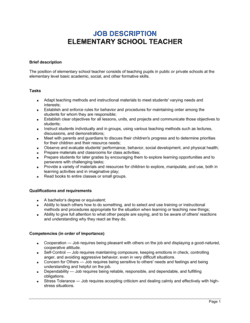
Part of your Business Operating System

This document is one of 3,000+ business & legal templates included in Business in a Box.

  • Fill-in-the-blanks — ready in minutes
  • 100% customizable Word document
  • Compatible with all office suites
  • Export to PDF and share electronically

Create your document in 3 simple steps.

From template to signed document — all inside one Business Operating System.
1
Download or open template

Access over 3,000+ business and legal templates for any business task, project or initiative.

2
Edit and fill in the blanks with AI

Customize your ready-made business document template and save it in the cloud.

3
Save, Share, Send, Sign

Share your files and folders with your team. Create a space of seamless collaboration.

Save time, save money, and create top-quality documents.

★★★★★

"Fantastic value! I'm not sure how I'd do without it. It's worth its weight in gold and paid back for itself many times."

Managing Director · Mall Farm
Robert Whalley
Managing Director, Mall Farm Proprietary Limited
★★★★★

"I have been using Business in a Box for years. It has been the most useful source of templates I have encountered. I recommend it to anyone."

Business Owner · 4+ years
Dr Michael John Freestone
Business Owner
★★★★★

"It has been a life saver so many times I have lost count. Business in a Box has saved me so much time and as you know, time is money."

Owner · Upstate Web
David G. Moore Jr.
Owner, Upstate Web

Run your business with a system — not scattered tools

Stop downloading documents. Start operating with clarity. Business in a Box gives you the Business Operating System used by over 250,000 companies worldwide to structure, run, and grow their business.

Free Forever Plan · No credit card required