City and Regional Planning Aide Job Description Template

Free Word download • Edit online • Save & share with Drive • Export to PDF

2 pages20–30 min to fillDifficulty: StandardSignature requiredLegal review recommended
Learn more ↓
FreeCity and Regional Planning Aide Job Description Template

At a glance

What it is
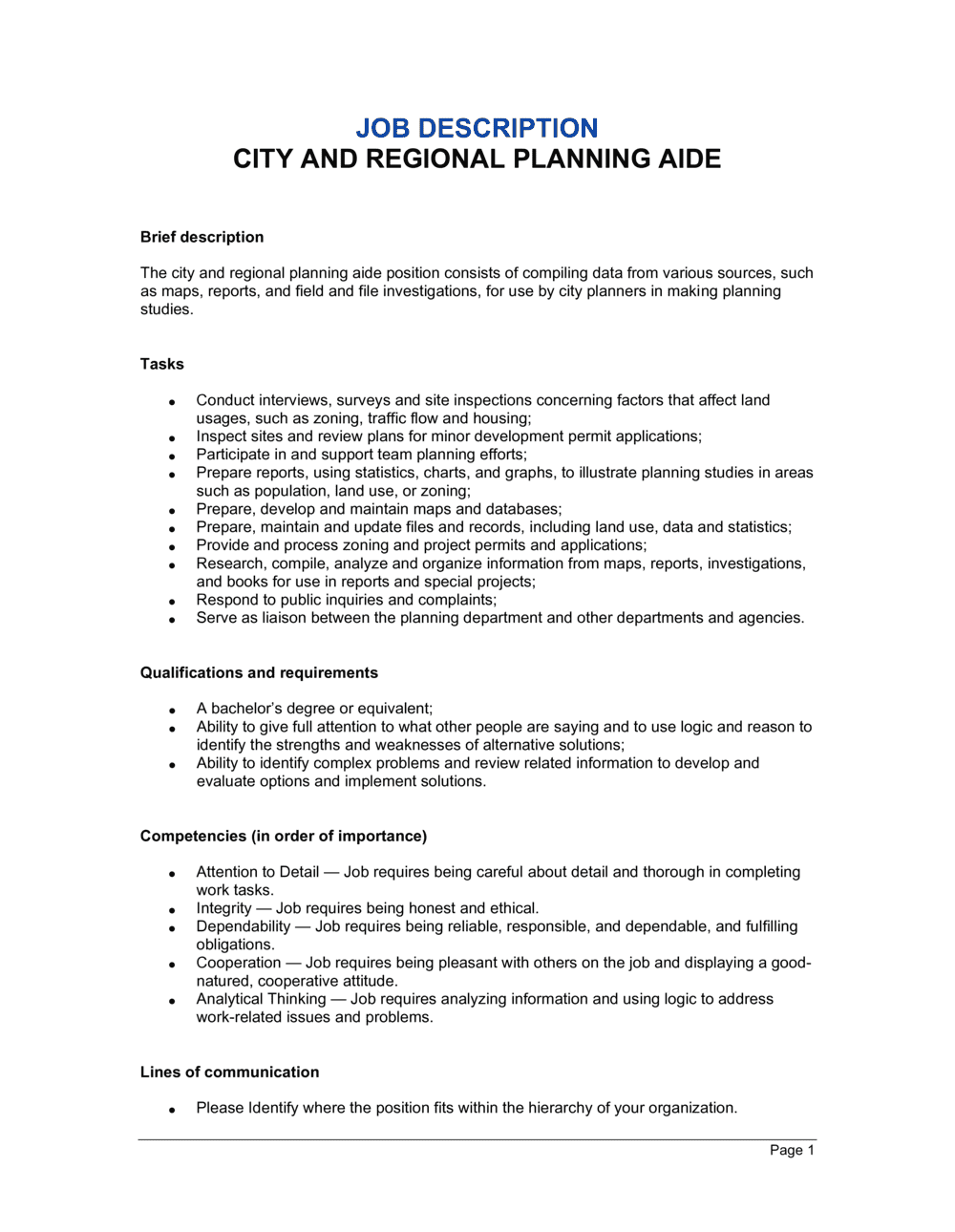
A City and Regional Planning Aide Job Description is a formal employment document that defines the role, responsibilities, required qualifications, reporting structure, and working conditions for a planning support professional in a municipal, county, or regional government context. This free Word download provides a structured, legally grounded starting point you can edit online and export as PDF for posting, onboarding, or classification review.
When you need it
Use it when hiring a new planning aide, reclassifying an existing position, posting a vacancy through a civil service portal, or updating role documentation to reflect changed duties following a departmental reorganization.
What's inside
Position summary, essential duties and responsibilities, required and preferred qualifications, supervisory relationships, working conditions, physical demands, compensation band reference, and acknowledgment signature block for employer and employee.

What is a City and Regional Planning Aide Job Description?

A City and Regional Planning Aide Job Description is a formal employment document that defines the duties, required qualifications, supervisory structure, physical demands, and working conditions for a planning support professional employed by a municipal, county, or regional government agency. It functions as both a civil service classification record and a binding statement of the role's essential functions — the latter being a legally significant designation under disability accommodation law and wage-and-hour compliance frameworks. This free Word download provides a complete, editable structure that covers every required element from the position identification block through the tri-party acknowledgment signature block, formatted for immediate use in a public-sector HR process.

Why You Need This Document

Without a properly drafted and signed job description, a planning aide position exists in a legal and administrative vacuum that creates compounding risk across four distinct areas. First, an undocumented or vague FLSA status exposes the jurisdiction to back-overtime liability stretching up to three years under federal law. Second, an incomplete list of essential functions prevents the employer from conducting a lawful ADA interactive process when an accommodation request arises — courts and arbitrators require specificity, not generic office-environment language. Third, in unionized public-sector environments, an unsigned or undated description becomes inadmissible in grievance proceedings challenging discipline, reclassification, or duty assignments. Fourth, civil service classification analysts cannot accurately grade or pay a position they cannot compare against class specifications — resulting in systemic pay inequity that surfaces during audit. This template eliminates all four gaps with a structured, legally grounded document you can complete in under an hour and use with confidence in any civil service, hiring, or compliance context.

Which variant fits your situation?

If your situation is…Use this template
Hiring an entry-level aide with no prior planning experienceCity And Regional Planning Aide Job Description (Entry Level)
Posting a senior aide role requiring GIS certification and independent project managementSenior Planning Technician Job Description
Defining a contracted planning support role rather than a staff positionIndependent Contractor Agreement
Hiring a full licensed urban planner rather than a support aideUrban Planner Job Description
Documenting the overall employment relationship after the position is filledEmployment Contract
Posting a temporary or seasonal planning aide for a specific projectFixed-Term Employment Contract
Creating a broader planning department staffing frameworkOrganizational Chart Template

Common mistakes to avoid

❌ Omitting the FLSA status designation

Why it matters: Without a documented non-exempt classification, supervisors may deny overtime to a planning aide who is legally entitled to it, creating wage-and-hour liability that can extend back three years under the FLSA.

Fix: Add an FLSA status line to the position identification block and confirm the designation with HR legal counsel before publishing the posting.

❌ Inflating required education credentials beyond job necessity

Why it matters: Requiring a bachelor's degree for a role that genuinely requires only an associate's degree or equivalent experience can constitute disparate-impact discrimination if the requirement disproportionately excludes protected groups without documented business necessity.

Fix: Align required qualifications with the actual competencies the job demands, and document in writing the business justification for each credential.

❌ Failing to document physical demands

Why it matters: Without specific physical requirements on record, the employer cannot conduct a lawful ADA interactive process when an employee requests accommodation — and risks being unable to defend a termination or transfer decision based on inability to perform physical duties.

Fix: List each physical activity with specifics — lift up to 30 lbs, drive a vehicle up to 20% of work time, stand during public hearings — so the record is clear before a request arises.

❌ Listing the same job description as both a posting document and the binding employment record without version control

Why it matters: Job postings are often written to attract applicants and contain marketing language that conflicts with the operational detail required in a personnel file description — using the same document for both creates ambiguity in grievance and reclassification proceedings.

Fix: Maintain two versions: a public-facing posting and an internal classification record. Both should be dated and signed; differences should be reconcilable and defensible.

❌ Signing the acknowledgment after the employee's start date

Why it matters: An unsigned job description at the time of hire weakens the employer's position in discipline, performance management, and reclassification proceedings, as the employee can credibly claim the duties were never formally agreed to.

Fix: Include the job description acknowledgment in the offer package and obtain signatures on or before day one, following the same timing discipline as the employment contract itself.

❌ Never updating the description after duties change materially

Why it matters: A job description that no longer reflects actual duties undermines FLSA exemption defenses, ADA essential-function analyses, and civil service classification audits — all of which rely on the description as authoritative.

Fix: Establish a formal review cycle — at minimum annually and within 30 days of any material duty change — and document each revision with a dated amendment signed by the supervisor and HR director.

The 10 key clauses, explained

Position Identification Block

In plain language: States the official job title, department, division, position control number, FLSA status, and salary grade or pay band.

Sample language
Job Title: City and Regional Planning Aide | Department: [DEPARTMENT NAME] | Division: [DIVISION NAME] | Position Control No.: [PCN] | FLSA Status: Non-Exempt | Pay Grade: [GRADE/BAND]

Common mistake: Omitting the FLSA status designation. Without it, managers may inadvertently deny overtime pay to a non-exempt planning aide, creating wage-and-hour liability under the FLSA or equivalent provincial statute.

Position Summary

In plain language: A 3–5 sentence overview of the role's primary purpose, the level of supervision received, and the general nature of the work — written for job boards, civil service postings, and classification review.

Sample language
Under the supervision of the [SUPERVISOR TITLE], the City and Regional Planning Aide performs technical and administrative support work assisting in the preparation, analysis, and presentation of land-use, zoning, and community development plans. Work is performed with limited independent judgment and is reviewed for accuracy and adherence to established procedures.

Common mistake: Writing the summary at such a high level of abstraction that it could describe any administrative role. Specificity — referencing zoning, GIS, or land-use analysis — is required for valid civil service classification.

Essential Duties and Responsibilities

In plain language: An itemized list of the core functions the employee must perform, including the estimated percentage of time spent on each major duty cluster, to establish ADA essential-function status.

Sample language
Essential duties include: (1) conducting field surveys and collecting data on land use, traffic, and environmental conditions ([X]% of time); (2) preparing GIS maps, charts, and statistical reports using [SOFTWARE] ([X]% of time); (3) reviewing permit applications for completeness and zoning compliance ([X]% of time); (4) assisting in the preparation of planning commission staff reports ([X]% of time).

Common mistake: Listing marginal or incidental duties as essential functions. Under the ADA, an employer cannot refuse to accommodate an employee's disability based on a duty that represents less than 5% of working time and is easily redistributed.

Supervisory Relationships

In plain language: Identifies who the employee reports to, at what level of supervision the work is performed, and whether the position has any authority to supervise, direct, or evaluate others.

Sample language
Reports to: [SUPERVISOR TITLE]. Work is performed under direct supervision with established procedures and periodic review. This position does not have supervisory authority over other employees.

Common mistake: Leaving the supervisory relationship blank or vague. An undefined reporting line creates ambiguity in performance review authority, union grievance procedures, and workers' compensation chain-of-command requirements.

Required Qualifications

In plain language: States the minimum education, experience, licensure, and technical skills an applicant must possess to be considered for the position — the threshold for civil service eligibility.

Sample language
Minimum qualifications: Associate's degree in urban planning, geography, public administration, or a related field, or [X] years of equivalent experience in a planning or land-use environment. Proficiency in GIS software ([SOFTWARE NAME]). Valid driver's license required.

Common mistake: Setting education requirements higher than the job genuinely demands — e.g., requiring a bachelor's degree for tasks that a two-year program covers adequately. This can constitute disparate-impact discrimination if the requirement disproportionately excludes protected groups without a documented business necessity.

Preferred Qualifications

In plain language: Lists knowledge, experience, and certifications that strengthen a candidate's application but are not minimum requirements for appointment.

Sample language
Preferred: Experience with [PLANNING SOFTWARE]; familiarity with [JURISDICTION] zoning code; completion of AICP coursework; bilingual proficiency in [LANGUAGE].

Common mistake: Treating preferred qualifications as tiebreakers in civil service scoring without documenting that weighting in the examination plan. Applying unwritten preference criteria after applications close exposes the hiring process to merit-system challenges.

Working Conditions and Physical Demands

In plain language: Describes the work environment — office, field, hybrid — and the physical requirements of the role, including lifting, standing, driving, and outdoor exposure, to satisfy ADA interactive-process obligations.

Sample language
Work is performed primarily in an office environment with periodic field assignments requiring outdoor work in varying weather conditions. Employee must be able to: lift and carry materials up to [X] lbs; operate a vehicle to conduct field surveys; stand for periods of up to [X] hours during public hearings.

Common mistake: Omitting physical demands entirely. Without documented physical requirements, the employer cannot engage in a lawful ADA interactive process when an employee or applicant requests accommodation for a condition that affects those demands.

Tools, Equipment, and Technology

In plain language: Lists the specific software, equipment, and systems the employee is expected to operate — establishing minimum technical competency and supporting IT access provisioning.

Sample language
Required tools: GIS platforms ([SOFTWARE NAME]); Microsoft Office Suite; [PERMITTING SOFTWARE]; standard survey equipment; departmental vehicles. Familiarity with [STATE/PROVINCIAL] public records systems preferred.

Common mistake: Generic references to 'standard office software' that do not specify the actual platforms in use. Planning aides are expected to be productive on day one with specific GIS and permitting systems — vague language leads to onboarding gaps and mismatched hires.

Compensation and Benefits Reference

In plain language: References the applicable pay grade or salary range, the benefits program, and any collective bargaining agreement that governs the position — without embedding specific dollar amounts in the job description itself.

Sample language
Compensation: Pay Grade [X], Step [Y]–[Z], per the [JURISDICTION] Classification and Compensation Plan currently in effect. Benefits are governed by the applicable collective bargaining agreement or employee handbook. Salary ranges are subject to annual budget appropriation.

Common mistake: Stating a specific salary dollar amount in the job description rather than referencing the pay grade. When the compensation plan is updated, every job description that cites a specific amount must be amended — creating administrative burden and potential inconsistency claims.

Acknowledgment and Signature Block

In plain language: Records that both the employer's authorized representative and the employee have reviewed, understood, and accepted the job description as an accurate statement of the position's duties and conditions.

Sample language
I have read and understand the duties, requirements, and conditions described in this job description. Employee Signature: __________________ Date: ________ | Supervisor Signature: __________________ Date: ________ | HR Director Approval: __________________ Date: ________

Common mistake: Obtaining only the employee's signature and not the supervisor's or HR director's. A tri-party acknowledgment creates a clear record that the description was reviewed and approved at the department level — essential for grievance defense and reclassification requests.

How to fill it out

  1. 1

    Complete the position identification block

    Enter the official job title, department, division, position control number, FLSA status (non-exempt for most planning aides), and the applicable pay grade or salary band from your current classification plan.

    💡 Confirm the FLSA classification with HR or legal before publishing — misclassifying a non-exempt aide as exempt is one of the most common and costly wage-and-hour errors in local government.

  2. 2

    Draft the position summary

    Write 3–5 sentences describing the role's primary purpose, the nature of work performed, and the level of supervision received. Reference specific planning functions — zoning review, GIS mapping, permit intake — rather than generic administrative language.

    💡 Civil service classification analysts compare the position summary against class specifications to determine grade. Generic summaries often result in underpayment of the position.

  3. 3

    List essential duties with time percentages

    Itemize each core function and estimate the percentage of working time dedicated to each duty cluster. Mark duties as essential only if they represent a meaningful, non-redistributable portion of the role.

    💡 Aim for 5–8 essential duty statements; fewer suggests the role is too narrow for a full-time position, more suggests the description is actually covering two roles.

  4. 4

    Define the supervisory relationship

    Name the supervisor's title, specify the level of oversight (direct, general, or administrative), and confirm whether the aide has any lead-worker or supervisory authority over others.

    💡 In unionized jurisdictions, the presence or absence of supervisory authority determines bargaining unit eligibility — a misstatement here can trigger a unit clarification petition.

  5. 5

    Set required and preferred qualifications

    State the minimum education and experience a candidate must have to qualify. Separately list preferred qualifications that add value but are not eliminatory. Ensure required credentials are genuinely necessary for the role.

    💡 If your jurisdiction uses a structured civil service examination, required qualifications must match the approved class specification exactly — deviations require a formal amendment before posting.

  6. 6

    Document working conditions and physical demands

    Describe the primary work environment and list specific physical activities the role requires — lifting limits, driving frequency, outdoor exposure, extended standing. Be precise rather than vague.

    💡 This section is the foundation for any future ADA reasonable accommodation analysis. Courts and arbitrators look for specificity; 'normal office conditions' is insufficient.

  7. 7

    Obtain signatures before the employee's first day

    Have the hiring supervisor, HR director, and incoming employee sign the acknowledgment block before the start date. File the signed original in the personnel record.

    💡 In jurisdictions with civil service systems, an unsigned or undated job description may be challenged in a reclassification appeal — signatures establish the baseline duties at the time of appointment.

  8. 8

    Schedule a review date

    Add a next-review date — typically 12–24 months or upon any material change in duties — to the header or footer of the document. Record the review date in your HR calendar.

    💡 Job descriptions that are never updated become legally problematic: courts have found that outdated descriptions reflecting obsolete duties cannot support a valid FLSA exemption or ADA essential-function defense.

Frequently asked questions

What does a city and regional planning aide do?

A city and regional planning aide provides technical and administrative support to licensed planners working on land-use, zoning, environmental, and community development projects. Typical duties include conducting field surveys, preparing GIS maps, reviewing permit applications for completeness, compiling statistical data, and drafting staff reports for planning commission hearings. The role operates under supervision and does not require independent professional judgment at the level of a licensed planner.

Why does a planning aide job description need to be a formal legal document?

In the public sector, a job description is the foundational document for civil service classification, merit-system hiring, FLSA compliance, ADA accommodation analysis, and labor-relations grievance proceedings. Courts, arbitrators, and civil service commissions treat the signed job description as the authoritative record of a position's duties and requirements. An informal or incomplete description creates liability exposure on multiple fronts simultaneously.

What qualifications are typically required for a planning aide position?

Most jurisdictions require an associate's degree in urban planning, geography, environmental studies, or public administration — or an equivalent combination of education and experience. GIS proficiency and a valid driver's license are standard requirements. Some positions require familiarity with specific permitting software or local zoning codes. A bachelor's degree is typically reserved for senior aide or planning technician classifications.

Is a planning aide an exempt or non-exempt employee under the FLSA?

Planning aides are almost universally classified as non-exempt under the FLSA because they perform technical support work under supervision rather than exercising the independent discretion and judgment required for the administrative or learned professional exemptions. This means they are entitled to overtime at 1.5 times their regular rate for hours worked beyond 40 in a workweek. Employers should confirm the designation with legal counsel, particularly for senior aide roles with broader responsibilities.

Do I need to include physical demands in a planning aide job description?

Yes. Planning aides regularly conduct field surveys, attend public hearings, operate vehicles, and carry equipment. Documenting these physical demands in the job description is legally necessary to support the ADA interactive process if an employee or applicant requests accommodation. A description that omits physical demands cannot be used to support a determination that a specific physical activity is an essential function of the role.

How often should a planning aide job description be updated?

At minimum, review it annually as part of the performance cycle and within 30 days of any material change in duties — such as the adoption of new GIS platforms, a reorganization that shifts supervision, or a significant change in the permit intake workload. Job descriptions more than 24 months old without a documented review are routinely challenged in civil service reclassification appeals and FLSA audits.

Can a city use the same job description for multiple planning aide positions?

A single class specification can cover multiple positions in the same classification, but individual position descriptions should capture any position-specific duties, software requirements, or supervisory relationships that differ across incumbents. Using an identical description for roles with materially different day-to-day work undermines classification accuracy and can create pay equity problems if the differences are significant.

What is the difference between a job description and a job posting for a planning aide?

A job posting is a marketing document designed to attract qualified applicants — it emphasizes the role's appeal and summarizes key requirements. A job description is a binding internal record that defines essential functions, classification criteria, physical demands, and supervisory relationships for HR, legal, and civil service purposes. The posting is derived from the description, not a substitute for it. Both should be maintained with separate version control and dated signatures.

Does a planning aide job description need to be signed?

Yes. A tri-party signature — employee, supervisor, and HR director — is best practice and in many civil service systems a procedural requirement. The employee's signature confirms they received and understood the description; the supervisor's signature establishes that the description accurately reflects current duties; the HR director's approval confirms classification compliance. Signatures should be obtained before or on the employee's first day of work.

How this compares to alternatives

vs Urban Planner Job Description

An urban planner job description covers a licensed professional who exercises independent judgment, leads community engagement, and manages projects from inception to adoption. A planning aide description covers a support role performed under supervision, with technical and administrative functions. The aide position typically requires an associate's degree; the planner position requires a bachelor's or master's degree and often AICP certification. Using the wrong template results in misclassification and pay grade errors.

vs Employment Contract

A job description defines what the employee is expected to do — duties, qualifications, and working conditions. An employment contract defines the legal terms of the relationship — compensation, benefits, IP assignment, termination, and severance. Both documents are needed: the job description establishes the role; the contract governs the employment itself. The job description is typically incorporated by reference into the employment contract.

vs Independent Contractor Agreement

A planning aide job description creates an employer-employee relationship with all associated entitlements — overtime, benefits, workers' compensation, and civil service protections. An independent contractor agreement engages a self-employed professional for a defined scope of work with no employment entitlements. Misclassifying a planning aide as a contractor exposes the jurisdiction to back taxes, benefit liability, and civil service merit-system violations.

vs Fixed-Term Employment Contract

A fixed-term contract governs the legal duration and termination conditions for a time-limited position. A job description defines the duties and qualifications regardless of whether the position is permanent or fixed-term. Both are required when hiring a planning aide for a grant-funded project with a defined end date — the description establishes the role; the fixed-term contract establishes when and how it ends.

Industry-specific considerations

Municipal Government

Planning aides in city government support zoning administration, permit intake, and planning commission meetings — requiring civil service classification compliance and FLSA non-exempt designation.

Regional Planning Agencies

Multi-jurisdictional agencies hire planning aides to support transportation, environmental, and land-use studies across member counties, often requiring cross-boundary GIS work and intergovernmental reporting.

Nonprofit and Community Development

Nonprofits focused on affordable housing and land use hire planning aides to support community outreach, rezoning applications, and grant-funded planning studies — with job descriptions tailored to grant compliance requirements.

Consulting and Engineering Firms

Private planning and engineering consultancies hire planning aides as billable support staff, requiring job descriptions that align with client contract deliverables and professional services labor classifications.

Jurisdictional notes

United States

Planning aide positions in US municipal and county government are governed by civil service merit systems at the state and local level. The FLSA classifies most planning aides as non-exempt, entitling them to overtime for hours exceeding 40 per week. The ADA requires that essential functions be specifically documented to support the interactive accommodation process. State-specific wage-and-hour laws — particularly in California, New York, and Washington — may impose additional documentation and classification requirements beyond federal minimums.

Canada

Provincial employment standards legislation — including Ontario's Employment Standards Act and BC's Employment Standards Act — governs minimum notice, overtime, and termination entitlements for planning aides in municipal and regional government. Quebec requires all employment documents for provincially regulated public-sector employers to be provided in French. Human rights codes in each province mandate that job requirements be defensibly connected to bona fide occupational requirements, with particular attention to education and physical demand criteria.

United Kingdom

Local planning authorities in England, Scotland, Wales, and Northern Ireland must comply with the Equality Act 2010, which requires that job requirements be justified as proportionate means of achieving a legitimate aim. Job descriptions for planning support roles in the public sector are subject to equal pay legislation and should be evaluated through job evaluation schemes such as NJC for Local Government Services. The Working Time Regulations 1998 set limits on working hours that must be reflected in the working conditions section.

European Union

The EU Transparent and Predictable Working Conditions Directive (2019/1152) requires that employees receive written information on the essential aspects of their role, including duties, working conditions, and probationary terms, within seven days of commencing work. GDPR applies to the personal data collected and retained in job descriptions and personnel files — including applicant data gathered during the hiring process. Member state labor law varies significantly; France, Germany, and the Netherlands each impose specific requirements on job classification and pay-grade transparency.

Template vs lawyer — what fits your deal?

PathBest forCostTime
Use the templateStandard planning aide hires in jurisdictions with established civil service class specifications and a documented HR processFree30–60 minutes
Template + legal reviewNew positions without an existing class specification, roles in unionized environments, or jurisdictions undergoing reclassification audits$300–$800 (HR consultant or employment attorney review)2–5 business days
Custom draftedPositions with novel duties not covered by existing class specs, multi-jurisdictional agencies, or descriptions required as evidence in classification litigation$1,000–$3,5001–3 weeks

Glossary

Position Classification
The formal process of assigning a job to a specific grade or pay band based on its duties, responsibilities, and required qualifications.
Essential Functions
The core duties that define a position and cannot be removed without fundamentally changing the job — a legal distinction under the ADA and equivalent statutes.
FLSA Status
A US designation — exempt or non-exempt — that determines whether an employee is entitled to overtime pay under the Fair Labor Standards Act.
Civil Service Classification
A merit-based system used by government employers to group positions with similar duties and qualifications into official job classes with defined pay ranges.
GIS (Geographic Information System)
Software used to capture, manage, analyze, and display geographic data — a core technical tool for planning aides supporting land-use and infrastructure work.
Supervisory Relationship
The documented chain of command — who the employee reports to and whether the position has authority to direct the work of others.
Knowledge, Skills, and Abilities (KSAs)
A structured framework used in public-sector hiring to define the competencies required to perform a job at an acceptable level.
Reasonable Accommodation
A modification to a job, work environment, or the way work is performed that enables a qualified person with a disability to perform essential functions.
At-Will Employment
An employment arrangement in which either party may end the relationship at any time for any lawful reason — applicable in most US states but not in Canada, the UK, or the EU.
Position Control Number
A unique identifier assigned by HR or finance to each authorized position for budget tracking, headcount management, and payroll purposes.
Bona Fide Occupational Qualification (BFOQ)
A qualification that an employer may lawfully require for a specific job when it is genuinely necessary for job performance — a narrow legal exception to anti-discrimination rules.

Part of your Business Operating System

This document is one of 3,000+ business & legal templates included in Business in a Box.

  • Fill-in-the-blanks — ready in minutes
  • 100% customizable Word document
  • Compatible with all office suites
  • Export to PDF and share electronically

Create your document in 3 simple steps.

From template to signed document — all inside one Business Operating System.
1
Download or open template

Access over 3,000+ business and legal templates for any business task, project or initiative.

2
Edit and fill in the blanks with AI

Customize your ready-made business document template and save it in the cloud.

3
Save, Share, Send, Sign

Share your files and folders with your team. Create a space of seamless collaboration.

Save time, save money, and create top-quality documents.

★★★★★

"Fantastic value! I'm not sure how I'd do without it. It's worth its weight in gold and paid back for itself many times."

Managing Director · Mall Farm
Robert Whalley
Managing Director, Mall Farm Proprietary Limited
★★★★★

"I have been using Business in a Box for years. It has been the most useful source of templates I have encountered. I recommend it to anyone."

Business Owner · 4+ years
Dr Michael John Freestone
Business Owner
★★★★★

"It has been a life saver so many times I have lost count. Business in a Box has saved me so much time and as you know, time is money."

Owner · Upstate Web
David G. Moore Jr.
Owner, Upstate Web

Run your business with a system — not scattered tools

Stop downloading documents. Start operating with clarity. Business in a Box gives you the Business Operating System used by over 250,000 companies worldwide to structure, run, and grow their business.

Start free · No credit card required