1
Enter the salon's legal entity name and location
Use the salon's registered business name — not the trade name alone — and specify the physical address where the hairdresser will work. If the salon has multiple locations, state which applies.
💡 If the stylist may be asked to work across locations, add 'or such other location as reasonably required by the Employer' to avoid amendment obligations later.
2
Define the role title and reporting line
Specify the exact job title (e.g., Senior Hair Stylist, Colourist, Junior Hairdresser) and the name or title of the person they report to. Add a brief summary sentence describing the role's purpose.
💡 Avoid inflating titles — a 'Senior Stylist' who reports to an owner-operator has different expectations than one managing junior staff, and title-duty mismatches create performance management problems.
3
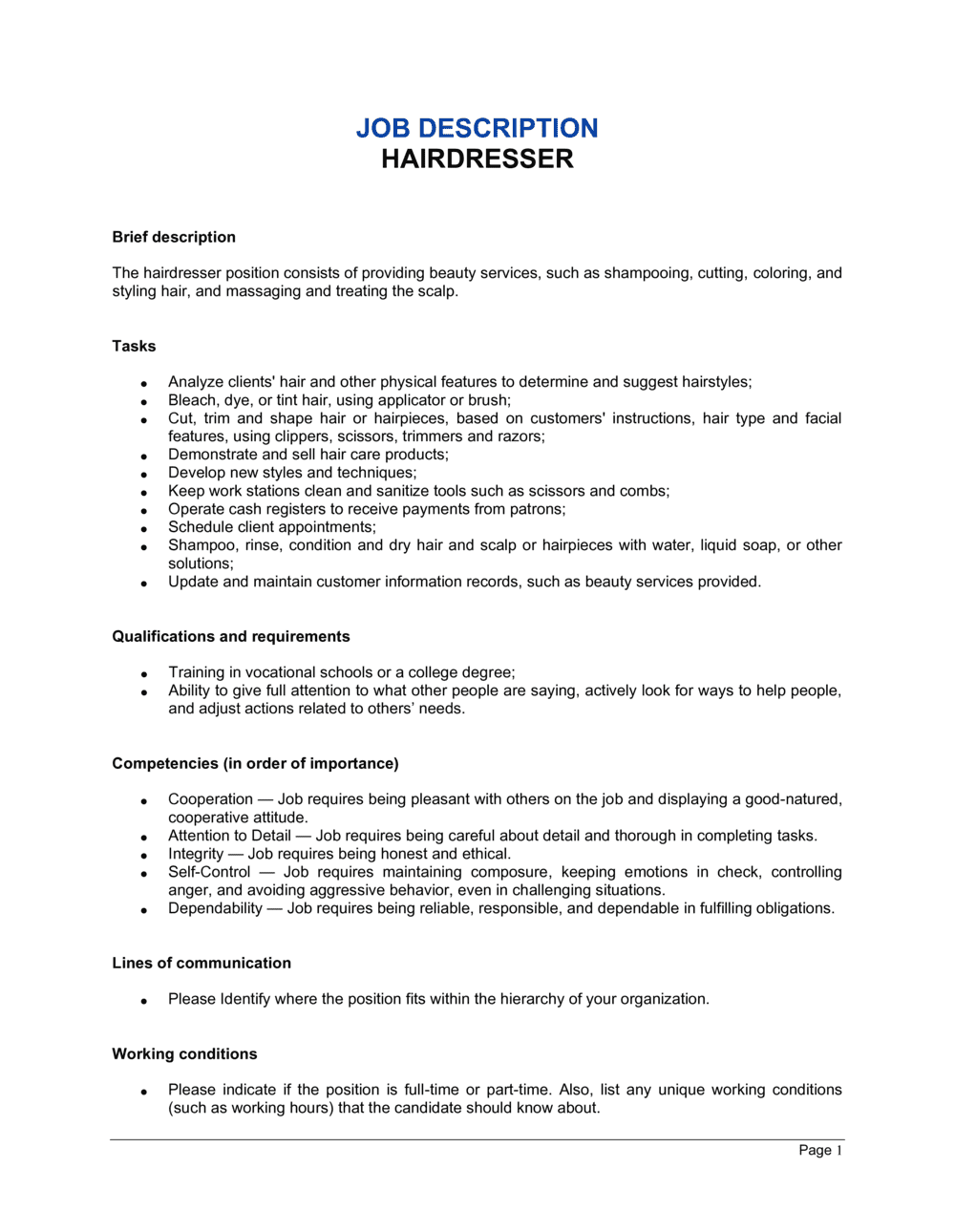
List all required services and duties in specific terms
Write out every service the employee is expected to perform — haircuts, colour, bleach, perms, blowouts, extensions, retail sales — and include client consultation and booking management duties.
💡 Move granular service lists to a Schedule A attached to the employment contract so the job description can be updated without amending the main agreement.
4
Confirm licence requirements and insert the licence number
Record the employee's cosmetology or barbering licence number and the issuing authority. State the obligation to maintain the licence and notify the employer if it is suspended or expires.
💡 Set a calendar reminder for the licence renewal date — lapses expose the salon to regulatory penalties and create grounds for employment disputes.
5
Complete the compensation block with exact figures
Enter the base hourly rate or salary, commission percentage (if applicable), payment frequency, and whether tips are retained by the employee or pooled. Confirm the figure meets or exceeds the applicable minimum wage.
💡 Where commission applies, include a floor: 'Employee will receive no less than $[MINIMUM WAGE] per hour for all hours worked, with commission credited first against this floor.'
6
Set the schedule and availability requirements
Specify the regular working days, start and end times, and minimum hours. Note any Saturday, Sunday, or evening availability requirements explicitly.
💡 Include a clause allowing the employer to adjust the schedule by [X] days' notice — locking in a rigid schedule in writing limits operational flexibility.
7
Tailor the non-solicitation clause to the role
Set the restriction period proportionate to the stylist's seniority and client relationship depth — 6 months for junior stylists, up to 12 months for senior or lead stylists with large established client books.
💡 Confirm non-solicitation enforceability in your jurisdiction before finalizing — California and several other states impose strict limits on post-employment restrictions even for hairdressers.
8
Sign before the first day of work and retain a countersigned copy
Both the employer and employee must sign before or on the first day of employment. Post-start-date signatures risk voiding restrictive covenants for lack of consideration in common-law jurisdictions.
💡 Use Business in a Box eSign to timestamp execution and store the countersigned document automatically — avoid relying on emailed PDF exchanges without a signature audit trail.