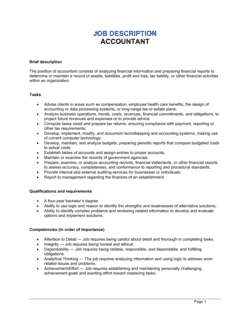
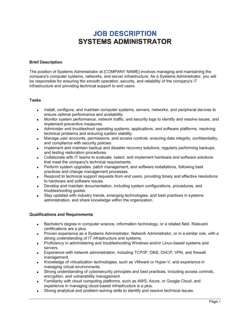
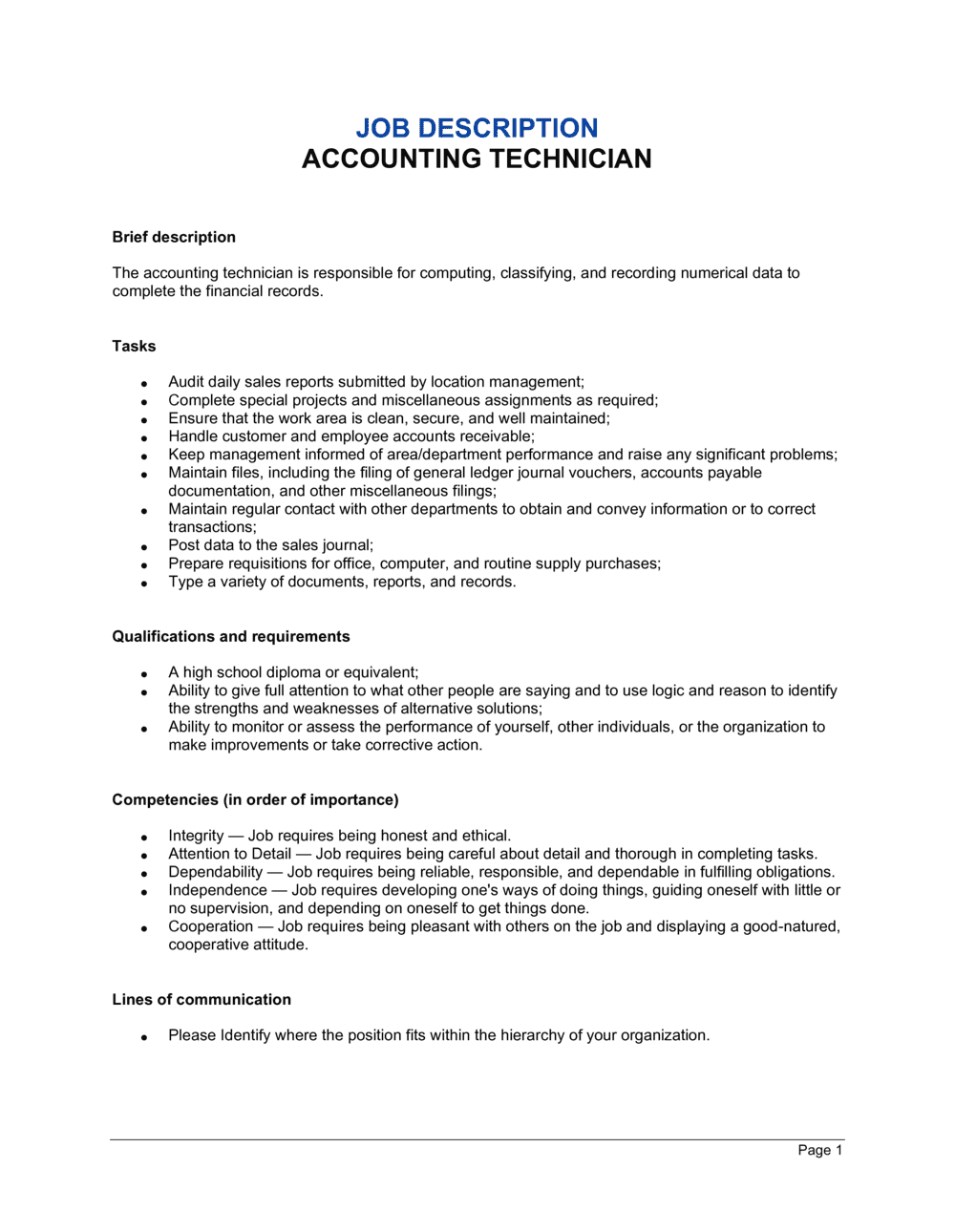
Accounting Technician Job Description Template

Free Word download • Edit online • Save & share with Drive • Export to PDF

3 pages25–30 min to fillDifficulty: StandardSignature requiredLegal review recommended
Learn more ↓
FreeAccounting Technician Job Description Template

At a glance

What it is
An Accounting Technician Job Description is a formal document that defines the scope of an accounting technician role within an organization — covering duties, required qualifications, reporting lines, compensation range, and performance expectations. This free Word download can be edited online and exported as PDF for internal approval, posting on job boards, or inclusion in an employment contract package.
When you need it
Use it when creating a new accounting technician position, backfilling a vacancy, or standardizing role definitions across a finance department. It is also required when attaching a formal position description to an employment agreement prior to a candidate's first day.
What's inside
Job title and department, position summary, detailed duties and responsibilities, required and preferred qualifications, reporting structure, compensation and benefits overview, working conditions, and acknowledgment signature block for the employee and hiring manager.

What is an Accounting Technician Job Description?

An Accounting Technician Job Description is a formal document that defines the scope, duties, qualifications, reporting structure, compensation range, and performance expectations for an accounting technician position within an organization. It covers every material dimension of the role — from transaction-level responsibilities such as accounts payable processing and bank reconciliations, to the minimum credentials required, the supervisor the technician reports to, and the confidentiality obligations that apply given the sensitive financial data they handle. When signed by the employee and hiring manager, the document becomes part of the employment record and provides a binding reference point for onboarding, performance management, and, if necessary, disciplinary proceedings.

Why You Need This Document

Without a clearly written and signed job description, role expectations exist only in someone's head — and head knowledge does not hold up in a performance review dispute, a wrongful termination claim, or a pay equity audit. An accounting technician who processes vendor invoices, reconciles bank accounts, and prepares month-end journal entries has access to some of the most sensitive data in your organization; the duties and confidentiality obligations that govern that access need to be documented and acknowledged in writing before day one. Employers in Colorado, California, New York, and other pay-transparency jurisdictions are also legally required to include a salary range in any posting — a requirement this template satisfies. By pairing this job description with a signed employment agreement, you close the gaps that leave employers exposed to misclassification penalties, implied contract claims, and compensation disputes before they arise.

Which variant fits your situation?

If your situation is…Use this template
Hiring a junior accounts payable or receivable clerkAccounting Clerk Job Description
Defining a senior or supervisory accounting technician roleSenior Accountant Job Description
Posting a full-charge bookkeeper positionBookkeeper Job Description
Hiring a certified public accountant or CPAAccountant Job Description
Defining a payroll-specific accounting support rolePayroll Administrator Job Description
Attaching the job description to a formal employment contractEmployment Contract
Hiring a temporary or contract accounting technicianIndependent Contractor Agreement

Common mistakes to avoid

❌ Omitting the FLSA or employment classification

Why it matters: Misclassifying an accounting technician as exempt when they perform routine, non-discretionary tasks exposes the employer to back overtime, liquidated damages, and DOL or equivalent agency penalties.

Fix: Confirm classification before drafting. Accounting technicians whose primary duties are processing transactions and reconciliations are typically non-exempt — document the analysis in the HR file.

❌ Listing duties without frequency or volume

Why it matters: Vague duty statements like 'processes invoices' give candidates no way to assess fit and give managers no baseline for performance evaluation — leading to mismatched hires and disputed expectations.

Fix: Add frequency (daily, weekly, monthly) and volume (150 invoices per week, 8 bank accounts) to each significant duty so both parties enter the relationship with aligned expectations.

❌ Skipping the salary range in jurisdictions that require it

Why it matters: Colorado, California, New York, Washington, and other jurisdictions mandate salary range disclosure in job postings. Non-compliance results in fines and removes the employer from compliant job boards.

Fix: Research pay transparency requirements in every jurisdiction where the role may be posted or filled. Add the range before the description leaves HR review.

❌ Using the job description as the sole confidentiality agreement

Why it matters: A confidentiality clause in a job description is generally not enforceable as a standalone agreement — courts look for mutual consideration and a signed employment contract or NDA.

Fix: Pair the job description with a signed employment agreement or standalone NDA that includes a proper confidentiality clause. The job description clause should reference, not replace, that document.

❌ Omitting the not-an-employment-contract disclaimer

Why it matters: Without a clear disclaimer, employees in some jurisdictions have successfully argued that job description language — particularly around duties and compensation — creates implied contractual terms.

Fix: Add a one-sentence disclaimer in the signature block stating that the job description does not constitute an employment contract and that the governing terms are set out in a separate agreement.

❌ Setting required qualifications that are not job-related

Why it matters: Requiring credentials that do not predict job performance — such as a four-year degree for a role requiring only associate-level accounting skills — can constitute disparate impact discrimination and shrinks the qualified candidate pool unnecessarily.

Fix: Audit every required qualification against the essential duties. If you cannot explain how the credential improves performance of a specific duty, reclassify it as preferred or remove it.

The 10 key clauses, explained

Job Title, Department, and Classification

In plain language: States the official position title, the department it sits in, the employment classification (full-time, part-time, exempt or non-exempt), and the effective date of the description.

Sample language
Job Title: Accounting Technician | Department: Finance & Accounting | Classification: Full-Time, Non-Exempt | Effective Date: [DATE]

Common mistake: Leaving the FLSA or employment classification blank. Misclassifying a non-exempt accounting technician as exempt exposes the employer to back overtime pay and regulatory penalties.

Position Summary

In plain language: A concise paragraph explaining what the accounting technician does, why the role exists, and how it supports the broader finance function.

Sample language
The Accounting Technician supports the Finance department of [COMPANY NAME] by maintaining accurate financial records, processing accounts payable and receivable transactions, performing monthly bank reconciliations, and assisting in the preparation of financial reports under the supervision of the [TITLE].

Common mistake: Writing a position summary that simply repeats the job title. A vague summary fails to attract qualified candidates and provides no baseline for performance management.

Essential Duties and Responsibilities

In plain language: A detailed, prioritized list of the tasks the accounting technician is expected to perform regularly, written in action-verb format.

Sample language
1. Process vendor invoices and employee expense reports in [ACCOUNTING SOFTWARE] within [X] business days of receipt. 2. Perform monthly bank and credit card reconciliations for [X] accounts. 3. Prepare and post journal entries to the general ledger. 4. Assist in month-end and year-end close procedures. 5. Generate AR aging reports weekly and follow up on balances overdue by more than [X] days.

Common mistake: Listing duties without frequency or volume context. 'Processes invoices' tells a candidate nothing; '150–200 vendor invoices per week' sets a realistic expectation and filters for the right candidates.

Required Qualifications

In plain language: The minimum education, certification, years of experience, and technical skills a candidate must have to be considered for the role.

Sample language
Required: Associate's degree in Accounting, Finance, or a related field, or equivalent combination of education and experience. Minimum [X] years of bookkeeping or accounting support experience. Proficiency in [ACCOUNTING SOFTWARE — e.g., QuickBooks, Sage, NetSuite]. Working knowledge of GAAP principles.

Common mistake: Setting minimum qualifications that are either too low (attracting unqualified candidates) or artificially inflated (potentially triggering discrimination claims for requirements unrelated to job performance).

Preferred Qualifications

In plain language: Additional credentials or experience that are advantageous but not required — used to identify stronger candidates above the minimum threshold.

Sample language
Preferred: Accounting Technician certification (e.g., AAT, APA, or CAT). Experience with [SPECIFIC ERP OR SOFTWARE]. Prior experience in [INDUSTRY]. Familiarity with [APPLICABLE TAX REGIME — e.g., GST/HST, VAT, sales tax].

Common mistake: Listing preferred qualifications that are functionally treated as required during screening. This practice can reduce the qualified candidate pool unnecessarily and may create legal exposure if preferred credentials screen out protected groups.

Reporting Structure and Supervision

In plain language: Specifies who the accounting technician reports to directly, any dotted-line reporting relationships, and whether the role has supervisory responsibility over other staff.

Sample language
Reports to: [CONTROLLER / ACCOUNTING MANAGER / CFO]. Dotted-line coordination with: [DEPARTMENT HEADS] for expense approvals. Supervisory responsibility: None / Oversees [X] accounts payable clerk(s).

Common mistake: Omitting the reporting line entirely, which creates confusion about decision-making authority, approval chains, and who conducts performance reviews.

Compensation, Classification, and Benefits

In plain language: States the salary range or hourly rate, overtime eligibility, and a reference to the benefits package the position qualifies for.

Sample language
Salary Range: $[MIN] – $[MAX] per year / Hourly Rate: $[MIN] – $[MAX]. Overtime: Eligible (non-exempt) / Not eligible (exempt). Benefits: Eligible for the Company's standard benefits program including health, dental, vision, and retirement, as described in the current Employee Handbook.

Common mistake: Publishing a single salary figure instead of a range, or omitting compensation entirely. In jurisdictions with pay transparency laws — including Colorado, California, and New York — failing to include a salary range is a compliance violation.

Working Conditions and Physical Requirements

In plain language: Describes the work environment (office, remote, hybrid), standard hours, and any physical demands relevant to the role.

Sample language
Work Environment: [On-site / Hybrid / Remote]. Standard Hours: Monday–Friday, [START TIME] – [END TIME], with occasional overtime during month-end and year-end close. Physical Requirements: Prolonged periods of sitting at a workstation. Ability to lift up to [X] lbs for filing and office supply management.

Common mistake: Skipping physical requirements entirely for office roles. Even sedentary positions have ADA-relevant physical requirements — omitting them removes an important accommodation reference point.

Confidentiality and Data Handling Obligations

In plain language: Affirms that the accounting technician will handle financial data, vendor information, and payroll records with strict confidentiality and in accordance with company policy and applicable law.

Sample language
The Accounting Technician will have access to sensitive financial data, including vendor payment details, payroll information, and company financial statements. Employee agrees to maintain strict confidentiality of all such information during and after employment, consistent with [COMPANY NAME]'s Data Protection Policy and applicable law.

Common mistake: Treating the job description's confidentiality clause as a substitute for the confidentiality clause in the employment agreement. The two must be aligned — inconsistencies between them can create ambiguity in enforcement.

Acknowledgment and Signature Block

In plain language: A section where both the employee and the hiring manager or HR representative sign and date the document to confirm the employee has received, read, and understood the job description.

Sample language
I have read and understood the duties, qualifications, and expectations set out in this job description. I understand that this document does not constitute an employment contract and that my employment remains [at-will / subject to the terms of my Employment Agreement dated [DATE]]. Employee Signature: _________________ Date: ________ | Manager Signature: _________________ Date: ________

Common mistake: Omitting the disclaimer that the job description is not an employment contract. Without it, employees in some jurisdictions have argued that the job description creates enforceable contractual terms — particularly around duties, compensation, or termination.

How to fill it out

  1. 1

    Confirm the job classification before anything else

    Determine whether the role is full-time or part-time, and whether it is exempt or non-exempt under FLSA (US) or the equivalent classification in your jurisdiction. This classification drives overtime eligibility and affects several other fields.

    💡 Accounting technicians who primarily perform routine bookkeeping tasks are almost always non-exempt under FLSA — confirm with an HR advisor before listing the role as exempt.

  2. 2

    Write the position summary from the organization's perspective

    Draft two to three sentences explaining what the accounting technician does, the primary outputs they are responsible for, and how the role supports the finance function. Write for a reader who knows nothing about your internal structure.

    💡 A strong position summary answers three questions in order: What does this person do? For whom? To what end? If any of those answers is missing, the summary is incomplete.

  3. 3

    List essential duties with frequency and volume indicators

    Write eight to twelve duty statements in action-verb format. For recurring tasks, include the frequency (daily, weekly, monthly) and volume (number of invoices, accounts, or reports) so candidates can self-assess fit.

    💡 Lead with the most time-consuming duties. Candidates and managers both use the order of the duty list as a proxy for what the role actually prioritizes.

  4. 4

    Set qualifications that match the actual job requirements

    Enter the minimum education, years of experience, and technical skills that genuinely predict success in the role. For preferred qualifications, list only credentials that provide a measurable performance advantage.

    💡 Cross-reference the duty list when setting qualifications. Every required qualification should map to at least one essential duty — if it doesn't, remove it.

  5. 5

    Define the reporting structure and any supervisory scope

    Enter the direct supervisor's title, any dotted-line relationships, and whether the accounting technician will oversee any other staff. If the role has no supervisory duties, state that explicitly.

    💡 Use titles rather than names in the reporting structure. When the manager changes, the job description remains accurate without amendment.

  6. 6

    Enter the compensation range and benefits reference

    Add the salary or hourly range for the position. Reference the benefits program by category (health, dental, retirement) rather than embedding specific plan details, which change annually.

    💡 If your jurisdiction has a pay transparency law, including the salary range is a legal requirement — not optional. Check state and local requirements before posting.

  7. 7

    Add confidentiality and data handling language

    Insert the confidentiality obligations relevant to the role, referencing the company's Data Protection Policy by name. Ensure the language is consistent with the confidentiality clause in the employee's employment agreement.

    💡 If the accounting technician will have access to payroll data, call that out specifically. Payroll confidentiality is treated differently from general financial data in several jurisdictions.

  8. 8

    Obtain signatures before or on the first day

    Present the signed job description together with the employment agreement for execution before the employee's start date. Retain a signed copy in the employee's HR file and provide a copy to the employee.

    💡 Include the not-an-employment-contract disclaimer in the signature block and have the employee initial it separately if your jurisdiction has a history of job-description contract claims.

Frequently asked questions

What is an accounting technician job description?

An accounting technician job description is a formal document that defines the scope, duties, qualifications, reporting structure, and compensation range for an accounting technician position within an organization. It serves as the authoritative reference for recruiting, onboarding, performance management, and compensation decisions. When signed by the employee, it also forms part of the employment documentation package.

What does an accounting technician do?

An accounting technician handles day-to-day financial record-keeping tasks below the CPA level — including processing accounts payable and receivable invoices, performing bank reconciliations, posting journal entries to the general ledger, preparing basic financial reports, and supporting month-end and year-end close procedures. The exact scope varies by industry and organization size.

What qualifications should I require for an accounting technician?

Minimum qualifications typically include an associate's degree in accounting, finance, or a related field — or equivalent work experience — along with one to three years of bookkeeping or accounting support experience and proficiency in at least one accounting software platform such as QuickBooks, Sage, or NetSuite. Preferred qualifications may include an AAT, APA, or CAT certification. Avoid requiring a four-year degree if the duties do not demand it, as this can reduce the candidate pool and raise compliance questions.

Is an accounting technician job description a legally binding document?

A job description is generally not a standalone binding contract in most jurisdictions, but it can create implied obligations if it contains specific duty or compensation promises without a disclaimer. Courts have considered job descriptions as evidence of the employment relationship's terms. For this reason, every job description should include a clear disclaimer stating that it does not constitute an employment contract, and should be accompanied by a signed employment agreement.

Should the job description be signed by the employee?

Yes. Having the employee sign and date the job description before or on their first day confirms they received, read, and understood their role expectations. This signed acknowledgment is valuable in performance management and termination situations where disputed duties or expectations are raised. Retain the signed copy in the employee's HR file alongside their employment agreement.

Do I need to include a salary range in the job description?

In several US states — including Colorado, California, New York, and Washington — pay transparency laws require salary range disclosure in job postings and sometimes in job descriptions provided to candidates. In Canada, Ontario and British Columbia are moving toward similar requirements. In the UK and EU, pay equity reporting obligations are expanding. Check the applicable rules in every jurisdiction where the role will be posted or filled before finalizing the document.

How is an accounting technician different from a full accountant?

An accounting technician performs structured, transaction-level tasks — data entry, reconciliations, invoice processing, and basic report preparation — typically under the supervision of a CPA or controller. A full accountant applies professional judgment to complex financial decisions, prepares and signs off on financial statements, and may hold a CPA, CA, or ACCA designation. The distinction matters for classification, compensation benchmarking, and liability — accountants bear professional responsibility for their work product; technicians generally do not.

How often should an accounting technician job description be updated?

Review and update the job description annually as part of the performance review cycle, or immediately when the role's duties, reporting structure, or compensation band changes materially. A job description more than two years old is likely inaccurate for an accounting technician role, given how rapidly accounting software and compliance requirements evolve. Have the employee re-sign the updated version and retain both copies in the HR file.

Can I use this job description for a contract or freelance accounting technician?

This template is designed for an employment relationship. For an independent contractor or freelance accounting technician, use an Independent Contractor Agreement instead, which sets out scope of work, deliverables, payment terms, and IP ownership without creating an employer-employee relationship. Misclassifying a regular worker as a contractor using an employment-style job description triggers back payroll taxes, benefits liability, and regulatory penalties in most jurisdictions.

How this compares to alternatives

vs Accountant Job Description

An accountant job description targets CPA-level or equivalent professionals responsible for financial statement preparation, complex tax matters, and independent judgment on accounting issues. An accounting technician job description covers structured, transaction-level support duties performed under supervision. Use the technician template for roles that do not require a professional designation or sign-off authority.

vs Bookkeeper Job Description

A bookkeeper job description typically covers a narrower scope — data entry, bank reconciliations, and basic reporting — often for a small business with a single set of books. An accounting technician role is broader in scope, may span multiple cost centers or entities, and often includes support for period-end closes and basic financial analysis. The technician title is also more commonly used in public-sector and mid-market organizations.

vs Payroll Administrator Job Description

A payroll administrator job description focuses specifically on payroll processing, tax withholding, benefits deductions, and compliance with payroll legislation. An accounting technician job description covers the full AP/AR and general ledger cycle, of which payroll may be one component. For roles that are predominantly payroll-focused, use the dedicated payroll template.

vs Employment Contract

A job description defines the role's scope, duties, and expectations. An employment contract is the binding legal agreement governing the employment relationship — covering compensation, IP assignment, confidentiality, non-compete, termination, and severance. The two documents work together: the signed job description is typically attached as a schedule to the employment contract. Neither replaces the other.

Industry-specific considerations

Professional Services

Accounting technicians in law firms, consulting practices, and engineering firms manage client disbursement tracking, WIP reporting, and billing support alongside standard AP/AR duties.

Healthcare

Healthcare accounting technicians handle medical billing codes, insurance reimbursement reconciliations, and HIPAA-compliant financial data handling — requirements that must be reflected in the duties and confidentiality clauses.

Manufacturing

Manufacturing environments require accounting technicians to support inventory costing, purchase order matching, and cost-of-goods-sold reconciliations across multiple production cost centers.

Government and Public Sector

Public-sector accounting technicians operate under fund accounting frameworks, must comply with government auditing standards (GAGAS in the US, PSAB in Canada), and often require security clearance or background check conditions in the job description.

Jurisdictional notes

United States

Accounting technicians are almost always classified as non-exempt under the FLSA because their primary duties are routine and do not require the exercise of discretion and independent judgment on significant matters. Pay transparency laws in Colorado (EPEWA), California, New York, and Washington require salary ranges in job postings. Several states also restrict asking about prior salary history. Review state-specific requirements before finalizing the description.

Canada

Each province sets its own employment standards minimum, including overtime thresholds and pay equity requirements. Ontario's Pay Transparency Act and British Columbia's pay transparency reporting obligations are expanding. Quebec requires that any document provided to a French-speaking employee in a provincially regulated employer be in French. The Certified Accounting Technician (CAT) designation is recognized in several provinces as a relevant credential.

United Kingdom

UK employers must provide a written statement of employment particulars on or before the employee's first day, of which the job description forms a key part. The AAT (Association of Accounting Technicians) qualification is the standard benchmark for accounting technician roles and should be referenced in qualifications. Gender pay gap reporting obligations apply to employers with 250 or more employees, making salary band documentation important for compliance.

European Union

The EU Pay Transparency Directive (2023/970) requires member states to implement salary disclosure obligations for job applicants by June 2026. GDPR obligations apply to any financial or personal data the accounting technician accesses, and the confidentiality clause should reference the organization's data processing policy. Works council notification may be required in Germany, France, and the Netherlands before posting a new position.

Template vs lawyer — what fits your deal?

PathBest forCostTime
Use the templateSmall businesses and HR teams hiring a standard accounting technician for a domestic, single-jurisdiction roleFree30–60 minutes
Template + legal reviewOrganizations in jurisdictions with pay transparency laws, or roles with payroll data access requiring specific confidentiality language$150–$400 (HR advisor or employment lawyer review)1–2 days
Custom draftedPublic-sector employers, regulated industries (healthcare, financial services), or multi-jurisdiction postings requiring jurisdiction-specific compliance$500–$1,5003–7 days

Glossary

Accounting Technician
A finance professional who handles day-to-day bookkeeping, accounts payable and receivable, bank reconciliations, and support for financial reporting — typically below the CPA level.
Position Summary
A 2–4 sentence overview of the role's primary purpose and its contribution to the organization, placed at the top of a job description.
Essential Duties
The core tasks an employee must be able to perform, with or without reasonable accommodation, that define the fundamental nature of the job.
Preferred Qualifications
Credentials, skills, or experience that are desirable but not mandatory — used to differentiate candidates above the minimum threshold.
Reporting Structure
The formal hierarchy specifying who the accounting technician reports to and, if applicable, which roles they supervise or coordinate.
Compensation Band
The minimum and maximum salary range for a position, established by HR and finance based on market data and internal pay equity analysis.
Bank Reconciliation
The process of matching a company's internal cash records to the corresponding bank statement to identify and resolve discrepancies.
Accounts Payable (AP)
Money owed by the organization to suppliers and vendors for goods and services received but not yet paid.
Accounts Receivable (AR)
Money owed to the organization by customers for goods or services delivered but not yet collected.
General Ledger
The master record of all financial transactions of an organization, organized by account and used to prepare financial statements.
Acknowledgment Signature
A signature block where the employee confirms they have read, understood, and received a copy of the job description — distinct from a contractual signature.

Part of your Business Operating System

This document is one of 3,000+ business & legal templates included in Business in a Box.

  • Fill-in-the-blanks — ready in minutes
  • 100% customizable Word document
  • Compatible with all office suites
  • Export to PDF and share electronically

Create your document in 3 simple steps.

From template to signed document — all inside one Business Operating System.
1
Download or open template

Access over 3,000+ business and legal templates for any business task, project or initiative.

2
Edit and fill in the blanks with AI

Customize your ready-made business document template and save it in the cloud.

3
Save, Share, Send, Sign

Share your files and folders with your team. Create a space of seamless collaboration.

Save time, save money, and create top-quality documents.

★★★★★

"Fantastic value! I'm not sure how I'd do without it. It's worth its weight in gold and paid back for itself many times."

Managing Director · Mall Farm
Robert Whalley
Managing Director, Mall Farm Proprietary Limited
★★★★★

"I have been using Business in a Box for years. It has been the most useful source of templates I have encountered. I recommend it to anyone."

Business Owner · 4+ years
Dr Michael John Freestone
Business Owner
★★★★★

"It has been a life saver so many times I have lost count. Business in a Box has saved me so much time and as you know, time is money."

Owner · Upstate Web
David G. Moore Jr.
Owner, Upstate Web

Run your business with a system — not scattered tools

Stop downloading documents. Start operating with clarity. Business in a Box gives you the Business Operating System used by over 250,000 companies worldwide to structure, run, and grow their business.

Free Forever Plan · No credit card required