General Ledger Template

Free Excel download β€’ Use online β€’ Print or share

1 pageβ€’20–30 min to useβ€’Difficulty: Standardβ€’Signature requiredβ€’Legal review recommended
Learn more ↓
FreeXLSGeneral Ledger Template

At a glance

What it is
A General Ledger is the master financial record of a business, capturing every debit and credit transaction across all accounts β€” assets, liabilities, equity, revenue, and expenses β€” in a structured, date-ordered format. This free Word download gives you a ready-to-use template you can edit online, populate with your chart of accounts, and export as PDF for internal reporting, audit preparation, or lender submission.
When you need it
Use it from the moment your business begins transacting β€” and maintain it continuously throughout each fiscal year. It becomes especially critical at year-end close, during tax preparation, when applying for financing, or when responding to an audit request from a tax authority.
What's inside
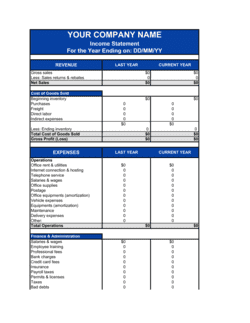
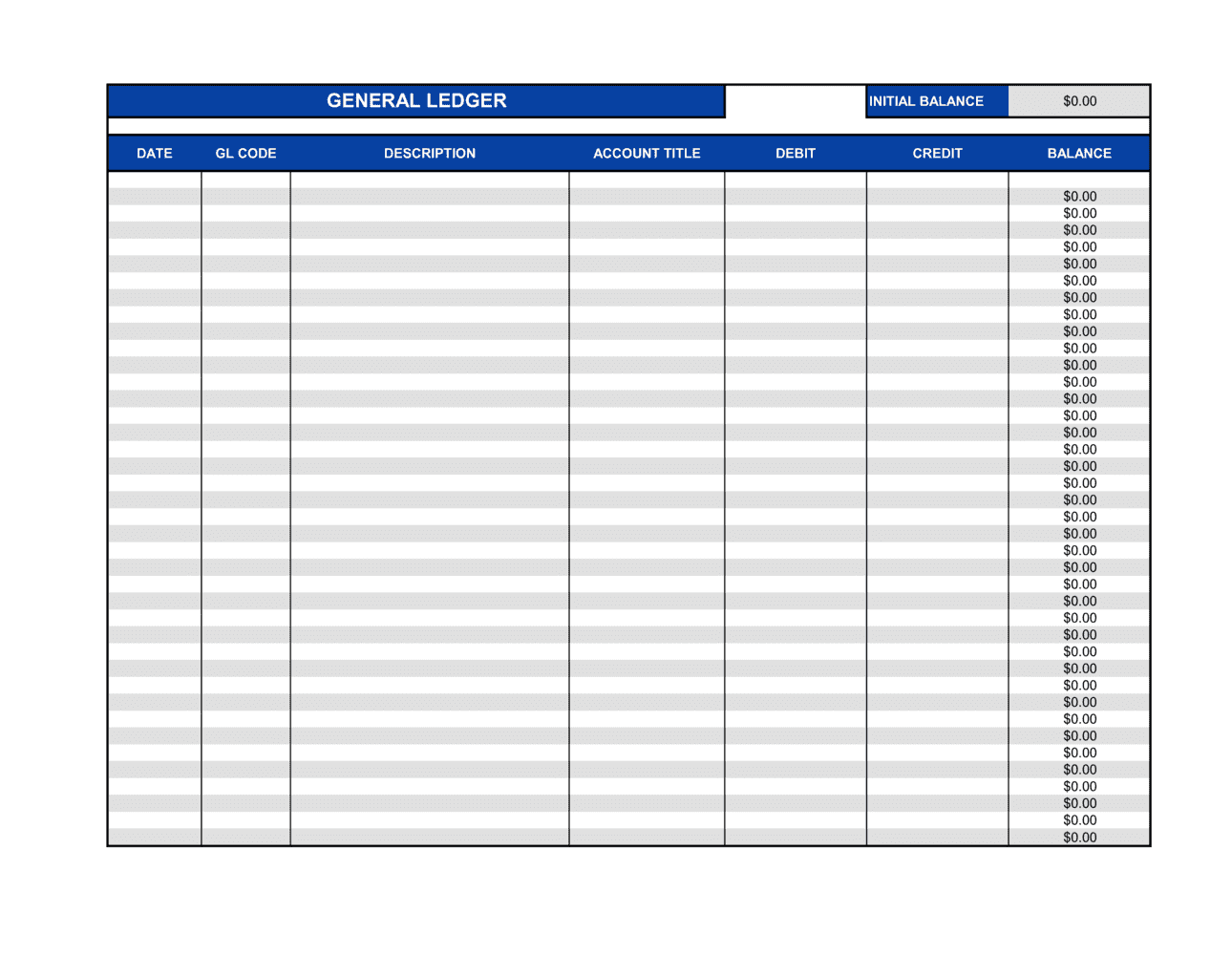
The template includes account identification fields, transaction date and reference number columns, debit and credit entry fields, running balance calculations, and period-end totals organized by account code. It covers all five account categories: assets, liabilities, equity, revenue, and expenses.

What is a General Ledger?

A General Ledger is the master financial record of a business, capturing every debit and credit transaction across all five account categories β€” assets, liabilities, equity, revenue, and expenses β€” in date order, organized by account code. It is the central source from which every financial statement is derived: the income statement draws from revenue and expense accounts, the balance sheet draws from asset, liability, and equity accounts, and the cash flow statement reconciles cash movements recorded within it. Every other accounting document β€” journals, subsidiary ledgers, invoices, and bank reconciliations β€” ultimately feeds into or is verified against the general ledger, making it the authoritative record of a business's financial position at any point in time.

Why You Need This Document

Without a maintained general ledger, a business cannot produce accurate financial statements, pass an audit, or demonstrate financial credibility to a lender or investor. Tax authorities in every major jurisdiction β€” the IRS, CRA, HMRC, and EU member state revenue services β€” require businesses to maintain records sufficient to support their tax returns, and the general ledger is the standard by which that requirement is measured. A missing or disorganized ledger during an audit typically results in estimated tax assessments, penalties, and interest that far exceed the cost of keeping clean records in the first place. Bookkeeping fraud in small businesses is also almost exclusively enabled by the absence of a properly maintained ledger with dual-authorization controls β€” studies consistently find it runs undetected for an average of 18 months. This template gives you a structured, audit-ready starting point that enforces the account coding, reference-number discipline, running balance tracking, and authorization trail that protect your business financially and legally from the first transaction forward.

Which variant fits your situation?

If your situation is…Use this template
Tracking all company-wide accounts in a single master recordGeneral Ledger
Recording only accounts receivable transactions and customer balancesAccounts Receivable Ledger
Recording only accounts payable transactions and vendor balancesAccounts Payable Ledger
Summarizing all ledger account balances at a point in timeTrial Balance
Tracking petty cash disbursements and replenishmentsPetty Cash Log
Reconciling a single bank account against ledger entriesBank Reconciliation Statement
Reporting income and expenses for a specific periodIncome Statement

Common mistakes to avoid

❌ Posting entries on the entry date instead of the transaction date

Why it matters: Transactions recorded in the wrong period misstate revenue, expenses, assets, and liabilities in both the overstated and understated periods, creating adjusting entries and restatement risk.

Fix: Always use the date the economic event occurred β€” the invoice date, payment date, or service delivery date β€” regardless of when the data entry takes place.

❌ Skipping the reference number field

Why it matters: Without a cross-reference to the source document, every entry becomes a dead end during audit review. Tax authorities and auditors routinely request the supporting document behind any ledger entry.

Fix: Assign and record a unique reference number for every entry β€” journal entry number, invoice number, or check number β€” and file source documents in the same sequence.

❌ Allowing one person to both post and approve entries

Why it matters: Single-person authorization removes the primary internal control that prevents and detects fraud. Studies consistently find that bookkeeping fraud in small businesses runs undetected an average of 18 months before discovery.

Fix: Implement a two-person rule: one person prepares and posts entries, a different person reviews and approves the period close before financials are finalized or submitted.

❌ Not labeling adjusting entries distinctly from regular entries

Why it matters: Unmarked adjusting entries are indistinguishable from original transactions during audit review, leading to questions about every accrual, deferral, and depreciation charge β€” turning a routine review into a lengthy investigation.

Fix: Mark all adjusting entries with an 'ADJ' prefix on the reference number, note the basis (e.g., 'straight-line depreciation, 60-month useful life'), and list them in a separate adjusting entries schedule.

❌ Mixing personal and business transactions in the same ledger

Why it matters: Commingled personal and business expenses invalidate the business's financial records for tax purposes, create potential liability for tax fraud, and pierce the corporate veil for liability protection.

Fix: Open a dedicated business bank account and credit card from day one, and post only transactions originating from those accounts to the business general ledger.

❌ Closing the period before completing bank reconciliation

Why it matters: A period close without a completed bank reconciliation leaves undetected discrepancies β€” outstanding checks, bank fees, or fraudulent transactions β€” baked into the financial statements.

Fix: Make bank reconciliation a mandatory prerequisite for period close. No ledger should be signed off until every account's ledger balance agrees with the reconciled bank or statement balance.

The 10 key clauses, explained

Account Identification Header

In plain language: Names the account, assigns its unique account code, and categorizes it as an asset, liability, equity, revenue, or expense account.

Sample language
Account Name: [ACCOUNT NAME] | Account Code: [XXXX] | Account Type: [ASSET / LIABILITY / EQUITY / REVENUE / EXPENSE] | Normal Balance: [DEBIT / CREDIT]

Common mistake: Assigning the wrong account type to an account. Classifying a liability as an expense, for example, distorts the balance sheet and creates mismatches that surface only at audit time.

Transaction Date

In plain language: Records the exact calendar date the transaction occurred β€” the economic event date, not the date it was entered into the system.

Sample language
Date: [YYYY-MM-DD]

Common mistake: Using the entry date instead of the transaction date. This misaligns revenue and expense recognition with the correct accounting period, creating period-cutoff errors that distort financial statements.

Reference Number

In plain language: A cross-reference to the originating journal entry, invoice, receipt, or payment document that supports the ledger entry.

Sample language
Reference No.: [JE-2026-0047 / INV-0312 / CHQ-0089]

Common mistake: Leaving the reference field blank or using a generic note like 'misc.' Without a traceable reference, locating the source document during an audit or dispute requires a full manual search.

Transaction Description

In plain language: A brief narrative explaining what the transaction represents β€” vendor name, service rendered, or nature of the payment.

Sample language
Description: [Vendor Name] β€” [Service/Product Description] | [Customer Name] β€” [Invoice No.] payment received

Common mistake: Writing one-word descriptions like 'payment' or 'expense.' Vague descriptions make reconciliation and audit preparation significantly slower and increase the risk of duplicate entries going undetected.

Debit Column

In plain language: Records the amount debited to this account in the transaction, increasing asset and expense accounts or decreasing liability and equity accounts.

Sample language
Debit: $[AMOUNT]

Common mistake: Entering a debit amount in the credit column β€” or vice versa β€” because the bookkeeper confused the normal balance direction. This creates an out-of-balance trial balance that can take hours to locate and correct.

Credit Column

In plain language: Records the amount credited to this account in the transaction, increasing liability, equity, and revenue accounts or decreasing asset and expense accounts.

Sample language
Credit: $[AMOUNT]

Common mistake: Omitting the corresponding credit entry entirely when posting. A one-sided entry throws the entire ledger out of balance and triggers an immediate trial balance discrepancy.

Running Balance

In plain language: The account's cumulative balance after each transaction is posted, updated continuously so the current balance is always visible without a separate calculation.

Sample language
Balance: $[RUNNING TOTAL] [DR / CR]

Common mistake: Calculating the running balance only at period-end rather than after every entry. Without a continuous balance, errors accumulate silently and are far harder to isolate when discovered.

Period Subtotals

In plain language: The total debits and total credits posted to the account within a defined accounting period β€” month, quarter, or year β€” used to prepare trial balance and financial statements.

Sample language
Period: [MONTH / QUARTER / YEAR] | Total Debits: $[X] | Total Credits: $[X] | Closing Balance: $[X] [DR / CR]

Common mistake: Mixing transactions from two accounting periods in a single subtotal block. Period-cutoff errors misstate revenue or expenses in both affected periods and require adjusting entries to correct.

Adjusting Entry Notation

In plain language: Flags entries that are adjustments β€” accruals, deferrals, depreciation, or corrections β€” rather than original cash transactions, so they can be traced back to the underlying calculation.

Sample language
Entry Type: [ADJUSTING] | Adjustment Basis: [ACCRUAL / DEFERRAL / DEPRECIATION / CORRECTION] | Authorized By: [NAME / TITLE]

Common mistake: Posting adjusting entries without labeling them as such or documenting the underlying basis. Unmarked adjustments look like errors during audit review and require time-consuming explanations.

Authorized Signatory Block

In plain language: Records who prepared the ledger entries, who reviewed them, and who approved the period close β€” establishing an auditable authorization trail.

Sample language
Prepared By: [NAME / DATE] | Reviewed By: [NAME / DATE] | Period Close Approved By: [NAME / TITLE / DATE]

Common mistake: Allowing a single person to both prepare and approve ledger entries without a second reviewer. Single-person authorization is the primary internal control gap that enables bookkeeping fraud to go undetected.

How to fill it out

  1. 1

    Set up your chart of accounts

    Before posting any entries, establish a numbered chart of accounts with every account your business uses. Assign 1000s to assets, 2000s to liabilities, 3000s to equity, 4000s to revenue, and 5000s–6000s to expenses.

    πŸ’‘ Keep account codes consistent with your tax filing categories from the start β€” retrofitting codes mid-year forces a full re-mapping exercise.

  2. 2

    Create a ledger page for each account

    Use a separate ledger section for each account in your chart. Include the account name, code, type, and normal balance direction (debit or credit) in the header before recording any transactions.

    πŸ’‘ Color-code or tab asset, liability, equity, revenue, and expense sections so any reviewer can navigate the ledger without explanation.

  3. 3

    Record transactions from journal entries in date order

    Post each journal entry to the affected ledger accounts on the date the economic event occurred. Enter the reference number, description, and the debit or credit amount in the correct column.

    πŸ’‘ Post journal entries to the ledger daily during high-transaction periods β€” letting postings accumulate for more than a week makes error isolation significantly harder.

  4. 4

    Update the running balance after every entry

    After each posting, calculate and record the new running balance. Add debits and subtract credits for debit-normal accounts; add credits and subtract debits for credit-normal accounts.

    πŸ’‘ If the running balance switches from its normal direction, stop and verify before continuing β€” an unexpected sign change almost always signals a posting error.

  5. 5

    Post adjusting entries at period-end

    At month-end or year-end, post all adjusting entries β€” accruals, deferrals, prepaid amortization, and depreciation β€” and label each clearly as 'ADJUSTING' with the basis documented.

    πŸ’‘ Prepare a separate adjusting entries schedule before posting so every adjustment can be reviewed and approved as a batch rather than individually.

  6. 6

    Extract a trial balance and verify it balances

    List every account's closing balance and confirm that total debits equal total credits. A trial balance that does not balance signals a posting error, a missing entry, or a transposition that must be found and corrected before closing.

    πŸ’‘ If the trial balance is off, check the difference against common transposition errors β€” a $90 discrepancy, for example, often means digits were swapped in a $X9 vs. $9X entry.

  7. 7

    Complete the authorized signatory block

    Have the preparer sign and date the ledger, then route it to a reviewer β€” a second bookkeeper, controller, or accountant β€” who signs off independently before the period close is finalized.

    πŸ’‘ Never let the same person who posted the entries also approve the period close. Dual authorization is the single most effective fraud deterrent in a small business accounting environment.

  8. 8

    Archive the completed ledger with supporting documents

    File the finalized period ledger alongside the trial balance, bank reconciliation, and all supporting journal entries. Store digitally in a secure, backed-up location organized by fiscal year and period.

    πŸ’‘ Most tax authorities require businesses to retain accounting records for 6–7 years β€” structure your archive folder naming to match fiscal year and month for instant retrieval.

Frequently asked questions

What is a general ledger?

A general ledger is the master financial record of a business that captures every debit and credit transaction across all accounts β€” assets, liabilities, equity, revenue, and expenses β€” in date order. It is the central source of truth from which all financial statements (income statement, balance sheet, and cash flow statement) are derived. Every other accounting record β€” journals, subsidiary ledgers, bank reconciliations β€” feeds into or is verified against the general ledger.

What is the difference between a general ledger and a journal?

A journal is the first point of entry for a transaction β€” it records what happened, when, in which accounts, and for how much. The general ledger is where those journal entries are posted by account, accumulating a running balance for each. The journal is the chronological record; the ledger is the account-by-account record. Both are required for a complete double-entry bookkeeping system.

What accounts appear in a general ledger?

All five account categories appear: assets (cash, accounts receivable, inventory, property), liabilities (accounts payable, loans, accrued expenses), equity (common stock, retained earnings, owner's draws), revenue (sales, service income, interest income), and expenses (rent, payroll, utilities, depreciation). Each account has its own dedicated ledger section with a running balance.

Is a general ledger legally required?

No single law universally mandates the term 'general ledger,' but tax authorities in the US, Canada, the UK, and the EU all require businesses to maintain accurate, organized financial records sufficient to support tax returns and withstand audit. In practice, a general ledger β€” or its equivalent in accounting software β€” is the standard method of meeting that requirement. Failure to maintain adequate records can result in penalties, estimated assessments, and in some cases criminal liability for tax evasion.

How long should I retain general ledger records?

The IRS requires businesses to retain records supporting tax returns for a minimum of 3 years from the filing date, but 6–7 years is the recommended standard to cover the statute of limitations for substantial understatements of income. Canada's CRA requires 6 years from the end of the tax year. HMRC in the UK requires 5 years for self-assessment taxpayers and 6 years for VAT records. EU member states range from 5 to 10 years depending on the country and record type.

Can I use a spreadsheet as a general ledger?

Yes β€” a well-structured spreadsheet covering account codes, transaction dates, reference numbers, debit and credit columns, and running balances satisfies the record-keeping requirements in most jurisdictions for small businesses. The risks are formula errors, version-control issues, and the absence of an audit trail for changes. Accounting software automates posting, enforces double-entry rules, and maintains a change log β€” making it preferable as transaction volume grows beyond roughly 50 entries per month.

What is the difference between a general ledger and a trial balance?

The general ledger contains every individual transaction posted to every account, in detail. A trial balance is a summary report extracted from the general ledger that lists each account's closing balance in a single row, verifying that total debits equal total credits. The trial balance is prepared from the ledger β€” it does not replace it. The ledger is the source; the trial balance is a check on that source before financial statements are prepared.

What happens if my trial balance does not balance?

An out-of-balance trial balance means at least one posting error exists β€” a one-sided entry, a transposition, a debit posted to the wrong account, or an arithmetic error in a running balance. Start by checking for transpositions (differences divisible by 9 often indicate swapped digits), then verify that every journal entry has an equal debit and credit posted. Do not close the period or prepare financial statements until the trial balance balances to zero difference.

Do I need a separate general ledger for each entity?

Yes β€” each legal entity must maintain its own general ledger. Commingling transactions from multiple entities in a single ledger makes it impossible to produce accurate financial statements for each entity, creates tax filing errors, and can pierce the liability protection of corporate structures. If you operate multiple entities, use entity-specific account codes and separate ledger files, with intercompany transactions recorded in both entities' ledgers as elimination entries.

How this compares to alternatives

vs Trial Balance

A trial balance is a summary extracted from the general ledger, listing each account's closing balance in a single line to verify that debits equal credits. The general ledger contains every transaction in detail; the trial balance is a checkpoint derived from it. Both are necessary β€” you cannot prepare a trial balance without a general ledger, and a trial balance alone is insufficient to satisfy audit requirements.

vs Income Statement

An income statement reports total revenue and expenses for a period, producing a net income or loss figure. It is assembled from the revenue and expense accounts in the general ledger. The general ledger is the source record; the income statement is a derived output. Errors in the ledger flow directly into the income statement, making ledger accuracy the prerequisite for reliable financial reporting.

vs Bank Reconciliation Statement

A bank reconciliation compares the cash account balance in the general ledger against the bank statement balance, identifying timing differences and errors. The reconciliation does not replace the ledger β€” it validates a single account within it. Completing a bank reconciliation is a prerequisite for closing the ledger each period, not an alternative to maintaining it.

vs Chart of Accounts

A chart of accounts is the numbered index of every account a business uses β€” the structural framework that defines how the general ledger is organized. The ledger is the transaction record populated within that framework. You design the chart of accounts first, then use it to structure and populate the general ledger throughout the year.

Industry-specific considerations

Professional Services

Revenue is recognized by engagement or milestone, requiring separate ledger accounts per client project to support billing reconciliation and work-in-progress tracking.

Retail and E-commerce

High transaction volumes require daily posting disciplines; inventory accounts must reconcile to physical counts and cost-of-goods-sold entries must match sales at the SKU level.

Construction

Job-cost ledger accounts track materials, labor, and overhead by project; percentage-of-completion revenue recognition requires careful period-cutoff entries tied to contract milestones.

Healthcare

Patient billing, insurance reimbursements, and government program payments require separate revenue accounts by payer type, with accounts receivable subsidiary ledgers reconciling to each payer's remittance.

Manufacturing

Raw materials, work-in-process, and finished goods require three separate inventory accounts; standard-cost variances must be posted as adjusting entries and reconciled to actual production costs.

Nonprofit Organizations

Fund accounting requires separate restricted and unrestricted revenue accounts; grant expenditures must be tracked by funding source to satisfy donor reporting and audit requirements.

Jurisdictional notes

United States

The IRS requires businesses to maintain books and records sufficient to support tax returns and does not prescribe a specific ledger format. Records must generally be retained for 3 years from the filing date, though 6–7 years is recommended. The FASB's Generally Accepted Accounting Principles (GAAP) govern financial reporting for businesses preparing audited statements. Cash-basis and accrual-basis taxpayers maintain ledgers differently; the method elected on the first tax return must be applied consistently.

Canada

The Canada Revenue Agency requires businesses to keep adequate books and records to determine tax obligations, retaining them for a minimum of 6 years from the end of the last tax year they relate to. ASPE (Accounting Standards for Private Enterprises) or IFRS apply depending on whether the entity is publicly accountable. Quebec businesses operating under provincial jurisdiction must maintain records in French or ensure French versions are available on request.

United Kingdom

HMRC requires companies registered under the Companies Act to keep accounting records for 6 years from the end of the financial year for companies, and 5 years from the 31 January submission deadline for self-assessment taxpayers. Making Tax Digital (MTD) requirements mean that VAT-registered businesses must keep digital records and submit VAT returns using compatible software. UK GAAP (FRS 102) or IFRS applies depending on company size and public interest classification.

European Union

EU member states each implement their own accounting record retention requirements, generally ranging from 5 to 10 years. France requires 10 years for accounting documents; Germany requires 10 years for books of account and 6 years for business correspondence. GDPR affects how financial records containing personal data are stored and who may access them. Businesses in EU member states preparing consolidated statements typically apply IFRS as adopted by the EU, with local GAAP applying to individual entity statutory accounts.

Template vs lawyer β€” what fits your deal?

PathBest forCostTime
Use the templateSmall businesses and sole proprietors maintaining records for internal use and standard tax filingFree1–2 hours setup; 15–30 minutes per posting session
Template + legal reviewGrowing businesses preparing for their first audit, bank financing, or multi-entity consolidation$300–$1,500 for a bookkeeper or accountant review and setup1–5 days
Custom draftedRegulated industries, public companies, complex multi-entity structures, or businesses under active audit$2,000–$10,000+ for a CPA firm engagement or ERP implementation2–8 weeks

Glossary

Chart of Accounts
A numbered list of every account used by a business, organized by category β€” assets, liabilities, equity, revenue, and expenses β€” that forms the structure of the general ledger.
Double-Entry Bookkeeping
An accounting method where every transaction is recorded as both a debit in one account and an equal credit in another, keeping the accounting equation in balance.
Debit
An entry that increases asset and expense accounts or decreases liability, equity, and revenue accounts β€” always recorded in the left column of a ledger entry.
Credit
An entry that increases liability, equity, and revenue accounts or decreases asset and expense accounts β€” always recorded in the right column of a ledger entry.
Journal Entry
The original record of a transaction, noting the date, accounts affected, amounts, and a brief description, before the amounts are posted to the general ledger.
Trial Balance
A summary report listing all general ledger account balances at a point in time, used to verify that total debits equal total credits before preparing financial statements.
Account Code
A numeric or alphanumeric identifier assigned to each ledger account for consistent classification and retrieval, typically following a standard numbering convention such as 1000s for assets, 2000s for liabilities.
Posting
The process of transferring amounts from journal entries into the corresponding general ledger accounts, updating each account's running balance.
Reconciliation
The process of comparing general ledger account balances against external records β€” bank statements, invoices, or subsidiary ledgers β€” to identify and resolve discrepancies.
Closing Entries
Period-end journal entries that transfer balances from temporary revenue and expense accounts to the retained earnings equity account, resetting those accounts to zero for the next period.
Subsidiary Ledger
A detailed ledger supporting a single control account in the general ledger β€” for example, individual customer balances that roll up into the accounts receivable control account.

Part of your Business Operating System

This document is one of 3,000+ business & legal templates included in Business in a Box.

  • Fill-in-the-blanks β€” ready in minutes
  • 100% customizable Word document
  • Compatible with all office suites
  • Export to PDF and share electronically

Create your document in 3 simple steps.

From template to signed document β€” all inside one Business Operating System.
1
Download or open template

Access over 3,000+ business and legal templates for any business task, project or initiative.

2
Edit and fill in the blanks with AI

Customize your ready-made business document template and save it in the cloud.

3
Save, Share, Send, Sign

Share your files and folders with your team. Create a space of seamless collaboration.

Save time, save money, and create top-quality documents.

β˜…β˜…β˜…β˜…β˜…

"Fantastic value! I'm not sure how I'd do without it. It's worth its weight in gold and paid back for itself many times."

Managing Director Β· Mall Farm
Robert Whalley
Managing Director, Mall Farm Proprietary Limited
β˜…β˜…β˜…β˜…β˜…

"I have been using Business in a Box for years. It has been the most useful source of templates I have encountered. I recommend it to anyone."

Business Owner Β· 4+ years
Dr Michael John Freestone
Business Owner
β˜…β˜…β˜…β˜…β˜…

"It has been a life saver so many times I have lost count. Business in a Box has saved me so much time and as you know, time is money."

Owner Β· Upstate Web
David G. Moore Jr.
Owner, Upstate Web

Run your business with a system β€” not scattered tools

Stop downloading documents. Start operating with clarity. Business in a Box gives you the Business Operating System used by over 250,000 companies worldwide to structure, run, and grow their business.

Start freeΒ Β·Β No credit card required