1
Identify all parties with full legal names
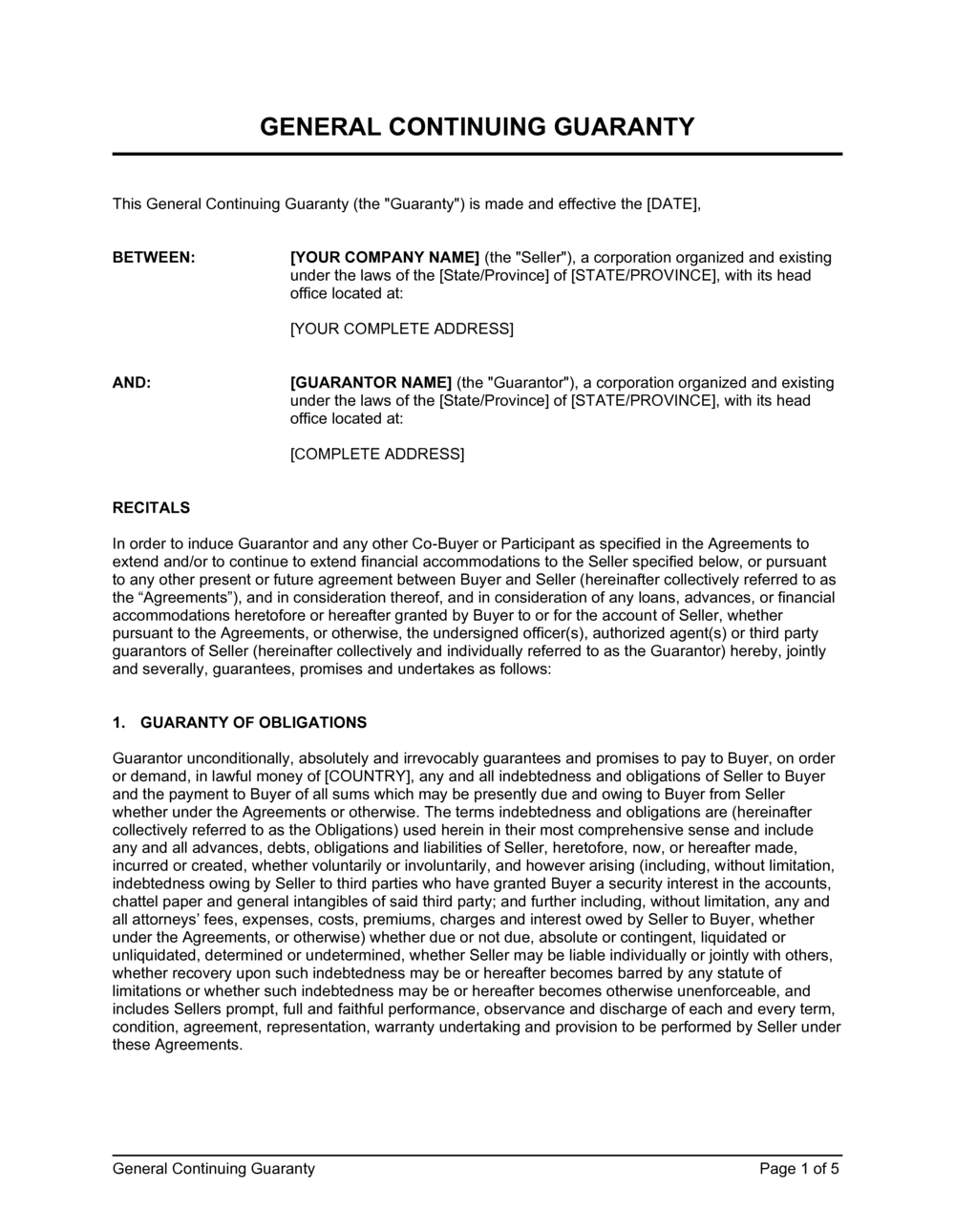
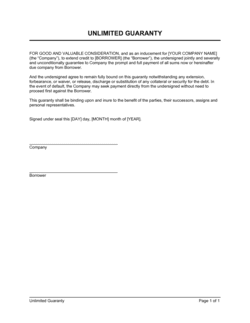
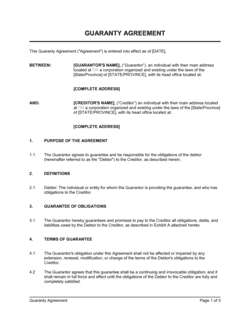
Enter the guarantor's full legal name (individual or registered entity), the creditor's legal name, and the principal debtor's legal name. Confirm each name matches government-issued ID or corporate registration documents.
💡 For individual guarantors, include their home address in addition to any business address — this is required for enforcement and service of process in most jurisdictions.
2
Describe the underlying obligation
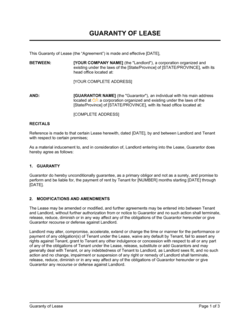
In the recitals, clearly reference the underlying credit agreement, lease, or supply contract being guaranteed — include the agreement date and the maximum credit limit or loan amount if applicable.
💡 A specific reference to the underlying agreement prevents disputes about which obligations are covered and helps courts quickly identify the guaranty's scope.
3
Define the scope of guaranteed obligations
Confirm that the definition of 'Obligations' covers principal, accrued interest, fees, costs of enforcement, and any future advances or renewals of the underlying debt. Broaden or narrow this scope deliberately based on the transaction.
💡 If the creditor intends to extend future credit beyond the initial amount, ensure 'future advances' and 'renewals' are explicitly included — courts may not imply them.
4
Review and confirm the waivers of suretyship defenses
Read each waiver carefully and ensure it reflects the agreed transaction. Standard waivers include waiver of demand, notice, presentment, and defenses arising from modifications or release of collateral.
💡 Have the guarantor initial or acknowledge each waiver separately if required by local law or the creditor's underwriting standards — some institutional lenders require this.
5
Set the governing law and jurisdiction
Enter the state or country whose law will govern the guaranty and the forum for dispute resolution. Match the governing law to the jurisdiction with the most significant connection to the transaction — typically where the creditor is located or where the underlying agreement will be performed.
💡 Confirm that the selected jurisdiction enforces jury waivers — several states, including California, significantly restrict contractual jury trial waivers.
6
Complete the guarantor's representations
Verify that the guarantor can truthfully make each representation — legal capacity, authority, solvency, and voluntary execution. For corporate guarantors, attach a board resolution or officer's certificate confirming authorization.
💡 If the guarantor is a married individual in a community property state (e.g., California, Texas, Arizona), obtain the non-guarantor spouse's signature or consent to bind community property assets.
7
Execute before or at the same time as the underlying agreement
The guaranty should be signed contemporaneously with — or before — the underlying credit agreement, lease, or supply contract. Post-execution guaranties may lack consideration and face enforceability challenges.
💡 In transactions where the guaranty is a condition to closing, include a condition precedent in the underlying agreement that requires delivery of a fully executed guaranty.
8
Retain executed originals and store securely
The creditor should retain at least one fully executed original. For high-value guaranties, notarize the guarantor's signature to facilitate recording or enforcement in foreign jurisdictions.
💡 Store executed guaranties alongside the underlying credit file so they are immediately accessible if enforcement becomes necessary — a guaranty is worthless if it cannot be located.