Bank Reconciliation Template

Free Excel download β€’ Edit online β€’ Save & share with Drive β€’ Export to PDF

1 pageβ€’20–30 min to fillβ€’Difficulty: Standardβ€’Signature requiredβ€’Legal review recommended
Learn more ↓
FreeXLSBank Reconciliation Template

At a glance

What it is
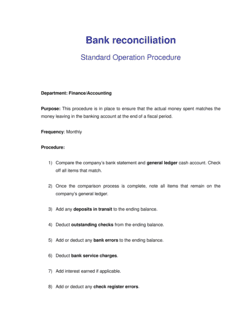
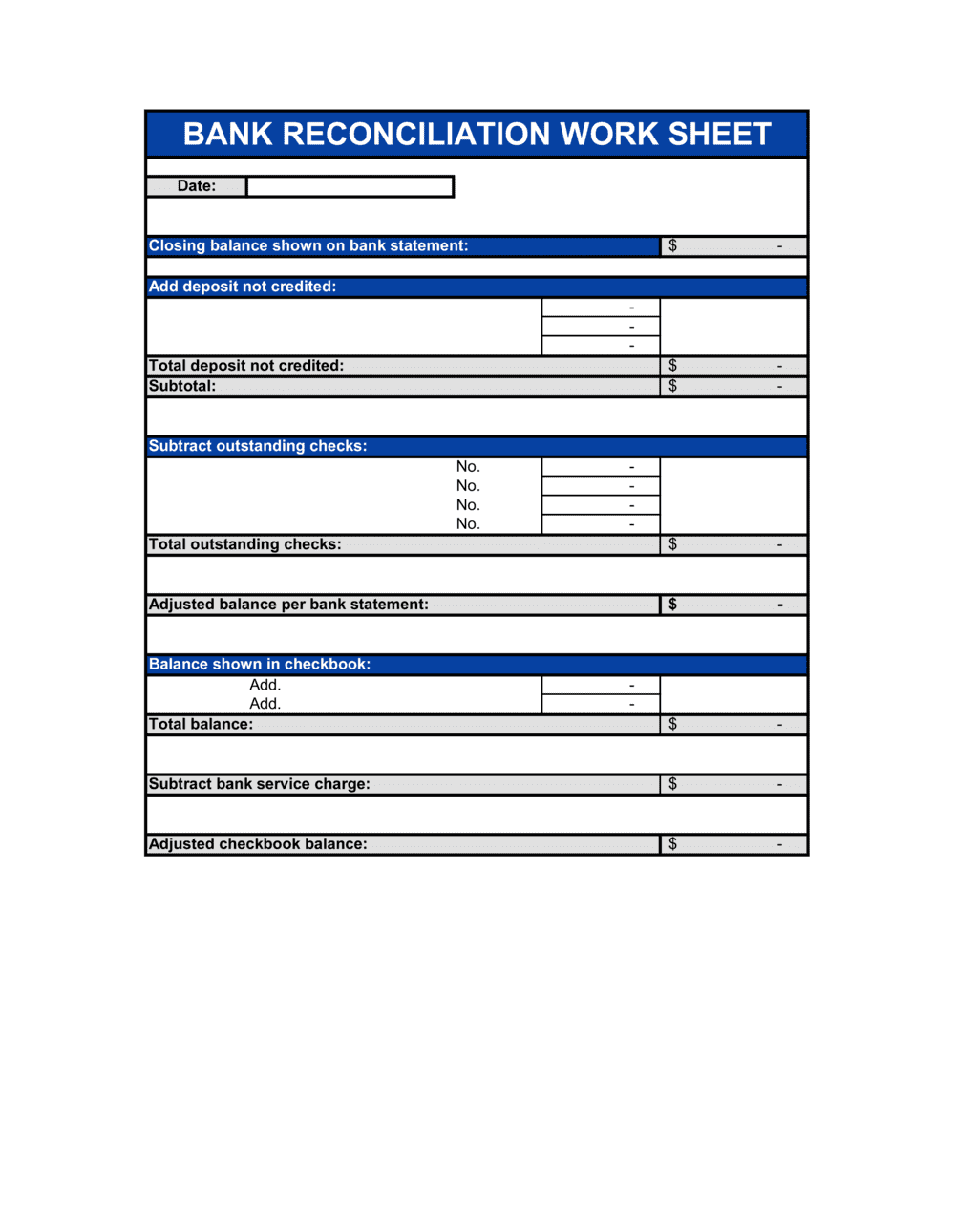
A Bank Reconciliation is a formal accounting document that compares a company's internal cash ledger balances against the corresponding bank statement for the same period, identifies every discrepancy, and produces a certified adjusted balance signed off by the preparer and a reviewing officer. This free Word download gives you a structured, auditor-ready reconciliation form you can edit online and export as PDF for monthly or quarterly close procedures.
When you need it
Complete a bank reconciliation at the end of every accounting period β€” monthly at minimum β€” or immediately when a discrepancy between your books and your bank statement cannot be explained. Auditors, lenders, and investors typically require reconciliations as supporting evidence for any period under review.
What's inside
Company and account identification, reconciliation period, opening and closing balances from both the ledger and the bank statement, itemized outstanding checks and deposits in transit, bank errors and book errors, adjusted balances, a discrepancy log, and preparer and reviewer certification signatures.

What is a Bank Reconciliation?

A Bank Reconciliation is a formal accounting and internal-control document that systematically compares a company's general ledger cash balance to the corresponding bank statement for the same period, identifies every difference β€” whether a timing item or an error β€” and produces a certified adjusted balance signed off by both a preparer and an independent reviewer. Unlike an informal cash check, a properly completed bank reconciliation creates a traceable, signed record that satisfies auditor requirements, supports tax filings, and documents the segregation-of-duties controls that protect a business against occupational fraud. It is completed at the end of every accounting period and retained as a primary financial record.

Why You Need This Document

Cash is the most liquid and fraud-susceptible asset on any balance sheet, and the bank reconciliation is the single most important control that stands between accurate books and an undetected embezzlement or error. Without a signed, period-end reconciliation, discrepancies between your ledger and your actual bank balance accumulate silently β€” NSF checks go unreversed, bank service charges pile up unrecorded, and fictitious transactions remain invisible until a lender, investor, or auditor asks for documentation you cannot produce. The IRS, CRA, HMRC, and most EU tax authorities require businesses to retain supporting records β€” including reconciliations β€” for six to ten years, and external auditors treat a missing or unsigned reconciliation as a significant internal control deficiency. This template gives you a structured, audit-ready document with the preparer and reviewer certification built in, so your month-end close produces evidence that holds up under scrutiny.

Which variant fits your situation?

If your situation is…Use this template
Reconciling a single operating account at month-endMonthly Bank Reconciliation
Reconciling a petty cash fund against receipts and disbursementsPetty Cash Reconciliation
Reconciling accounts at the end of a fiscal quarter for management reportingQuarterly Bank Reconciliation
Reconciling a business credit card statement against the ledgerCredit Card Reconciliation
Reconciling multiple accounts into a consolidated cash position statementCash Reconciliation Summary
Reconciling an intercompany loan or holding account between related entitiesIntercompany Account Reconciliation
Performing a full-year reconciliation for tax preparation or audit supportAnnual Bank Reconciliation

Common mistakes to avoid

❌ Same person prepares and approves the reconciliation

Why it matters: The entire fraud-detection value of a bank reconciliation depends on independent review. Self-approval is a well-documented vector for embezzlement and is a finding in virtually every occupational-fraud investigation involving cash.

Fix: Implement strict segregation of duties: the person who records cash transactions must not be the person who reconciles or approves. In a one-person office, have the business owner review and sign off personally.

❌ Carrying forward unexplained prior-period variances

Why it matters: An unresolved variance from a prior period compounds β€” it becomes harder to isolate with each passing month and signals to auditors that the reconciliation process is not functioning as a control.

Fix: Treat any carry-forward variance as a critical open item. Investigate and resolve it before certifying the current period's reconciliation, even if it means re-opening the prior period.

❌ Allowing deposits in transit to remain uncleared across two or more periods

Why it matters: A deposit that does not appear on the following month's bank statement is almost always an error β€” either a fraudulent book entry, a bank processing failure, or a deposit that was never actually made.

Fix: Set a policy that any deposit in transit not cleared within 10 business days triggers an automatic investigation. Document the investigation outcome on the reconciliation form.

❌ Plugging an unexplained amount to force the reconciliation to balance

Why it matters: A plug obscures errors, prevents fraud detection, and constitutes a false record β€” which can expose the preparer and the company to significant legal and regulatory risk.

Fix: Never close a reconciliation with an unexplained plug. Log the unresolved amount in the discrepancy log, escalate to the controller or CFO, and hold the period open until the item is traced.

❌ Using the prior month's bank balance instead of downloading the current statement

Why it matters: Stale source data means the reconciliation validates nothing. Outstanding items from the prior period that cleared in the current period will be double-counted, and new charges will be missed entirely.

Fix: Download the official bank statement for the exact reconciliation period directly from the bank portal on or after the last day of the period. Date-stamp the downloaded document and attach it to the reconciliation file.

❌ Omitting NSF checks from the book-balance adjustment

Why it matters: An NSF return reduces the company's actual cash balance β€” if not reversed in the books, the ledger overstates cash, which flows into financial statements and misleads anyone relying on reported balances.

Fix: Review the bank statement specifically for NSF return items each period. Record a reversing journal entry immediately, then pursue collection from the issuer of the returned check.

The 10 key clauses, explained

Account Identification and Period Header

In plain language: Identifies the company, the specific bank account being reconciled (including the last four digits), the financial institution, and the exact reconciliation period start and end dates.

Sample language
Company: [COMPANY LEGAL NAME] | Bank: [BANK NAME] | Account: [ACCOUNT TYPE] ending [XXXX] | Reconciliation Period: [START DATE] to [END DATE]

Common mistake: Using only the account nickname rather than the account number's last four digits. When a company holds multiple accounts at the same bank, ambiguous headers cause reconciliations to be filed against the wrong account.

Opening Balance Confirmation

In plain language: States both the book opening balance (from the prior period's closing adjusted balance) and the bank statement opening balance, confirming they agree before the current period's activity is analyzed.

Sample language
Book Opening Balance (per GL as of [START DATE]): $[AMOUNT] | Bank Statement Opening Balance (per [BANK NAME] statement dated [DATE]): $[AMOUNT] | Variance: $[0.00 or AMOUNT]

Common mistake: Starting the current reconciliation without first confirming that the prior period's closing adjusted balance ties to the opening bank statement balance. An unresolved carry-forward variance corrupts every subsequent reconciliation.

Bank Statement Ending Balance

In plain language: Records the closing balance shown on the bank statement for the period, which serves as the starting point for the bank-side adjustments.

Sample language
Bank Statement Ending Balance as of [END DATE]: $[AMOUNT] (per [BANK NAME] statement, page [X])

Common mistake: Copying the bank balance from memory or a prior email rather than directly from the official bank statement. Even a one-digit transposition creates a false reconciling item that wastes hours to trace.

Outstanding Checks Schedule

In plain language: Lists every check issued and recorded in the books during or before the period that has not yet cleared the bank, with check number, date, payee, and amount for each item.

Sample language
Outstanding Checks: Check #[XXXX], dated [DATE], payable to [PAYEE], $[AMOUNT] | Check #[XXXX], dated [DATE], payable to [PAYEE], $[AMOUNT] | Total Outstanding Checks: $[TOTAL]

Common mistake: Omitting checks that have been outstanding for more than 90 days on the assumption they will never clear. Stale checks occasionally clear unexpectedly, and regulators may require escheatment of long-outstanding amounts.

Deposits in Transit Schedule

In plain language: Itemizes deposits recorded in the company's books before period end that do not appear on the bank statement because the bank processed them after the statement cut-off date.

Sample language
Deposits in Transit: Deposit dated [DATE], reference [REF], $[AMOUNT] | Deposit dated [DATE], reference [REF], $[AMOUNT] | Total Deposits in Transit: $[TOTAL]

Common mistake: Allowing the same deposit to appear as 'in transit' on two consecutive reconciliations without investigation. A deposit that fails to clear within 5–7 business days may indicate a processing error or a fraudulent posting.

Bank Errors and Bank Adjustments

In plain language: Documents any transactions on the bank statement that the company believes are bank errors β€” duplicate debits, misposted items, or fees charged in error β€” and the amounts the bank has agreed to correct.

Sample language
Bank Error β€” Duplicate debit on [DATE] for $[AMOUNT], reference [TRANSACTION ID], confirmed with [BANK NAME] on [DATE]. Correction pending bank credit. Adjustment to Bank Balance: +$[AMOUNT]

Common mistake: Recording a suspected bank error as an adjusting item without first contacting the bank and obtaining written confirmation. An unconfirmed bank error is a book error until the bank acknowledges it.

Book Errors and Adjusting Journal Entries

In plain language: Lists every error found in the company's general ledger during reconciliation, states the correct amount, and cross-references the journal entry number used to correct the book balance.

Sample language
Book Error β€” Check #[XXXX] to [PAYEE] recorded as $[WRONG AMOUNT]; actual amount $[CORRECT AMOUNT]. Difference: $[VARIANCE]. Corrected by Journal Entry #[JE NUMBER] dated [DATE].

Common mistake: Noting the error on the reconciliation form without creating and posting the corresponding journal entry. An acknowledged error that is not corrected in the ledger will reappear as a reconciling item in every future period.

Bank Charges, Interest, and NSF Items

In plain language: Captures bank service charges, wire fees, interest income, and NSF check reversals that appear on the bank statement but have not yet been recorded in the company's books, requiring book-side adjusting entries.

Sample language
Bank Service Charge β€” [DATE]: $[AMOUNT] | NSF Check returned β€” [PAYEE], check #[XXXX], [DATE]: $[AMOUNT] | Interest Earned β€” [DATE]: $[AMOUNT] | Net Adjustment to Book Balance: $[AMOUNT]

Common mistake: Recording bank interest income in the wrong period. Interest credited on the last day of the month may appear on the following month's statement depending on the bank's cut-off β€” verify the value date before recording.

Adjusted Balances and Reconciliation Proof

In plain language: Presents the final adjusted bank balance and the final adjusted book balance side by side, confirming they are equal β€” this equality is the proof that the reconciliation is complete and correct.

Sample language
Adjusted Bank Balance: $[AMOUNT] | Adjusted Book Balance: $[AMOUNT] | Difference: $[0.00] | Reconciliation Status: [COMPLETE / UNRESOLVED β€” see Discrepancy Log]

Common mistake: Forcing agreement by plugging an unexplained amount into either side of the reconciliation. Any residual difference must be traced and documented in the discrepancy log before the reconciliation is certified.

Preparer and Reviewer Certification

In plain language: Documents who prepared the reconciliation and who reviewed and approved it, with dates and signatures, establishing the segregation-of-duties control required by most internal control frameworks.

Sample language
Prepared by: [PREPARER NAME], [TITLE], Signature: _______________, Date: [DATE] | Reviewed and Approved by: [REVIEWER NAME], [TITLE], Signature: _______________, Date: [DATE]

Common mistake: Having the same person prepare and approve the reconciliation. This eliminates the independent review control, defeating the primary fraud-detection purpose of the document and violating SOX, COSO, and most audit requirements.

How to fill it out

  1. 1

    Gather source documents for the period

    Collect the official bank statement for the reconciliation period, the company's general ledger cash account detail for the same period, and the prior period's completed reconciliation to confirm the opening balance.

    πŸ’‘ Download the bank statement directly from the bank's portal as a PDF rather than relying on a CSV export β€” the PDF is the auditor-accepted source document.

  2. 2

    Complete the account identification and period header

    Enter the company's legal name, bank name, account type, last four digits of the account number, and the precise start and end dates of the reconciliation period.

    πŸ’‘ If you reconcile multiple accounts, use a separate form for each β€” never combine two accounts on a single reconciliation even if they are at the same bank.

  3. 3

    Confirm the opening balances agree

    Compare the book opening balance (prior period's adjusted book balance) to the bank statement's opening balance. Document any variance before proceeding β€” do not carry forward unexplained prior-period differences.

    πŸ’‘ If opening balances do not agree, re-open the prior period's reconciliation first. A carry-forward error compounding into the current period doubles the investigation time.

  4. 4

    List all outstanding checks

    Pull every check recorded in the ledger that does not appear as cleared on the bank statement. Enter check number, date, payee, and amount for each item, then total the list.

    πŸ’‘ Flag any check outstanding for more than 60 days. Investigate before certifying β€” long-outstanding checks may indicate a lost instrument, a stopped payment, or a fraudulent recording.

  5. 5

    List all deposits in transit

    Identify deposits recorded in the books before the period-end cut-off that do not appear on the bank statement. Enter the deposit date, reference, and amount for each, then total.

    πŸ’‘ Cross-reference deposits in transit against the next month's bank statement to confirm they cleared. If a prior-period deposit in transit still hasn't cleared after 10 business days, escalate immediately.

  6. 6

    Record bank charges, NSF items, and interest

    Scan the bank statement for service charges, wire fees, NSF reversals, and interest credits not yet in the ledger. List each item with its date and amount, then prepare the corresponding journal entries.

    πŸ’‘ Do not post journal entries until the reconciliation is reviewed and approved β€” premature posting makes it impossible to retrace the reconciliation if the reviewer finds an error.

  7. 7

    Document and investigate any book or bank errors

    List every discrepancy that cannot be explained by a timing difference. For book errors, cross-reference the journal entry that corrects it. For bank errors, note the date you contacted the bank and the expected correction date.

    πŸ’‘ Keep a running discrepancy log separate from the main form. This log becomes evidence for the auditor if the error takes more than one period to resolve.

  8. 8

    Verify adjusted balances are equal and obtain signatures

    Calculate the adjusted bank balance and adjusted book balance. Confirm they match to the cent. Have the preparer sign, then route to a separate reviewer for independent approval and signature.

    πŸ’‘ Never certify a reconciliation with a residual balance and a note saying 'under investigation' β€” document the open item in the discrepancy log and certify only after the discrepancy is resolved or formally escalated.

Frequently asked questions

What is a bank reconciliation?

A bank reconciliation is a formal accounting document that compares a company's internal cash ledger balance to the closing balance on its bank statement for the same period. It identifies timing differences β€” such as outstanding checks and deposits in transit β€” and errors on either side, then produces a certified adjusted balance that both the books and the bank agree on. It is one of the most fundamental internal controls in any accounting function.

How often should a bank reconciliation be performed?

Monthly reconciliation is the standard minimum for any business with ongoing transaction activity. High-volume businesses β€” retailers, e-commerce companies, or any entity processing hundreds of transactions per month β€” should reconcile weekly or even daily for critical accounts. Auditors and lenders typically expect to see monthly reconciliations completed within 10–15 business days of the period-end close.

Why does the bank reconciliation need to be signed?

A signature certifies that the preparer and a separate reviewer have independently verified the reconciliation is complete and accurate. This dual-approval control is required by the Sarbanes-Oxley Act (SOX) for public companies, by most external audit standards, and by internal control frameworks such as COSO. Without a signed approval, the document is a worksheet, not an auditable internal control.

What is the difference between the bank balance and the book balance?

The bank balance is the ending balance shown on the bank statement β€” reflecting all transactions the bank has processed. The book balance is the cash balance in the company's general ledger β€” reflecting all transactions the company has recorded. The two differ because of timing (outstanding checks, deposits in transit) and because some items appear on the bank statement before the company records them (bank charges, NSF returns, interest). The reconciliation bridges the two.

What happens if the bank reconciliation does not balance?

Any residual difference after accounting for all known timing items must be investigated β€” not plugged. Common causes include transposition errors (e.g., recording $1,530 as $1,350), duplicate entries, missing transactions, or an unrecorded bank charge. The difference should be logged in a discrepancy register and escalated to the controller or CFO. If fraud is suspected, escalate to management and legal counsel immediately rather than attempting to resolve it internally.

Who should prepare and who should approve a bank reconciliation?

The person who prepares the reconciliation should not have authority to initiate or record cash transactions β€” typically a bookkeeper or staff accountant. The approver should be someone independent of the transaction-recording function β€” a controller, CFO, or business owner. This segregation of duties is the single most important control in the reconciliation process and the primary defense against occupational cash fraud.

What records should be attached to a completed bank reconciliation?

At minimum: the official bank statement for the period, the general ledger cash account detail for the same period, copies of any journal entries made to correct book errors, and written correspondence with the bank regarding any confirmed bank errors. External auditors expect the complete package β€” a reconciliation form without supporting documents provides minimal audit evidence.

Can bank reconciliation software replace the manual template?

Accounting platforms such as QuickBooks, Xero, and NetSuite automate much of the matching process and reduce manual entry errors. However, the reconciliation must still be reviewed, exceptions must be investigated, and a signed approval record must be produced β€” the software does not eliminate the need for human judgment or the certification requirement. This template is useful for businesses without dedicated accounting software, for supplemental documentation, or as a standalone record for auditor delivery.

How this compares to alternatives

vs General Ledger Reconciliation

A general ledger reconciliation compares any two sets of records within the company's own books β€” for example, a subsidiary ledger to the GL control account. A bank reconciliation specifically compares the GL cash account to an external bank statement, making it a stronger internal control because it involves an independent third-party source. Both are needed for a complete month-end close.

vs Cash Flow Statement

A cash flow statement reports the sources and uses of cash over a period for external financial reporting purposes. A bank reconciliation verifies the accuracy of the ending cash balance on which the cash flow statement depends. The reconciliation is a back-office control document; the cash flow statement is a financial reporting output. You cannot produce a reliable cash flow statement without completing reconciliations first.

vs Petty Cash Log

A petty cash log tracks small cash disbursements against receipts for a physical cash fund held on premises. A bank reconciliation applies to bank account balances and electronic or check transactions. Both are cash control documents, but they address entirely different pools of cash β€” a business typically maintains both simultaneously.

vs Account Reconciliation Report

An account reconciliation report covers the reconciliation of any balance sheet account β€” accounts receivable, accounts payable, prepaid expenses β€” to supporting detail. A bank reconciliation is a specific type of account reconciliation focused exclusively on the cash account, with the added dimension of an external bank statement as the second source. Bank reconciliations are generally subject to more rigorous review because they directly address the most liquid and fraud-susceptible asset.

Industry-specific considerations

Retail and E-commerce

High daily transaction volume, split-tender sales, and third-party payment processor settlements create numerous timing items that require daily or weekly reconciliation to prevent balance drift.

Professional Services

Trust account reconciliation is legally required for law firms and real estate brokers β€” client funds must be reconciled separately from operating accounts on a monthly basis to satisfy bar association and licensing rules.

Nonprofit Organizations

Board oversight requirements and grant-compliance audits demand that reconciliations are completed monthly, reviewed by a board treasurer, and retained for a minimum of seven years in most jurisdictions.

Healthcare

Insurance reimbursement timing, patient payment plans, and Medicare/Medicaid remittance delays create large volumes of deposits in transit that must be tracked and aged carefully to avoid misstating cash.

Construction and Contracting

Progress billing, retainage holdbacks, and subcontractor payment timing mean that outstanding checks can remain uncleared for 30–60 days β€” requiring careful aging and lien-waiver cross-referencing.

Financial Services

Regulatory capital requirements mean that cash balances reported in filings must be supported by current, signed reconciliations β€” any unresolved discrepancy can trigger a regulatory inquiry.

Jurisdictional notes

United States

Public companies subject to the Sarbanes-Oxley Act (SOX) must maintain documented cash reconciliation procedures as part of internal control over financial reporting (ICFR) under Section 404. The IRS expects cash balances on tax returns to be supportable by bank reconciliations retained for a minimum of three years. State CPA licensing boards require trust account reconciliations for attorneys and real estate brokers monthly, with records kept for five to seven years depending on the state.

Canada

The Canada Revenue Agency (CRA) expects businesses to maintain books and records β€” including bank reconciliations β€” for a minimum of six years from the end of the tax year to which they relate. CPA Canada's auditing standards require external auditors to obtain and review bank reconciliations as primary cash audit evidence. Law societies in Ontario, British Columbia, and other provinces mandate monthly trust account reconciliations for legal practitioners, with immediate reporting obligations for shortfalls.

United Kingdom

HMRC expects businesses to maintain adequate accounting records, including bank reconciliations, for a minimum of six years under the Companies Act 2006. The Financial Reporting Council's auditing standards require UK auditors to test cash balances by reviewing reconciliations and confirming balances directly with banks. Solicitors regulated by the Solicitors Regulation Authority must reconcile client accounts monthly under the SRA Accounts Rules, with any shortage treated as a reportable breach.

European Union

EU member states generally require businesses to retain accounting records β€” including bank reconciliations β€” for seven to ten years, with Germany requiring ten years and France seven. Under GDPR, reconciliation documents containing personal data (e.g., employee or customer names on check payee lines) must be stored securely with access controls and retained no longer than necessary for the stated accounting purpose. The EU's Anti-Money Laundering Directives require credit institutions and certain obliged entities to maintain reconciled transaction records as part of customer due-diligence documentation.

Template vs lawyer β€” what fits your deal?

PathBest forCostTime
Use the templateSmall businesses, startups, and nonprofits performing standard monthly reconciliations with straightforward transaction volumesFree30–90 minutes per period
Template + legal reviewBusinesses preparing for an external audit, applying for a loan, or establishing a formal internal control program for the first time$200–$500 for a CPA or controller review session1–3 days
Custom draftedPublic companies, regulated financial institutions, or entities subject to SOX compliance requiring formally documented reconciliation procedures and controls$1,000–$5,000+ for a CPA firm engagement or internal audit design1–4 weeks

Glossary

Outstanding Check
A check issued and recorded in the company's books but not yet cleared through the bank, creating a temporary difference between ledger and bank balances.
Deposit in Transit
Cash or checks received and recorded by the company but not yet credited on the bank statement because the deposit was made too late in the period.
Adjusted Balance
The reconciled cash figure after adding and subtracting all identified reconciling items from both the bank and book balances β€” both sides must equal this amount.
Bank Error
A mistake made by the bank β€” such as a duplicate debit or a misposted transaction β€” that must be reported and corrected on the bank's side, not the company's books.
Book Error
An accounting entry recorded incorrectly in the company's general ledger that must be corrected with an adjusting journal entry.
Not Sufficient Funds (NSF) Check
A check deposited by the company that was returned by the issuer's bank due to insufficient funds β€” reducing the company's book balance and requiring reversal.
Bank Service Charge
A fee charged by the bank for account maintenance, wire transfers, or other services, visible on the bank statement but not yet recorded in the company's books.
Reconciling Item
Any transaction or amount that explains a difference between the book balance and the bank balance β€” classified as either a timing difference or an error.
General Ledger (GL)
The company's master accounting record that aggregates all transactions; the cash GL account balance is one side of every bank reconciliation.
Journal Entry
A formal accounting record used to correct book errors identified during reconciliation, debit and credit the appropriate accounts, and restore the general ledger to accuracy.
Internal Control
A policy or procedure β€” such as segregation of duties in the reconciliation process β€” designed to prevent or detect financial errors and fraud.
Segregation of Duties
An internal-control principle requiring that the person who records transactions is different from the person who reconciles and approves the bank reconciliation.

Part of your Business Operating System

This document is one of 3,000+ business & legal templates included in Business in a Box.

  • Fill-in-the-blanks β€” ready in minutes
  • 100% customizable Word document
  • Compatible with all office suites
  • Export to PDF and share electronically

Create your document in 3 simple steps.

From template to signed document β€” all inside one Business Operating System.
1
Download or open template

Access over 3,000+ business and legal templates for any business task, project or initiative.

2
Edit and fill in the blanks with AI

Customize your ready-made business document template and save it in the cloud.

3
Save, Share, Send, Sign

Share your files and folders with your team. Create a space of seamless collaboration.

Save time, save money, and create top-quality documents.

β˜…β˜…β˜…β˜…β˜…

"Fantastic value! I'm not sure how I'd do without it. It's worth its weight in gold and paid back for itself many times."

Managing Director Β· Mall Farm
Robert Whalley
Managing Director, Mall Farm Proprietary Limited
β˜…β˜…β˜…β˜…β˜…

"I have been using Business in a Box for years. It has been the most useful source of templates I have encountered. I recommend it to anyone."

Business Owner Β· 4+ years
Dr Michael John Freestone
Business Owner
β˜…β˜…β˜…β˜…β˜…

"It has been a life saver so many times I have lost count. Business in a Box has saved me so much time and as you know, time is money."

Owner Β· Upstate Web
David G. Moore Jr.
Owner, Upstate Web

Run your business with a system β€” not scattered tools

Stop downloading documents. Start operating with clarity. Business in a Box gives you the Business Operating System used by over 250,000 companies worldwide to structure, run, and grow their business.

Start freeΒ Β·Β No credit card required