Founders Agreement Template

Free Word download β€’ Edit online β€’ Save & share with Drive β€’ Export to PDF

11 pagesβ€’30–40 min to fillβ€’Difficulty: Complexβ€’Signature requiredβ€’Legal review recommended
Learn more ↓
FreeFounders Agreement Template

At a glance

What it is
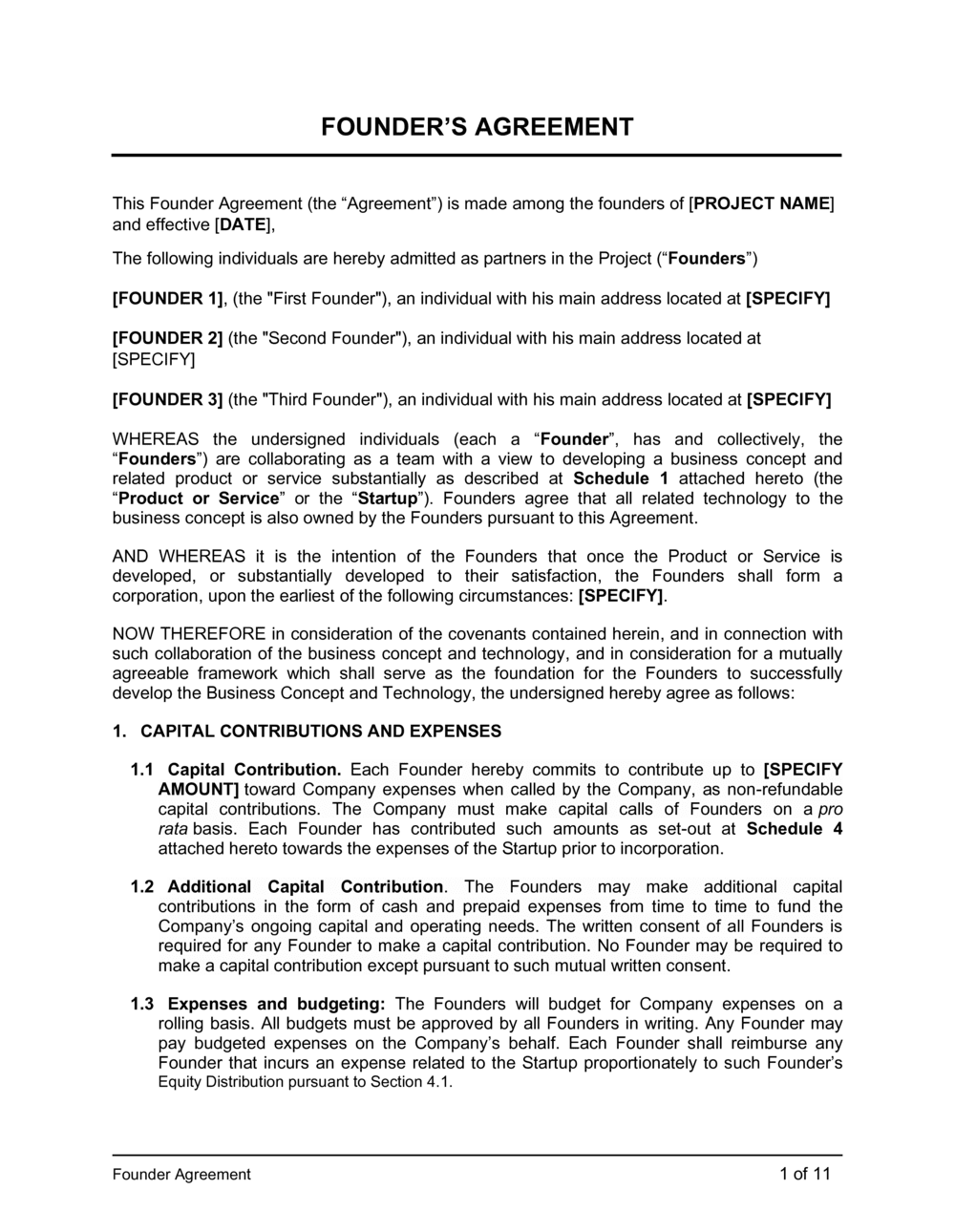
A Founders Agreement is a legally binding contract between the co-founders of a new company that defines each person's roles, equity ownership, vesting schedule, IP assignment, decision-making authority, and what happens when a founder exits. This free Word download gives you a structured, attorney-ready starting point you can edit online and export as PDF to sign before the first line of code is written or the first dollar is spent.
When you need it
Use it at the moment you decide to build a company with one or more partners β€” before incorporating, before taking investment, and before any founder contributes meaningful work or IP to the venture. The later you wait, the more expensive the conversation becomes.
What's inside
Founding team members and equity splits, role definitions and time commitments, founder vesting schedule with cliff and acceleration provisions, IP assignment, confidentiality, non-compete and non-solicitation restrictions, decision-making and voting thresholds, and buyout and exit procedures for departing founders.

What is a Founders Agreement?

A Founders Agreement is a legally binding contract between the co-founders of a new company that governs the foundational terms of their working relationship before formal corporate governance documents are in place. It records each founder's equity percentage, defines their role and minimum time commitment, establishes a vesting schedule that ties ownership to continued contribution, assigns all relevant intellectual property to the company, and sets out the process for removing or buying out a founder who departs. Unlike a handshake deal or an informal email thread, a signed founders agreement creates enforceable obligations on all sides β€” making it the single most important document a founding team can execute before writing the first line of code or spending the first dollar.

Why You Need This Document

Founding team disputes are among the leading causes of early-stage startup failure β€” and nearly all of them are made worse by the absence of a written agreement. Without a founders agreement, equity splits are undocumented and subject to competing recollections, IP built before incorporation may belong to the individual founder rather than the company, and a co-founder who leaves after six months can walk away with a 30% stake that blocks future financing and creates dead equity on the cap table indefinitely. Institutional investors routinely flag the absence of founder vesting as a due-diligence red flag and delay or decline term sheets until the issue is resolved. A founders agreement executed at day zero costs the founding team a few hours of honest conversation β€” the same conversation avoided at day zero typically costs tens of thousands of dollars in legal fees and months of delay at the worst possible moment in the company's life.

Which variant fits your situation?

If your situation is…Use this template
Two or three co-founders splitting equity at incorporationFounders Agreement
Adding a co-founder to a solo-founded company that already has tractionCo-Founder Equity Agreement (Post-Launch)
Documenting equity and roles before forming an LLC or corporationPartnership Agreement
Issuing stock options to early employees or advisorsStock Option Agreement
Protecting confidential information shared between potential co-foundersNon-Disclosure Agreement
Governing the relationship between LLC members rather than shareholdersLLC Operating Agreement
Defining a vesting schedule after a VC term sheet requires oneRestricted Stock Purchase Agreement

Common mistakes to avoid

❌ Delaying the agreement until after the product is built

Why it matters: Once a product exists and early users validate the idea, every founder's perceived value β€” and leverage β€” increases sharply. A split that felt obvious at ideation becomes contentious at traction.

Fix: Execute the founders agreement before any founder writes code, makes sales calls, or invests personal capital. The cost of the conversation at day zero is a fraction of what it costs at month six.

❌ No vesting schedule for founding equity

Why it matters: A founder who leaves after six months with 33% of the company creates dead equity that dilutes remaining founders in every future financing and signals governance risk to institutional investors.

Fix: Apply a standard four-year vest with a one-year cliff to all founding equity, regardless of how equal or trusted the relationship feels at the start.

❌ Omitting IP assignment for pre-incorporation work

Why it matters: If the core technology was built before the company was formed and ownership was never formally transferred, the founder β€” not the company β€” may own it. This defect can kill a funding round during due diligence.

Fix: Include an explicit assignment of all prior relevant IP in Schedule A, signed alongside the main agreement. Have a lawyer review any prior employment contracts that might include competing IP ownership clauses.

❌ No deadlock resolution mechanism in a 50/50 company

Why it matters: A deadlock between two equal founders with no resolution process can freeze the company for months β€” burning runway, stalling fundraising, and triggering key-person departures.

Fix: Include a mediation-first, buy-sell second deadlock clause. The buy-sell (shotgun) mechanism is rarely invoked but its existence alone creates a strong incentive to negotiate in good faith.

❌ Using the wrong governing law for the founders' locations

Why it matters: Choosing Delaware law when both founders live in California does not prevent California courts from applying California employment and IP law β€” including its ban on post-employment non-competes.

Fix: Choose governing law based on where the company is incorporated and where the majority of founders are based. Confirm with a lawyer that the choice-of-law clause will be respected for each specific clause type.

❌ Treating the founders agreement as a one-time document

Why it matters: Material changes β€” a new co-founder, a role change, a pivot β€” can make original terms misaligned or unenforceable without a documented amendment.

Fix: Include an amendment clause requiring all founders' written consent to modify any material term, and revisit the agreement whenever the founding team's composition or responsibilities change significantly.

The 10 key clauses, explained

Founding team and equity split

In plain language: Identifies each co-founder by legal name, states their initial ownership percentage, and records the class of shares or units each holds.

Sample language
The founding team consists of [FOUNDER 1 FULL NAME] ([X]%), [FOUNDER 2 FULL NAME] ([Y]%), and [FOUNDER 3 FULL NAME] ([Z]%), each holding [CLASS] shares of [COMPANY LEGAL NAME] (the 'Company').

Common mistake: Agreeing on a split verbally and leaving it out of the written document. Without a signed record, disputes default to each founder's recollection β€” which rarely match.

Roles, responsibilities, and time commitment

In plain language: Defines each founder's title, primary functional area, and expected minimum time commitment β€” full-time, part-time, or advisory.

Sample language
[FOUNDER 1] shall serve as Chief Executive Officer, responsible for [KEY FUNCTIONS], and shall devote no less than [X] hours per week to Company business. [FOUNDER 2] shall serve as Chief Technology Officer, responsible for [KEY FUNCTIONS], and shall devote full time to Company business.

Common mistake: Omitting minimum time commitments for part-time co-founders. A founder contributing 5 hours a week while holding 30% equity becomes a significant source of resentment and investor concern.

Vesting schedule and cliff

In plain language: Sets out the timeline over which each founder earns their equity, including the cliff period and the consequence of departure before or after the cliff.

Sample language
Each Founder's shares shall vest over [48] months with a [12]-month cliff from [VESTING COMMENCEMENT DATE]. Upon a Founder's departure before the cliff, all unvested shares shall be subject to repurchase at par value. After the cliff, shares vest monthly in equal installments.

Common mistake: Using the company incorporation date rather than each founder's actual start date as the vesting commencement date, which can leave a founder with unearned equity if roles were taken on at different times.

Intellectual property assignment

In plain language: Requires each founder to assign all prior and future work product, inventions, code, and IP related to the company's business to the company as a condition of their equity.

Sample language
Each Founder hereby irrevocably assigns to the Company all right, title, and interest in any and all work product, inventions, discoveries, and improvements conceived or developed by such Founder in connection with the Company's business, whether created before or after the date of this Agreement.

Common mistake: Failing to address prior IP a founder developed before the company was formed. Without a clear assignment of pre-existing IP, the founder β€” not the company β€” may own the core technology at incorporation.

Confidentiality

In plain language: Prohibits each founder from disclosing or using the company's confidential information β€” business plans, financials, product roadmaps, and customer data β€” outside the scope of their role.

Sample language
Each Founder shall hold in strict confidence all Confidential Information of the Company and shall not disclose or use any Confidential Information for any purpose other than furthering the Company's business, during or after the term of this Agreement.

Common mistake: No definition of what constitutes 'Confidential Information.' An undefined term is an unenforceable term β€” courts require a reasonable boundary around what qualifies.

Non-compete and non-solicitation

In plain language: Restricts founders from competing directly with the company or soliciting its employees and customers during their tenure and for a defined period after departure.

Sample language
During the term of this Agreement and for [12] months thereafter, each Founder shall not (a) engage in any business that competes directly with the Company within [GEOGRAPHIC AREA], or (b) solicit any employee, contractor, or customer of the Company.

Common mistake: Using identical non-compete terms for all founders regardless of role. A founder with direct customer access warrants tighter restrictions than one focused purely on internal product development.

Decision-making and voting

In plain language: Establishes the threshold required for ordinary and major decisions β€” simple majority, supermajority, or unanimous consent β€” and lists decisions that require board or all-founder approval.

Sample language
Ordinary business decisions require approval of Founders holding a majority of shares. The following decisions require unanimous Founder approval: (a) issuing new equity; (b) incurring debt exceeding $[X]; (c) selling or licensing material assets; (d) entering contracts exceeding $[X] in annual value.

Common mistake: Requiring unanimous consent for all decisions. In a two-founder company, unanimity on routine matters creates a deadlock mechanism that can paralyze operations over minor disagreements.

Founder departure, buyout, and right of first refusal

In plain language: Defines the process and price for repurchasing a departing founder's shares, including good-leaver and bad-leaver distinctions and the company's right of first refusal on any attempted transfer.

Sample language
Upon a Founder's voluntary resignation, termination for Cause, or death, the Company shall have the right to repurchase unvested shares at par value and vested shares at [FAIR MARKET VALUE / FORMULA]. Any proposed transfer of shares to a third party must first be offered to the Company and remaining Founders on the same terms.

Common mistake: No buyout mechanism at all. Without one, a departing founder retains their equity indefinitely β€” creating dead equity, blocking investor due diligence, and leaving no clean path to dilute or remove a disengaged co-founder.

Deadlock resolution

In plain language: Provides a structured process for resolving an impasse when equal co-founders cannot agree on a material decision β€” mediation, arbitration, or a buy-sell (shotgun) mechanism.

Sample language
In the event Founders are unable to resolve a material deadlock within [30] days, either Founder may invoke the buy-sell procedure: the invoking Founder shall name a price per share, and the other Founder must either buy the invoking Founder's shares or sell their own shares at that price within [30] days.

Common mistake: Omitting a deadlock clause entirely in a 50/50 split company. An equal split without a resolution mechanism means any disagreement can freeze the company indefinitely β€” a red flag for every institutional investor.

Governing law and dispute resolution

In plain language: Specifies which jurisdiction's law governs the agreement and how disputes are resolved β€” arbitration, mediation, or litigation β€” and in which venue.

Sample language
This Agreement shall be governed by the laws of the State of [STATE], without regard to conflict-of-law principles. Any dispute arising hereunder shall be resolved by binding arbitration administered by [AAA / JAMS] in [CITY, STATE], except that either party may seek injunctive relief in any court of competent jurisdiction.

Common mistake: Choosing a governing law with no connection to where the founders or company are based. Several states apply their own employment and IP laws regardless of the contract's choice-of-law clause.

How to fill it out

  1. 1

    List all co-founders and confirm legal names

    Enter each co-founder's full legal name as it appears on government-issued ID. Include the company's legal name and jurisdiction of incorporation, or the planned state of incorporation if not yet formed.

    πŸ’‘ Use the same legal name format across all founding documents β€” discrepancies between the founders agreement, cap table, and stock certificates create title defects that surface in due diligence.

  2. 2

    Agree on and document the equity split

    Record each founder's ownership percentage and the class of shares or units. If the split is not equal, document the rationale (prior contributions, role, capital investment) in a separate exhibit so the logic is clear to future investors.

    πŸ’‘ Have the equity conversation before any significant work is done β€” once early traction exists, every founder overestimates their contribution and the split becomes harder to negotiate fairly.

  3. 3

    Define each founder's role and time commitment

    State job titles, primary responsibilities, and a minimum weekly hours commitment for any founder who is not joining full-time. Include a trigger for renegotiation if a part-time founder transitions to full-time.

    πŸ’‘ Avoid vague titles like 'co-founder' without a functional area. Ambiguous roles create overlap and conflict β€” especially in two-person founding teams.

  4. 4

    Set the vesting schedule and cliff

    Enter the total vesting period (typically 48 months), cliff length (typically 12 months), and each founder's vesting commencement date. Confirm whether vesting is time-based only or includes performance milestones.

    πŸ’‘ Use each founder's actual start date, not the company's incorporation date. A founder who joined six months before incorporation should not lose those months of vested time.

  5. 5

    Attach and assign all prior IP

    List any inventions, code, designs, or research each founder developed before the company was formed that will be used in the business. Attach it as Schedule A and confirm the assignment clause covers this prior IP explicitly.

    πŸ’‘ If a founder developed core IP at a previous employer, consult a lawyer before assignment β€” some employment contracts include a broad IP ownership clause that could create a competing claim.

  6. 6

    Calibrate the non-compete scope

    Set geographic scope, duration, and breadth of activity for the non-compete based on each founder's role and access to competitive information. Flag jurisdictions where post-employment non-competes are restricted or banned.

    πŸ’‘ California voids most post-employment non-competes β€” if any founder lives or works in California, remove or replace that clause with a narrowly drawn non-solicitation provision.

  7. 7

    Define decision thresholds and reserved matters

    List decisions that require ordinary majority, supermajority, and unanimous consent. Identify the specific reserved matters β€” equity issuance, debt, asset sales, key contracts β€” that require all-founder or board approval.

    πŸ’‘ Keep the unanimous-consent list short: three to five genuinely major categories. A long list of reserved matters turns every operational decision into a negotiation.

  8. 8

    Execute before work begins β€” all founders sign

    All co-founders must sign the agreement before contributing meaningful work, IP, or capital. Obtain wet or electronic signatures with timestamps. Store the fully-executed copy in a shared, access-controlled document repository.

    πŸ’‘ Use a platform that timestamps execution and sends each signer a copy. A signed-but-undated agreement is almost as problematic as no agreement at all in a later dispute.

Frequently asked questions

What is a founders agreement?

A founders agreement is a legally binding contract between the co-founders of a startup that governs the core terms of their relationship: equity splits, roles, vesting schedules, IP ownership, confidentiality, non-compete restrictions, decision-making authority, and what happens when a founder leaves. It functions as the operating constitution of the founding team before formal corporate governance documents β€” like a shareholders agreement or operating agreement β€” are put in place.

When should a founders agreement be signed?

A founders agreement should be signed before any founder contributes meaningful work, IP, or capital to the venture β€” ideally before or at incorporation. The longer you wait, the more leverage each founder accumulates and the harder the equity and role conversations become. Most startup lawyers recommend executing it within the first week of deciding to build together.

What is the difference between a founders agreement and a shareholders agreement?

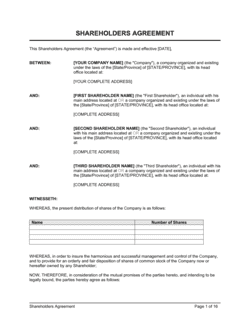
A founders agreement governs the founding team's relationship at the earliest stage β€” before outside investors or employees hold equity. A shareholders agreement is a broader document that governs all equity holders, including investors, and typically replaces or supplements the founders agreement after a priced funding round. The founders agreement is the early-stage precursor; the shareholders agreement is the post-investment successor.

Do all startups need a founders agreement?

Any company with two or more founders should have one. A solo founder has no co-founder relationship to govern, but the moment a second person joins with equity, a founders agreement is necessary. Without it, equity splits are undocumented, IP ownership is ambiguous, and there is no mechanism for removing or buying out a founder who leaves or stops contributing β€” issues that surface in every serious due diligence process.

What equity split should co-founders use?

There is no universally correct answer, but equal splits are the most common starting point for founding teams of two to three people with comparable contributions. Unequal splits are warranted when one founder contributed significant prior IP, capital, or a validated customer relationship. Whatever split is chosen, a vesting schedule is more important than the precise percentage β€” it ensures founders earn their equity over time rather than holding it passively after departure.

What is a founder vesting cliff?

A cliff is a minimum period β€” typically 12 months β€” that must pass before any of a founder's equity vests. If the founder departs before the cliff, they forfeit the entire unvested grant. After the cliff, equity vests on a monthly or quarterly basis over the remaining vesting period. The cliff protects the company and remaining founders from a co-founder who leaves in the first year while retaining a significant equity stake.

Is a founders agreement legally enforceable?

A properly drafted and executed founders agreement is generally enforceable as a binding contract when it contains the elements required by contract law: offer, acceptance, and consideration (the mutual equity grants and obligations typically provide this). Specific clauses β€” particularly non-competes β€” vary significantly in enforceability by jurisdiction. In California, for example, post-employment non-competes are largely unenforceable regardless of what the contract states.

What happens if a founder leaves before vesting is complete?

Under a standard founders agreement, unvested shares are subject to repurchase by the company at a price defined in the agreement β€” typically par value for a bad leaver (terminated for cause or violating the agreement) and fair market value for a good leaver (voluntary resignation or mutual departure). This mechanism prevents dead equity from accumulating on the cap table and keeps the departing founder from benefiting fully from work they did not complete.

Do I need a lawyer to draft a founders agreement?

For a straightforward two- or three-founder startup incorporating in a standard jurisdiction, a high-quality template is a strong starting point. Engage a startup lawyer when the equity split is unequal and contested, when a founder is contributing pre-existing IP with potential ownership complications, when any founder is based in a heavily regulated jurisdiction, or when the company is raising capital immediately after formation. A typical founders agreement review costs $500–$1,500.

How this compares to alternatives

vs Shareholders Agreement

A shareholders agreement governs all equity holders β€” including investors β€” and typically replaces or supplements the founders agreement after a priced funding round. A founders agreement is an early-stage document focused exclusively on the founding team's relationship before outside capital enters. Execute the founders agreement at formation; expect to negotiate a shareholders agreement at Series A or earlier if a lead investor requires one.

vs Partnership Agreement

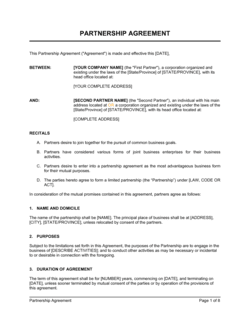
A partnership agreement governs the relationship between partners in a general or limited partnership β€” a specific legal structure with unlimited personal liability for general partners. A founders agreement is entity-agnostic and used with corporations and LLCs. If you are forming an LLC or corporation (the standard for venture-backed startups), use a founders agreement rather than a partnership agreement.

vs LLC Operating Agreement

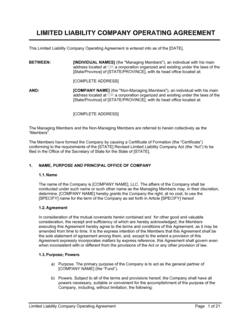
An LLC operating agreement governs the internal management of a limited liability company β€” member rights, profit distributions, and management authority β€” as a matter of state law. A founders agreement covers the personal relationship between founders, including equity vesting and IP assignment, which an operating agreement does not address. Startups using an LLC structure typically need both.

vs Employment Contract

An employment contract governs the employer-employee relationship β€” salary, duties, benefits, and termination. A founders agreement governs the equity relationship between co-founders as owners. For funded startups, founders often sign both: a founders agreement for ownership terms and an employment contract for compensation and at-will status. The two documents serve different legal functions and should not be combined.

Industry-specific considerations

SaaS / Technology

IP assignment for pre-incorporation code is critical; technical and business co-founders need explicit role boundaries to avoid early governance conflicts over product direction.

Consumer Goods / E-commerce

Brand IP, supplier relationships, and sourcing contacts are often founder-specific assets that must be formally assigned to the company to protect against a founder's departure.

Biotech / Life Sciences

University spin-out IP assignment requires coordination with institutional tech-transfer agreements; vesting terms often align with regulatory milestones rather than pure time.

Creative Agencies / Media

Creative IP β€” original content, proprietary methodologies, and client-facing work product β€” must be explicitly assigned to prevent a departing founder from claiming ownership of key deliverables.

Professional Services

Client relationships are concentrated in founding partners, making non-solicitation clauses for clients and employees particularly important upon departure.

Manufacturing / Hardware

Patent and trade-secret assignment for hardware designs and manufacturing processes is essential; co-founders often hold critical supplier relationships that must be assigned or documented.

Jurisdictional notes

United States

Delaware is the most common state of incorporation for venture-backed startups, and its courts have extensive precedent on founder equity and IP assignment. However, state employment law β€” particularly California's ban on post-employment non-competes β€” applies to founders based in that state regardless of where the company is incorporated. Founder IP assignment clauses must also comply with California Labor Code Β§2870, which limits assignment of off-duty inventions. Check state-specific rules before finalizing non-compete and IP terms.

Canada

Canadian founders agreements generally follow common-law contract principles, with provincial variations β€” Ontario and British Columbia are the most common incorporation jurisdictions for tech startups. Non-compete clauses are enforceable in Canada if reasonable in scope, duration, and geography, but courts apply a higher standard of scrutiny than in most US states. Quebec-based founders should ensure the agreement is available in French if required by applicable language legislation.

United Kingdom

UK founders agreements are governed by English contract law, which generally enforces post-employment restrictions if they protect a legitimate business interest and are reasonable in scope and duration β€” typically no more than 12 months. IP created by a founder in the course of their employment automatically vests in the employer under the Patents Act 1977 and Copyright, Designs and Patents Act 1988, but pre-incorporation IP assignment still requires an explicit clause. Companies House registration does not substitute for a signed founders agreement.

European Union

EU member states vary significantly in their treatment of post-employment non-competes β€” France, Germany, and the Netherlands typically require financial compensation to the departing founder during the restriction period, ranging from 25% to 100% of prior compensation. GDPR considerations apply if the agreement involves processing personal data of customers or employees. IP assignment for software and databases is generally effective under EU law, but specific rules in Germany and France on employee inventions may apply if founders are also employees of the company.

Template vs lawyer β€” what fits your deal?

PathBest forCostTime
Use the templateTwo- or three-person founding teams incorporating in a standard jurisdiction with an agreed-upon equal or straightforward equity splitFree1–3 hours
Template + legal reviewUnequal equity splits, pre-existing IP complications, any founder based in California or another restricted non-compete jurisdiction$500–$1,5003–7 days
Custom draftedComplex founding structures, university spin-outs, multiple co-founders with asymmetric contributions, or companies raising capital immediately after formation$2,000–$5,000+1–3 weeks

Glossary

Equity Split
The percentage of company ownership allocated to each co-founder, which determines their share of proceeds in any future sale or financing.
Vesting Schedule
A timeline over which a founder earns full ownership of their equity β€” typically four years β€” so that early departures do not leave a departed founder with a large passive stake.
Cliff
A minimum period β€” typically 12 months β€” that must pass before any equity vests; a founder who leaves before the cliff forfeits the entire unvested grant.
Acceleration
A provision that causes unvested equity to vest immediately upon a triggering event, such as an acquisition (single trigger) or an acquisition combined with termination (double trigger).
IP Assignment
A clause transferring ownership of all inventions, code, designs, and work product created by each founder to the company as a condition of their equity grant.
Drag-Along Right
A provision allowing founders holding a majority of shares to compel minority founders to vote in favor of a sale of the company on the same terms.
Right of First Refusal (ROFR)
The company's or other founders' contractual right to purchase a departing founder's shares before they are offered to any outside party.
Dead Equity
Shares held by a departed founder who no longer contributes to the company, which dilute remaining founders and can deter institutional investors.
Good Leaver / Bad Leaver
Classifications that determine the price at which a departing founder's unvested shares are repurchased β€” typically fair market value for a good leaver and par value for a bad leaver.
Cap Table
A spreadsheet listing all equity holders, their ownership percentages, and the effect of future financing rounds on each founder's stake.
Quorum
The minimum number or percentage of founders who must be present or represented for a vote on company decisions to be valid.

Part of your Business Operating System

This document is one of 3,000+ business & legal templates included in Business in a Box.

  • Fill-in-the-blanks β€” ready in minutes
  • 100% customizable Word document
  • Compatible with all office suites
  • Export to PDF and share electronically

Create your document in 3 simple steps.

From template to signed document β€” all inside one Business Operating System.
1
Download or open template

Access over 3,000+ business and legal templates for any business task, project or initiative.

2
Edit and fill in the blanks with AI

Customize your ready-made business document template and save it in the cloud.

3
Save, Share, Send, Sign

Share your files and folders with your team. Create a space of seamless collaboration.

Save time, save money, and create top-quality documents.

β˜…β˜…β˜…β˜…β˜…

"Fantastic value! I'm not sure how I'd do without it. It's worth its weight in gold and paid back for itself many times."

Managing Director Β· Mall Farm
Robert Whalley
Managing Director, Mall Farm Proprietary Limited
β˜…β˜…β˜…β˜…β˜…

"I have been using Business in a Box for years. It has been the most useful source of templates I have encountered. I recommend it to anyone."

Business Owner Β· 4+ years
Dr Michael John Freestone
Business Owner
β˜…β˜…β˜…β˜…β˜…

"It has been a life saver so many times I have lost count. Business in a Box has saved me so much time and as you know, time is money."

Owner Β· Upstate Web
David G. Moore Jr.
Owner, Upstate Web

Run your business with a system β€” not scattered tools

Stop downloading documents. Start operating with clarity. Business in a Box gives you the Business Operating System used by over 250,000 companies worldwide to structure, run, and grow their business.

Start freeΒ Β·Β No credit card required