Feasibility Report Template

Free Word download β€’ Edit online β€’ Save & share with Drive β€’ Export to PDF

15 pagesβ€’30–40 min to fillβ€’Difficulty: Complex
Learn more ↓
FreeFeasibility Report Template

At a glance

What it is
A Feasibility Report is a structured analytical document that evaluates whether a proposed project, investment, or business initiative is viable across four dimensions: market, technical, financial, and operational. This free Word download gives you a ready-to-edit framework you can complete online and export as PDF to present to stakeholders, lenders, or decision-makers.
When you need it
Use it before committing capital or resources to a new venture, product launch, facility expansion, or significant process change β€” any situation where the cost of proceeding blindly outweighs the cost of structured analysis.
What's inside
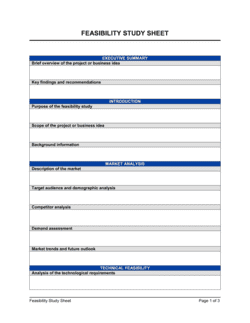
Executive summary, project description, market and demand analysis, technical and operational assessment, financial projections and cost-benefit analysis, risk evaluation, and a go/no-go recommendation with supporting rationale.

What is a Feasibility Report?

A Feasibility Report is a structured analytical document that evaluates whether a proposed project, investment, or business initiative is viable before resources are committed. It examines viability across four dimensions β€” market demand, technical requirements, financial return, and operational capacity β€” and culminates in a clear go/no-go recommendation supported by quantitative evidence. Unlike a business plan, which governs an ongoing company, a feasibility report is scoped to a single decision: should we proceed with this specific initiative given what we know about its costs, risks, and expected return?

Why You Need This Document

Organizations that skip feasibility analysis commit capital to projects that fail on predictable, avoidable grounds β€” insufficient market demand, underestimated infrastructure costs, or operational capacity that cannot absorb the initiative alongside existing workloads. A structured feasibility report forces you to surface those problems on paper before they surface on a job site, in a product launch, or in a quarterly financial review. Lenders and boards increasingly require a completed feasibility study before approving funding requests above a certain threshold; arriving without one signals insufficient preparation and routinely delays or kills approval. This template gives you a consistent, complete framework that covers every dimension decision-makers will scrutinize β€” so your recommendation arrives with the evidence needed to act on it.

Which variant fits your situation?

If your situation is…Use this template
Evaluating a new product concept at early ideation stageFeasibility Report (Product)
Assessing a construction or real estate development projectFeasibility Report (Real Estate)
Reviewing viability of entering a new geographic marketMarket Entry Feasibility Study
Deciding whether to build, buy, or outsource a capabilityMake vs. Buy Analysis
Presenting a high-level business case to senior leadershipBusiness Case Template
Rapid internal pre-screening before a full feasibility studyOne-Page Business Plan
Documenting expected ROI of a technology investmentCost-Benefit Analysis Template

Common mistakes to avoid

❌ Presenting a single financial scenario

Why it matters: Decision-makers always pressure-test the numbers. A report with only an optimistic projection signals the author hasn't stress-tested their own assumptions, which undermines confidence in the entire document.

Fix: Include a base case, a 20% revenue shortfall scenario, and a 15% cost overrun scenario in the financial section. Show NPV and payback period under each.

❌ Treating 'technically possible' as 'technically feasible'

Why it matters: A capability that requires 18 months to build and $2M in infrastructure cannot support a 6-month, $400K project β€” yet reports routinely mark these as feasible because the technology exists somewhere.

Fix: Define technical feasibility relative to the project's specific timeline, budget, and organizational capability β€” not the theoretical state of the art.

❌ Omitting internal stakeholders from the stakeholder analysis

Why it matters: A department head whose budget or headcount is affected by the project and who is not consulted can block final approval after months of work.

Fix: Map all stakeholders β€” internal and external β€” at the start of the study, identify those with veto or significant influence, and engage them before the report is finalized.

❌ Ending with 'further study recommended' when data supports a decision

Why it matters: An inconclusive recommendation wastes the entire study. Stakeholders interpret it as analytical paralysis or the author hedging against accountability.

Fix: If the data is genuinely insufficient, state exactly what additional information is needed, who will obtain it, and by what date β€” making the next step concrete rather than open-ended.

The 9 key sections, explained

Executive Summary

Project Description and Scope

Market and Demand Analysis

Technical Feasibility Assessment

Financial Analysis and Projections

Operational Feasibility

Risk Assessment

Stakeholder Analysis

Recommendation and Next Steps

How to fill it out

  1. 1

    Define the project scope and success criteria

    Write a precise description of what is being evaluated, what is in and out of scope, and the specific criteria that would constitute a feasible outcome. Ambiguous scope produces an ambiguous recommendation.

    πŸ’‘ Circulate the scope definition to key stakeholders for sign-off before any analysis begins β€” scope disputes mid-study are the leading cause of reports being rejected at the final gate.

  2. 2

    Conduct the market and demand analysis

    Research the target market size using at least two independent sources. Build a bottom-up demand estimate by identifying the number of reachable customers and their expected purchase frequency or volume.

    πŸ’‘ If your top-down and bottom-up estimates differ by more than 30%, revisit your customer segment definition before proceeding.

  3. 3

    Complete the technical feasibility assessment

    Inventory the technology, infrastructure, and skills the project requires. Compare these against what the organization currently has and document specific gaps with estimated remediation costs and timelines.

    πŸ’‘ Get input from technical leads or IT before writing this section β€” assumptions made without their input are the most common source of underestimated project costs.

  4. 4

    Build the financial model

    Estimate total CapEx and Year 1–3 OpEx from the bottom up. Project revenue or cost savings using your market analysis inputs. Calculate NPV, IRR, and payback period at your organization's standard discount rate.

    πŸ’‘ Include at least two sensitivity scenarios β€” a 20% revenue shortfall and a 15% cost overrun β€” so decision-makers can see the downside range before committing.

  5. 5

    Assess operational capacity

    Map every implementation task to a role or team and estimate the hours required. Compare this against current capacity to identify whether existing staff can absorb the work or new hires are needed.

    πŸ’‘ A Gantt chart or resource-loading spreadsheet attached as an appendix converts an abstract operational assessment into a concrete execution plan.

  6. 6

    Complete the risk register

    List all identified risks across market, technical, financial, and operational categories. Rate each for likelihood (high/medium/low) and impact, then propose a specific mitigation action and residual risk rating.

    πŸ’‘ Limit the register to the top 8–10 risks β€” an exhaustive list of 40 risks signals poor prioritization and makes the report harder to act on.

  7. 7

    Write the recommendation with clear next steps

    State the go/no-go decision in the first sentence of this section. Follow with the three to five pieces of evidence that most strongly support the decision and a numbered list of concrete next steps with owners and dates.

    πŸ’‘ If the recommendation is conditional, state the specific condition precisely β€” 'proceed if IRR exceeds 15% after Phase 1 cost confirmation' is actionable; 'proceed with caution' is not.

  8. 8

    Write the executive summary last

    Pull the single most important finding from each section and compress the entire report into one to two pages. The summary should stand alone β€” a reader who reads only it should understand the recommendation and its basis.

    πŸ’‘ Test the summary by having someone unfamiliar with the project read it and explain the recommendation back to you β€” if they cannot, tighten the summary before distributing.

Frequently asked questions

What is a feasibility report?

A feasibility report is a structured document that evaluates whether a proposed project or business initiative is viable across four dimensions: market demand, technical requirements, financial return, and operational capacity. It culminates in a go/no-go recommendation supported by quantitative analysis. Organizations use it to avoid committing capital and resources to initiatives that cannot succeed under realistic conditions.

What is the difference between a feasibility report and a business case?

A feasibility report asks whether an initiative can succeed β€” it is primarily analytical and evaluates viability. A business case asks whether the organization should pursue it β€” it is primarily persuasive and recommends a course of action with resource requirements and expected return. In practice, a feasibility report often feeds directly into the business case: the analysis provides the evidence; the business case makes the argument.

What sections should a feasibility report include?

A complete feasibility report covers: executive summary, project description and scope, market and demand analysis, technical feasibility assessment, financial analysis with NPV and payback period, operational feasibility, risk assessment with a rated risk register, stakeholder analysis, and a clear go/no-go recommendation with next steps. Skipping any of the four core dimensions β€” market, technical, financial, operational β€” produces an incomplete evaluation.

How long should a feasibility report be?

For most projects, 15–30 pages plus financial model appendices is appropriate. Simple internal initiatives may warrant 8–12 pages. Complex infrastructure, real estate, or multi-market studies can run 40–60 pages. Length should be driven by the number of open questions stakeholders need answered before committing β€” not by the desire to appear thorough.

Who typically writes a feasibility report?

Project managers, business analysts, or corporate development teams typically author feasibility reports for internal initiatives. For complex or high-stakes projects, organizations commission external consultants β€” particularly for technical assessments outside the organization's expertise or when an independent perspective adds credibility with investors or lenders.

What financial metrics should a feasibility report include?

At minimum: total project cost broken into CapEx and OpEx, projected revenue or cost savings, net present value (NPV) at the organization's standard discount rate, internal rate of return (IRR), and payback period. Sensitivity analysis testing the impact of a 15–20% variance in key assumptions is standard practice and should always accompany the base-case projections.

How is a feasibility report different from a project proposal?

A project proposal outlines what you want to do and requests approval or funding. A feasibility report provides the independent analytical evidence that the proposed action is viable before that approval is sought. In many organizations, a completed feasibility report is a prerequisite for a project proposal to be considered by leadership.

Can I use a template for a feasibility report?

Yes β€” a structured template ensures all four dimensions of feasibility are addressed consistently and prevents common omissions like missing sensitivity analysis or an unrated risk register. A template is appropriate for most internal and lender-facing studies. Engage an external consultant for high-stakes infrastructure projects, regulatory submissions, or when an independent assessment is specifically required by a funder or board.

How this compares to alternatives

vs Business Case

A feasibility report is an analytical evaluation of whether a project can succeed β€” it is objective and evidence-driven. A business case is a persuasive document recommending a specific course of action with resource requirements and expected return. The feasibility report typically comes first and provides the evidence the business case argues from. For smaller initiatives, organizations often combine both into a single document.

vs Business Plan

A business plan covers the full operational and strategic picture of an ongoing company β€” team, market, go-to-market, and multi-year financials β€” and is primarily used for fundraising or internal alignment. A feasibility report is scoped to a single project or initiative and asks a specific binary question: is this viable? Use a feasibility report before committing to a project; use a business plan to govern the company executing it.

vs Risk Assessment

A standalone risk assessment identifies, rates, and mitigates threats to an existing operation or project already approved. A feasibility report includes a risk assessment as one of several analytical components that together determine whether to proceed at all. If a project is already approved, a standalone risk assessment is the appropriate next step; if it is still under evaluation, it belongs inside a feasibility report.

vs Project Plan

A project plan defines how an approved initiative will be executed β€” tasks, timelines, owners, dependencies, and milestones. A feasibility report determines whether the initiative should be approved in the first place. These documents are sequential: complete the feasibility report, secure approval, then build the project plan. Skipping the feasibility report and proceeding straight to project planning is one of the leading causes of mid-project cancellations.

Industry-specific considerations

Construction and Real Estate

Site analysis, zoning and permit requirements, construction cost estimates, absorption rate projections, and phased CapEx schedules are standard additions to the core template.

Technology / SaaS

Build vs. buy analysis, API integration complexity, cloud infrastructure cost modeling, and time-to-market relative to competitor roadmaps drive the technical and financial sections.

Healthcare / MedTech

Regulatory pathway timelines (FDA clearance, CE marking), reimbursement code availability, clinical validation costs, and compliance infrastructure requirements must be addressed explicitly.

Manufacturing

Equipment lead times, capacity utilization rates, supply chain dependencies, energy costs, and environmental permitting are the most common factors that determine technical and operational feasibility.

Template vs pro β€” what fits your needs?

PathBest forCostTime
Use the templateInternal project evaluations, small business expansion decisions, and initiatives under $250K in total investmentFree1–2 weeks (20–40 hours)
Template + professional reviewLender-facing studies, board approvals, or projects where an independent financial model review adds credibility$500–$2,500 for a business analyst or financial advisor review2–3 weeks
Custom draftedInfrastructure projects, regulatory submissions, grant applications, or any initiative above $1M where an independent assessment is required$3,000–$20,000+ depending on project complexity4–10 weeks

Glossary

Feasibility Study
A formal investigation that determines whether a proposed project or initiative can be completed successfully given the available resources, market conditions, and constraints.
Go/No-Go Decision
A binary checkpoint at which stakeholders decide whether to proceed with, pause, or abandon a proposed initiative based on the findings of the feasibility analysis.
Net Present Value (NPV)
The difference between the present value of projected cash inflows and outflows over a project's life, used to determine whether the financial return justifies the investment.
Internal Rate of Return (IRR)
The discount rate at which a project's NPV equals zero β€” a higher IRR relative to the cost of capital indicates a more attractive investment.
Payback Period
The length of time required for a project's cumulative cash inflows to recover the initial investment, expressed in months or years.
Technical Feasibility
An assessment of whether the technology, infrastructure, skills, and processes required to execute the project are available and achievable within constraints.
Market Feasibility
An evaluation of demand, target customer segments, competitive landscape, and pricing to determine whether a sufficient market exists for the proposed initiative.
Sensitivity Analysis
A technique that tests how changes in key assumptions β€” revenue growth rate, cost per unit, or adoption rate β€” affect the projected financial outcomes.
Capital Expenditure (CapEx)
Upfront spending on physical assets, infrastructure, or systems required to initiate a project, distinct from ongoing operating expenses.
Stakeholder Analysis
An identification of all parties affected by a project, their level of influence, and whether their interests support or conflict with the initiative proceeding.

Part of your Business Operating System

This document is one of 3,000+ business & legal templates included in Business in a Box.

  • Fill-in-the-blanks β€” ready in minutes
  • 100% customizable Word document
  • Compatible with all office suites
  • Export to PDF and share electronically

Create your document in 3 simple steps.

From template to signed document β€” all inside one Business Operating System.
1
Download or open template

Access over 3,000+ business and legal templates for any business task, project or initiative.

2
Edit and fill in the blanks with AI

Customize your ready-made business document template and save it in the cloud.

3
Save, Share, Send, Sign

Share your files and folders with your team. Create a space of seamless collaboration.

Save time, save money, and create top-quality documents.

β˜…β˜…β˜…β˜…β˜…

"Fantastic value! I'm not sure how I'd do without it. It's worth its weight in gold and paid back for itself many times."

Managing Director Β· Mall Farm
Robert Whalley
Managing Director, Mall Farm Proprietary Limited
β˜…β˜…β˜…β˜…β˜…

"I have been using Business in a Box for years. It has been the most useful source of templates I have encountered. I recommend it to anyone."

Business Owner Β· 4+ years
Dr Michael John Freestone
Business Owner
β˜…β˜…β˜…β˜…β˜…

"It has been a life saver so many times I have lost count. Business in a Box has saved me so much time and as you know, time is money."

Owner Β· Upstate Web
David G. Moore Jr.
Owner, Upstate Web

Run your business with a system β€” not scattered tools

Stop downloading documents. Start operating with clarity. Business in a Box gives you the Business Operating System used by over 250,000 companies worldwide to structure, run, and grow their business.

Start freeΒ Β·Β No credit card required