1
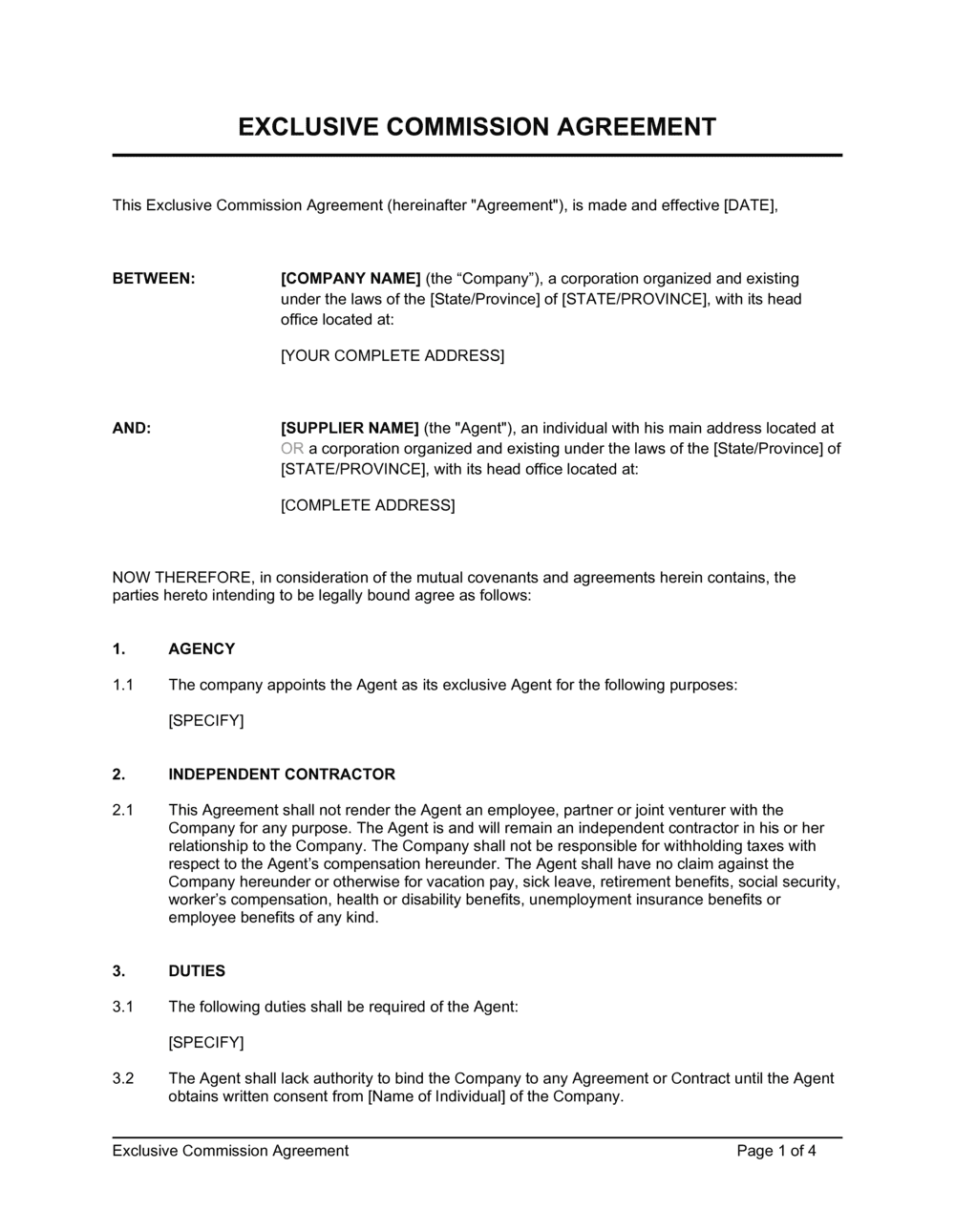
Identify the parties with their full legal entity names
Enter the principal's registered corporate name and the representative's full legal name or entity name — not a trade name or personal nickname. Include each party's registered address and, where applicable, company registration number.
💡 Confirm the representative's entity structure (sole trader, LLC, corporation) before filling in the parties block — the governing law and tax treatment differ significantly by entity type.
2
Define the exclusive territory with precision
Specify the territory by country, state or province, postal code range, or named customer segment. Explicitly state whether online or e-commerce sales to customers in the territory are included or excluded.
💡 If the territory is a country where commercial agency laws grant statutory protections (EU, UK), note this in the agreement and ensure termination provisions meet the statutory floor.
3
List the covered products or services
Name each product line or service category in scope, using the same designations used in your price list or product catalogue. If only a subset of your offering is covered, list what is explicitly excluded.
💡 Attach a Schedule A listing covered products by SKU or service code — this prevents ambiguity when new products launch mid-term.
4
Set the commission rate and calculation base
Enter the commission percentage and define the base — gross invoice, net of returns, net of taxes, or net of shipping. Specify when commission is earned (on invoice, on payment receipt, or on customer acceptance).
💡 Earned-on-payment terms protect principals from paying commission on deals that never settle; earned-on-invoice terms are more favorable to representatives — negotiate based on customer creditworthiness in the territory.
5
Set the performance minimum and review cycle
Enter the minimum sales volume (in dollars or units) and the period it covers (quarterly or annual). Define the consequence of missing it — non-exclusive conversion or termination with notice.
💡 Set the first-period minimum at roughly 60–70% of the representative's own forecast so there is room for ramp-up without triggering the penalty clause in Month 3.
6
Define the tail period and house accounts
Enter the tail period duration (typically 60–120 days) and list any house accounts the principal is retaining directly. Both parties should initial the house account schedule at signing.
💡 A 90-day tail is the market standard for most B2B sales cycles; extend to 180 days if the typical sales cycle for the product exceeds six months.
7
Complete the termination notice and cure periods
Set the without-cause notice period (typically 30–90 days depending on territory investment), the cure period for material breach (typically 10–30 days), and post-termination obligations such as returning materials and transferring customer contact records.
💡 In EU member states and the UK, statutory commercial agent compensation on termination can equal 1 year's average annual commission — confirm whether the contractual notice period meets the mandatory minimum before executing.
8
Sign before any sales activities begin
Both parties must execute the agreement before the representative begins any sales activities or receives any confidential information. Post-execution backdating creates evidentiary problems; pre-execution disclosure of pricing or customer data creates unprotected exposure.
💡 Use a dated cover page and have both parties initial every page, not just the signature block, to prevent disputed page substitutions.