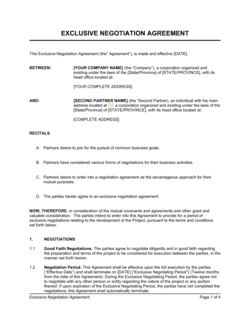
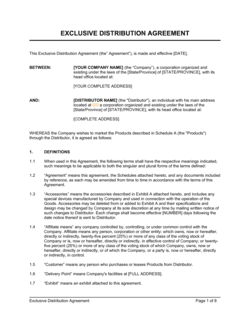
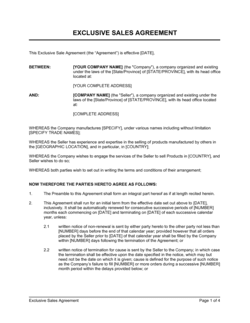
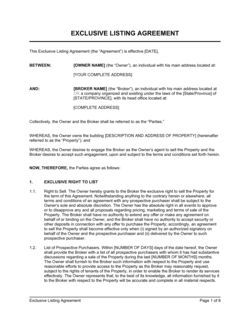
Exclusive Management Agreement Template

Free Word download • Edit online • Save & share with Drive • Export to PDF

8 pages30–40 min to fillDifficulty: ComplexSignature requiredLegal review recommended
Learn more ↓
FreeExclusive Management Agreement Template

At a glance

What it is
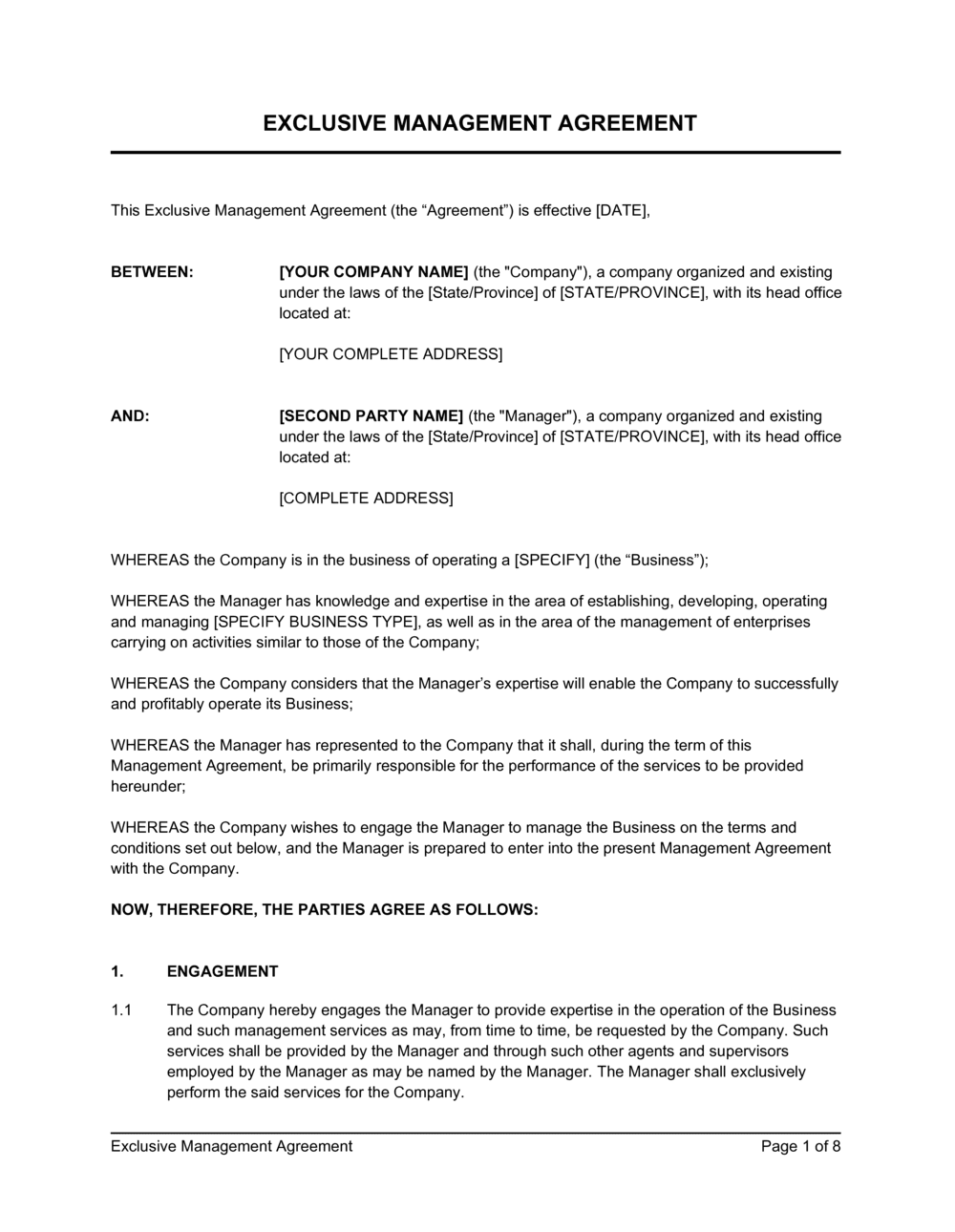
An Exclusive Management Agreement is a legally binding contract between a talent, artist, athlete, or business professional (the "Client") and a manager who is granted the sole and exclusive right to represent that Client in a defined field of activity. This free Word download covers commission rates, scope of authority, term and renewal, termination rights, and post-term obligations — all in a single editable document you can export as PDF and execute immediately.
When you need it
Use it when a manager is taking on full-time representation of a client and both parties need a binding record of the exclusive relationship, financial terms, and boundaries of the manager's authority. It is appropriate for artists, musicians, actors, athletes, social media influencers, executives, and any professional who engages a single representative to manage their career or business interests.
What's inside
Definitions of "exclusive" scope, commission rate and calculation basis, expense reimbursement, manager's authority to negotiate and contract on the client's behalf, term and automatic renewal, key-person and termination-for-cause provisions, post-term commission on "pipeline" deals, and governing law.

What is an Exclusive Management Agreement?

An Exclusive Management Agreement is a legally binding contract in which a client — typically an artist, musician, athlete, influencer, or professional — grants a single manager the sole and exclusive right to represent them within a defined field of activity for a specified term. Unlike a general service contract, it creates an ongoing, commission-based relationship with fiduciary-adjacent obligations: the manager acts in the client's interest, has authority to negotiate on their behalf, and is compensated only when the client earns. The exclusivity clause is the document's defining feature — it prevents the client from engaging any other manager for covered activities and gives the manager a clear contractual basis to invest time, relationships, and resources in the client's career without the risk of being displaced by a competing representative.

Why You Need This Document

Without a signed exclusive management agreement, neither party has enforceable clarity on the most consequential questions in the relationship: what percentage commission the manager earns, whether it applies to gross or net income, how long the relationship lasts, and what happens to ongoing deals after it ends. Managers who begin work on a handshake routinely find their commission disputed when a client's earnings increase. Clients who engage managers without a written agreement have no contractual basis to terminate, no audit rights over earnings collected, and no protection against a manager claiming post-term commission on deals the client negotiated independently. A properly drafted agreement executed before the first introduction is made resolves all of these risks — and this template gives you the structure to do it in under an hour.

Which variant fits your situation?

If your situation is…Use this template
Managing an individual musician or recording artistArtist Management Agreement
Representing a professional athlete for endorsements and contractsSports Agent Agreement
Non-exclusive representation where the client retains multiple managersNon-Exclusive Management Agreement
Engaging a business manager to handle financial affairs onlyBusiness Management Agreement
Short-term or project-specific management for a single event or releaseTalent Representation Agreement
Managing a band or musical group as an entity rather than an individualBand Management Agreement
Delegating booking authority to a booking agent rather than a career managerBooking Agent Agreement

Common mistakes to avoid

❌ No definition of 'gross earnings'

Why it matters: Without a defined calculation basis, managers and clients apply the commission to different numbers — the full contract value versus the amount actually received after deductions — producing persistent disputes on every payment cycle.

Fix: Add a definitions clause stating exactly what is included in 'gross earnings' (all cash and non-cash consideration received) and what, if anything, is excluded before commission is calculated.

❌ Blanket power of attorney with no dollar cap

Why it matters: A manager with unlimited signing authority can bind the client to multi-year contracts, merchandise licenses, or sync deals without the client's review or consent — creating obligations that are difficult to unwind.

Fix: Limit any power of attorney to routine booking contracts below a fixed dollar threshold (e.g., $5,000 per engagement) and require written client approval for all other agreements.

❌ Missing post-term commission definition of 'procured'

Why it matters: Ambiguous language allows former managers to claim commission on deals the client sourced independently after termination, simply because the client met the counterparty during the manager's tenure.

Fix: Define 'procured' as deals where the manager made the first substantive introduction and was the proximate cause of the agreement, documented by written correspondence dated during the term.

❌ No key-person clause

Why it matters: If the specific individual who attracted the client leaves the management company, the client is still bound to an exclusive agreement with an organization that may assign them to a junior staffer.

Fix: Add a key-person clause naming the individual manager whose personal involvement is material, with a right for the client to terminate on 30 days' notice if that person ceases to be primarily responsible for the account.

❌ Auto-renewal with a 30-day notice window

Why it matters: Artists and athletes on tour or in production routinely miss 30-day windows. Missing the deadline locks them into another full contractual term with no performance accountability mechanism.

Fix: Set the non-renewal notice deadline at 60–90 days before term expiry and include a calendar reminder obligation on the manager to notify the client 120 days before renewal.

❌ Governing law chosen without regard to entertainment industry statutes

Why it matters: California, New York, and Tennessee impose licensing requirements, commission caps, and fiduciary duties on managers that apply regardless of what governing law the contract selects, exposing unlicensed managers to penalties and voiding commission obligations.

Fix: Consult a lawyer familiar with the client's and manager's state of operation before selecting governing law. In California, for example, the Talent Agencies Act can void commission obligations if the manager procures employment without a talent agency license.

The 10 key clauses, explained

Parties, recitals, and field of activity

In plain language: Identifies the manager and client as legal parties, states the nature of the representation, and defines the specific field or industry in which the manager's authority is exclusive.

Sample language
This Exclusive Management Agreement is entered into as of [DATE] between [MANAGER NAME / ENTITY], ('Manager') and [CLIENT LEGAL NAME], ('Client'). Manager is engaged as the sole and exclusive manager of Client's career in the field of [FIELD OF ACTIVITY, e.g., recorded music, live performance, and related entertainment].

Common mistake: Defining the field of activity so broadly (e.g., 'all entertainment and media') that it conflicts with existing agency or label agreements the client already has, creating immediate breach of prior contracts.

Scope of manager's authority

In plain language: Specifies what the manager is and is not authorized to do on the client's behalf — negotiating deals, approving contracts, making public statements — and whether any limited power of attorney is granted.

Sample language
Manager is authorized to negotiate, solicit, and procure engagements, agreements, and contracts within the Field of Activity on Client's behalf. Manager shall not execute any agreement committing Client to fees in excess of $[AMOUNT] without Client's prior written approval.

Common mistake: Granting a blanket power of attorney without a dollar or category cap. This allows the manager to sign binding contracts of unlimited value without the client's knowledge or consent.

Term and renewal

In plain language: Sets the initial duration of the agreement and states whether it renews automatically, the notice period required to prevent renewal, and any performance benchmarks that can trigger early termination.

Sample language
The initial term of this Agreement shall be [NUMBER] year(s) commencing on [START DATE]. This Agreement shall automatically renew for successive [ONE-YEAR] periods unless either party provides written notice of non-renewal at least [60] days prior to the end of the then-current term.

Common mistake: Setting auto-renewal with only 30 days' notice when the client is likely traveling or on tour. A client who misses the window is locked into another full year with no performance accountability.

Commission rate and calculation basis

In plain language: States the percentage commission the manager earns, whether it is calculated on gross or net earnings, which income categories it applies to, and how and when it is paid.

Sample language
Manager shall be entitled to a commission of [15–20]% of Client's gross earnings derived from engagements, agreements, and contracts procured or negotiated by Manager within the Field of Activity during the term.

Common mistake: Failing to define 'gross earnings' in the agreement. Without a definition, disputes arise over whether tour-support costs, production expenses, or agent fees are deducted before or after commission is applied.

Expense reimbursement

In plain language: Covers which expenses the manager can incur on the client's behalf (travel, promotional materials, legal costs), whether prior approval is required, and how reimbursement is documented.

Sample language
Manager may incur reasonable expenses in connection with Client's career, provided that any single expense exceeding $[AMOUNT] shall require Client's prior written approval. Manager shall provide itemized expense reports within [30] days of incurring such expenses.

Common mistake: No expense cap or approval threshold. Managers have recouped six-figure sums in undisclosed expenses against client earnings when the contract contained no limit or approval requirement.

Exclusivity and conflict of interest

In plain language: Confirms the manager's exclusive status, requires disclosure of any other clients in the same field who may create a conflict, and sets boundaries on the manager representing competing talent.

Sample language
Manager agrees that Client's representation within the Field of Activity is exclusive. Manager shall promptly disclose to Client any representation of other artists or clients whose interests may directly conflict with Client's interests and shall obtain Client's written consent before accepting such representation.

Common mistake: Omitting the conflict-of-interest disclosure requirement entirely. A manager representing two competing artists in the same genre without disclosure has a direct financial incentive to favor one — and the client has no contractual recourse.

Accounting, statements, and audit rights

In plain language: Requires the manager to maintain accurate financial records of all earnings collected and commissions deducted, issue periodic statements, and allow the client to audit those records.

Sample language
Manager shall provide Client with a written accounting statement within [30] days after the end of each calendar quarter, itemizing all gross earnings received, commissions deducted, and expenses reimbursed. Client shall have the right to audit Manager's books and records upon [10] business days' written notice, at Client's expense, no more than once per calendar year.

Common mistake: No audit right clause. Without it, clients have discovered years of undisclosed earnings after their manager collected fees directly from venues or labels and failed to pass them through.

Termination for cause and termination for convenience

In plain language: Defines what constitutes cause for immediate termination (fraud, theft, breach, incapacity), establishes a cure period for non-material breaches, and states the notice requirement and consequences for termination without cause.

Sample language
Either party may terminate this Agreement for Cause immediately upon written notice if the other party commits fraud, theft, or a material breach that remains uncured for [30] days after written notice. Either party may terminate without Cause upon [90] days' written notice to the other party.

Common mistake: No cure period for non-material breaches. Courts frequently find that immediate termination for a curable administrative failure — a late accounting statement, for example — is itself a breach by the terminating party.

Post-term commission (sunset clause)

In plain language: Governs the manager's right to receive commission after the agreement ends on contracts negotiated or substantially performed during the term, typically structured as a declining percentage over 1–3 years.

Sample language
Following expiration or termination of this Agreement, Manager shall be entitled to receive [10]% of gross earnings derived from any agreement executed during the term or within [6] months following termination that was directly procured by Manager, for a period not to exceed [2] years from the date of termination.

Common mistake: Failing to define 'procured' for the purposes of the post-term commission. Managers have successfully claimed commission on deals the client negotiated independently after termination by arguing they 'introduced' the counterparty during the term.

Governing law, dispute resolution, and entire agreement

In plain language: States the jurisdiction whose law governs, selects arbitration or litigation for disputes, and confirms this contract supersedes all prior representations and side agreements between the parties.

Sample language
This Agreement shall be governed by the laws of [STATE / PROVINCE / COUNTRY]. Any dispute shall be resolved by binding arbitration administered by [AAA / JAMS / relevant body] in [CITY]. This Agreement constitutes the entire agreement between the parties and supersedes all prior oral or written understandings.

Common mistake: Choosing a governing law with no connection to where either party operates. California, New York, and Tennessee each have industry-specific entertainment statutes that override foreign governing-law clauses for in-state activity.

How to fill it out

  1. 1

    Identify both parties with full legal names

    Enter the manager's registered entity name (LLC, corporation, or sole trader) and the client's legal name exactly as it appears on government-issued ID or business registration. If the client performs under a stage name, add 'professionally known as [STAGE NAME]' in parentheses.

    💡 Using a personal name for the manager instead of their LLC exposes the manager's personal assets if the client sues over a disputed commission.

  2. 2

    Define the field of activity precisely

    List the specific industries, media, or engagement types covered by the exclusive — recorded music, live performance, brand endorsements, film and television, speaking engagements. Exclude categories where the client has existing representation.

    💡 A narrowly defined field of activity reduces conflicts with existing agency, label, or publishing agreements and avoids claims of tortious interference.

  3. 3

    Set the commission rate and calculation basis

    State the percentage (industry standard is 15–20% for entertainment managers), whether it applies to gross or net earnings, and which income categories it covers. Define 'gross earnings' and 'net earnings' explicitly in the definitions section.

    💡 Gross-based commissions are simpler to administer but can produce inequitable outcomes when a touring client has high production costs — consider a net basis with a defined, limited deduction list.

  4. 4

    Establish the term and renewal mechanics

    Set the initial term (typically 1–3 years for new relationships), the auto-renewal period (usually 1 year), and the written notice deadline required to prevent renewal. Consider including a performance benchmark — minimum earnings or number of signed deals — that triggers the client's early exit right.

    💡 A 90-day non-renewal notice window gives both parties enough lead time to plan transitions without disrupting active deal negotiations.

  5. 5

    Set the expense approval threshold

    Enter a per-item or per-month dollar amount above which the manager must obtain prior written approval before incurring expenses on the client's behalf. Include a quarterly reconciliation requirement.

    💡 A $500 per-item threshold works for most individual artists; raise it to $2,500–$5,000 for established acts with active touring schedules.

  6. 6

    Draft the post-term sunset clause

    Specify the post-term commission percentage, the definition of 'procured' contracts, and the sunset period. A declining structure — full commission in Year 1, half in Year 2, none after — is generally considered fair and is more likely to be upheld if disputed.

    💡 Require the manager to provide a written 'pipeline list' of all active deal negotiations within 30 days of termination so the scope of post-term commission is documented and agreed at exit.

  7. 7

    Include audit rights and accounting period

    State that the manager must deliver quarterly accounting statements and that the client has the right to audit financial records once per year with 10 business days' notice.

    💡 Specify that audit costs are borne by the client unless the audit reveals a discrepancy exceeding 5% of commission — the standard that shifts costs to the manager.

  8. 8

    Sign before any work or introductions begin

    Both parties must sign before the manager makes any introductions, negotiates any deal, or incurs any expense on the client's behalf. Post-commencement signatures create consideration problems and leave the commission basis disputed.

    💡 Use a countersignature process — client signs first, manager countersigns — so the commencement date is the manager's signature date, not the client's.

Frequently asked questions

What is an exclusive management agreement?

An exclusive management agreement is a binding contract in which a client — typically an artist, athlete, or professional — grants a single manager the sole right to represent them within a defined field of activity. It sets out the manager's authority, commission rate, term, and post-term obligations. The exclusivity means the client cannot engage any other manager for the covered activities during the term, giving the manager a clear basis to invest time and resources in developing the client's career.

What commission rate is standard in an exclusive management agreement?

Industry standard in entertainment management is 15–20% of gross earnings. Music managers typically charge 15–20%, while sports agents in the US are often regulated at 3–5% for player contracts though up to 20% for marketing and endorsement deals. The commission basis — gross versus net — materially affects the actual dollar amount, so the calculation should be defined precisely in the contract rather than relying on industry shorthand.

What is a sunset clause in a management agreement?

A sunset clause, also called a post-term commission provision, entitles the manager to receive commission for a defined period after the agreement ends on deals that were negotiated or procured during the term. A typical structure is full commission for 12 months, declining to half for a further 12 months, then zero. The clause exists because managers invest substantial time building relationships that generate income only after the agreement terminates — but it can be abused if "procured" is not clearly defined.

What is the difference between an exclusive management agreement and a talent agency agreement?

A talent agent procures employment — booking specific engagements, auditions, and gigs — and is licensed to do so under state law in California, New York, and several other jurisdictions. A personal manager advises on career strategy, coordinates the client's team, and typically does not procure employment directly. In practice, the line blurs. In California, a manager who regularly procures employment without a talent agency license risks having commission obligations voided entirely under the Talent Agencies Act.

Can a management agreement be terminated early?

Yes, most management agreements allow termination for cause — fraud, theft, or material breach uncured after a notice period — immediately, without further obligation. Termination without cause typically requires 60–90 days' written notice, after which post-term commission obligations on pipeline deals may still apply. Some agreements include performance benchmarks that give the client a unilateral exit right if the manager fails to secure a minimum level of earnings within a defined period.

Does an exclusive management agreement need to be in writing?

In most jurisdictions, verbal management agreements are technically enforceable, but written contracts are essential in practice. Oral agreements leave commission rates, scope, and termination rights entirely open to dispute. Several US states — including California — require written talent representation agreements to be enforceable. Given the financial stakes involved, a signed written agreement executed before the relationship begins is the minimum prudent standard.

What does 'exclusive' actually mean in this agreement?

Exclusive means the client agrees not to engage any other person or entity as manager for the defined field of activity during the term. The client cannot sign a competing management agreement, and the manager has the contractual right to be the sole point of contact for career opportunities in that field. The exclusivity should be bounded by field of activity — a music manager's exclusivity should not inadvertently prevent the client from hiring a separate literary agent or sports endorsement specialist.

Is a power of attorney clause necessary in a management agreement?

A power of attorney is not required, but managers often request one to sign routine contracts — standard booking agreements, venue deals, and appearance releases — on the client's behalf when the client is traveling or unavailable. If included, it should be narrowly drafted with a dollar cap and a list of permitted contract types, and should exclude any agreement that creates a financial obligation beyond a defined threshold.

What happens to ongoing deals if the management agreement is terminated?

Termination ends the manager's authority to negotiate new deals, but existing contracts remain in force according to their own terms. The post-term sunset clause governs whether and how much commission the manager continues to earn on those agreements. The parties should exchange a written pipeline list at termination documenting all active negotiations so there is no ambiguity over which deals are subject to post-term commission.

How this compares to alternatives

vs Non-Exclusive Management Agreement

A non-exclusive management agreement allows the client to engage multiple managers simultaneously across the same or overlapping fields of activity. It is appropriate for emerging talent testing the market or clients with activity in clearly segmented fields that different managers handle independently. An exclusive agreement is standard once a manager is making a full-time investment in the client's career and requires protection against being undercut by a competing manager.

vs Talent Agency Agreement

A talent agency agreement is issued by a licensed talent agent to procure specific employment engagements — auditions, bookings, gigs. A management agreement covers broader career strategy, team coordination, and long-term development. In California and New York, only licensed talent agents may legally procure employment; management agreements that stray into procurement expose the manager to license violations and potential commission forfeiture.

vs Independent Contractor Agreement

An independent contractor agreement engages a service provider for defined deliverables at a fixed or hourly rate. A management agreement compensates the manager by commission on earnings rather than a flat fee and creates an ongoing fiduciary-adjacent relationship rather than a project-based one. Using an independent contractor agreement for a management relationship leaves commission entitlements, exclusivity, and post-term obligations undefined.

vs Agency Agreement

A general agency agreement authorizes an agent to act on a principal's behalf in commercial transactions — often sales, distribution, or procurement. A management agreement is narrowly tailored to career and talent representation, with industry-specific commission structures, exclusivity provisions, and post-term sunset clauses not found in standard commercial agency agreements. The two documents serve different legal and commercial functions and should not be used interchangeably.

Industry-specific considerations

Music and recording

Commission structures must distinguish between touring income, recording advances, sync licensing, and merchandise — each may carry a different effective rate depending on gross versus net calculation basis.

Film and television

Talent managers in film and TV must navigate talent agency licensing laws in California and New York, residuals reporting obligations, and guild-mandated commission caps on SAG-AFTRA covered work.

Professional sports

Player contract commissions are capped by league collective bargaining agreements (e.g., 3% in the NFL, 4% in the NBA), making endorsement and appearance income the primary high-commission revenue stream.

Digital media and influencer

Brand deal and sponsored content agreements are the core managed asset; commission clauses must address cash fees, gifted product valuation, equity stakes in brand partnerships, and exclusivity windows that overlap with the management term.

Speaking and thought leadership

Speaking fee commissions (typically 15–25%) apply to keynote, workshop, and media appearance bookings; the manager's exclusive scope should carve out the client's own inbound inquiries and existing corporate relationships.

Sports and entertainment technology

Technology founders and executives engaging speakers' bureaus or PR-adjacent managers use management agreements that blend traditional talent commission structures with business development retainers, requiring careful scope drafting to avoid conflicts with investor obligations.

Jurisdictional notes

United States

California's Talent Agencies Act requires a license to procure employment for artists; unlicensed managers who cross into procurement risk having all commission obligations voided by the Labor Commissioner. New York has similar but less strictly enforced licensing requirements. Tennessee's Personal Manager Act imposes disclosure obligations on managers representing recording artists. Commission rates for athletes are capped by league CBAs regardless of what the agreement states.

Canada

Canada has no federal equivalent to California's Talent Agencies Act, but Quebec's Act Respecting Labour Standards may classify certain management arrangements as employment relationships subject to statutory protections. Common-law fiduciary duties apply to managers who exercise significant control over a client's financial affairs. Commission disputes are resolved in provincial courts, with Ontario and British Columbia being the most active jurisdictions for entertainment industry litigation.

United Kingdom

The UK does not impose a licensing requirement on personal managers, but the Consumer Rights Act 2015 and Unfair Contract Terms Act 1977 may render overly broad exclusivity or disproportionate commission provisions unenforceable. Music managers operating under the Music Managers Forum Code of Practice are held to additional conduct standards. Post-Brexit, UK managers operating in EU territories must consider whether separate EU-jurisdiction agreements are required for touring and licensing activity.

European Union

EU member states vary significantly in their regulation of talent representation. France requires agents (agents artistiques) to hold a license issued by the DIRECCTE and imposes a 10% commission cap on certain performing artist engagements. Germany's Künstlersozialversicherungsgesetz (KSV) may impose social insurance contributions on fees paid to managers acting as intermediaries. GDPR applies to all client personal data processed by the manager, requiring a data processing addendum if personal data is shared with third-party promoters, labels, or brands.

Template vs lawyer — what fits your deal?

PathBest forCostTime
Use the templateEmerging artists, early-stage creators, or managers formalizing a new relationship before significant earnings beginFree30–60 minutes
Template + legal reviewClients with existing label, agency, or publishing agreements that the management scope must not conflict with$500–$1,5003–7 days
Custom draftedEstablished talent with significant existing income, complex multi-territory activity, or managers requiring industry-specific licensing compliance$2,000–$8,000+2–4 weeks

Glossary

Exclusive Representation
A contractual arrangement in which the client grants one manager the sole right to act on their behalf within a defined field, preventing engagement of any other manager for the same scope.
Commission
The percentage of gross or net earnings the manager receives as compensation for securing opportunities and managing the client's career.
Gross Earnings
Total income earned by the client from engagements or contracts before deducting expenses, taxes, or third-party fees.
Net Earnings
Client income after deducting specified expenses — such as touring costs, production fees, or agent commissions — as defined in the agreement.
Term
The fixed duration of the management relationship, typically expressed in years, after which the contract expires or automatically renews unless either party gives notice.
Key-Person Clause
A provision allowing the client to terminate if a specific named individual at the management company is no longer personally handling the account.
Post-Term Commission (Sunset Clause)
A declining or fixed commission the manager earns on deals negotiated during the term that continue to generate income after the agreement ends.
Power of Attorney
An optional grant allowing the manager to sign certain agreements on the client's behalf, typically limited to routine booking or licensing contracts within a defined dollar threshold.
Termination for Cause
The right to end the agreement immediately due to a material breach — such as fraud, theft, or failure to account — without paying any further commission or notice period.
Field of Activity
The specific industry, medium, or type of engagement covered by the exclusive — e.g., recorded music, live performance, film and television, or brand endorsements.
Accounting Period
The interval — typically monthly or quarterly — at which the manager must provide a financial statement of earnings collected and commissions deducted.
Right of Approval
A clause reserving the client's personal consent for certain categories of contract, appearance, or creative decision, regardless of the manager's general authority.

Part of your Business Operating System

This document is one of 3,000+ business & legal templates included in Business in a Box.

  • Fill-in-the-blanks — ready in minutes
  • 100% customizable Word document
  • Compatible with all office suites
  • Export to PDF and share electronically

Create your document in 3 simple steps.

From template to signed document — all inside one Business Operating System.
1
Download or open template

Access over 3,000+ business and legal templates for any business task, project or initiative.

2
Edit and fill in the blanks with AI

Customize your ready-made business document template and save it in the cloud.

3
Save, Share, Send, Sign

Share your files and folders with your team. Create a space of seamless collaboration.

Save time, save money, and create top-quality documents.

★★★★★

"Fantastic value! I'm not sure how I'd do without it. It's worth its weight in gold and paid back for itself many times."

Managing Director · Mall Farm
Robert Whalley
Managing Director, Mall Farm Proprietary Limited
★★★★★

"I have been using Business in a Box for years. It has been the most useful source of templates I have encountered. I recommend it to anyone."

Business Owner · 4+ years
Dr Michael John Freestone
Business Owner
★★★★★

"It has been a life saver so many times I have lost count. Business in a Box has saved me so much time and as you know, time is money."

Owner · Upstate Web
David G. Moore Jr.
Owner, Upstate Web

Run your business with a system — not scattered tools

Stop downloading documents. Start operating with clarity. Business in a Box gives you the Business Operating System used by over 250,000 companies worldwide to structure, run, and grow their business.

Start free · No credit card required